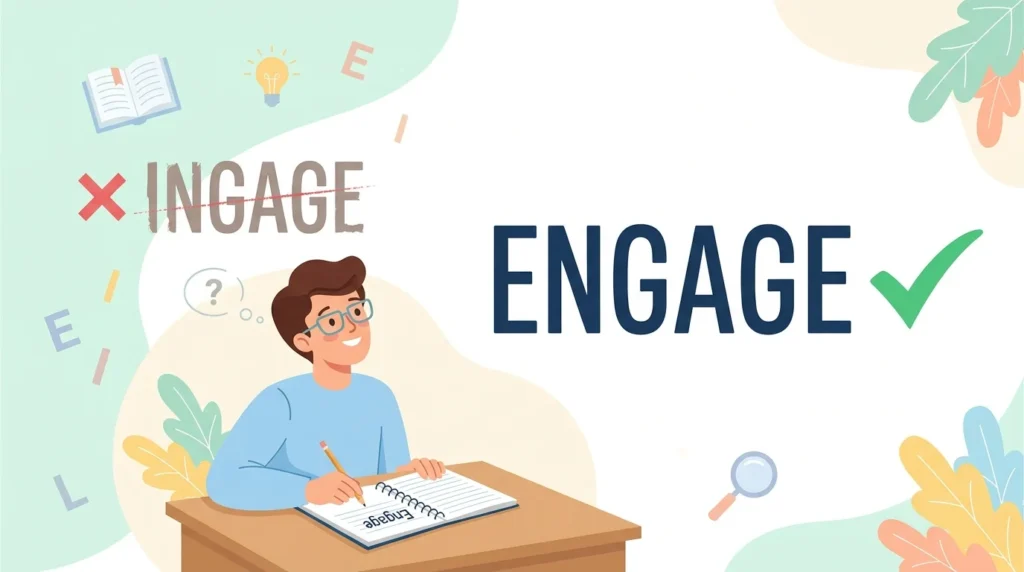

Engage is the correct spelling in modern standard English. Ingage is not the spelling you should use in contemporary writing. Although ingage appears in older English as an obsolete variant, modern dictionaries identify engage as the standard form. Use engage when you mean to involve, participate, attract attention, hire, communicate with, or become committed to something.
What Is the Difference Between Ingage and Engage?
The difference between ingage and engage is mainly one of spelling.
Engage is the standard modern English verb. It has several meanings, including:
- to become involved in something
- to involve another person
- to attract or hold someone’s attention
- to communicate or interact with someone
- to hire someone for a service
- to participate in an activity
- to make a commitment
- to make mechanical parts connect or operate
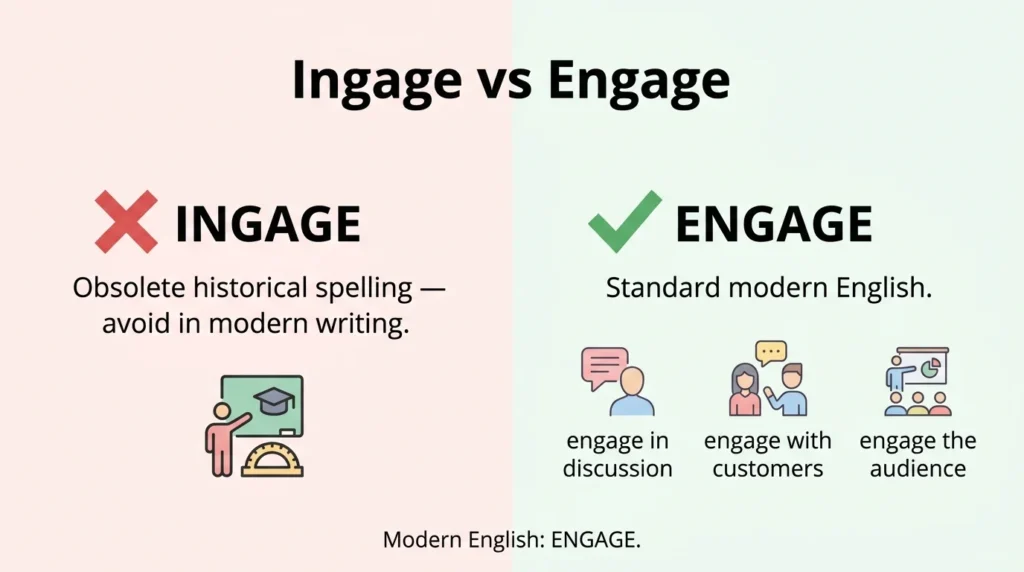
Ingage, by contrast, is not the standard spelling used in modern English. It can be found in historical texts as an obsolete spelling, but that does not make it appropriate for contemporary everyday, academic, professional, or business writing.
For modern writing, the rule is simple:
Use “engage,” not “ingage.”
For example:
- ✅ The teacher wants to engage the students.
- ❌ The teacher wants to ingage the students.
Why It Matters
A one-letter spelling error can make an otherwise strong piece of writing look careless.
The problem is especially noticeable in professional communication. Imagine writing:
“We want to ingage more customers through social media.”
The reader can understand your meaning, but the spelling error may reduce confidence in the rest of the message.
The correct version is:
“We want to engage more customers through social media.”
This matters in several situations:
- Emails: spelling mistakes can make professional communication look rushed.
- Academic writing: incorrect spelling can affect the overall quality of an assignment or paper.
- Business writing: a spelling error in a proposal or presentation can weaken credibility.
- Marketing: engage is extremely common when discussing audiences and customers.
- Social media: captions, posts, and calls to action frequently use engage.
- Job applications: correct spelling helps create a polished impression.
- Web content: repeated misspellings can make published content appear poorly edited.
The mistake is easy to understand because engage is pronounced with an initial sound that can be perceived as either “en-” or “in-” by some learners. English spelling does not always provide an exact visual representation of pronunciation.
Read More: Home Made vs Homemade: Which Spelling Is Correct?
The Core Rule
In modern standard English, spell the word as “engage.” “Ingage” is an obsolete historical spelling and should not be used as the normal spelling today.
The important distinction is between historical existence and modern correctness.
It would be inaccurate to say that ingage has never existed. Historical English sources contain the spelling, and modern dictionary material describes it as an obsolete form.
But if you are writing an email, essay, report, website, text message, application, or social media post today, choose engage.
How to Use Engage
The verb engage has several common patterns. Learning these patterns is more useful than memorizing one definition.
1. Engage someone in something
Use engage + person + in + activity/topic when you involve someone in an activity, discussion, or conversation.
Examples:
- The teacher engaged the students in a debate.
- She engaged her guests in conversation.
- The manager engaged the team in a discussion about the new policy.
The structure is:
engage + someone + in + something
2. Engage in something
Use engage in + activity when someone participates in an activity.
Examples:
- They engage in regular exercise.
- The students engaged in a detailed discussion.
- We should engage in meaningful conversations.
The structure is:
engage in + activity
This construction is common in formal and academic English.
3. Engage with someone or something
Use engage with when the meaning involves interacting with, responding to, or dealing with a person, idea, problem, audience, or organization.
Examples:
- The company wants to engage with its customers.
- Students should engage with the material critically.
- We need to engage with the problem instead of ignoring it.
The exact meaning depends on context.
4. Engage someone’s attention
Here, engage means to attract and hold attention.
Examples:
- The speaker quickly engaged the audience’s attention.
- The interactive lesson engaged the children.
- The documentary engaged my interest from the beginning.
5. Engage someone for a service
In some contexts, especially formal or professional English, engage means to hire or arrange for someone’s services.
Examples:
- They engaged a lawyer to review the contract.
- We engaged a consultant to advise the company.
- She was engaged as an independent researcher.
This meaning is established in modern English dictionaries.
6. Engage a machine or mechanism
Engage can also describe connecting or activating mechanical parts.
Examples:
- Press the pedal to engage the clutch.
- The gears engaged smoothly.
- Engage the parking brake before leaving the vehicle.
This is a different meaning from social or educational engagement, but the spelling remains the same.
Correct Examples of Engage
Here are examples across everyday, professional, academic, and digital communication.
- Conversation:
“I tried to engage him in a conversation about the new project.” - Workplace:
“The manager encouraged employees to engage with customers directly.” - Education:
“Interactive activities can engage students more effectively than long lectures.” - Academic writing:
“The study examines how young people engage with digital media.” - Business:
“Our company wants to engage new clients through educational content.” - Email:
“We would like to engage your services for the upcoming project.” - Social media:
“The brand created a question to engage its followers.” - Meeting:
“Everyone was encouraged to engage in the discussion.” - Customer service:
“Our representatives actively engage with customers to understand their concerns.” - Personal communication:
“She was so engaging that everyone wanted to continue the conversation.” - Technology:
“The system automatically engages the security mechanism.” - Relationships:
“He became more engaged in the community after moving there.”
Notice that engage does not have one fixed meaning. The surrounding words determine the exact sense.
Read More: Either vs Eather: Which Spelling Is Correct?
Incorrect vs. Correct
| ❌ Incorrect | ✅ Correct | Why |
|---|---|---|
| We need to ingage our customers. | We need to engage our customers. | Engage is the standard modern spelling. |
| The teacher tried to ingage the class. | The teacher tried to engage the class. | The verb is spelled engage. |
| Please ingage in the discussion. | Please engage in the discussion. | The standard phrase is engage in. |
| She wants to ingage with the audience. | She wants to engage with the audience. | Engage with is the correct modern construction. |
| The company hopes to ingage new clients. | The company hopes to engage new clients. | Ingage is not the standard spelling. |
| The lesson failed to ingage students. | The lesson failed to engage students. | The correct verb is engage. |
| We should ingage in meaningful dialogue. | We should engage in meaningful dialogue. | Engage in means participate in or become involved in. |
| The speaker successfully ingaged the audience. | The speaker successfully engaged the audience. | The past tense is engaged, not ingaged. |
| The campaign is designed to ingage followers. | The campaign is designed to engage followers. | Engage is the standard spelling in marketing English. |
| The company hired a consultant to ingage customers. | The company hired a consultant to engage customers. | The initial spelling is en-, not in-. |
Why People Make This Mistake
The confusion between ingage and engage is understandable.
1. Pronunciation can mislead you
English pronunciation does not always tell you exactly how a word is spelled.
Engage is pronounced approximately en-GAYJ. Depending on a speaker’s accent and how quickly the word is spoken, the first vowel may not feel strongly different from the vowel in words beginning with in-.
A learner may therefore hear something close to “ingage” and reproduce that spelling.
2. English has many words beginning with “in-”
Words such as:
- involve
- include
- increase
- interact
- influence
- inform
all begin with in-.
Because engage has a similar meaning to some of these words, a writer may unconsciously transfer the spelling pattern.
3. Fast typing creates spelling errors
When writing quickly, people often type what sounds familiar rather than checking each letter.
The difference between en and in is small visually:
- en + gage → engage
- in + gage → ingage
That makes the error easy to produce.
4. Autocomplete is not a grammar teacher
Spell-checking software can help, but it should not replace knowledge.
Depending on the software, context, language settings, or custom dictionaries, a typing system may not always flag every unusual form immediately.
5. Translation can interfere
English learners may map a familiar word from another language onto English spelling or pronunciation. When a word has no obvious spelling pattern in the learner’s first language, errors such as ingage become more likely.
The best solution is to learn the correct word as a complete unit:
engage
rather than trying to reconstruct its spelling from pronunciation.
Common Mistakes Checklist
Mistake 1: Writing “ingage”
What happens: You replace the first e with i.
Why it happens: The pronunciation can make the first vowel difficult to identify.
How to avoid it: Memorize the first two letters as EN.
Mistake 2: Writing “ingaged”
What happens: You create the past tense from the incorrect spelling.
Correct form: engaged
Example:
- ❌ The audience was ingaged.
- ✅ The audience was engaged.
Mistake 3: Writing “ingaging”
Correct form: engaging
Example:
- ❌ She is an ingaging speaker.
- ✅ She is an engaging speaker.
Mistake 4: Confusing “engage in” and “engage with”
These structures can overlap in meaning, but they are not always interchangeable.
- engage in an activity = participate in it
- engage with a person/problem/idea = interact with or deal with it
Examples:
- We engaged in a discussion.
- We engaged with the audience.
Mistake 5: Assuming “ingage” is simply an alternative modern spelling
It is not.
Historical evidence shows that ingage existed as an older spelling, but modern standard English uses engage.
Ingage vs. Engage in Real English
Grammatically Correct
Engage is the normal modern form used by fluent English speakers and in contemporary standard writing. You can use it in everyday conversation, professional communication, academic writing, marketing, education, and many other contexts. Its meaning changes according to the construction: engage in means participate, while engage with often means interact with or deal with something.
Grammatically Possible but Unnatural
Ingage can appear in historical texts because it was once used as an alternative spelling. That historical evidence makes it inaccurate to claim that the spelling never existed. However, seeing it in an old text does not mean it is a natural modern alternative. A contemporary reader will generally interpret ingage as a spelling error unless it is being used as a proper name or deliberately historical form.
Natural, Everyday English
For modern everyday English, simply use engage. Native and proficient speakers use it naturally in expressions such as engage with customers, engage in conversation, engage students, and engage someone’s attention. If you are unsure whether ingage might be acceptable, replace it with engage. That choice will fit standard contemporary English.
American vs. British English
There is no standard American-versus-British spelling difference between these two forms.
Both American and British English use:
engage
The spelling ingage is not a standard modern alternative in either variety.
The pronunciation can vary somewhat between accents, but the spelling remains engage.
This is important because some spelling questions genuinely have regional answers. For example, other English words may differ between American and British spelling. Ingage vs. engage is not one of those cases.
Formal vs. Informal Usage
The spelling does not change according to formality.
Use engage in both informal and formal writing.
However, the meaning and construction can have different levels of formality.
For example:
Everyday:
“I tried to engage him in conversation.”
Professional:
“The company plans to engage an external consultant.”
Academic:
“The researchers examined how participants engaged with the material.”
Technical:
“The operator should engage the clutch before changing gears.”
So you do not need a separate informal spelling. There is no situation in modern standard English where you should switch from engage to ingage because the context is informal.
Comparison Table
| Feature | Engage | Ingage |
|---|---|---|
| Modern standard English | ✅ Yes | ❌ No |
| Standard spelling today | ✅ Yes | ❌ No |
| Can mean “involve” | ✅ Yes | ❌ Not as a modern standard word |
| Can mean “participate” | ✅ Yes | ❌ No |
| Can mean “attract attention” | ✅ Yes | ❌ No |
| Used in business English | ✅ Yes | ❌ No |
| Used in academic English | ✅ Yes | ❌ No |
| Used in everyday English | ✅ Yes | ❌ No |
| Historical usage | Yes | Yes, as an obsolete spelling |
| Recommended today | ✅ Use it | ❌ Avoid it |
Where Did Engage Come From?
The history of engage helps explain why the spelling can seem unusual.
The word entered English through French. Its history is connected with the idea of a pledge or commitment. The modern meanings developed over time from this older concept of being bound or committed to something.
The word is recorded in English from the Middle English period. Oxford’s dictionary notes that the word was formerly also spelled ingage, which explains why the alternative spelling can occasionally appear in historical material.
The meanings expanded over the centuries. Engage developed senses involving commitment, participation, attention, employment, conflict, and mechanical connection.
This history gives us an important lesson:
A spelling can exist historically without being a normal spelling in modern English.
Related Words From Engage
Learning the word family can make the spelling easier to remember.
| Word | Meaning | Example |
|---|---|---|
| engage | involve, participate, attract, commit | We need to engage customers. |
| engaged | involved or committed | She is deeply engaged in the project. |
| engagement | involvement, commitment, or an appointment | Customer engagement increased. |
| engaging | interesting or involving | The speaker was engaging. |
| reengage | engage again | The campaign aims to reengage inactive users. |
Notice the spelling pattern:
engage → engaged → engaging → engagement → reengage
The e remains part of the word family.
Memory Trick
Use this simple mnemonic:
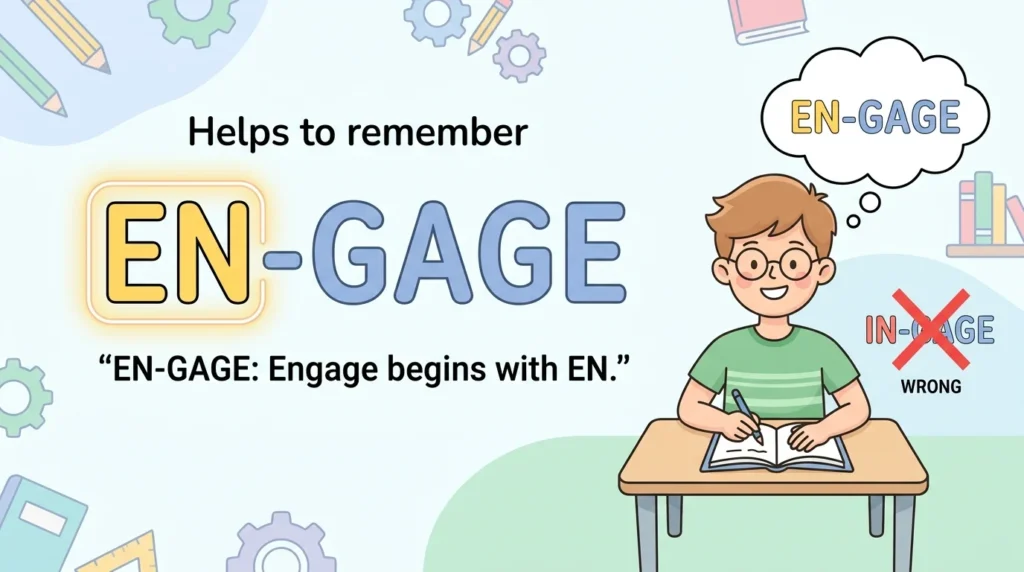
ENGAGE starts with EN, just like ENJOY and ENTER.
Think:
EN + GAGE = ENGAGE
You can also remember the phrase:
“Engage begins with E for English.”
The goal is not to invent a complicated rule. You simply want to train your eyes to recognize the correct shape:
EN-GAGE
not:
IN-GAGE
If you repeatedly see and write the correct form, the spelling becomes automatic.
Real-Life Situations
Job Interview
Interviewer: “How would you engage customers who are not interested?”
Here, engage means attract or involve customers.
Read More: Unenroll vs Disenroll: Meaning and Key Difference
Workplace Meeting
“Everyone should engage in the discussion.”
Here, engage in means participate in the discussion.
Business Email
“We would like to engage your company for this project.”
Here, engage means arrange to use someone’s professional services.
Classroom
“The teacher used games to engage the students.”
Here, engage means attract and hold the students’ attention.
Social Media
“The brand created a poll to engage its followers.”
Here, engage means encourage interaction or involvement.
Academic Writing
“The paper examines how students engage with online learning materials.”
Here, engage with means interact with or respond to the material.
Text Message
“That movie really engaged me.”
Here, engaged means held the speaker’s interest.
Technical Instructions
“Engage the brake before starting the engine.”
Here, engage refers to activating or bringing a mechanism into operation.
Expert Tips
1. Learn the phrase, not just the word
Instead of memorizing only engage, learn common combinations:
- engage in discussion
- engage with customers
- engage the audience
- engage someone’s attention
- engage a consultant
- become engaged
- engage the mechanism
This makes correct usage much easier.
2. Watch the preposition
The preposition after engage can change the construction.
Engage in usually introduces an activity:
She engaged in research.
Engage with usually introduces a person, idea, issue, audience, or material:
She engaged with the research findings.
3. Do not trust pronunciation alone
English contains many words whose spelling cannot be predicted perfectly from pronunciation.
Treat engage as a spelling pattern you need to recognize.
4. Remember the word family
If you know:
engage → engaged → engaging → engagement
you reinforce the correct spelling several times.
5. Do not overcorrect historical texts
If you are reading an old book and encounter ingage, do not automatically assume the author made a typo. Historical spelling conventions were different, and ingage is documented as an obsolete form.
But when writing modern English, use engage.
Read More: Mama vs. Momma: Which Spelling Is Correct?
FAQ
Is “ingage” a correct English word?
Not as a standard modern English spelling. Engage is the normal modern form. Ingage has historical evidence as an obsolete spelling, so it is more accurate to call it an obsolete form than to claim that it has never existed.
Should I use “ingage” in an email?
No. Use engage. This applies to professional emails, personal emails, academic messages, and ordinary online communication.
Why does “ingage” look like it could be correct?
The pronunciation of engage can make the first vowel less obvious, especially when the word is spoken quickly. English spelling also contains many common words beginning with in-, which can reinforce the confusion.
Is “ingage” an old spelling of “engage”?
Yes. Historical dictionary evidence records ingage as an obsolete form of engage. This is why the spelling can occasionally be found in older English material.
Is “ingage” acceptable in British English?
No, not as a normal modern spelling. British English uses engage.
Is “ingage” acceptable in American English?
No, not as a standard modern spelling. American English also uses engage.
What is the past tense of engage?
The past tense and past participle are engaged.
Example:
The students engaged in a lively discussion.
What is the present participle of engage?
The present participle is engaging.
Example:
The teacher gave an engaging presentation.
What is the noun form of engage?
The common noun is engagement.
Depending on context, engagement can refer to involvement, participation, commitment, an appointment, or a promise to marry.
What does “engage with” mean?
Engage with generally means to interact with, respond to, or deal with someone or something.
Example:
The company needs to engage with its customers.
What does “engage in” mean?
Engage in generally means to participate in or become involved in an activity.
Example:
They regularly engage in community projects.
Is “engage” a verb?
Yes. Engage is primarily a verb. It can be transitive or intransitive depending on how it is used.
For example:
The teacher engaged the students.
Here it has a direct object.
But:
The students engaged in discussion.
Here it is used with the preposition in.
Mini Quiz
| # | Question | Answer | Explanation |
|---|---|---|---|
| 1 | Which spelling is correct: ingage or engage? | Engage | Engage is the standard modern spelling. |
| 2 | Fill in the blank: “The teacher wanted to ___ the students.” | engage | Engage students means involve or interest them. |
| 3 | Fill in the blank: “They regularly ___ in sports.” | engage | The standard construction is engage in. |
| 4 | Correct the sentence: “We need to ingage our customers.” | “We need to engage our customers.” | Ingage is not the standard modern spelling. |
| 5 | Which is correct? A) ingaged B) engaged | B) engaged | The past tense is engaged. |
| 6 | Which is correct? A) engaging B) ingaging | A) engaging | The present participle is engaging. |
| 7 | Choose the correct sentence: A) “She engaged with the audience.” B) “She ingaged with the audience.” | A | Engage with is the standard modern construction. |
| 8 | Does “ingage” have any historical use? | Yes | It appears as an obsolete historical spelling. |
| 9 | Fill in the blank: “The presentation was highly ___.” | engaging | Engaging means interesting or holding attention. |
| 10 | Correct the sentence: “The company plans to ingage a consultant.” | “The company plans to engage a consultant.” | Engage can mean hire or arrange for someone’s services. |
Quick Summary
Engage is the correct modern spelling; ingage should not be used in contemporary standard English. The confusion is understandable because pronunciation does not always make the first vowel obvious, and historical English did use ingage as an obsolete variant. Today, however, use engage in every normal context. You can engage someone in conversation, engage in an activity, engage with customers, engage an audience, or engage someone’s attention. The same spelling works in American and British English. Remember the simple pattern EN-GAGE, and use related forms such as engaged, engaging, engagement, and reengage to reinforce the correct spelling.