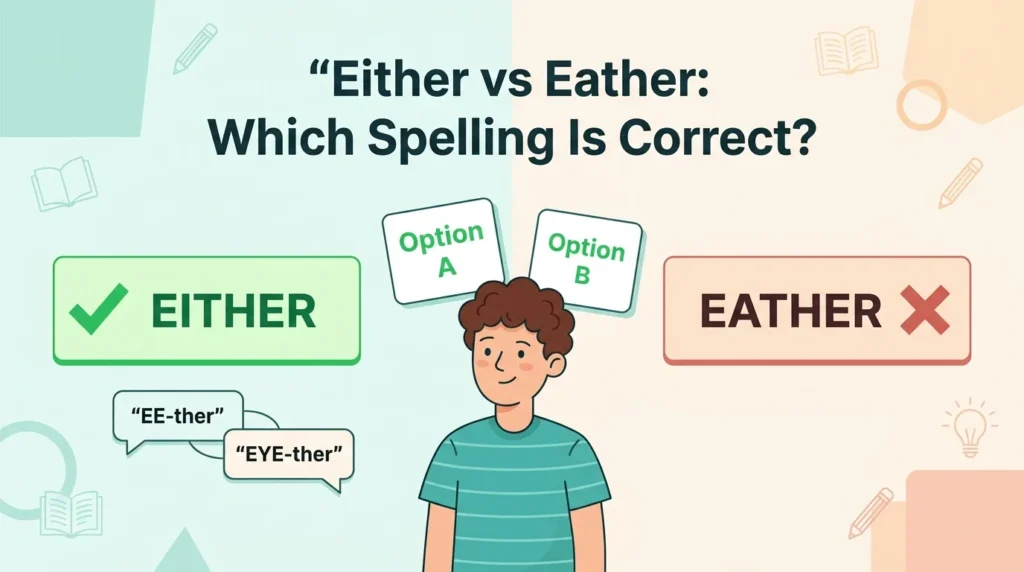

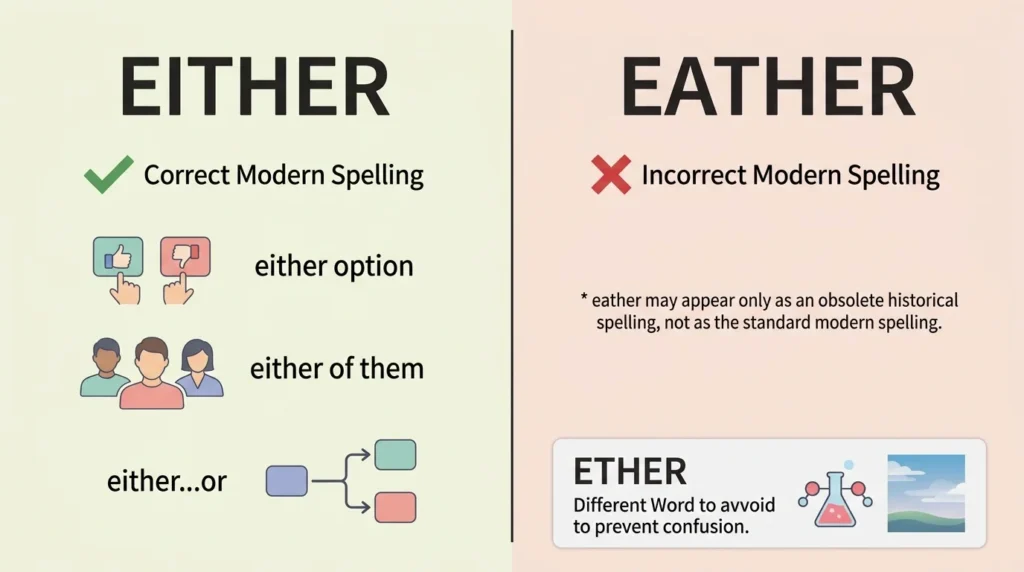
Either is the correct modern spelling. Eather is not used as the standard spelling of this word in contemporary English. Use either when you mean “one or the other of two,” “each of two,” or when it appears in structures such as either…or and negative sentences such as “I don’t like it either.” Although eather can be found as an obsolete historical spelling, it should not be used in modern standard writing.
What Is “Either”?
Either is a standard English word used in several grammatical ways.
Most commonly, it refers to one of two choices or possibilities:
You can choose either option.
Here, either means that one of the two options can be chosen.
It can also mean each of two, as in:
There are doors at either end of the hallway.
In this sentence, either end refers to each of the two ends.
The word can also appear after a negative statement:
I don’t like coffee either.
Here, either means something similar to also or as well, but it follows a negative expression.
Another very common structure is:
Either we leave now or we miss the train.
The structure either…or presents two alternatives.
Modern dictionaries classify either as a determiner and pronoun in some uses and as an adverb in others. Its pronunciation can vary between major varieties of English, but the spelling remains either.
Why It Matters
A spelling mistake such as eather can make otherwise clear writing look careless.
The difference matters particularly in:
- School assignments and examinations
- Job applications
- Business emails
- Reports and proposals
- Academic writing
- Website content
- Professional correspondence
- Social media posts
- English-language tests
For example:
❌ You can eather call me or email me.
✅ You can either call me or email me.
The second sentence immediately looks standard and professional.
The mistake is especially easy to make because either does not have one pronunciation that perfectly reveals its spelling. Both EE-ther and EYE-ther are established pronunciations.
The Core Rule
RULE: In modern standard English, spell the word as “either,” not “eather.”
Remember:
either = correct modern spelling
eather = not the standard modern spelling
There is one historical qualification worth knowing: eather can appear in older texts as an obsolete spelling of either. That historical use does not make it appropriate in contemporary English.
How to Use “Either”
The easiest way to understand either is to learn its main sentence patterns.
Either + singular noun
Use either before a singular noun when referring to one of two possibilities.
Either answer is acceptable.
You can choose either route.
Either candidate could win.
Either solution should work.
The noun immediately after either is normally singular in this structure.
Either of + plural noun or pronoun
Use either of before a plural noun or pronoun.
Either of these answers is acceptable.
Either of the candidates could win.
Either of them can help you.
Either of the two routes will take you there.
In careful formal writing, a singular verb is generally preferred after either of:
Either of the options is suitable.
In informal usage, plural agreement is also heard and used:
Either of the options are suitable.
For formal writing, however, choosing the singular verb is the safer option.
Either…or
The structure either…or presents two alternatives.
You can either stay here or come with us.
Either Sara or Ahmed will lead the meeting.
We can either start today or wait until Monday.
When the two subjects are singular, a singular verb normally follows:
Either Ali or Hamza is responsible.
When the subjects differ in number, agreement can follow the nearer subject:
Either the manager or the employees are responsible.
Either the employees or the manager is responsible.
This is often called proximity agreement because the verb agrees with the noun closest to it.
Either in negative sentences
Either can appear at the end of a negative sentence.
I don’t like the movie either.
She isn’t coming either.
We haven’t finished the report either.
Here, either means approximately also or as well, but it is normally used with a negative statement.
Compare:
I like the movie too.
I don’t like the movie either.
Either as “each of two”
Sometimes either means each of two, rather than simply “one or the other.”
There are windows on either side of the room.
This means there are windows on both sides, with either referring to each of the two sides.
Another example:
There is a lamp at either end of the table.
The meaning is “at each of the two ends.”
Correct Examples
Here are examples showing how either works in different types of real writing.
| Situation | Correct example |
|---|---|
| Conversation | You can sit in either chair. |
| Conversation | Either way, I’m happy to help. |
| Please send the document to either address. | |
| Workplace | Either department can handle the request. |
| Meeting | We can either discuss it now or schedule another meeting. |
| School | Either answer could receive full credit if properly explained. |
| Academic writing | Either explanation may account for the observed difference. |
| Social media | You can either agree or disagree, but be respectful. |
| Interview | I would be happy to work in either department. |
| Customer service | You may contact us by either phone or email. |
| Travel | You can enter through either gate. |
| Everyday writing | I don’t want either option. |
Incorrect vs. Correct
| ❌ Incorrect | ✅ Correct | Why |
|---|---|---|
| You can eather stay or leave. | You can either stay or leave. | Either is the standard spelling. |
| I don’t like eather option. | I don’t like either option. | The word is spelled either. |
| Eather answer is acceptable. | Either answer is acceptable. | Either refers to one of two choices. |
| Choose eather color. | Choose either color. | The standard spelling is either. |
| We can eather call or email. | We can either call or email. | The standard correlative structure is either…or. |
| I can’t go eather. | I can’t go either. | Either follows the negative statement. |
| Eather of them can help. | Either of them can help. | The correct form is either of. |
| There is a door at eather end. | There is a door at either end. | Either can mean each of two. |
| You can take eather route. | You can take either route. | Either is the correct spelling. |
| Eather solution should work. | Either solution should work. | Eather is not the modern standard spelling. |
Read More: Unenroll vs Disenroll: Meaning and Key Difference
Why Do People Spell “Either” as “Eather”?
The mistake is understandable because English spelling and pronunciation do not always match neatly.
1. Pronunciation can be misleading
Either has two accepted pronunciations.
It can be pronounced approximately as:
- EE-ther
- EYE-ther
Cambridge and other major dictionaries recognize both pronunciation patterns.
Because the spoken word can sound different from what a learner expects, some people attempt to spell it according to the sound they hear.
2. Similar words make “eather” look believable
English contains familiar words such as:
- feather
- weather
- leather
- together
The spelling pattern -eather is therefore visually familiar.
That can make eather look like a plausible spelling even though it is not the standard modern spelling of either.
3. English spelling is not purely phonetic
A common learner assumption is:
“If I can hear the sound, I should be able to spell the word exactly from that sound.”
English does not work that consistently.
The same sound can be represented by different spellings, and the same spelling can sometimes have different pronunciations.
Either is a good example because its accepted pronunciation varies while its standard spelling stays the same.
4. Typing quickly creates spelling errors
Fast typing can produce eather instead of either, particularly when the writer is relying on memory rather than checking the word visually.
Spellcheck can help, but it should not replace proofreading.
5. English learners may transfer spelling patterns from other words
Learners often use familiar spelling patterns to predict unfamiliar words. If they already know words such as feather and weather, eather can seem logical.
The solution is not to memorize every English spelling rule. Sometimes the easiest solution is simply to memorize the spelling of a frequently used word.
Common Mistakes Checklist
Mistake 1: Writing “eather”
What happens: The writer uses eather instead of either.
Why: The spelling seems to match familiar English patterns.
How to avoid it: Memorize the phrase either…or.
Mistake 2: Assuming pronunciation changes the spelling
What happens: A speaker hears “EE-ther” and assumes another spelling might be needed.
Why: English pronunciation varies by speaker and region.
How to avoid it: Remember that both common pronunciations use the same spelling: either.
Mistake 3: Confusing “either” with “ether”
What happens: A writer substitutes ether for either.
Why: The two words look and sound somewhat similar.
How to avoid it: Remember that ether is a different word, while either expresses alternatives or refers to each of two.
Mistake 4: Using “either” without understanding the sentence
What happens: The writer knows the spelling but uses the word incorrectly.
Why: Correct spelling does not automatically mean correct grammar.
How to avoid it: Learn the common structures: either option, either of them, either…or, and …either after a negative statement.
Mistake 5: Assuming “either” always means only one
What happens: A reader interprets every use of either as “one or the other.”
Why: That is its most familiar meaning.
How to avoid it: Notice contexts such as “on either side,” where it can mean each of two.
“Either” in Real English
“Either” is grammatically correct and natural for choices
You can choose either option.
This is completely natural when there are two available choices. It is common in conversation, instructions, customer service, workplace communication, and formal writing. The word does not sound unusually formal or unusually casual. It is an ordinary part of everyday English.
“Either…or” is natural when presenting alternatives
We can either meet today or talk tomorrow.
This is one of the most useful everyday patterns. Speakers use it to present alternatives clearly. The structure is equally useful in informal conversation and professional communication, although very long either…or constructions can become difficult to follow.
“Either” after a negative statement is natural
I don’t want coffee either.
This is normal English. Here, either adds agreement with a negative statement. A common mistake is to use too in the same position:
❌ I don’t want coffee too.
✅ I don’t want coffee either.
“Me either” is a special informal case
You may hear:
“I don’t like it.”
“Me either.”
This occurs in informal speech, particularly in North American English. However, “me neither” and structures such as “Neither do I” are also established ways to respond to a negative statement. For formal writing, use a complete grammatical structure rather than relying on the conversational “me either.”
“Either side” does not always mean “only one side”
Consider:
There are trees on either side of the road.
Here, either side means each of the two sides. The sentence does not mean that trees exist on only one side.
This distinction is important because the meaning of either depends on its construction and context.
American vs. British English
There is no American-versus-British spelling difference between either and eather.
The standard spelling is:
| Variety | Correct spelling |
|---|---|
| American English | either |
| British English | either |
| Canadian English | either |
| International English | either |
What can differ is pronunciation, not the standard spelling.
Both major British and American pronunciation references record variants corresponding roughly to EYE-ther and EE-ther.
So you should not write eather simply because you hear someone pronounce either differently.
Read More: Mama vs. Momma: Which Spelling Is Correct?
Formal vs. Informal Usage
Either is suitable in both formal and informal English.
Formal
Either candidate may submit a revised application.
Either party may terminate the agreement under these conditions.
Everyday
Either one is fine with me.
We can go either way.
The spelling never changes according to formality.
The main register difference worth remembering is the informal response “me either.” In formal writing, a clearer structure such as “Neither do I” is preferable.
Either vs. Eather: Comparison Table
| Feature | Either | Eather |
|---|---|---|
| Standard modern spelling | ✅ Yes | ❌ No |
| Used for two alternatives | ✅ Yes | ❌ No |
| Used in “either…or” | ✅ Yes | ❌ No |
| Used after negative statements | ✅ Yes | ❌ No |
| Used in formal writing | ✅ Yes | ❌ No |
| Used in everyday English | ✅ Yes | ❌ No |
| Common modern dictionary word | ✅ Yes | ❌ No |
| Historical/obsolete spelling | — | ⚠️ Yes, historically |
| Correct choice for modern writing | ✅ Yes | ❌ No |
The historical point is important: eather has appeared as an obsolete spelling of either, but that does not make it a suitable modern spelling.
Be Careful: “Either” and “Ether” Are Different
One particularly useful distinction is:
either ≠ ether
Either
Means one or the other of two, each of two, or appears in other grammatical constructions.
You can choose either answer.
Ether
Is a completely different word with scientific and historical uses.
The researchers studied the properties of ether.
So if you are trying to spell the word meaning “one or the other,” neither eather nor ether is the answer.
The correct spelling is:
either
Memory Trick
Use this simple mnemonic:
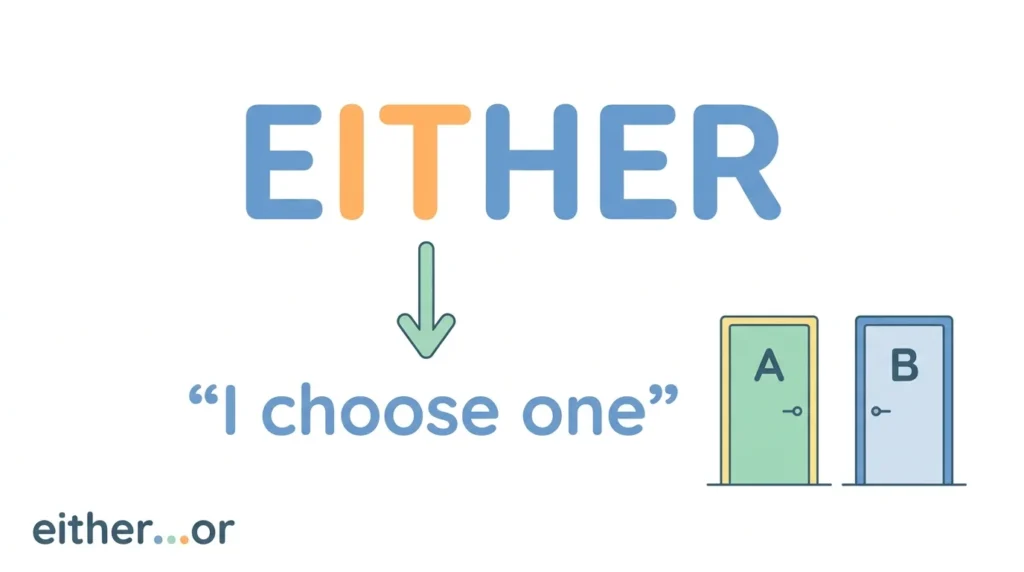
Either has “I” because “I” choose one.
Think:
EITHER → I → choice
For example:
Either tea or coffee.
You are choosing between two possibilities.
Another useful memory link is:
either ↔ neither
Both words contain i before t/h:
either
neither
So if you remember neither, it can help you remember the spelling of either.
Real-Life Situations
1. In an interview
“I would be comfortable working in either department.”
You are saying that both of the two departments are acceptable choices.
2. In a business meeting
“We can either launch this week or postpone the release.”
The sentence presents two alternatives.
3. In an email
“Please send the invoice to either of these addresses.”
The recipient can use one of the two addresses.
4. In a text message
“Either way, let me know when you arrive.”
The exact choice does not affect the speaker’s request.
5. In an exam
“Either answer can be correct if the reasoning is clearly explained.”
The word identifies two possible answers.
6. In academic writing
“Either explanation could account for the observed result.”
This presents two possible explanations.
7. In customer service
“You may pay by either card or bank transfer.”
Two payment methods are being presented as alternatives.
8. In everyday conversation
“I don’t want either one.”
The speaker rejects both options.
9. In directions
“The building is on either side of the entrance.”
Here, the context determines whether either side means each of the two sides.
10. On social media
“You can either agree with the idea or challenge it.”
The writer is presenting two possible responses.
Mini Quiz
| # | Question | Answer | Explanation |
|---|---|---|---|
| 1 | Which spelling is correct: either or eather? | Either | Either is the standard modern spelling. |
| 2 | Fill in the blank: You can ___ stay here or come with us. | either | The structure is either…or. |
| 3 | Correct the sentence: “I don’t like eather option.” | I don’t like either option. | Either is the correct spelling. |
| 4 | Which is correct? A) Either of them is available. B) Eather of them is available. | A | Either of is the correct structure. |
| 5 | Fill in the blank: I don’t want coffee ___. | either | Either can follow a negative statement. |
| 6 | Is this correct? “Either answer is acceptable.” | Yes | Either can refer to one of two answers. |
| 7 | Choose the correct sentence. A) We can eather call or email. B) We can either call or email. | B | The standard spelling is either. |
| 8 | What does “either side” mean in “There are shops on either side of the street”? | Each of the two sides | Either can mean each of two in this construction. |
| 9 | Which spelling should you use in modern professional writing? | Either | Eather is not the standard modern spelling. |
| 10 | Correct the sentence: “You may choose eather route.” | You may choose either route. | Either is the correct form before a singular noun referring to two choices. |
Expert Tips
Learn the phrase, not just the spelling
Instead of memorizing either as an isolated word, remember common combinations:
- either option
- either answer
- either way
- either one
- either of them
- either…or
- not … either
These patterns make the spelling easier to recall automatically.
Do not change the spelling because of pronunciation
You may hear EE-ther or EYE-ther. Both are established pronunciations. The spelling remains either.
Remember that “either” has more than one meaning
It can express:
- One or the other of two
- Each of two
- Agreement after a negative statement
- An alternative through either…or
Learning these meanings will prevent grammar mistakes even after you have solved the spelling problem.
Watch the word “of”
The pattern is:
either of + plural noun/pronoun
For example:
Either of the answers is acceptable.
Not:
❌ Either of the answer is acceptable.
Don’t confuse spelling accuracy with grammar accuracy
Writing either instead of eather solves the spelling problem, but you still need to use the word correctly.
Compare:
Either answer is acceptable.
with:
Either of the answers is acceptable.
Both can be correct, but they use different grammatical structures.
FAQ
Is “eather” a correct spelling?
No, not as the standard modern spelling of the word meaning “one or the other of two.” Use either in contemporary English. Eather does occur as an obsolete historical spelling, so saying it has never existed in any form would be inaccurate.
Read More: Seing vs Seeing: Which Spelling Is Correct?
Why do people spell either as eather?
The most likely reason is pronunciation and spelling pattern confusion. Either has two widely recognized pronunciations, approximately EE-ther and EYE-ther, which can make its spelling less predictable for learners.
How do you spell either correctly?
Spell it:
E-I-T-H-E-R
The correct spelling is either.
Is either pronounced “ee-ther” or “eye-ther”?
Both pronunciations are accepted. Pronunciation varies by speaker and variety of English. Major pronunciation references record both forms.
Is “eather” an English word?
It can be found in historical sources as an obsolete spelling of either. However, it is not the standard spelling you should use in modern English writing.
Is either used only for two choices?
Not always in the simple sense of “one or the other.” In expressions such as either side or either end, it can mean each of two.
Can I say “either of them”?
Yes.
Either of them can help you.
The structure either of + plural noun/pronoun is standard.
Should I write “either of the options is” or “either of the options are”?
For formal writing, “either of the options is” is the safer choice. Plural agreement is also found in informal usage, but formal English generally favors the singular verb after either of.
Is “either” formal or informal?
Both. Either is a normal English word used in casual conversation, business writing, academic writing, and formal documents.
Is “either” the opposite of “neither”?
They are closely related but not exact opposites in every grammatical context. Either generally refers to one or the other of two, while neither means not one and not the other.
Either answer is possible.
Neither answer is correct.
Is “ether” the same as “either”?
No. Ether is a different word. It should not be used as a spelling alternative for either.
Can I use “me either”?
You may hear “me either” in informal speech, particularly in North American English. In formal writing, use a fuller construction such as “Neither do I” or “I don’t either.”
Quick Summary
Either is the correct modern spelling when you mean one or the other of two things, each of two, or when you use the word in structures such as either…or and negative sentences. Eather is not the standard modern spelling, although it can be found as an obsolete historical spelling. The confusion mainly comes from pronunciation because either has two accepted pronunciations, approximately EE-ther and EYE-ther. Remember the spelling with this simple trick: either has “I” because “I” choose one. For modern writing—whether formal, informal, academic, professional, American, British, or international—use either.