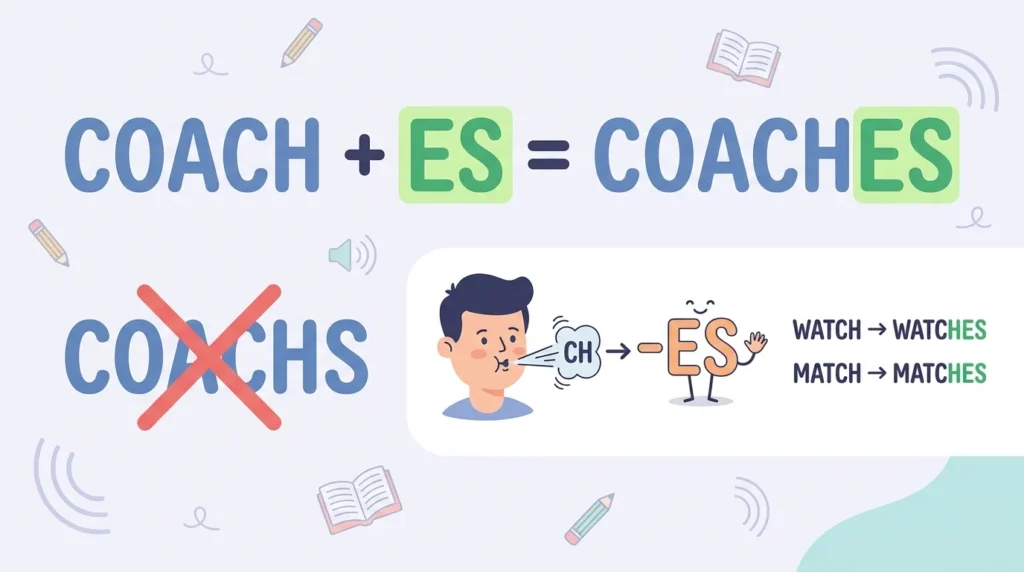

If you are wondering whether the correct plural of coach is coaches or coachs, the answer is simple: coaches is correct, while coachs is an incorrect spelling in standard English.
But there is more to understand than simply adding -es. The word coaches can be a plural noun or a verb, while coach’s and coaches’ have different meanings. Knowing the difference helps you avoid mistakes in emails, schoolwork, professional writing, sports articles, and everyday English.
What Is the Difference Between Coaches and Coachs?
The difference is straightforward:
- coach = one coach
- coaches = more than one coach
- coachs = incorrect standard spelling
- coach’s = something belonging to one coach
- coaches’ = something belonging to multiple coaches
For example:
The coach arrived early.
This refers to one coach.
The coaches arrived early.
This refers to more than one coach.
You should not write:
The coachs arrived early. ❌
The correct version is:
The coaches arrived early. ✅
The word coach has several meanings. It can refer to someone who trains or teaches people, such as a sports coach or career coach. In British English, it can also refer to a long-distance bus, and coach has other transportation-related meanings as well.
Why Does Coach Become Coaches?
The basic reason is the spelling and sound at the end of coach.
English nouns do not all form plurals in exactly the same way. Many simply take -s:
- book → books
- player → players
- teacher → teachers
- student → students
But nouns ending in certain sounds, including -ch, commonly take -es:
- watch → watches
- match → matches
- church → churches
- branch → branches
- coach → coaches
English grammar references describe this as a regular plural pattern for nouns ending in -ch, -s, -sh, -x, or -z.
So:
coach + es = coaches
Not:
coach + s = coachs
There is also a pronunciation reason. The plural ending in coaches is pronounced with an extra syllable:
coach → /koʊtʃ/
coaches → /ˈkoʊ.tʃɪz/
The -es ending produces a natural plural pronunciation.
Read More: Ingage vs Engage: Which Spelling Is Correct?
The Core Rule
When you mean more than one coach, use coaches. Never use coachs as the standard plural spelling.
The easiest pattern to remember is:
coach → coaches
The same type of plural spelling appears in words such as:
watch → watches
match → matches
branch → branches
church → churches
However, be careful with the word -ch itself. The broader rule is based on pronunciation and spelling patterns, and English has exceptions in some other word groups. For coach, though, there is no uncertainty:
coach → coaches
How to Use Coaches Correctly
1. Coaches as a plural noun
Use coaches when you are talking about two or more coaches.
The coaches discussed the players’ progress.
Three coaches attended the training session.
The school hired two new coaches.
The noun can describe sports coaches, career coaches, fitness coaches, academic coaches, and other people who provide instruction or guidance.
2. Coaches as a verb
Coaches can also be a verb.
It is the third-person singular present-tense form of coach.
For example:
She coaches the university basketball team.
Here, coaches does not mean “more than one coach.” It means she trains or instructs the team.
Compare:
The coaches train the players.
Coaches = plural noun.
Maria coaches the players.
Coaches = verb.
This distinction is important because the same spelling can perform two different grammatical jobs. Merriam-Webster also identifies coaches as both the plural of the noun coach and the third-person singular present form of the verb coach.
3. Coaches in different contexts
Sports:
The coaches prepared the team for the final.
Business:
Several executive coaches attended the conference.
Education:
The academic coaches helped students prepare for their exams.
Transportation:
The coaches arrived at the station before noon.
Personal development:
The career coaches offered advice to recent graduates.
The meaning changes according to context, but the plural spelling remains coaches.
Correct Examples
Here are examples showing how coaches works in real writing.
- Conversation:
“The coaches are meeting after practice.” - Email:
“Please remind all coaches that the meeting starts at 10 a.m.” - School:
“The school has hired two new sports coaches.” - Workplace:
“Our leadership coaches will work with the management team.” - Academic writing:
“Experienced coaches can influence athletes’ motivation and performance.” - Social media:
“Great coaches do more than teach skills; they build confidence.” - Sports journalism:
“Both coaches praised their players after the match.” - Business communication:
“The company provides professional coaches for newly promoted managers.” - Transportation:
“Several coaches were waiting outside the terminal.” - Everyday English:
“The coaches asked everyone to arrive early.”
Notice that none of these examples uses coachs.
Read More: Unenroll vs Disenroll: Meaning and Key Difference
Incorrect vs. Correct
| ❌ Incorrect | ✅ Correct | Why |
|---|---|---|
| The coachs arrived early. | The coaches arrived early. | The plural of coach is formed with -es. |
| We hired three coachs. | We hired three coaches. | Coach ends in the relevant -ch pattern. |
| The coachs met yesterday. | The coaches met yesterday. | More than one coach requires the plural form coaches. |
| All coachs must attend. | All coaches must attend. | Coachs is not the standard plural spelling. |
| Several coachs joined the program. | Several coaches joined the program. | Use coaches for multiple people. |
| The school needs two coachs. | The school needs two coaches. | The standard plural is coaches. |
| Our football coachs are experienced. | Our football coaches are experienced. | The plural noun requires -es. |
| Five coachs attended the event. | Five coaches attended the event. | Coaches is the correct plural. |
| The company hired business coachs. | The company hired business coaches. | Compound expressions still use the correct plural form. |
| The team thanked its coachs. | The team thanked its coaches. | The word remains coaches regardless of context. |
Why People Make the “Coachs” Mistake
The mistake is understandable because one of the most common English plural rules is simply:
noun + s
For example:
- car → cars
- table → tables
- teacher → teachers
- player → players
- computer → computers
A learner may therefore apply the same pattern automatically:
coach + s = coachs
The problem is that English has several plural spelling patterns. The ending of the singular noun can change what you need to add.
Read More: Home Made vs Homemade: Which Spelling Is Correct?
Phonetic similarity
The singular word coach ends in the /tʃ/ sound. Learners may hear the word clearly but not know that its written plural requires -es.
Spelling overlap
The word already ends with the letter h, so adding another s can look visually reasonable:
coachs
But English spelling does not always work by simply adding one letter.
Overgeneralization
Learners often learn:
“To make a noun plural, add s.”
That is a useful starting rule, but it is not the complete rule system.
Autocomplete and spellcheck
Typing tools can sometimes make mistakes easier to overlook. A writer may type quickly, accept an autocomplete suggestion, or fail to notice a spelling error during proofreading.
Spellcheck is useful, but it should not replace knowledge of common spelling patterns.
Translation interference
Learners whose first language forms plurals differently may transfer their native-language pattern into English. This can make a form such as coachs seem more logical than coaches.
The solution is not to memorize every plural separately. Learn useful spelling patterns and then apply them to familiar words.
Common Mistakes Checklist
Mistake 1: Writing “coachs”
Problem: You are treating coach like a noun that simply takes -s.
Fix: Remember:
coach → coaches
Mistake 2: Confusing coaches with coach’s
These forms have different meanings.
The coaches arrived.
More than one coach.
The coach’s office is upstairs.
Something belonging to one coach.
Mistake 3: Confusing coaches with coaches’
The apostrophe changes the meaning.
The coaches met after practice.
Several coaches.
The coaches’ meeting lasted two hours.
A meeting associated with several coaches.
Mistake 4: Adding an apostrophe to make a plural
Do not write:
The coach’s arrived. ❌
if you simply mean several coaches.
Write:
The coaches arrived. ✅
An apostrophe is not normally used to make an ordinary plural.
Mistake 5: Assuming every word ending in “ch” behaves identically in every context
For this word, the answer is easy:
coach → coaches
But English spelling contains exceptions and historical patterns, so it is better to learn the rule as a useful pattern rather than claim that every English word ending in ch must behave identically.
Coaches in Real English
Grammatically correct and natural
“The coaches met before the game.”
This is completely natural everyday English. Coaches is the ordinary plural noun, and there is no reason to use an apostrophe. The word is equally appropriate in conversation, news writing, school writing, workplace communication, and formal documents. The same spelling works whether you are talking about sports coaches, career coaches, or another type of coach.
Grammatically possible but not the intended form
“She coaches the team.”
This is also completely correct, but here coaches is not a plural noun. It is a verb. The subject is she, so the verb coach takes the third-person singular -s form: she coaches. Understanding this prevents readers from mistakenly interpreting every occurrence of coaches as a plural noun.
Natural everyday English
“We have three coaches this season.”
This is the most natural way to express the idea of having three people who coach a team. A speaker would not normally use coachs, and there is no special informal alternative that replaces coaches. The standard form works naturally in both casual and professional communication.
Possessive meaning
“The coaches’ meeting starts at five.”
Here, coaches’ is not another plural form. It is a plural possessive: the meeting is associated with several coaches. The apostrophe comes after the s because coaches is already a regular plural ending in s. This is different from coach’s, which indicates possession or association with one coach.
Read More: Either vs Eather: Which Spelling Is Correct?
American vs. British English
There is no spelling difference between American and British English for this plural.
Both varieties use:
coach → coaches
So these are correct in both varieties:
The coaches arrived early.
Several coaches attended the meeting.
She coaches the team.
The word coach itself can have somewhat different transportation uses across varieties. For example, British English commonly uses coach for a long-distance bus, while American English may use other terms such as bus or motorcoach depending on the context. But this does not change the plural spelling coaches.
Formal vs. Informal Usage
There is no meaningful formal/informal spelling difference here.
Use coaches in:
- academic writing
- business emails
- reports
- sports journalism
- school assignments
- social media
- text messages
- everyday conversation
Coachs should not be used as an informal alternative. Even in casual writing, the standard plural remains coaches.
For example:
Formal:
All coaches are required to attend the annual seminar.
Informal:
The coaches are meeting later.
Both use coaches.
Coaches, Coach’s, and Coaches’: What’s the Difference?
This is where many writers get confused.
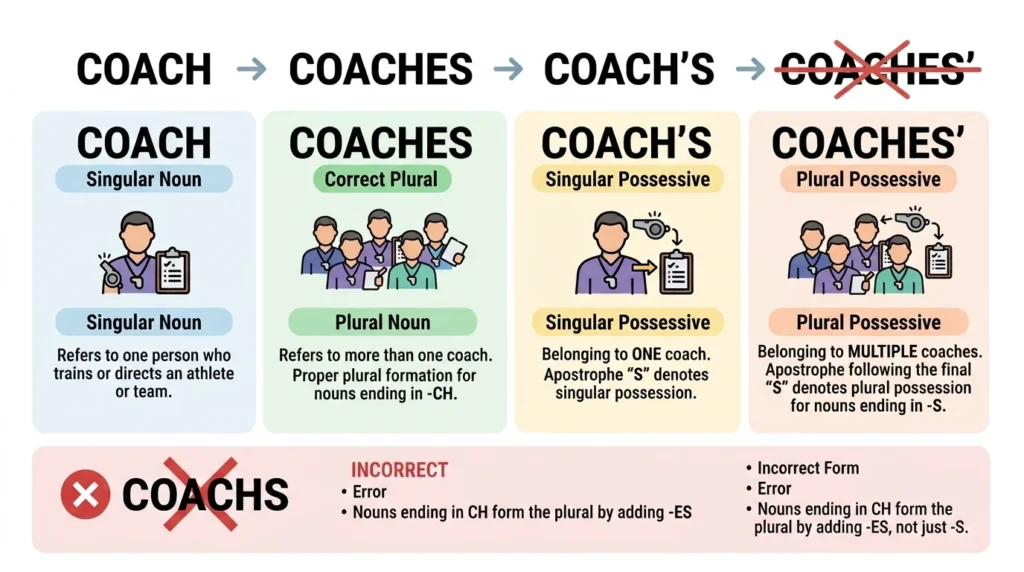
| Form | Grammar | Meaning | Example |
|---|---|---|---|
| coach | Singular noun | One coach | The coach arrived. |
| coaches | Plural noun | More than one coach | The coaches arrived. |
| coaches | Verb | He/she/it trains or instructs | She coaches the team. |
| coach’s | Singular possessive | Belonging to one coach | The coach’s office is open. |
| coaches’ | Plural possessive | Belonging to several coaches | The coaches’ meeting starts soon. |
| coachs | Incorrect | Not the standard plural | Avoid this form. |
A quick test is to ask what you mean.
Do you mean more than one?
→ coaches
Do you mean one coach owns or is associated with something?
→ coach’s
Do you mean several coaches own or are associated with something?
→ coaches’
Memory Trick
Use this simple mnemonic:
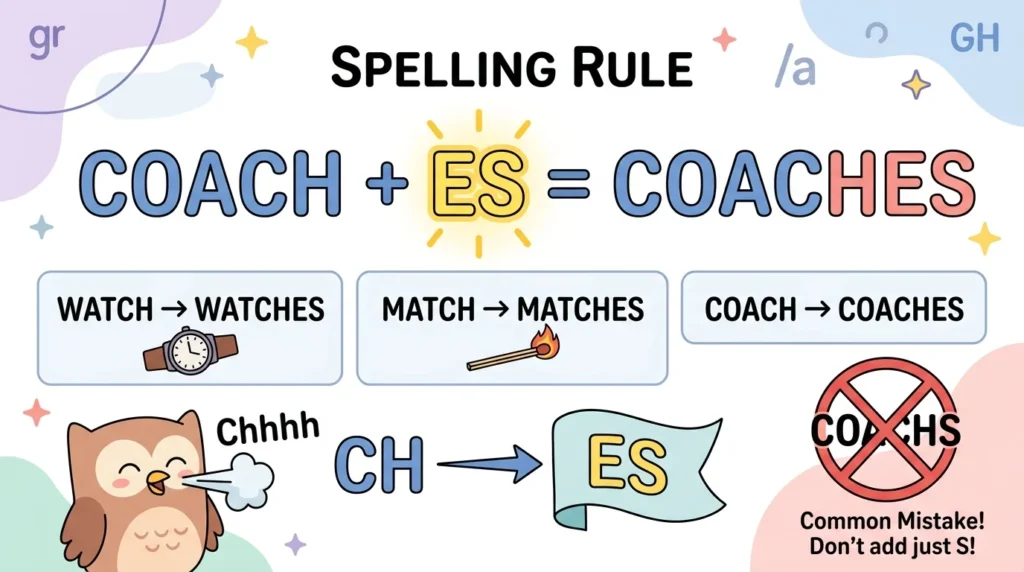
A coach needs “ES” to become more than one: coach + ES = coaches.
Or remember the visual pattern:
CH → ES
- watch → watches
- match → matches
- church → churches
- coach → coaches
Think:
“Coach needs extra letters.”
That makes it easier to remember that coachs is not the standard plural.
Real-Life Situations
In a sports meeting
You are talking about three people who train a team.
Correct:
The three coaches met before practice.
In an email
You are sending instructions to multiple coaches.
Correct:
Please forward this message to all coaches.
In an interview
You are describing your experience.
Correct:
I have worked with several professional coaches.
In a school assignment
You are discussing athletic training.
Correct:
Successful coaches often combine technical instruction with motivation.
In a text message
You are asking about several trainers.
Correct:
Are the coaches coming tonight?
In a business report
You are discussing professional development.
Correct:
Executive coaches can help managers develop leadership skills.
When showing possession
You mean the office belonging to one coach.
Correct:
The coach’s office is on the second floor.
When showing plural possession
You mean an event involving several coaches.
Correct:
The coaches’ meeting begins at 4 p.m.
Expert Tips
Tip 1: Do not rely only on “add s”
The simple plural rule works for many English nouns, but not all of them.
Instead, look at the ending of the word.
Tip 2: Learn words in pairs
Rather than memorizing only:
coach
learn:
coach → coaches
This creates a stronger spelling connection.
Tip 3: Listen for the extra syllable
coach has one syllable.
coaches has two:
COACH-es
That extra syllable can remind you that the plural is written with -es.
Tip 4: Watch the apostrophe
Compare:
coaches
coach’s
coaches’
They look similar, but they perform different grammatical jobs.
Tip 5: Read the whole sentence
If you see:
She coaches the team.
you are looking at a verb.
If you see:
The coaches arrived.
you are looking at a plural noun.
Context tells you which grammatical role the word has.
FAQ
Is “coachs” a correct spelling?
No. Coachs is not the standard English plural of coach. The correct plural is coaches.
What is the plural of coach?
The plural is coaches.
One coach
Two coaches
Why is it “coaches” and not “coachs”?
Because coach ends in the -ch pattern that normally takes -es when forming the plural. Therefore:
coach → coaches
Is “coaches” a noun or a verb?
It can be either.
As a noun:
The coaches arrived.
As a verb:
She coaches the team.
Is “coach’s” the plural of coach?
No. Coach’s is normally the singular possessive form.
The coach’s car is outside.
This means the car belongs to one coach or is associated with one coach.
What is the plural possessive of coach?
The plural possessive is coaches’.
The coaches’ offices are on the second floor.
It indicates that something belongs to or is associated with multiple coaches.
Is “coaches” the same in American and British English?
Yes. Both American and British English use coaches as the plural spelling of coach.
Can “coaches” refer to buses?
Yes. In British English, coach can refer to a long-distance bus, so coaches can refer to multiple buses. The word also has transportation-related meanings in other varieties of English.
How do you pronounce coaches?
It is commonly pronounced approximately “KOH-chiz.” The plural has an extra syllable compared with coach.
Can “coaches” be a verb?
Yes.
She coaches young athletes.
Here, coaches is the third-person singular present form of the verb coach.
What is the easiest way to remember the spelling?
Remember:
coach → coaches
Think of the pattern:
watch → watches
match → matches
coach → coaches
Never write coachs when you mean the standard plural.
Mini Quiz
| # | Question | Answer | Explanation |
|---|---|---|---|
| 1 | Which is correct: coaches or coachs? | Coaches | Coaches is the standard plural of coach. |
| 2 | Complete: “The two ___ arrived early.” | coaches | More than one coach requires the plural noun. |
| 3 | Correct the sentence: “The coachs met after the game.” | The coaches met after the game. | The plural requires -es. |
| 4 | Complete: “Sarah ___ the school team.” | coaches | Here coaches is a third-person singular verb. |
| 5 | Which is correct for one coach’s office? | the coach’s office | Coach’s is the singular possessive. |
| 6 | Which is correct for a meeting involving several coaches? | the coaches’ meeting | Coaches’ is the plural possessive. |
| 7 | True or false: “Coachs” is an informal plural that is acceptable in texting. | False | Casual writing does not make coachs a standard plural. |
| 8 | Complete: “Several football ___ attended the event.” | coaches | The sentence needs a plural noun. |
| 9 | Correct the sentence: “The coaches’s office is closed.” | The coaches’ office is closed. | A regular plural ending in s takes an apostrophe after the s for the plural possessive. |
| 10 | Choose the correct sentence: A) “She coachs the team.” B) “She coaches the team.” | B: She coaches the team. | Coaches is the third-person singular present form of coach. |
Quick Summary
Coaches is the correct standard plural of coach. Coachs is an incorrect spelling. The plural is formed by adding -es because coach ends in the -ch pattern: coach → coaches. The word coaches can also be a verb, as in “She coaches the team.” Do not confuse it with coach’s, which is usually the possessive form for one coach, or coaches’, which shows possession or association involving multiple coaches. American and British English use the same spelling. The easiest memory trick is simple: coach needs ES to become coaches. Whenever you mean more than one coach, write coaches, never coachs.