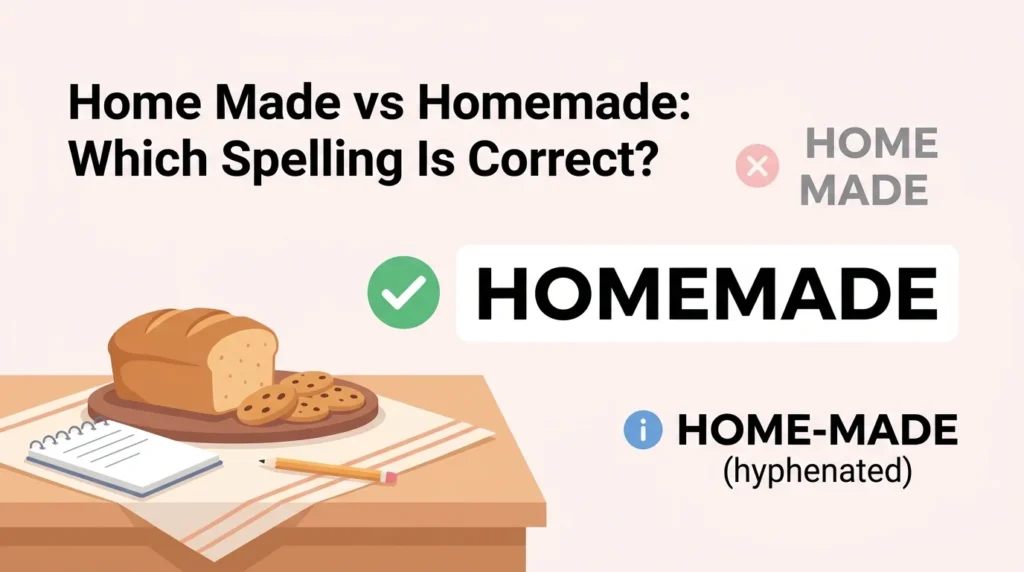

Homemade is the standard one-word spelling in modern English: homemade cake, homemade bread, and homemade soap. In British English, home-made is also accepted and appears in major dictionaries. Home made, written as two separate words, is not the normal modern spelling of the adjective. If you are writing for an international or American audience, homemade is the safest choice.
What Is the Difference Between Home Made and Homemade?
The main difference is spelling and standard usage, not meaning.
Homemade is an adjective meaning something was made at home rather than bought from a shop or produced commercially. It can describe food, crafts, products, tools, furniture, and other things made at home or through one’s own efforts.
For example:
- homemade bread
- homemade cookies
- homemade jam
- homemade furniture
- homemade decorations
The form home-made also exists, especially in British English. Cambridge lists home-made as a UK variant, while its main entry uses homemade.
The form home made is different because it separates the compound into two words. When you mean the adjective describing something produced at home, homemade is the normal modern choice.
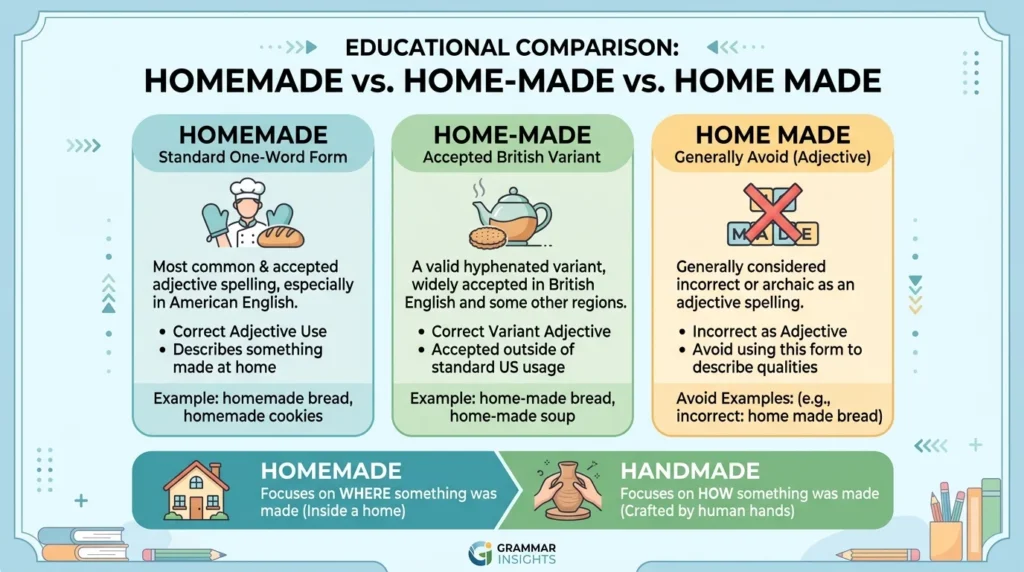
The simple distinction
- Homemade = standard one-word spelling
- Home-made = accepted hyphenated British variant
- Home made = generally avoid when you mean the adjective
So if you are writing a sentence such as:
She brought a homemade cake.
Homemade is the best choice.
Why It Matters
A spelling mistake involving a familiar compound word can make otherwise strong writing look careless.
This matters especially in:
- school assignments
- business websites
- product descriptions
- menus
- recipes
- social media posts
- advertisements
- emails
- academic writing
- professional communication
Consider these two sentences:
We sell home made cookies.
We sell homemade cookies.
The meaning is easy to understand in both cases, but homemade cookies follows the standard modern spelling more naturally.
This is particularly useful when writing product descriptions. If a business advertises homemade bread, homemade candles, or homemade skincare products, the single-word form looks polished and conventional.
The Core Rule
Use “homemade” as one word when it is an adjective meaning “made at home.”
In British English, home-made is also accepted. In American English, homemade is the normal form. Major dictionaries recognize homemade as an adjective meaning made at home, while Cambridge and Collins also record the hyphenated British form.
Read More: Either vs Eather: Which Spelling Is Correct?
The easiest rule to remember
If you can replace the expression with “made at home,” use:
homemade
Examples:
- homemade bread
- homemade soup
- homemade cards
- homemade furniture
- homemade gifts
Do not normally write:
- home made bread
- home made soup
- home made cards
How to Use Homemade
Before a noun
The most common use is as an adjective directly before a noun.
Examples:
We had homemade pizza for dinner.
She brought homemade cookies to the office.
He sells homemade candles online.
They served homemade bread with the meal.
Here, homemade tells the reader what kind of pizza, cookies, candles, or bread is being discussed.
After a linking verb
Homemade can also appear after a linking verb such as be.
Examples:
The bread is homemade.
These cookies are homemade.
The decorations were homemade.
The sauce tastes homemade.
In these sentences, homemade describes the subject rather than appearing directly before a noun.
With food
Food is probably the most familiar context for homemade.
Common combinations include:
- homemade bread
- homemade cake
- homemade soup
- homemade pasta
- homemade jam
- homemade pizza
- homemade cookies
- homemade sauce
- homemade ice cream
- homemade yogurt
Dictionary examples also show homemade being used naturally with food such as bread, cakes, wine, soup, cheese sauce, and ice cream.
With non-food items
Homemade is not limited to cooking.
You can also use it for things made at home or through one’s own efforts:
- homemade furniture
- homemade decorations
- homemade cards
- homemade toys
- homemade tools
- homemade clothing
- homemade gifts
- homemade equipment
Merriam-Webster defines the word broadly enough to include things made in the home, on the premises, or through one’s own efforts.
Correct Examples
Here are examples from everyday conversation, school, work, business, social media, and academic contexts.
- Conversation:
“Would you like some homemade lemonade?” - Email:
“I brought some homemade cookies for everyone in the office.” - School:
“For the project, we built a homemade model of the solar system.” - Workplace:
“The team shared homemade snacks during the meeting.” - Social media:
“Nothing beats homemade pizza on a Friday night.” - Recipe writing:
“This recipe makes enough homemade tomato sauce for four servings.” - Business description:
“Our shop specializes in homemade jams and traditional preserves.” - Academic writing:
“The researchers used a homemade device for the preliminary experiment.” - Text message:
“Mom made homemade soup. Come over if you want some.” - General writing:
“The children prepared homemade cards for their teachers.” - Product description:
“Each basket includes homemade biscuits and locally produced tea.” - Conversation about crafts:
“She gave me a homemade scarf for my birthday.”
Incorrect vs. Correct
| ❌ Incorrect | ✅ Correct | Why |
|---|---|---|
| We ate home made bread. | We ate homemade bread. | Homemade is normally written as one word when it functions as the adjective. |
| She sells home made cakes. | She sells homemade cakes. | The standard modern form is homemade. |
| I prefer home made food. | I prefer homemade food. | The compound adjective is normally closed into one word. |
| He gave me a home made card. | He gave me a homemade card. | Homemade is the conventional spelling. |
| They served home made soup. | They served homemade soup. | The adjective is normally written as one word. |
| We bought some home made jam. | We bought some homemade jam. | Homemade is the standard modern form. |
| She prepared a home made meal. | She prepared a homemade meal. | The compound adjective is normally closed. |
| I love home made cookies. | I love homemade cookies. | Homemade is the natural modern spelling. |
| He built a home made tool. | He built a homemade tool. | The adjective is normally written as one word. |
| They gave us home made gifts. | They gave us homemade gifts. | Homemade is the standard form for this meaning. |
What about “home-made”?
The hyphenated form is not necessarily wrong.
For example:
She brought a home-made cake.
This form is accepted in British English and appears in major dictionaries as a UK variant.
However, if you want one spelling that works smoothly for a broad international audience, homemade is the simplest choice.
Why People Make This Mistake
1. The words sound separate
When people pronounce homemade, the word contains two recognizable parts:
home + made
That can make writers feel that the expression should remain two words.
English does not always work that way. Many common combinations that began as separate words eventually became closed compounds.
Examples include:
- bedroom
- notebook
- classroom
- football
- homemade
The spelling must therefore be learned as a conventional word rather than reconstructed from pronunciation.
2. English has many compound-word patterns
English uses several patterns for compounds:
- one word: homemade
- hyphenated: well-known
- two words: high school
There is no single rule that tells you every compound must use one pattern.
That is why relying only on logic can cause problems. Familiar compounds often have established dictionary spellings.
3. Older writing creates confusion
Readers may encounter home-made in older books, British publications, historical documents, or other sources.
That can make the writer wonder whether home made must also be acceptable.
It does not follow that conclusion.
The existence of a historical or regional spelling does not automatically make every possible variation standard today.
4. Spellcheck is not always enough
Modern spellcheckers can identify many obvious errors, but spelling tools do not replace knowledge of usage.
A word can be understandable without being the preferred form.
For example, someone may type home made and receive no obvious warning depending on the software, language settings, or context.
That does not make the two-word form the best editorial choice.
5. Translation interference
Learners whose first language forms compound expressions differently may naturally separate home and made.
This is especially common when translating an expression literally from another language.
The solution is simple: learn the English expression as a complete unit:
homemade = made at home
Common Mistakes Checklist
Mistake 1: Writing “home made” as the default
Problem: You treat the two parts as ordinary separate words.
Better approach: Use homemade when it functions as the adjective.
homemade bread
Mistake 2: Assuming “home-made” is always wrong
Problem: You may incorrectly believe that the hyphenated form is a spelling error.
Better approach: Recognize that home-made is an accepted British variant.
Mistake 3: Assuming all English-speaking countries use exactly the same spelling
Problem: English has regional spelling and style differences.
Better approach: For international and American-facing writing, homemade is the safest default. For British English, home-made may also be acceptable.
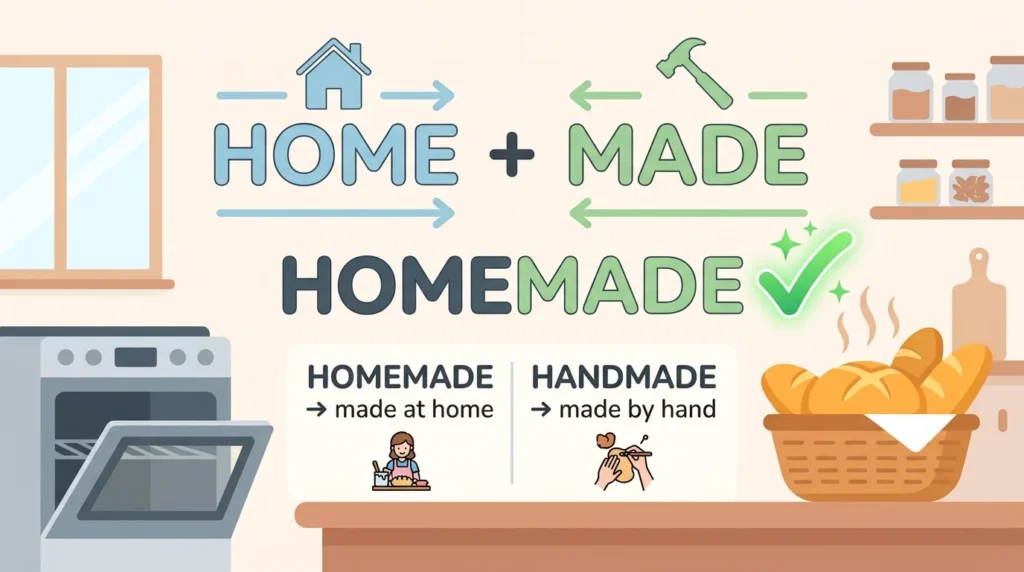
Mistake 4: Confusing homemade with handmade
Problem: You focus on the method instead of the place of production.
Better approach: Remember:
homemade = made at home
handmade = made by hand
These ideas can overlap, but they are not identical. A sweater can be handmade in a professional workshop without being homemade. Conversely, something made at home can be produced with an appliance or machine and still be described as homemade.
Mistake 5: Assuming homemade means “made personally by me”
Problem: You interpret homemade as “I personally made it.”
Better approach: Homemade primarily indicates that something was made at home or domestically. It does not necessarily identify the person who made it. Merriam-Webster also includes the broader sense of something made through one’s own efforts.
Homemade in Real English
1. Grammatically correct and natural
“I made homemade bread for breakfast.”
This is completely natural everyday English. Homemade bread is a familiar noun phrase, especially when talking about food prepared at home rather than purchased from a shop. The same pattern works with many common foods: homemade soup, homemade cake, homemade pasta, and homemade cookies. Dictionary examples show this type of usage repeatedly.
2. Grammatically possible but less standard
“I made home made bread for breakfast.”
The reader will almost certainly understand the intended meaning, but the two-word spelling is not the normal modern form of the adjective. It can therefore look like a spelling mistake or an inconsistent compound-word choice. In polished writing, replace it with homemade. If you are following a British style that permits the hyphenated variant, home-made is also possible.
3. Natural British variation
“I made home-made bread for breakfast.”
This is a legitimate British spelling variant. Major dictionaries identify home-made as a UK form. That does not mean it is required in British English, however. Homemade is also widely recognized and understood. If you are not following a specific British house style, using homemade gives you a simple, internationally familiar form.
4. Homemade versus handmade
“She sells handmade jewelry.”
Here, handmade is the correct word because the focus is on the method of production: the jewelry was made by hand. Homemade would emphasize that something was made at home. Merriam-Webster defines handmade as “made by hand or by a hand process,” making the distinction clear.
American vs. British English
There is a genuine regional difference worth knowing.
| English variety | Preferred/common form | Example |
|---|---|---|
| American English | homemade | homemade bread |
| British English | homemade or home-made | homemade bread / home-made bread |
| International writing | homemade | homemade bread |
Cambridge identifies homemade as the main entry while also recording home-made in UK usage. Collins similarly lists the British form home-made.
Which should you choose?
If your audience is international, use:
homemade
If you are specifically following a British publication’s established style, home-made may be appropriate.
Do not treat home made as the preferred alternative simply because British English permits home-made.
Formal vs. Informal Usage
There is no major formal-versus-informal meaning difference between homemade and home-made.
Both can appear in ordinary and formal contexts.
For example:
Informal:
I made some homemade cookies.
Professional:
The company specializes in homemade preserves.
Academic:
The experiment used a homemade measuring device.
The important issue is consistency with your chosen English variety and editorial style.
For most modern writing, homemade is the easiest form to use consistently.
Homemade vs. Home-Made vs. Home Made
| Feature | Homemade | Home-made | Home made |
|---|---|---|---|
| Number of words | One | One compound with hyphen | Two |
| Meaning | Made at home | Made at home | Intended to mean the same thing |
| Modern standard use | Yes | Yes, especially British | Generally avoid |
| American English | Standard | Less common | Not preferred |
| British English | Standard/common | Accepted variant | Not the normal adjective spelling |
| Best choice for international writing | Yes | Acceptable | No |
| Example | homemade bread | home-made bread | home made bread |
Homemade vs. Handmade
These words are close in meaning but should not be treated as interchangeable.
| Word | Main idea | Example |
|---|---|---|
| Homemade | Made at home | homemade soup |
| Handmade | Made by hand | handmade pottery |
| Home-made | British variant of homemade | home-made cake |
| Home made | Two-word form to avoid for this adjective | home made cake |
A product can be both homemade and handmade.
For example:
She knitted a homemade, handmade scarf.
Here, homemade tells us where it was made, while handmade tells us how it was made.
Read More: Seing vs Seeing: Which Spelling Is Correct?
Homemade vs. Home-Cooked
These terms are related but not identical.
Homemade is broader. It can describe food and non-food items.
Home-cooked specifically describes food that has been cooked at home.
Compare:
homemade bread
homemade soap
homemade furniture
home-cooked dinner
You would not normally call furniture home-cooked, because cooking is not involved.
On the other hand, a meal can be both:
a homemade, home-cooked dinner
Memory Trick
Use this simple memory trick:
HOME + MADE = HOMEMADE
Think of the two ideas joining together permanently:
home + made → homemade
If something was made at home, think homemade.
For handmade, think:
hand + made → handmade
The easiest distinction is:
Where? → homemade
How? → handmade
Real-Life Situations
In an interview
“I enjoy cooking, and I often bring homemade food to family gatherings.”
The speaker is describing food prepared at home.
In a business meeting
“We are considering a product line based on homemade-style recipes.”
The word describes the nature or style of the products.
In an email
“Thank you for organizing the event. I will bring a homemade dessert.”
The one-word spelling is clean and professional.
In a text message
“I made homemade pizza tonight!”
This is a natural everyday use.
In a school assignment
“The students created a homemade model using cardboard and recycled materials.”
Here, homemade describes something constructed outside a commercial manufacturing setting.
On social media
“Sunday afternoon + homemade cookies = a perfect combination.”
The one-word spelling is natural for casual digital writing.
On a product label
“Homemade Strawberry Jam”
The word clearly tells the buyer that the product is presented as made at home.
In a recipe
“Store the homemade sauce in an airtight container.”
Again, homemade functions as an adjective modifying sauce.
Expert Tips
Tip 1: Learn the whole word
Do not memorize it as two independent words every time you write it.
Learn:
homemade
as a complete vocabulary item.
Tip 2: Use the one-word form as your default
Unless you are intentionally following a British style that uses the hyphenated form, homemade is the easiest spelling to choose.
Tip 3: Do not overthink the hyphen
You do not need to insert a hyphen simply because the word contains two meaningful parts.
Established compound words often become closed over time.
Tip 4: Distinguish spelling from meaning
The difference between homemade and home-made is mainly one of spelling convention and regional style. They normally express the same basic idea.
Tip 5: Remember that homemade is broader than food
Do not limit the word to recipes.
You can have:
- homemade furniture
- homemade decorations
- homemade cards
- homemade equipment
- homemade gifts
- homemade clothing
Tip 6: Be careful with “handmade”
handmade pottery
If the important information is that a person made something by hand, use handmade.
If the important information is that it was made at home, use homemade.
homemade pottery
Sometimes both descriptions are accurate.
Tip 7: Keep your style consistent
If an article uses homemade throughout, do not randomly switch to home-made unless there is a reason.
Consistency makes writing easier to read and edit.
Quick Summary
Homemade is the standard one-word spelling used to describe something made at home. It is the safest choice for American English and for most international writing. Home-made is also an accepted British English variant and has the same basic meaning. Home made, written as two separate words, is not the normal modern spelling of the adjective and should generally be avoided in polished writing. Remember the distinction this way: homemade focuses on where something was made, while handmade focuses on how it was made. If you are unsure which spelling to use, choose homemade.
FAQ
Is “homemade” one word or two?
Homemade is one word. It is the standard modern spelling of the adjective meaning made at home.
Is “home made” grammatically correct?
When you mean the adjective meaning “made at home,” home made is not the normal modern spelling. Use homemade instead.
Is “home-made” correct in British English?
Yes. Home-made is an accepted British English variant. Major dictionaries list it as a UK form.
Should I write “homemade” or “home-made”?
For most modern writing, homemade is the simplest choice. If you are specifically following British usage or a publication’s style guide that uses home-made, the hyphenated version is also acceptable.
Is homemade only used for food?
No. You can use homemade for many things made at home, including furniture, decorations, cards, tools, clothing, and other products.
Is homemade the same as handmade?
No. Homemade focuses on where something was made, while handmade focuses on the fact that it was made by hand. Something can be both homemade and handmade.
Can a homemade product be made with a machine?
Yes. Homemade describes the place or domestic nature of production; it does not necessarily mean that every part was made manually. A person can make something at home using ordinary household equipment.
Is “homemade” formal English?
Yes. Homemade is suitable for casual, professional, educational, and many formal contexts. The word itself is not informal.
Is “home-made” outdated?
Not exactly. It remains an accepted British variant. Calling it simply “wrong” would be inaccurate. However, homemade is the straightforward modern form for most audiences.
What is the opposite of homemade?
Depending on the context, possible contrasts include store-bought, commercially made, factory-made, or ready-made.
For example:
I prefer homemade bread to store-bought bread.
Can I use “homemade” in academic writing?
Yes. There is nothing inherently informal about the word. If the meaning is relevant, homemade can be used in academic writing.
Which spelling is best for SEO and web writing?
Use homemade as your primary spelling. It is concise, widely recognized, and the standard form for American English and broad international audiences. If discussing British English, you can mention home-made as a regional variant.
Mini Quiz
| # | Question | Answer | Explanation |
|---|---|---|---|
| 1 | Which spelling is normally preferred? A) home made B) homemade C) home-made | B) homemade | Homemade is the standard one-word form. |
| 2 | Fill in the blank: “She baked a ___ cake.” | homemade | Homemade is the adjective describing the cake. |
| 3 | Which is the British variant? A) home-made B) home made C) homes-made | A) home-made | Home-made is an accepted UK variant. |
| 4 | Correct the sentence: “We sell home made cookies.” | We sell homemade cookies. | The adjective is normally written as one word. |
| 5 | Which word emphasizes production by hand? A) homemade B) handmade | B) handmade | Handmade describes something made by hand or by a hand process. |
| 6 | Fill in the blank: “My grandmother makes ___ jam.” | homemade | Jam made at home can be described as homemade. |
| 7 | True or false: Homemade can describe non-food items. | True | Homemade can describe furniture, cards, tools, decorations, and more. |
| 8 | Correct the sentence: “He gave me a home made gift.” | He gave me a homemade gift. | Homemade is the standard modern spelling. |
| 9 | Which sentence is best for broad international writing? A) I bought home made bread. B) I bought home-made bread. C) I bought homemade bread. | C) I bought homemade bread. | Homemade is the simplest widely accepted form. |
| 10 | Choose the best word: “The necklace was ___ in a small studio.” | handmade | The sentence emphasizes the method of production rather than the fact that it was made at home. |
Final Takeaway
When you are deciding between home made vs. homemade, choose homemade in most modern writing.
Use:
homemade cake
homemade food
homemade products
homemade gifts
Remember that home-made is also accepted in British English, so it should not automatically be marked as wrong. The form to avoid as your normal adjective spelling is home made.
The simplest rule is:
Made at home = homemade.