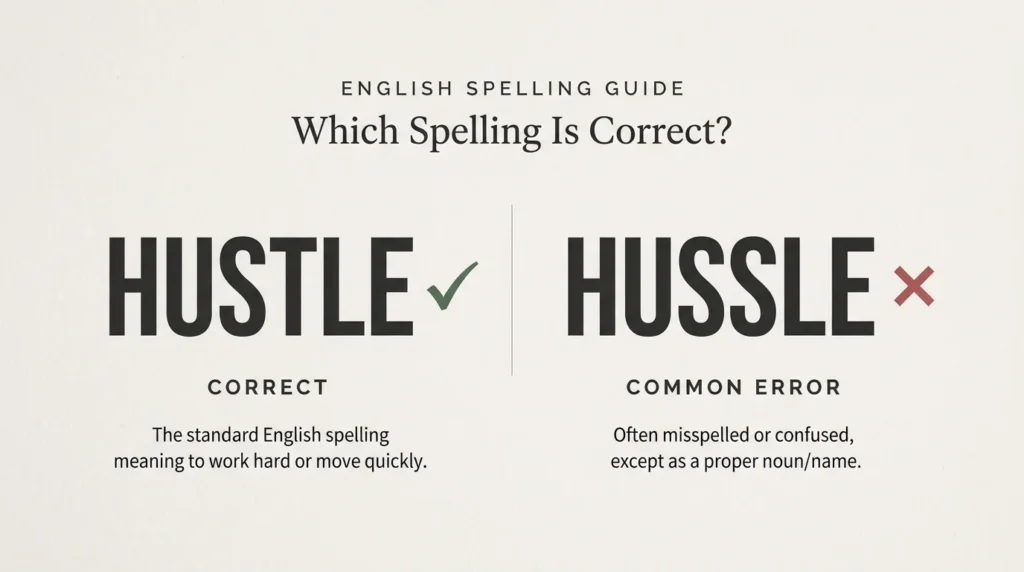

Hustle is correct; hussle is not the standard spelling of the English word. Use hustle when describing energetic work, quick movement, determined effort, or a side job. For example, “She started a side hustle to earn extra money.” Do not write “She started a side hussle.” However, preserve Hussle when it is the established spelling of a person’s name, brand, or creative title.
What Is Hustle?
Hustle is an English word that functions as both a verb and a noun. Its meaning depends on the situation, but it often relates to speed, effort, activity, or the way someone tries to achieve a result.
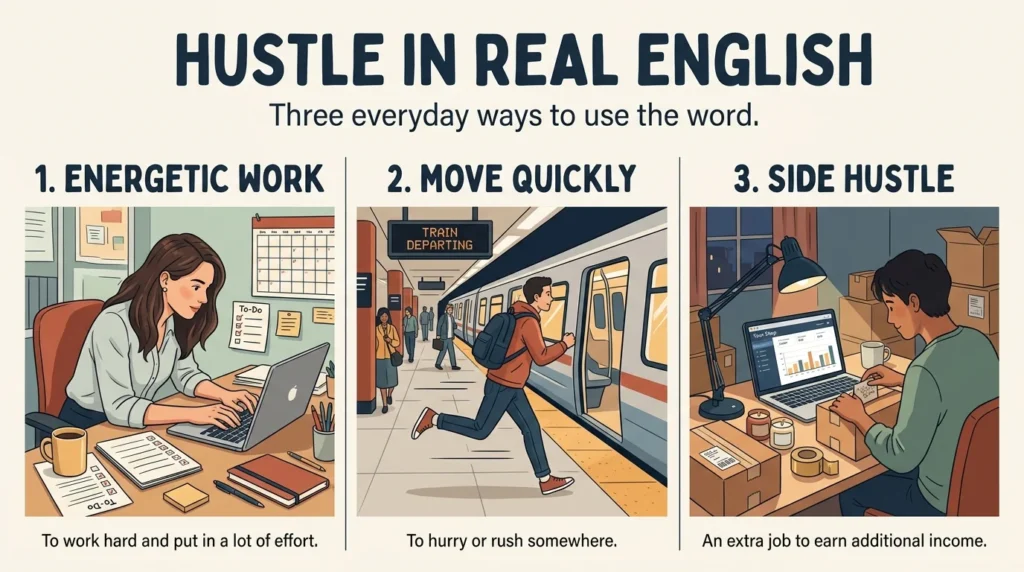
As a verb, hustle can mean to move quickly, work energetically, or encourage someone to act faster.
Examples:
- We need to hustle if we want to catch the train.
- She hustles to finish her work before the deadline.
- The coach told the players to hustle back onto the field.
As a noun, hustle can describe energetic effort, busy activity, or a way of earning money.
Examples:
- His hustle helped him build a successful business.
- The hustle of city life can be exhausting.
- Freelance writing is her side hustle.
The word can also have a negative meaning. Depending on the context, to hustle someone may mean to pressure, deceive, or trick that person, particularly to obtain money.
For instance:
“The tourist realized that the street seller was trying to hustle him.”
Therefore, hustle does not always mean honest hard work. The surrounding sentence determines its meaning.
Why the Difference Matters
Spelling errors can change how polished and professional your writing appears. Although readers will often understand hussle, they may interpret it as a mistake rather than an intentional choice.
Consider where the difference matters:
- Schoolwork: An incorrect spelling can cost you marks in a spelling test or written assignment.
- Professional emails: Correct spelling helps your message look carefully prepared.
- Business content: A spelling mistake in a website, advertisement, or product description can distract customers.
- Social media: A caption such as “Respect the hustle” looks correct, while “Respect the hussle” may appear careless.
- Academic writing: Standard spelling helps maintain consistency and clarity.
- Branding: If a company intentionally uses Hussle in its name, changing it to Hustle could identify a different brand.
The key is to distinguish an ordinary English word from a deliberately chosen name.
The Core Rule
The spelling rule
Use hustle with one s when you mean energetic work, quick movement, effort, or a money-making activity.
- Correct: She has a successful side hustle.
- Incorrect: She has a successful side hussle.
Use Hussle only when that spelling is intentional, such as in a person’s name, business name, username, or title.
Remember that this is primarily a spelling distinction, not a comparison between two standard English vocabulary words.
Read More: Alot vs. A Lot vs. Allot: The Spelling Mistake to Avoid.
How to Use Hustle Correctly
The easiest way to use hustle correctly is to identify what you want to express. The word can describe movement, work, ambition, busy activity, or a way of earning money.
1. Use Hustle as a Verb
A verb describes an action. When hustle is a verb, it can describe moving quickly, working energetically, or urging someone to move faster.
Examples:
- We hustled to reach the station before the train departed.
- The team hustled to complete the project on time.
- She hustles between classes and her part-time job.
- The manager asked everyone to hustle before the store opened.
The verb also has different forms:
| Form | Example |
|---|---|
| Base form | I hustle every day. |
| Third-person singular | He hustles after work. |
| Past tense | They hustled to finish the task. |
| Present participle | She is hustling to meet the deadline. |
| Past participle | We have hustled all week. |
Notice that the spelling remains consistent. You write hustles, hustled, and hustling, not hussles, hussled, or hussling when using the standard word.
2. Use Hustle as a Noun
A noun names a person, place, thing, activity, or idea. As a noun, hustle can refer to effort, energetic activity, or a way to earn additional income.
Examples:
- Her hustle impressed the entire team.
- The morning hustle makes the city feel alive.
- Photography became his side hustle.
- The players won praise for their hustle and determination.
In business and everyday conversation, side hustle commonly means an additional income-generating activity alongside a person’s main job or other commitments.
3. Use Hustle in Business and Motivational Writing
In business, hustle often suggests initiative, persistence, and energetic effort.
Examples:
- Building a company takes more than hustle; it also requires planning.
- His entrepreneurial hustle helped him find his first customers.
- She turned her weekend hustle into a full-time career.
However, avoid assuming that hustle always means working harder or longer. The word can suggest determination, but effective work also depends on strategy, skills, resources, and sound decisions.
4. Use Hustle in Everyday Conversation
The word also appears naturally in casual instructions and expressions.
Examples:
- “Hustle up! We’re going to be late.”
- “I need to hustle if I’m going to finish this today.”
- “I respect her hustle.”
- “Life in this city is one constant hustle.”
The meaning changes with context. The first sentence urges someone to hurry, the second describes effort, and the third expresses admiration for someone’s determination.
Correct Examples of Hustle in Different Situations
The following examples show how to use hustle across everyday, professional, academic, and online communication.
- Conversation: “We’d better hustle or we’ll miss the bus.”
- Email: “Our team is hustling to complete the revisions before Friday.”
- School: “The coach praised our hustle during the final minutes of the match.”
- Workplace: “Everyone hustled to prepare the conference room before the clients arrived.”
- Social media: “Small steps, consistent effort, and a little hustle every day.”
- Academic writing: “The novel portrays the hustle of urban life through its crowded streets and busy markets.”
- Entrepreneurship: “Her weekend baking hustle eventually developed into a small business.”
- Travel: “We had to hustle through the airport to reach our departure gate.”
- Sports: “The team’s hustle helped them recover possession of the ball.”
- Personal finance: “He uses his side hustle to build an emergency fund.”
- Customer service: “The staff hustled to serve everyone during the lunch rush.”
- Negative context: “The investigator discovered that the offer was a hustle designed to trick unsuspecting customers.”
All 12 examples use the standard spelling hustle. The meaning ranges from positive determination to hurried movement and dishonest activity.
Incorrect vs. Correct: Hustle and Hussle
The following table shows common spelling errors and their corrections.
| ❌ Incorrect | ✅ Correct | Why |
|---|---|---|
| I need to hussle today. | I need to hustle today. | Hustle is the standard spelling of the verb. |
| She started a side hussle. | She started a side hustle. | The established expression is side hustle. |
| He has the hussle to succeed. | He has the hustle to succeed. | The noun takes one s. |
| We hussled to catch the bus. | We hustled to catch the bus. | The past-tense form is hustled. |
| They are hussling to finish. | They are hustling to finish. | The standard present participle is hustling. |
| Our team hussles every day. | Our team hustles every day. | The third-person singular form is hustles. |
| Respect the hussle. | Respect the hustle. | Use the standard spelling in this expression. |
| His online hussle is growing. | His online hustle is growing. | An ordinary income-generating activity is a hustle. |
| The players showed great hussle. | The players showed great hustle. | The noun refers to energetic effort. |
| We must hussle before the deadline. | We must hustle before the deadline. | The verb means to work quickly or energetically here. |
| She kept hussling after work. | She kept hustling after work. | The standard spelling retains one s. |
| The city hussle never stops. | The city hustle never stops. | The ordinary noun is spelled hustle. |
Important exception: These corrections apply when the intended word is the ordinary English word hustle. If a sentence refers to an actual person, business, or creative work whose official name is Hussle, retain the name’s original spelling.
Why People Make This Mistake
The confusion between hustle and hussle is understandable. English spelling is not always predictable from pronunciation, and repeated exposure to an incorrect form can make it seem familiar.
Pronunciation Influences Spelling
In common English pronunciation, hustle is pronounced approximately HUSS-uhl, with the middle t not strongly released in many accents.
When people learn a word by hearing it, they may not remember every letter. They may write what seems to match the sound, even when the conventional spelling differs.
The solution is to learn the written form alongside its pronunciation.
Double-Consonant Patterns Cause Confusion
English has many words with doubled consonants, including success, address, and misspell. A writer may incorrectly assume that hustle follows the same pattern.
But English spelling does not allow us to add a consonant simply because a sound feels strong. The conventional spelling must be learned for each word.
Online Usage Can Reinforce Errors
Social media posts, usernames, merchandise, and informal captions sometimes use unconventional spellings. Seeing hussle repeatedly can make it look acceptable as an ordinary word.
However, repetition online does not establish standard spelling.
A stylized name can be intentional, while the same spelling in an ordinary sentence can be an error.
Autocomplete and Spellcheck Are Not Perfect
Spellcheck can help identify mistakes, but it is not a substitute for understanding a word. Some tools may overlook errors, accept names, or behave differently according to their dictionaries and settings.
If a sentence contains “side hussle,” check the phrase manually rather than assuming the software has approved it.
Translation Can Add Another Layer of Confusion
Learners who speak other languages may initially learn hustle through translations for hard work, urgency, ambition, or earning money. Those translations can help explain the meaning, but they do not necessarily help someone remember the English spelling.
The best approach is to learn the spelling, pronunciation, and a complete example sentence together.
Read More: Appendices vs Appendixes: Which Is Correct?
Common Mistakes Checklist
Before publishing or submitting your writing, check these common errors.
- Adding an extra s: Write hustle, not hussle, when using the ordinary English word.
- Misspelling related forms: Use hustles, hustled, and hustling.
- Writing side hussle: The standard phrase is side hustle.
- Assuming every use is positive: Depending on context, hustle can also imply deception or aggressive pressure.
- Confusing a name with a vocabulary word: Preserve an official name such as Hussle when referring to that particular person or brand.
- Trusting every online spelling: Popularity does not automatically make a spelling standard.
- Relying entirely on spellcheck: Review the sentence and its meaning yourself.
The practical habit is simple: whenever you mean energetic work, quick movement, or a side job, check that you have written hustle.
Hustle vs Hussle in Real English
Grammatically Correct
Hustle is the established spelling of the ordinary English word. It works as both a noun and a verb, and its inflected forms follow standard spelling: hustles, hustled, and hustling. Sentences such as “She has a side hustle” and “They hustled to finish” are grammatically correct. The spelling hussle is not a standard alternative when expressing these same meanings.
Grammatically Possible but Unnatural
A sentence can contain the correctly spelled word hustle and still sound awkward because of its wording or context. For example, “I performed a hustle of working quickly” is understandable, but it is not a natural way to describe working fast. “I worked quickly” or “I hustled to finish” communicates the idea more clearly. Correct spelling is essential, but natural English also depends on word choice and sentence structure.
Natural, Everyday English
Expressions such as “I need to hustle,” “Respect the hustle,” and “She has a side hustle” are natural in the appropriate contexts. The first expresses urgency or effort, the second often praises determination, and the third describes an additional income-generating activity. However, hustle can sound informal or motivational in some professional contexts. For a formal report, work efficiently, make a determined effort, or additional source of income may be more precise.
American vs. British English
There is no standard American-versus-British spelling difference in this comparison. Hustle is the standard spelling in both American and British English; hussle is not the regular alternative in either variety.
Some pronunciations may vary by accent, but that does not change the spelling.
Examples:
- American English: “She started a side hustle.”
- British English: “She started a side hustle.”
Both use the same spelling. You do not need to choose between hustle and hussle based on which variety of English you are writing.
Formal vs. Informal Usage
Hustle appears in informal conversation, business discussions, sports commentary, and some professional writing. Whether it is the best word depends on the meaning and tone you want.
| Context | Recommended wording | Reason |
|---|---|---|
| Casual conversation | “We need to hustle.” | Direct and natural when urging someone to hurry. |
| Motivational caption | “Respect the hustle.” | Expressive and familiar in informal writing. |
| Business article | “Her hustle helped launch the company.” | Suitable when a conversational tone fits the article. |
| Formal report | “The team worked efficiently.” | More precise and neutral. |
| Financial discussion | “She has an additional source of income.” | Clearer for formal financial contexts. |
| Academic essay | “The characters experience the pressures of urban life.” | Often more precise than using hustle vaguely. |
The important distinction is that hustle is a legitimate English word, not inherently slang or incorrect. Its suitability depends on the sentence, audience, and purpose.
Hustle vs Hussle: Comparison Table
| Feature | Hustle | Hussle |
|---|---|---|
| Standard spelling | Correct | Not standard for this word |
| Meaning | Effort, quick movement, energetic work, or other context-dependent meanings | No standard equivalent meaning |
| Part of speech | Noun and verb | Not a standard spelling of the noun or verb |
| Past tense | Hustled | Not the standard form |
| Present participle | Hustling | Not the standard form |
| Side-job expression | Side hustle | Side hussle is a spelling error |
| Formal writing | Acceptable when appropriate to context | Avoid as an ordinary vocabulary word |
| Informal writing | Common | May appear as a typo or stylized spelling |
| Names and brands | Correct when this is the chosen name | Can be correct when intentionally used as a proper name |
| American English | Standard spelling | Not the standard alternative |
| British English | Standard spelling | Not the standard alternative |
The distinction is straightforward: hustle is the standard English word, whereas Hussle requires a special context, such as an established name, to be appropriate.
Memory Trick: How to Remember Hustle
Use this simple mnemonic:
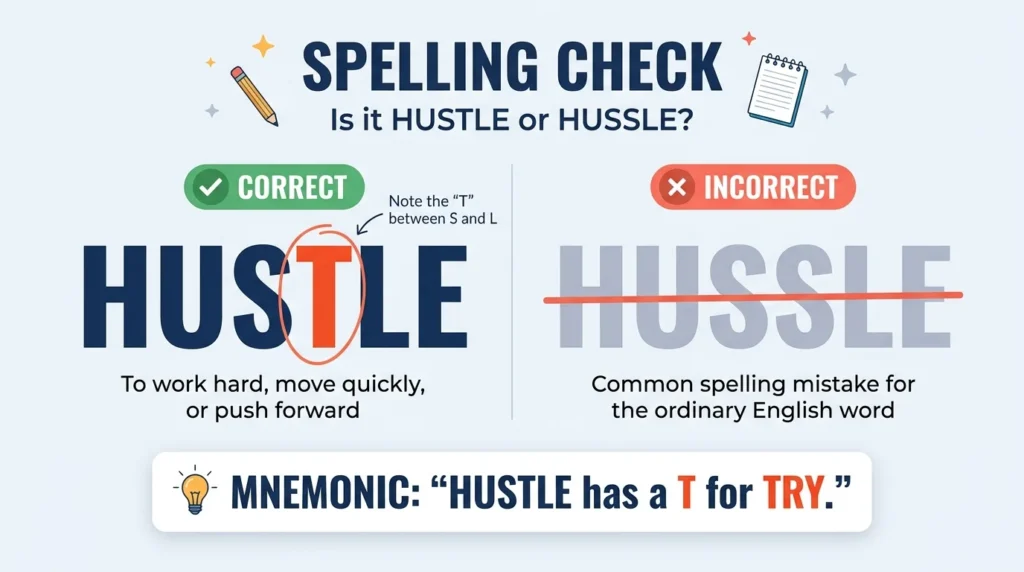
HUSTLE has a T for “Try.”
Think of the phrase:
“Try hard, hustle smart.”
The letter T in hustle reminds you that the correct spelling includes a t between the s and the l. The word is spelled:
H – U – S – T – L – E
When you write about hard work, ambition, moving quickly, or a side job, remember the t.
One extra letter can be the difference between the standard spelling and a spelling mistake.
Hustle vs Hussle in Real-Life Situations
Situation 1: A Job Interview
A candidate explains how they developed their skills outside working hours.
Incorrect: “My online hussle helped me gain experience.”
Correct: “My online hustle helped me gain experience.”
Why: The candidate is referring to an ordinary income-generating activity, so the standard spelling is hustle.
Situation 2: A Workplace Meeting
A manager needs the team to complete a presentation before a client arrives.
Incorrect: “We need to hussle to finish the presentation.”
Correct: “We need to hustle to finish the presentation.”
Why: Here, hustle is a verb expressing urgency and energetic effort.
Situation 3: A Text Message
A friend is running late for a train.
Incorrect: “Hussle! The train is almost here.”
Correct: “Hustle! The train is almost here.”
Why: The speaker is telling the friend to hurry.
Situation 4: A School Exam
A student writes about the effort required to succeed in sports.
Incorrect: “The players showed great hussle.”
Correct: “The players showed great hustle.”
Why: The noun describes energy, determination, and effort.
Situation 5: A Business Website
An entrepreneur describes a small business operated alongside a full-time job.
Incorrect: “Start your own side hussle.”
Correct: “Start your own side hustle.”
Why: Side hustle is the established expression. Correct spelling is especially important in published business content.
Situation 6: A Person’s Name
A writer discusses the late rapper Nipsey Hussle.
Correct: “Nipsey Hussle influenced many listeners through his music and entrepreneurial work.”
Why: Hussle is the established spelling of his stage name. Changing it to Hustle would incorrectly alter the name. This exception does not make hussle a standard spelling of the ordinary English word.
Read More: Sence vs Sense: Which Spelling Is Correct?
Expert Tips for Using Hustle Correctly
Learn the Word in Phrases
Remember complete expressions rather than isolated letters:
- Side hustle
- Hustle and determination
- Hustle to finish
- Respect the hustle
- The hustle of city life
Learning phrases helps reinforce the correct spelling while showing you how the word works in real sentences.
Check the Meaning Before Choosing a Synonym
Hustle can describe effort, urgency, or dishonest activity. Do not replace it automatically with hard work.
For example, “The salesman tried to hustle the customer” may imply that the salesman was trying to deceive or exploit the customer. “The salesman worked hard to help the customer” communicates a very different idea.
Choose Precision Over Motivational Language
In business writing, hustle can sound energetic, but it may not explain exactly what someone did.
Instead of writing:
“She used hustle to grow the business.”
You could write:
“She contacted prospective customers daily, improved the sales process, and followed up on every lead.”
The second sentence provides evidence of effort rather than simply praising it.
Preserve Names Exactly
Do not automatically correct Hussle when it appears in a person’s name, business name, username, or creative title. Check what the name refers to first.
Proofread Word Forms Together
If you have written hustle several times, search your document for hussle as well. This can catch repeated errors in long articles, website pages, and marketing campaigns.
Quick Summary
Hustle is the correct standard English spelling; hussle is generally a misspelling when used as the ordinary word. Hustle can function as a noun or verb and describe energetic work, quick movement, determination, a side job, or—in some contexts—deceptive activity. Its standard forms include hustles, hustled, and hustling. The spelling is the same in American and British English. Remember the T in hustle with the mnemonic “Try hard, hustle smart.” If you are writing an email, school assignment, business article, or social media caption, use hustle. Preserve Hussle when it is the intentional spelling of a person’s name, brand, or title.
Read More: Summarize vs Summarise: Which Spelling Is Correct?
Frequently Asked Questions
1. Is it hustle or hussle?
Hustle is the correct spelling of the ordinary English word. Hussle is generally a misspelling when you mean working hard, moving quickly, or making an energetic effort.
2. Is hussle ever correct?
Yes, in specific contexts. Hussle can be correct as a person’s name, business name, username, or creative title. It is not the standard spelling of the ordinary English word hustle.
3. What does hustle mean in simple English?
Hustle means to move quickly, work energetically, or make a determined effort. As a noun, it can describe effort, busy activity, or an additional income-generating activity. Its meaning depends on context.
4. What is a side hustle?
A side hustle is an activity that generates additional income alongside someone’s main job or other commitments. Examples include freelance writing, tutoring, selling handmade products, and providing services outside regular working hours.
5. Why do people spell hustle as hussle?
People may confuse the spellings because the word’s pronunciation does not clearly reveal every letter. The familiar pattern of doubled consonants in other English words and exposure to unconventional online spellings may also contribute to the error.
6. Is hustle a noun or a verb?
It can be both. In “They hustle every day,” it is a verb. In “Their hustle impressed me,” it is a noun. The sentence determines its grammatical role.
7. What is the past tense of hustle?
The past tense is hustled. For example, “We hustled to finish the project before the deadline.” The standard spelling uses one s and retains the t.
8. Is hustle formal or informal English?
Hustle is a standard English word used in both informal and professional contexts. However, it can sound conversational or motivational. In formal writing, alternatives such as work efficiently, make a determined effort, or additional income source may be more precise.
9. Is hustle spelled differently in British and American English?
No. Hustle is the standard spelling in both varieties. The difference between hustle and hussle is not an American-versus-British spelling distinction.
10. What does “respect the hustle” mean?
“Respect the hustle” is an informal expression that praises someone’s determination, effort, initiative, or resourcefulness. It is often used to show admiration for someone working toward a goal.
11. What is the difference between hustle and hard work?
Hard work directly describes effort devoted to a task. Hustle can suggest energetic effort, urgency, initiative, or resourcefulness. Depending on the context, hustle can also have a negative meaning related to deception.
12. How can I remember the correct spelling of hustle?
Remember “HUSTLE has a T for Try.” When you mean energetic work, quick movement, or a side job, use hustle. This mnemonic reinforces the letter that is often missed in the incorrect spelling hussle.
Mini Quiz: Hustle vs Hussle
Test your understanding with these 10 questions. Each answer includes an explanation so you can learn from any mistakes.
| No. | Question | Answer and explanation |
|---|---|---|
| 1 | Multiple choice: Which spelling is standard English? A) Hussle B) Hustle C) Husstle | Answer: B) Hustle. It is the standard spelling of the English word. |
| 2 | Fill in the blank: She started a side ______ to earn extra money. | Answer: hustle. Side hustle is the established expression for an additional income-generating activity. |
| 3 | Correct the sentence: We need to hussle if we want to catch the train. | Answer: We need to hustle if we want to catch the train. Why: Hustle is the correct spelling of the verb. |
| 4 | Multiple choice: What is the past tense of hustle? A) Hussled B) Hustled C) Hustleing | Answer: B) Hustled. The standard past-tense form is hustled. |
| 5 | Fill in the blank: The players showed great ______ during the final minutes. | Answer: hustle. As a noun, it can describe energy, determination, and effort. |
| 6 | Correct the sentence: She is hussling to finish her assignment. | Answer: She is hustling to finish her assignment. Why: The standard present participle is hustling. |
| 7 | Multiple choice: Which sentence uses hustle as a noun? A) They hustle every morning. B) Her hustle impressed the coach. C) He hustled home. | Answer: B. In this sentence, hustle names a quality or type of effort. |
| 8 | Fill in the blank: The correct spelling is H-U-S-__-L-E. | Answer: T. The word is spelled hustle, with a t between s and l. |
| 9 | Correct the sentence: The manager praised the team’s hussle and determination. | Answer: The manager praised the team’s hustle and determination. Why: The sentence refers to energetic effort, so the standard spelling is hustle. |
| 10 | Multiple choice: When can Hussle be correct? A) Whenever you mean hard work B) As an intentional proper name or title C) As the standard British spelling | Answer: B. A proper name can use an intentional spelling that differs from standard vocabulary. |