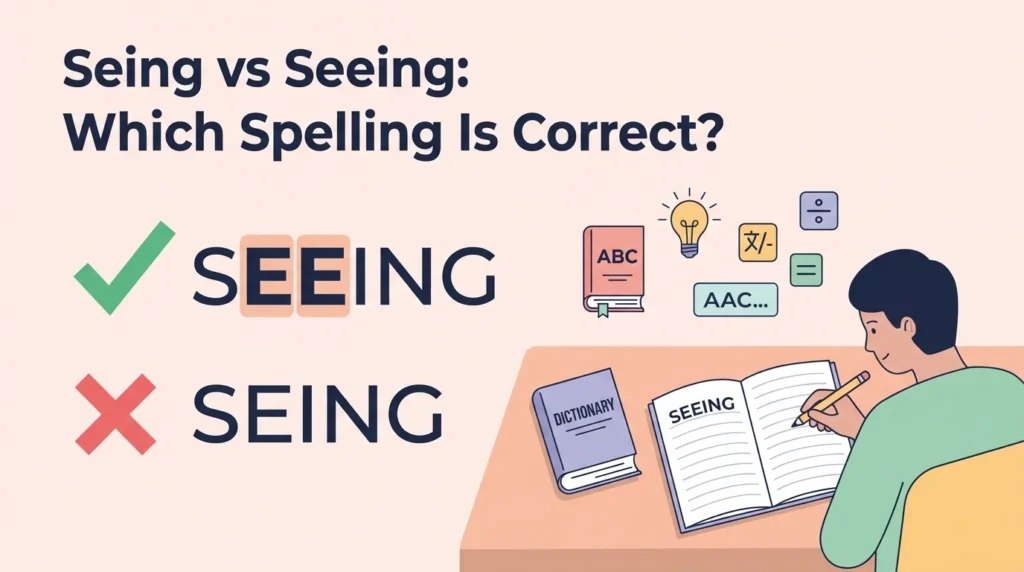

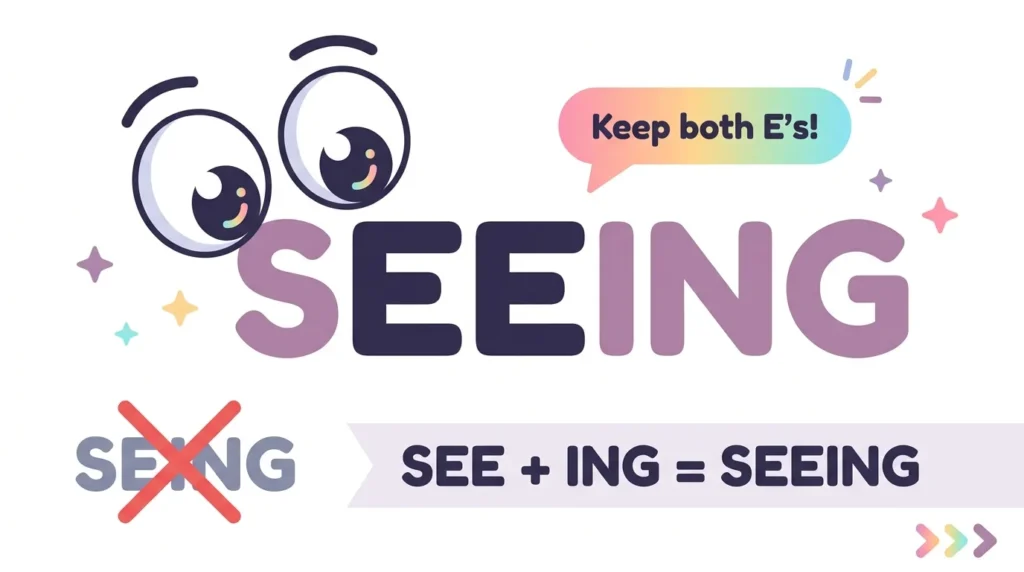
Seeing is the correct spelling in standard English. Seing is a misspelling. Seeing is the present participle and gerund form of the verb see. When you add -ing to see, you keep both e’s: see + ing = seeing. For example, “I am seeing the doctor tomorrow” and “Seeing the results made her happy” are correct.
What Is the Difference Between Seing and Seeing?
The difference is simple:
- Seeing = the correct standard-English spelling.
- Seing = an incorrect spelling of seeing.
The word seeing comes from the verb see. It can describe the act of using your eyes, noticing something, understanding something, meeting someone, or experiencing something, depending on the context. It can also function as a gerund or as a conjunction meaning roughly “considering that” or “because.” (Merriam-Webster)
For example:
I am seeing a beautiful view from my window.
Here, seeing describes visual perception.
Seeing the traffic, we decided to take another route.
Here, seeing introduces a reason.
The important point is that the spelling remains seeing in both cases.
Why It Matters
A one-letter spelling error can make otherwise strong writing look careless.
You might type seing in:
- an email to a client
- a school assignment
- a university paper
- a work report
- a social media post
- a text message
- a professional application
- an English-language exam
The mistake is especially easy to overlook because seing looks as if it could follow the usual rule for verbs ending in a silent e.
Compare:
- make → making
- take → taking
- write → writing
- hope → hoping
A learner may therefore assume:
see → seing
But see does not follow that spelling pattern.
The standard form is:
see → seeing
The Core Rule
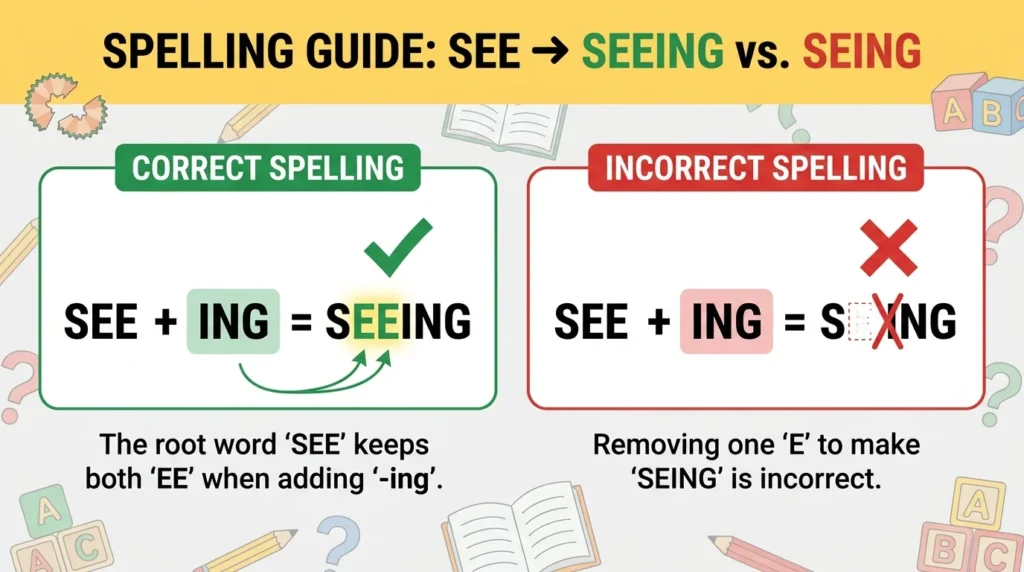
Rule: When forming the -ing form of “see,” keep both e’s and add “-ing”: see + ing = seeing.
So:
SEE + ING = SEEING
Not:
SEE + ING = SEING
The spelling seeing contains three consecutive vowels:
s + e + e + i + n + g
That may look unusual, but it is completely standard.
The same basic spelling pattern appears in other English words such as:
- agree → agreeing
- free → freeing
- flee → fleeing
- knee → kneeing
So there is no need to remove one of the e’s simply because the word is followed by -ing.
Read More: Stellar vs Steller: Which One Is Correct?
How to Use Seeing
1. Seeing as the -ing form of “see”
The most basic use of seeing is as the present participle of see.
I am seeing a movie tonight.
She is seeing the doctor tomorrow.
We were seeing the same problem again and again.
The form can occur in continuous verb structures and other constructions where the -ing form is required.
2. Seeing as a gerund
A gerund is an -ing form that functions like a noun.
Seeing is believing.
Seeing the final result was exciting.
I enjoy seeing new places.
In these sentences, seeing is not simply describing an ongoing action. It functions as a noun-like element in the sentence.
3. Seeing in “seeing that”
Seeing that can introduce a reason and means something like considering that or because.
Seeing that everyone was tired, we ended the meeting early.
This use is recognized in standard English.
4. Seeing in “seeing as”
Seeing as is also used to introduce a reason.
Seeing as it was already late, we went home.
Cambridge identifies seeing as as informal and seeing as how as nonstandard, while seeing that is also used. (Cambridge Dictionary)
For formal writing, since, because, or given that may often be a cleaner choice.
5. Seeing someone
Seeing can also mean meeting or spending time with someone.
I’m seeing my manager tomorrow.
It can also refer to a romantic relationship:
She’s seeing someone at the moment.
This continuous use is well established in English.
Read More: Less Than vs Less Then: Which Is Correct?
Correct Examples
Here are examples showing seeing in different real-life situations.
| Situation | Correct example |
|---|---|
| Conversation | “I’m seeing what you mean now.” |
| Text message | “I’m looking forward to seeing you.” |
| “Thank you for seeing this matter through.” | |
| Workplace | “We are seeing positive results from the new strategy.” |
| School | “Seeing the experiment helped me understand the theory.” |
| Academic writing | “The researchers observed changes after seeing the initial results.” |
| Social media | “Seeing this view never gets old.” |
| Travel | “We spent the afternoon seeing the historic sites.” |
| Appointment | “I’m seeing the dentist on Friday.” |
| Everyday English | “I keep seeing the same mistake in this report.” |
| Relationship | “He has been seeing someone for several months.” |
| Reason | “Seeing that the shop was closed, we returned home.” |
The spelling is seeing in every example.
Incorrect vs. Correct
| ❌ Incorrect | ✅ Correct | Why |
|---|---|---|
| I am seing a movie tonight. | I am seeing a movie tonight. | The -ing form of see is seeing. |
| She is seing her doctor tomorrow. | She is seeing her doctor tomorrow. | Both e’s in see remain before -ing. |
| I enjoy seing new places. | I enjoy seeing new places. | Seeing is the gerund form here. |
| We were seing the same problem. | We were seeing the same problem. | The present participle is seeing. |
| I look forward to seing you. | I look forward to seeing you. | Seeing follows to when to is part of the phrase “look forward to.” |
| Seing the results changed my opinion. | Seeing the results changed my opinion. | The -ing form keeps both e’s. |
| He is seing someone new. | He is seeing someone new. | Seeing can mean dating someone. |
| Are you seing what I mean? | Are you seeing what I mean? | Seeing can mean understanding or noticing. |
| We kept seing the same advertisement. | We kept seeing the same advertisement. | Seeing is the correct -ing form. |
| Seing that it was raining, we stayed inside. | Seeing that it was raining, we stayed inside. | The standard spelling is seeing. |
Why People Make This Mistake
The error is understandable because English has a strong and useful spelling pattern involving final e.
Many verbs lose a final silent e before -ing:
- write → writing
- drive → driving
- smile → smiling
- move → moving
- hope → hoping
Learners may overgeneralize that pattern and apply it to see.
But the two e’s in see are not functioning like the final silent e in write or make. The spelling of the verb is see, and its standard -ing form is seeing.
Read More: Partys vs Parties: Which Is Correct?
There is also a visual reason for the mistake. When people see:
see + ing
they may instinctively try to simplify the spelling:
se + ing → seing
But English does not simplify the spelling that way.
Phonetic similarity
Pronunciation can also contribute to the mistake.
Seeing is commonly pronounced approximately:
/ˈsiː.ɪŋ/
The word has two syllables, with the vowel sounds flowing from the long ee sound into the -ing ending.
Because the extra e is not pronounced as a separate letter sound, learners may feel that one of the e’s is unnecessary.
But spelling is not always a one-to-one representation of pronunciation.
Spelling overlap
Words such as making, taking, and writing reinforce the expectation that an e disappears before -ing.
That expectation works for many verbs.
It does not work for see.
Autocomplete and spellcheck
Spellcheck can catch seing in many contexts, but it should not be your only defense.
Automatic correction can sometimes fail to flag a mistake, especially when software does not understand the intended context.
The better solution is to remember the word formation:
see + ing = seeing
Translation interference
Learners whose first language handles verb endings differently may naturally apply a spelling pattern from their native language.
That can make seing feel more logical than seeing.
The safest approach is to learn the complete English form rather than translating the spelling rule directly from another language.
Common Mistakes Checklist
Mistake 1: Dropping one e
❌ seing
✅ seeing
Why it happens: The writer remembers that many verbs drop final e before -ing.
How to avoid it: Remember that see is spelled with two e’s, and both remain in seeing.
Mistake 2: Thinking “seing” is a pronunciation-based spelling
❌ seing
✅ seeing
Why it happens: The second e is not pronounced as an independent sound.
How to avoid it: Learn the written form rather than trying to spell the word exactly as it sounds.
Mistake 3: Confusing “seeing” with “seen”
These are different forms of see:
- see — base form
- saw — past tense
- seen — past participle
- seeing — -ing form
For example:
I see the problem.
I saw the problem yesterday.
I have seen the problem before.
I am seeing the problem differently now.
Mistake 4: Assuming every verb ending in e behaves identically
English spelling rules have patterns, but they also have exceptions and special cases.
See is not spelled like make or write when forming its -ing form.
Mistake 5: Writing “seing” because it looks shorter
Shorter does not mean correct.
The extra e in seeing is part of the established spelling of the word.
Read More: Chriss vs Chris: Which Spelling Is Correct?
Seeing in Real English
Seeing as visual perception
Seeing is completely natural when you mean using your eyes to perceive something. For example, “I was seeing the mountains from the train” can be grammatical in a suitable context, although everyday English may often prefer “I could see the mountains from the train.” Cambridge notes that speakers commonly use can see when talking about something they are visually perceiving at the moment.
Seeing as understanding
When see means “understand,” English normally uses forms such as “I see” or “I can see what you mean.” A sentence such as “I’m seeing what you mean” may be possible in a particular context, but it is not normally the most natural everyday way to express simple understanding.
Seeing someone tomorrow
Seeing is very natural when see means meeting or visiting someone as part of a planned arrangement. “I’m seeing my doctor tomorrow” and “I’m seeing Sarah at three” are ordinary English constructions. This is different from the simple act of perceiving something with your eyes.
Seeing someone romantically
Seeing is also natural when talking about dating or having a romantic relationship. For example, “She’s seeing someone” can mean that she is romantically involved with someone. This meaning is established in standard English, not merely informal slang.
Seeing that
Seeing that is a natural construction meaning roughly “considering that” or “because.” For example, “Seeing that the weather was getting worse, we left early.” It is especially useful when the first part of the sentence explains the reason for the action that follows.
American vs. British English
There is no spelling difference between American and British English for this word.
Both varieties use:
seeing
not:
seing
The meanings and major grammatical uses of seeing are also broadly shared across the two varieties.
There can be differences in how particular expressions are preferred in different contexts, but there is no AmE/BrE spelling variant in which seing becomes correct.
Formal vs. Informal Usage
Seeing itself is appropriate in formal and informal English.
For example:
The researchers are seeing significant changes in the data.
is suitable for formal writing.
Likewise:
I’m seeing my friend tonight.
is perfectly natural in everyday conversation.
The register issue is more relevant to certain expressions containing seeing.
For example:
Seeing that the evidence was incomplete, the committee postponed the decision.
This can work in formal prose.
By contrast:
Seeing as we’re already here, let’s stay.
is more conversational. Cambridge specifically labels seeing as as informal. (Cambridge Dictionary)
For highly formal writing, because, since, or given that may be preferable depending on the sentence.
Comparison Table
| Feature | Seing | Seeing |
|---|---|---|
| Standard English spelling | ❌ No | ✅ Yes |
| Correct -ing form of see | ❌ No | ✅ Yes |
| Contains both e’s from see | ❌ No | ✅ Yes |
| Used as present participle | ❌ No | ✅ Yes |
| Used as a gerund | ❌ No | ✅ Yes |
| Can mean visual perception | ❌ No | ✅ Yes |
| Can mean meeting someone | ❌ No | ✅ Yes |
| Can refer to dating | ❌ No | ✅ Yes |
| Can occur in “seeing that” | ❌ No | ✅ Yes |
| Appropriate in standard writing | ❌ No | ✅ Yes |
Memory Trick
Use this simple formula:
SEE + ING = SEEING
Think:
“I see two E’s, and I keep two E’s.”
So when you are unsure, mentally write:
SEE → SEEING
not:
SEE → SEING
Another useful memory phrase is:
Seeing is believing.
The familiar expression itself contains the correct spelling: seeing.
Real-Life Situations
In a meeting
Your manager asks whether you understand the new plan.
“Yes, I’m seeing how the changes will improve the workflow.”
A more natural alternative for simple understanding would often be:
“Yes, I see how the changes will improve the workflow.”
The spelling issue remains the same: if you use the -ing form, it is seeing.
In an email
You want to tell a colleague that you are looking forward to meeting them.
“I look forward to seeing you at the conference.”
Not:
“I look forward to seing you.”
In a text message
“It was great seeing you yesterday!”
At work
“We’re seeing stronger engagement since the campaign began.”
At an appointment
“I’m seeing my dentist on Thursday.”
In an exam
If the question asks for the correct -ing form of see, the answer is:
seeing
On social media
“Seeing this place at sunset never gets old.”
Mini Quiz
| # | Question | Answer | Explanation |
|---|---|---|---|
| 1 | Choose the correct spelling: seing / seeing | seeing | Seeing is the standard -ing form of see. |
| 2 | Complete: “I am ___ my doctor tomorrow.” | seeing | Seeing is used for a planned meeting or appointment. |
| 3 | Correct the sentence: “I enjoy seing new places.” | “I enjoy seeing new places.” | The correct spelling contains both e’s. |
| 4 | True or false: “Seing” is the standard -ing form of “see.” | False | The correct form is seeing. |
| 5 | Complete: “___ is believing.” | Seeing | Seeing functions as a gerund in this expression. |
| 6 | Which is correct? A) seing the results B) seeing the results | B) seeing the results | See retains both e’s before -ing. |
| 7 | Correct the sentence: “She is seing someone new.” | “She is seeing someone new.” | Seeing can mean dating someone. |
| 8 | Complete: “___ that it was late, we went home.” | Seeing | Seeing that can introduce a reason. |
| 9 | Which is correct? A) I look forward to seing you. B) I look forward to seeing you. | B | The correct spelling is seeing. |
| 10 | Fill in the rule: see + ___ = seeing | -ing | Add -ing to see without removing either e. |
Expert Tips
Learn the whole word, not just the rule
If spelling rules are confusing, memorize seeing as a complete word.
This is especially useful because the common “drop the final e” pattern can lead you in the wrong direction.
Read More: Chriss vs Chris: Which Spelling Is Correct?
Separate spelling from pronunciation
Do not remove letters simply because you cannot hear them as separate sounds.
English spelling often preserves letter patterns that pronunciation does not make obvious.
Remember the word family
Think of the main forms together:
see → saw → seen → seeing
This makes it easier to recognize seeing as a legitimate form of the verb rather than trying to construct its spelling from scratch.
Watch for “look forward to seeing”
This is a particularly common phrase:
I look forward to seeing you.
Here, to is a preposition, so it is followed by the -ing form rather than the base verb.
Don’t let spellcheck teach you the rule
Spellcheck is useful for catching errors, but understanding why seeing is correct will help you spell it correctly even when no software is available.
FAQ
Is “seing” ever correct in English?
No. Seing is not the standard English spelling of the -ing form of see. The correct form is seeing.
Why does “seeing” have two e’s?
Because the base verb is spelled see, and its standard -ing form is seeing. The two e’s are retained rather than reducing the spelling to seing.
Is “seeing” a verb?
Yes. Seeing is the present participle of the verb see. It can also function as a gerund or occur in other grammatical constructions.
Is “seeing” a gerund?
It can be. In “Seeing is believing,” for example, seeing functions as a noun-like gerund.
Is “seeing” an adjective?
It can function adjectivally in certain contexts, such as seeing eye dog, although the word has several grammatical roles depending on the sentence.
Can “seeing” mean “understanding”?
Yes, depending on the construction. See can mean understand or recognize, as in “I see what you mean.” However, the continuous form is not normally used simply to mean “understand” in ordinary conversation.
Is “seeing that” grammatically correct?
Yes. Seeing that can mean “considering that” or “because.”
Seeing that it was raining, we stayed inside.
This use is recognized in standard dictionaries.
Is “seeing as” correct?
Yes, seeing as is used in English, particularly in informal contexts. Cambridge labels it informal. (Cambridge Dictionary)
Is “seeing as how” correct?
It occurs in real English, but Cambridge labels seeing as how as nonstandard. For formal writing, alternatives such as because, since, or given that are safer choices.
Is “I am seeing” grammatically correct?
Yes, but its naturalness depends on the meaning. It is very natural for planned meetings or relationships, as in “I am seeing my doctor tomorrow” or “She is seeing someone.” For simple visual perception, English often prefers “I can see” instead.
What is the easiest way to remember “seeing”?
Remember:
SEE + ING = SEEING
The two e’s stay.
Quick Summary
Seeing is the correct spelling, while seing is a misspelling. Seeing is the present participle and gerund form of see, and the two e’s in the base word remain when -ing is added. You can use seeing to describe visual perception, meeting someone, dating someone, or functioning as a gerund. It also appears in expressions such as seeing that and seeing as. Do not apply the usual “drop the final e” pattern from words such as make → making to see. The easiest memory trick is simple: see + ing = seeing. If you remember the phrase “Seeing is believing,” you will also remember the correct spelling