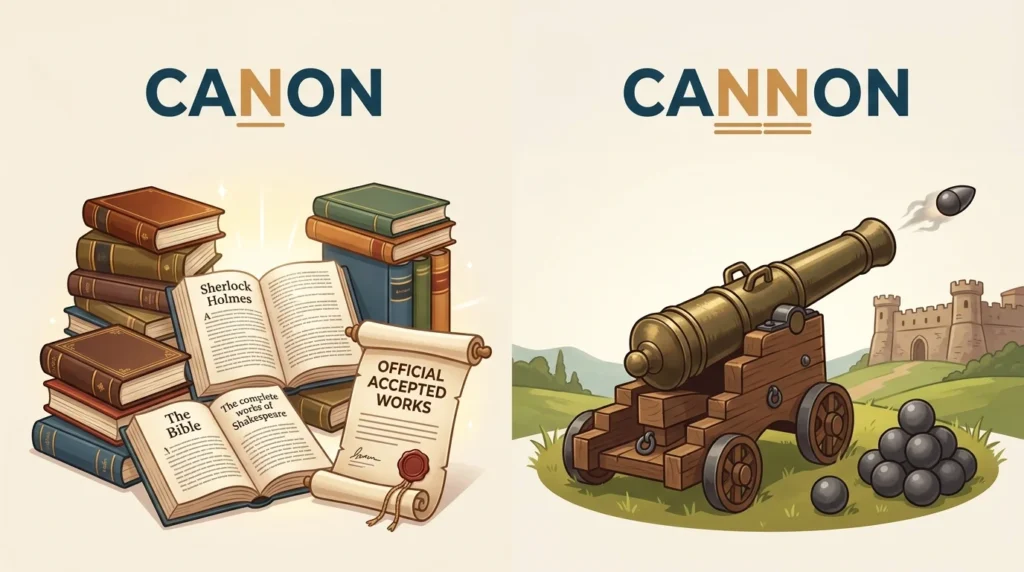

Canon and cannon are different words with different meanings, although they are normally pronounced the same. Canon refers to an accepted rule, standard, or recognized collection of works, texts, or official events in a fictional story. Cannon usually means a large gun or artillery weapon. Use canon for accepted ideas, works, or story facts; use cannon when you mean a weapon or something related to one.
What Is the Difference Between Canon and Cannon?
The main difference is meaning and spelling.
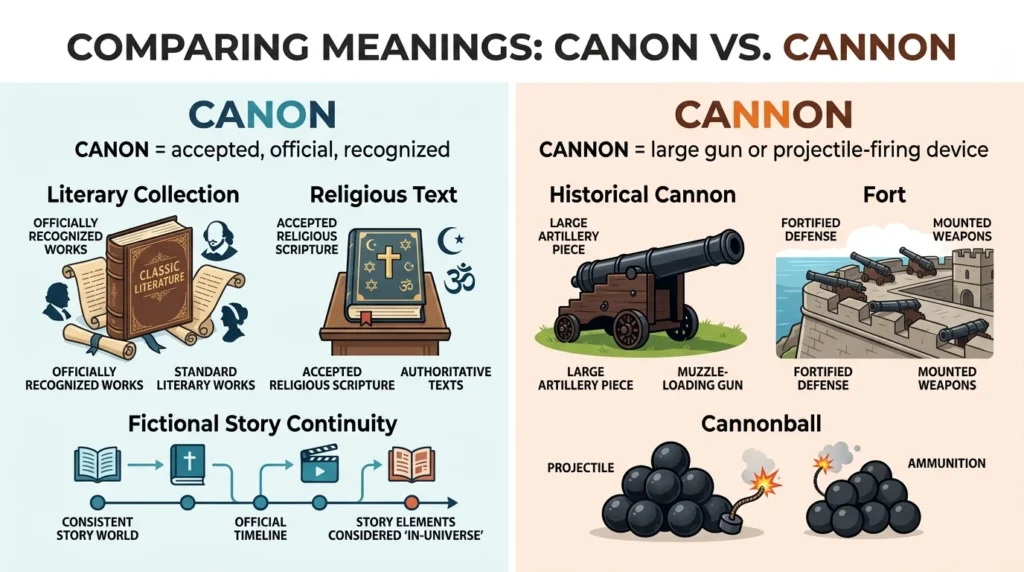
Canon has one n in the middle. It is used for ideas such as accepted rules, authoritative texts, important works of literature, and events officially recognized as part of a fictional story.
Cannon has two n’s in the middle. It usually refers to a large gun designed to fire a projectile.
The two words are commonly pronounced alike, so hearing them does not tell you which spelling to use. You have to use the meaning and context to choose the correct word.
A simple way to separate them is:
- Canon = an accepted rule, collection, or official story element
- Cannon = a large gun or something that forcefully projects something
For example:
The deleted scene is not part of the canon.
But:
The museum has a restored cannon from the eighteenth century.
Changing one letter changes the meaning completely.
Why It Matters
This spelling difference matters because canon and cannon are not interchangeable.
A spelling mistake can change the meaning of an otherwise correct sentence. This is especially noticeable in academic writing, literary criticism, religious studies, film discussions, history, and online fandoms.
Compare:
The character is not part of the cannon.
The reader may understand what you mean from context, but the correct word is:
The character is not part of the canon.
Now compare:
The fort displayed an old canon.
If you mean a historical weapon, this should be:
The fort displayed an old cannon.
The error is easy to make because the words sound alike. But precise spelling is important when the two words belong to completely different areas of meaning.
Read More: Abley vs Ably: Which Spelling Is Correct?
The Core Rule
Use canon for accepted rules, standards, recognized collections, authoritative texts, and officially established events in a fictional universe. Use cannon for a large gun or related projectile-firing device.
When you are unsure, look at the meaning rather than the pronunciation.
If you could replace the word with “official,” “accepted,” “recognized,” or “established,” you probably need canon.
If you mean “a large gun” or something that launches a projectile with force, you probably need cannon.
What Does Canon Mean?
Canon is a noun with several related meanings. At its broadest, it refers to something that has been accepted, recognized, established, or treated as authoritative.
The word appears in several fields.
Canon in Literature
In literature, a canon is a body of works regarded as important, influential, or representative of a particular literary tradition.
For example:
Many universities still teach works from the English literary canon.
Here, canon does not mean a rule in the narrow sense. It refers to a recognized collection or body of literature.
A writer can also have a personal or professional canon:
Her later novels became an important part of her literary canon.
Canon in Religion
In religious contexts, canon can refer to the collection of texts accepted as authoritative within a religious tradition.
For example:
Scholars continue to study the development of the biblical canon.
The expression canon law has a related but more specific meaning. It refers to the body of laws and regulations governing a Christian church or religious institution.
So:
The church follows its canon law.
Here, canon has nothing to do with a weapon.
Canon in Movies, Television, Books, and Games
Modern popular culture frequently uses canon to describe what is officially established as true within a fictional universe.
For example:
The director confirmed that the character’s childhood is canon.
This means the character’s childhood is officially part of the story’s established continuity.
You might also see:
That episode is not canon.
This means the episode or its events are not considered part of the official fictional continuity.
This use is especially common when fans discuss movies, television series, novels, comics, and video games.
Canon in Music
In music, a canon can also refer to a composition in which one musical part imitates another, as in the well-known musical form associated with a round.
This is a specialized meaning, but it is another reason why canon cannot simply be defined as “a collection of books.”
Canon as an Accepted Standard or Principle
Canon can also refer to a recognized rule, principle, or standard.
For example:
The principles became an important canon of artistic practice.
In this use, the word is closer to rule, principle, or standard than to “collection of books.”
What Does Cannon Mean?
Cannon normally refers to a large gun or artillery weapon designed to fire a projectile.
For example:
The soldiers moved the cannon into position.
The word is strongly associated with military history, artillery, ships, forts, and historical warfare.
You might also see:
The museum displays a nineteenth-century cannon.
Or:
The ship carried several cannons.
The word has also developed some extended uses.
For example:
The stadium uses a T-shirt cannon.
Here, cannon describes a device that launches T-shirts rather than a traditional military weapon.
There are also figurative uses:
The goalkeeper has a cannon for a left foot.
In this kind of expression, cannon suggests exceptional power, especially when describing someone’s throwing or kicking ability.
English also uses cannon in certain specialized contexts, including billiards and snooker. In British usage, a cannon can refer to a shot in which the cue ball strikes another ball or balls.
How to Use Canon and Cannon
The easiest approach is to identify the subject of the sentence.
Use Canon When You Mean:
- An accepted body of literary works
- An authoritative collection of religious texts
- A recognized rule or principle
- Canon law
- An author’s recognized body of work
- Official events in a fictional universe
- A story element accepted as part of official continuity
- A recognized musical form or composition
Use Cannon When You Mean:
- A large gun
- An artillery weapon
- A historical gun mounted on a ship or fort
- A device that launches objects forcefully
- A cannon in certain sports-related expressions
- A figurative description of something extremely powerful
The surrounding words often make the correct spelling obvious.
Correct Examples
Here are examples covering different types of everyday and professional writing.
Conversation
“Is that character actually part of the canon?”
Here, canon means officially established story material.
The editor asked whether the scene was considered canon before approving the article.
The sentence concerns fictional continuity, so canon is correct.
School Writing
The course examines several works from the classical literary canon.
The word refers to a recognized body of literature.
Academic Writing
The study questions whether the text should remain within the established canon.
Again, canon means an accepted body of works.
Workplace Writing
The company has developed a canon of principles that guides its creative work.
Here, canon refers to an established set of principles.
Social Media
That scene is officially canon now.
This is a natural use of canon in online discussions about fictional stories.
History
The museum preserves an iron cannon from the colonial period.
This refers to a historical weapon.
Military History
The crew prepared the cannon before the battle began.
The weapon meaning makes cannon correct.
Museum Description
Visitors can see a restored naval cannon near the entrance.
The word describes artillery.
Sports Commentary
The striker has a cannon of a left foot.
This is a figurative use describing great power.
Incorrect vs. Correct
| ❌ Incorrect | ✅ Correct | Why |
|---|---|---|
| The movie is part of the cannon. | The movie is part of the canon. | Canon means the officially accepted story material. |
| The soldiers loaded the canon. | The soldiers loaded the cannon. | A large gun is a cannon. |
| The author is part of the literary cannon. | The author is part of the literary canon. | A literary canon is a recognized body of works. |
| The fort displayed an old canon. | The fort displayed an old cannon. | The sentence refers to a weapon. |
| That episode isn’t cannon. | That episode isn’t canon. | The meaning is fictional continuity. |
| The ship fired its canon. | The ship fired its cannon. | A ship can fire a cannon. |
| The novel became part of the national cannon. | The novel became part of the national canon. | The sentence refers to an accepted body of literature. |
| The character’s backstory is cannon. | The character’s backstory is canon. | The backstory is officially established in the fictional world. |
| The museum restored the ancient canon. | The museum restored the ancient cannon. | The object is a historical weapon. |
| The critic discussed the modern literary cannon. | The critic discussed the modern literary canon. | The sentence concerns literature, not artillery. |
The important point is that these are not two spellings of the same word. They are different words with different meanings.
Why People Make This Mistake
They Sound the Same
The biggest reason is pronunciation.
In ordinary English, canon and cannon are homophones: words that sound the same but have different meanings and spellings.
If you hear:
“That isn’t canon.”
you cannot determine the spelling from sound alone.
You have to understand what the speaker means.
The Spellings Are Almost Identical
The visual difference is only one letter:
canon
cannon
That makes the pair particularly easy to confuse while typing.
People Overgeneralize the Word “Cannon”
Because cannon is strongly associated with weapons, writers sometimes incorrectly add the extra n to canon whenever they are unsure about the spelling.
This is especially common in online discussions about fictional stories, where canon is now a common technical term.
Autocomplete and Spellcheck Are Not Enough
Spellcheck can identify many obvious spelling errors, but it cannot always determine which correctly spelled word you intended.
Both canon and cannon are legitimate English words.
So a sentence such as:
The episode is cannon.
may not trigger the correction you expect, even though the intended word is probably canon.
The problem is semantic: the wrong word is correctly spelled but incorrectly chosen.
Translation Interference
Learners who speak another language may encounter additional confusion if their first language does not distinguish these concepts or represents them with similar-sounding words.
The safest solution is not to memorize pronunciation. Memorize the meaning-to-spelling connection.
Common Mistakes Checklist
Mistake 1: Using Cannon for Fictional Continuity
Wrong:
Is this character cannon?
Correct:
Is this character canon?
Why: The sentence asks whether the character officially belongs to the story.
How to avoid it: Think official story = canon.
Mistake 2: Using Canon for a Weapon
Wrong:
The castle had a large canon.
Correct:
The castle had a large cannon.
Why: The sentence describes artillery.
How to avoid it: Think large gun = cannon.
Mistake 3: Writing “Literary Cannon”
Wrong:
She studies the literary cannon.
Correct:
She studies the literary canon.
Why: A literary canon is a recognized body of literature.
Mistake 4: Assuming Canon Always Means Religion
Canon has religious uses, but its meaning is much broader.
It can refer to literature, fictional continuity, rules, principles, music, and other established collections or standards.
Mistake 5: Choosing by Sound
Because both words sound alike, pronunciation cannot tell you which spelling to use.
Instead, ask:
Am I talking about an accepted body of works or an official story?
If yes, choose canon.
Ask:
Am I talking about a large gun or projectile-firing device?
If yes, choose cannon.
Canon vs Cannon in Real English
Canon: Grammatically Correct and Natural
The following uses are normal and natural when the context is literature, religion, art, or fictional continuity:
The novel is part of the literary canon.
The director confirmed that the scene is canon.
Scholars debated which texts belong to the canon.
These sentences use canon in established senses of the word.
Canon: Correct but More Specialized
Some uses of canon are perfectly correct but depend on a particular field.
For example:
The composer wrote a canon.
This is natural in a discussion of music but may sound unfamiliar to someone who does not know the musical term.
Likewise:
The church’s canon law was discussed in the seminar.
This is correct, but it belongs to a specialized religious or legal context.
Read More: Skillset vs Skill Set: Which One Is Correct?
Cannon: Grammatically Correct and Natural
These are ordinary uses:
The museum has a restored cannon.
The soldiers moved the cannon.
The ship fired its cannon.
The meaning is straightforward: the word refers to a weapon or, in some contexts, an object or device associated with forceful projection.
Cannon: Correct but Figurative
Some modern expressions use cannon metaphorically:
She has a cannon of an arm.
The speaker is not saying that the person’s arm is literally a weapon. The comparison emphasizes exceptional power.
This is natural in informal sports-related English, but it is less appropriate in formal academic writing.
American vs. British English
There is no major American-versus-British spelling distinction between canon and cannon for their ordinary meanings.
Both varieties use:
- canon for an accepted rule, collection, or official fictional continuity
- cannon for a large gun or related meanings
Some specialized meanings of cannon differ by regional usage. For example, British English has a sports meaning connected with billiards or snooker that may be unfamiliar to many American English speakers.
For ordinary writing, however, the key distinction remains the same: one n for canon, two n’s for cannon.
Formal vs. Informal Usage
Both words are standard English and can appear in formal writing.
Canon is common in formal contexts such as:
- academic writing
- literary criticism
- religious studies
- art history
- cultural studies
It is also common in informal online discussions, especially when people discuss fictional universes.
Cannon is appropriate in formal historical or military writing:
The fort contained several nineteenth-century cannons.
It can also appear informally in figurative expressions:
He has a cannon of an arm.
The word itself is not informal; particular figurative uses may be.
Canon vs Cannon Comparison Table
| Feature | Canon | Cannon |
|---|---|---|
| Spelling | One n in the middle | Two n’s in the middle |
| Pronunciation | Usually /ˈkænən/ | Usually /ˈkænən/ |
| Main meaning | Accepted rule, standard, collection, or official story material | Large gun or artillery weapon |
| Literature | Literary canon | Not normally used |
| Religion | Religious canon, canon law | Not normally used |
| Fiction | Official story continuity | Usually incorrect for this meaning |
| Military history | Usually not the intended word | Historical or modern weapon |
| Music | A musical form/composition | Not the same meaning |
| Figurative use | Accepted/established material | Powerful person or object |
| Common mistake | Writing cannon when canon is intended | Writing canon when cannon is intended |
Memory Trick
Remember:
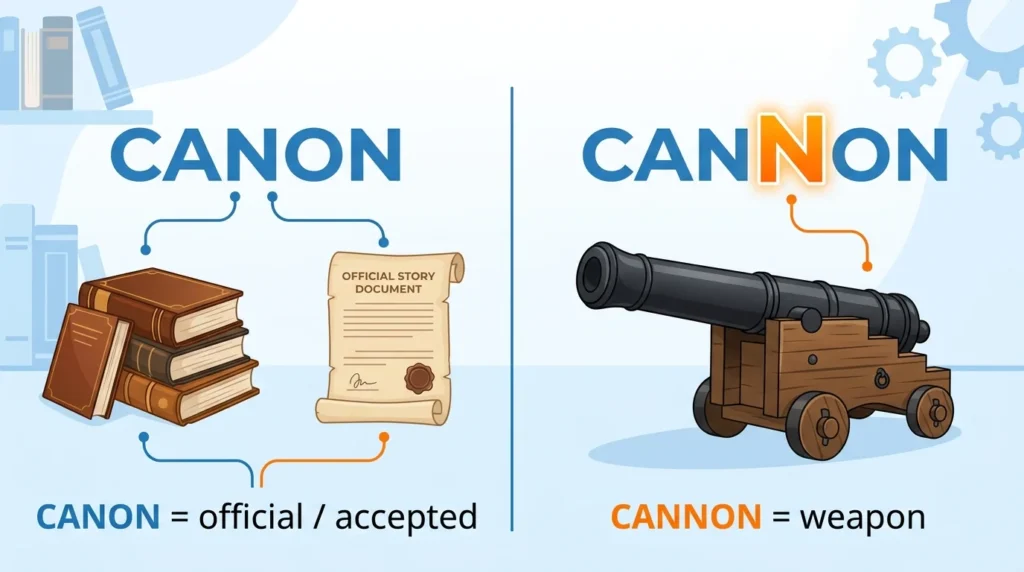
Canon = official. Cannon = fires.
There is also a spelling clue:
Cannon has an extra N because it is the heavier word.
Do not rely on the mnemonic alone, though. The strongest memory method is to connect each spelling with its meaning:
canon → accepted or official
cannon → weapon
If you remember that pair, the spelling becomes much easier.
Real-Life Situations
Interview
Imagine you are interviewing a filmmaker about a popular series.
You ask:
“Is the character’s childhood part of the official canon?”
Canon is correct because you are asking about established story continuity.
Meeting
A publishing team is discussing classic literature.
Someone says:
“We should include more works from the literary canon.”
Again, canon is correct because the discussion concerns recognized literature.
A museum curator writes:
“The cannon has been moved to the east gallery.”
Here, cannon is correct because the museum is discussing a historical weapon.
Text Message
A friend asks:
“Wait, is that scene canon?”
The spelling canon is correct even though the conversation is informal.
Exam
A history student writes:
“The fort was defended by several cannons.”
The correct spelling is cannons because the student is referring to artillery weapons.
Online Discussion
A fan writes:
“That theory isn’t canon because the creator rejected it.”
The word canon is correct because the discussion concerns what is officially established in the fictional universe.
Mini Quiz
| # | Question | Answer | Explanation |
|---|---|---|---|
| 1 | The novel became part of the literary ___ . | canon | A literary canon is a recognized body of literature. |
| 2 | The soldiers loaded the ___ before sunrise. | cannon | A cannon is a large gun or artillery weapon. |
| 3 | Is this episode ___? | canon | The question concerns official fictional continuity. |
| 4 | The museum displays an eighteenth-century ___ . | cannon | The object is a historical weapon. |
| 5 | Correct the sentence: “The character is not part of the cannon.” | The character is not part of the canon. | The sentence concerns story continuity. |
| 6 | Which word belongs in this sentence? “The course studies the literary ___.” | canon | The sentence refers to recognized literature. |
| 7 | Which is correct: “The ship fired its canon” or “The ship fired its cannon”? | The ship fired its cannon. | A ship can fire a cannon. |
| 8 | Complete the sentence: “The director confirmed that the scene is ___.” | canon | The scene is officially part of the story. |
| 9 | Correct the sentence: “The fort contained three canons.” | The fort contained three cannons. | The sentence refers to three artillery weapons. |
| 10 | Choose the correct word: “Scholars debated which texts belong to the religious ___.” | canon | A religious canon is an accepted collection of authoritative texts. |
Expert Tips
1. Do Not Learn These Words by Pronunciation
Pronunciation will not help much because canon and cannon are normally pronounced the same.
Learn the meaning instead.
2. Look at the Noun Around It
Certain combinations make the choice almost automatic:
- literary canon
- biblical canon
- official canon
- canon law
- story canon
- naval cannon
- cannon fire
- cannonball
- water cannon
Recognizing common word combinations is often faster than thinking through a dictionary definition.
3. Remember That Both Words Are Correct
The question is not:
Which spelling is correct?
Both are correct words.
The real question is:
Which word expresses the meaning I need?
That is a much more useful way to approach confusing-word pairs.
4. Context Beats Spellcheck
Spellcheck may accept both words because both are legitimate English words.
If you write:
The episode is cannon.
the software may not know that you intended canon.
Human meaning and context still matter.
5. Be Especially Careful in Fandom Writing
The word canon is now common in discussions of fictional universes.
If you write about books, films, comics, games, or television series, remember:
Official story information = canon
Not:
cannon
6. Remember the Difference in One Second
If you mean a rule, collection, or official story element, write:
canon
If you mean a large gun, write:
cannon
FAQ
Are canon and cannon pronounced the same?
Usually, yes. In standard English, they are commonly pronounced alike, which makes them homophones. Their meanings and spellings are different.
Is “cannon” ever correct when talking about a movie?
Usually not if you mean the official story or continuity. In that context, the correct word is canon.
For example:
The scene is part of the canon.
Is “canon” a weapon?
No, not in its ordinary modern meaning. Cannon is the word normally used for the large gun or artillery weapon.
What does “not canon” mean?
In a fictional universe, not canon generally means that something is not officially accepted as part of the established story or continuity.
What is a literary canon?
A literary canon is a body of works that are regarded as important, influential, representative, or established within a particular literary tradition.
What is canon law?
Canon law is a body of laws and regulations governing a Christian church or religious institution.
What is the plural of canon?
The plural of canon is canons.
For example:
The scholars discussed several literary canons.
What is the plural of cannon?
The usual plural is cannons.
For example:
The museum displays several historic cannons.
Some dictionaries also record cannon as a plural form, especially in certain traditional or technical uses, but cannons is the straightforward plural in ordinary modern English.
Can cannon be used as a verb?
Yes. Cannon can function as a verb in specialized or figurative contexts. For example, in British billiards and snooker, cannon can describe a shot in which the cue ball strikes another ball.
Is “canon” only used for religion?
No. Religion is only one area in which canon is used. It is also common in literature, art, music, law, and discussions of fictional continuity.
How do I remember canon vs cannon?
Use this simple distinction:
Canon = accepted or official.
Cannon = a weapon.
The extra n in cannon can remind you of its heavier, weapon-related meaning.
Which is correct: “movie canon” or “movie cannon”?
Movie canon is correct when you mean the official or established story material of a movie or fictional universe.
Quick Summary
Canon and cannon sound alike but have different meanings. Canon, with one n in the middle, refers to an accepted rule, standard, recognized collection of works, authoritative texts, or officially established material in a fictional universe. Cannon, with two n’s, usually refers to a large gun or artillery weapon and can also appear in related or figurative expressions. The best way to remember the difference is simple: canon = accepted or official; cannon = weapon. Context is more reliable than pronunciation because both words are legitimate English words. When discussing literature, religion, fictional continuity, or established principles, choose canon. When discussing artillery or a powerful projectile-firing device, choose cannon.