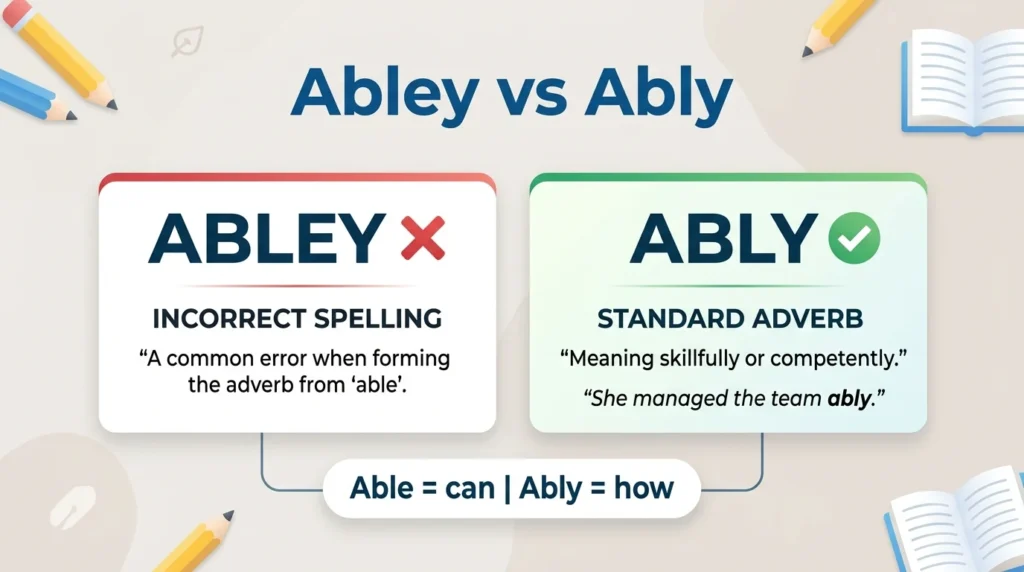

Use ably when you mean “skillfully,” “competently,” or “in an able manner.”
- Correct: She ably managed the project.
- Incorrect: She abley managed the project.
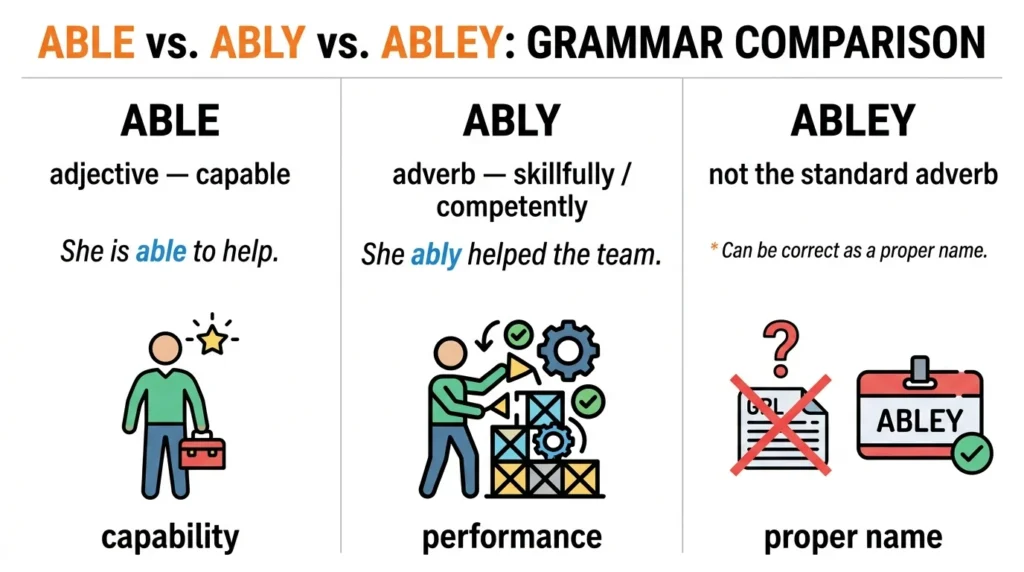
Abley is not the standard spelling of the adverb. However, Abley may correctly appear as a surname or another proper name. So, if you are describing how someone performed an action, choose ably.
What Is Ably?
Ably is an adverb. It describes the way someone performs an action and means with skill, competence, or ability.
For example:
The manager ably handled the difficult situation.
Here, ably tells us how the manager handled the situation. The manager did it competently and skillfully.
The word belongs to the same word family as able:
- able — adjective
- ably — adverb
- ability — noun
Dictionaries define ably in terms such as “skillfully,” “competently,” and “in an able manner.” It has been part of English for centuries and is a standard word in both American and British English.
The important point is simple:
Able describes capability. Ably describes how an action is performed.
Compare:
- She is able to solve the problem.
- She solved the problem ably.
The first sentence says she has the ability to solve it. The second says she performed the action skillfully.
Why It Matters
A one-letter spelling mistake can change how polished your writing appears.
You may encounter this issue in:
- School assignments
- University essays
- Business emails
- Reports
- Job applications
- Performance reviews
- Articles and blog posts
- Professional recommendations
- Social media posts
- Formal correspondence
Writing abley when you mean ably can make a sentence look like it contains a spelling error.
For example:
The new director abley managed the transition.
The reader can probably understand what you mean, but abley is not the standard spelling for this meaning.
The corrected version is:
The new director ably managed the transition.
This is especially useful to remember because ably often appears in writing that describes performance, leadership, assistance, explanation, representation, or management.
The Core Rule
When you need the adverb meaning “skillfully” or “competently,” use ably, not abley.
The simplest word formation is:
able → ably
Not:
able → abley ❌
The final e does not remain in ably.
This is one of those English spelling patterns that can feel less obvious than it looks. English does not always form an adverb by simply attaching letters to the complete adjective.
Other familiar examples show similar spelling changes:
- able → ably
- simple → simply
- gentle → gently
- true → truly
- due → duly
These words should not all be treated as one perfectly uniform spelling rule, but they demonstrate an important point: adding an adverb ending can change the spelling of the base word.
How to Use It
Use ably when you want to describe the quality or competence with which someone performs an action.
Common patterns include:
Ably + verb
She ably led the discussion.
He ably defended his position.
The teacher ably explained the difficult concept.
Was/were + ably + past participle
This pattern is particularly common in formal and professional writing.
The team was ably supported by experienced staff.
The project was ably managed from start to finish.
The organization was ably represented at the conference.
Ably + describing a professional performance
The editor ably handled the complex revisions.
The lawyer ably presented the evidence.
The researcher ably summarized the findings.
In all of these sentences, ably answers a question such as:
How did the person perform the action?
The answer is:
Skillfully. Competently. Capably.
Correct Examples
Here are examples across different types of real-world writing.
- Conversation:
She ably handled the difficult questions. - Business email:
Daniel ably coordinated the meeting with our international clients. - Workplace:
The new supervisor ably managed the team during the transition. - School:
Maria ably explained her argument during the class presentation. - Academic writing:
The author ably examines the relationship between language and culture. - Professional recommendation:
She ably performed her responsibilities throughout the project. - Report:
The committee was ably supported by several technical advisers. - Social media:
Our event team ably handled every last-minute change. - Journalistic writing:
The presenter ably guided the audience through a complicated subject. - Formal letter:
He ably represented the organization at the regional conference.
Notice that ably is particularly useful when the action requires competence, judgment, organization, leadership, or skill.
Read More: Skillset vs Skill Set: Which One Is Correct?
Incorrect vs. Correct
| ❌ Incorrect | ✅ Correct | Why |
|---|---|---|
| She abley managed the project. | She ably managed the project. | Ably is the standard adverb meaning competently. |
| He abley answered the question. | He ably answered the question. | The word describing how he answered is ably. |
| The lawyer abley defended her client. | The lawyer ably defended her client. | Ably describes the manner of the lawyer’s defense. |
| The manager abley handled the crisis. | The manager ably handled the crisis. | The correct adverb is ably. |
| They abley organized the event. | They ably organized the event. | Abley is not the standard adverb. |
| She abley represented the company. | She ably represented the company. | Use ably for competent performance. |
| The teacher abley explained the lesson. | The teacher ably explained the lesson. | Ably modifies explained. |
| He is abley to finish it. | He is able to finish it. | Here you need the adjective able, not the adverb ably. |
| She performed abley under pressure. | She performed ably under pressure. | Ably describes how she performed. |
| The team abley completed the task. | The team ably completed the task. | The standard spelling is ably. |
The eighth example is especially important. Not every sentence containing able should become ably. The two words have different grammatical jobs.
Why People Make This Mistake
The spelling of “able” looks complete
The word able is extremely familiar. When writers need an adverb, they may naturally think:
able + y = abley
That looks reasonable at first glance.
But the standard form is:
able → ably
The spelling therefore needs to be learned as a word-form change rather than guessed from the appearance of able.
The sound does not help much
Ably is pronounced approximately like “AY-blee.”
When spoken aloud, the difference between ably and the imagined spelling abley is not obvious to someone who is thinking about spelling rather than pronunciation.
This is why the error can survive in someone’s writing even when the writer knows exactly what the word means.
Spelling patterns can be misleading
English contains many adverbs ending in -ly:
- quickly
- slowly
- carefully
- clearly
- wisely
- safely
A writer may therefore assume that the complete adjective should simply receive an extra ending.
But spelling changes occur in many English word families. Ably is the established form.
Autocomplete and spellcheck are not enough
Modern writing tools can catch many spelling mistakes, but they should not replace knowledge of the word.
A tool may also behave differently depending on context, dictionary settings, or whether a word is recognized as a name.
Knowing the distinction yourself is more reliable:
Able = capable.
Ably = skillfully or competently.
Translation interference can contribute
Learners who think in another language may expect a direct equivalent of “able + adverb ending.” English does not always build words in a way that maps neatly onto another language.
The safest approach is to learn ably as the established English form rather than trying to construct it from a general spelling formula.
Common Mistakes Checklist
Mistake 1: Writing “abley”
Problem: You are using abley as the adverb meaning “skillfully.”
Fix: Replace it with ably.
❌ She abley handled the meeting.
✅ She ably handled the meeting.
Mistake 2: Writing “able” when you need “ably”
Problem: The sentence describes how an action was performed, but you use the adjective.
❌ The manager able handled the situation.
Fix:
✅ The manager ably handled the situation.
Mistake 3: Writing “ably” when you need “able”
This is the opposite error.
❌ She is ably to complete the task.
✅ She is able to complete the task.
Able follows forms of be in constructions such as is able to and describes capability.
Mistake 4: Assuming every adjective takes “-y”
English word formation is not always predictable from spelling alone.
Do not create abley simply because the base word is able. The established form is ably.
Mistake 5: Treating “Abley” as automatically wrong
There is an important exception.
Abley can be a surname or another proper name. For example:
Mr. Abley attended the meeting.
Here, Abley is a name, not an attempt to spell the adverb ably. The surname is documented in English-language records.
Ably in Real English
Grammatically correct and natural
The team ably managed the project.
This is both grammatically correct and natural, particularly in professional, editorial, academic, or evaluative writing. Ably works especially well when the writer is highlighting competence in a meaningful task. Dictionaries give examples involving assistance, performance, explanation, representation, and similar actions.
Grammatically correct but less natural in casual situations
He ably made his morning coffee.
The sentence is understandable and grammatically possible, but ably sounds unnecessarily formal for such an ordinary activity. A casual speaker would normally say something like “He made his coffee well” or simply “He made his coffee.” The issue here is not correctness; it is whether the word fits the importance and tone of the situation.
Natural in professional or evaluative writing
She ably led the department through the transition.
This is a natural use because the sentence evaluates someone’s performance in a role that involves responsibility and skill. Ably gives the sentence a polished, professional tone. It is particularly suitable when describing leadership, assistance, representation, management, writing, explanation, or other substantial tasks.
Correct but sometimes replaceable with a simpler word
He ably answered all the questions.
This is correct. However, depending on the context, He answered all the questions well may sound more conversational. Ably is useful when you want to emphasize competence, but it is not necessary every time you mean “well.” Good writing chooses the word that fits the situation rather than using a sophisticated word simply because it is available.
American vs. British English
There is no meaningful American-versus-British spelling difference between ably and abley.
Ably is the standard form in both varieties.
Pronunciation can vary slightly between speakers, but the spelling remains ably. Major English dictionaries list the same standard word for American and British English.
So you do not need to change:
American English: ably
British English: ably
There is no standard British abley alternative.
Formal vs. Informal Usage
Ably is completely correct in both formal and informal English, but it is more naturally associated with polished or evaluative writing than with very casual conversation.
| Context | Example | Naturalness |
|---|---|---|
| Academic writing | The author ably examines the issue. | Very natural |
| Business report | The manager ably led the project. | Very natural |
| Recommendation letter | She ably performed her responsibilities. | Very natural |
| News or review writing | The presenter ably explains the issue. | Very natural |
| Professional email | He ably handled the client request. | Natural |
| Casual conversation | She ably made breakfast. | Grammatically possible, but unusually formal |
| Casual text | He ably fixed the chair. | Possible, but “fixed it well” may sound more natural |
The key distinction is register—the level of formality appropriate to a situation.
You do not need to avoid ably in everyday English. Simply use it when the meaning and tone make sense.
Comparison Table
| Feature | Able | Ably | Abley |
|---|---|---|---|
| Standard English word? | Yes | Yes | Not as the ordinary adverb |
| Part of speech | Adjective | Adverb | Usually a misspelling in this context |
| Basic meaning | Capable | Skillfully or competently | Not the standard adverb form |
| Describes | A person or thing’s capability | How an action is performed | — |
| Example | She is able to help. | She ably helped the team. | ❌ She abley helped the team. |
| Common in professional writing? | Yes | Yes | No |
| Can be a proper name? | Sometimes | Rarely relevant | Yes, as Abley in names |
The most important distinction is between able and ably. Abley only becomes acceptable when it has a different function, such as being part of a proper name.
Memory Trick
Use this simple two-word test:
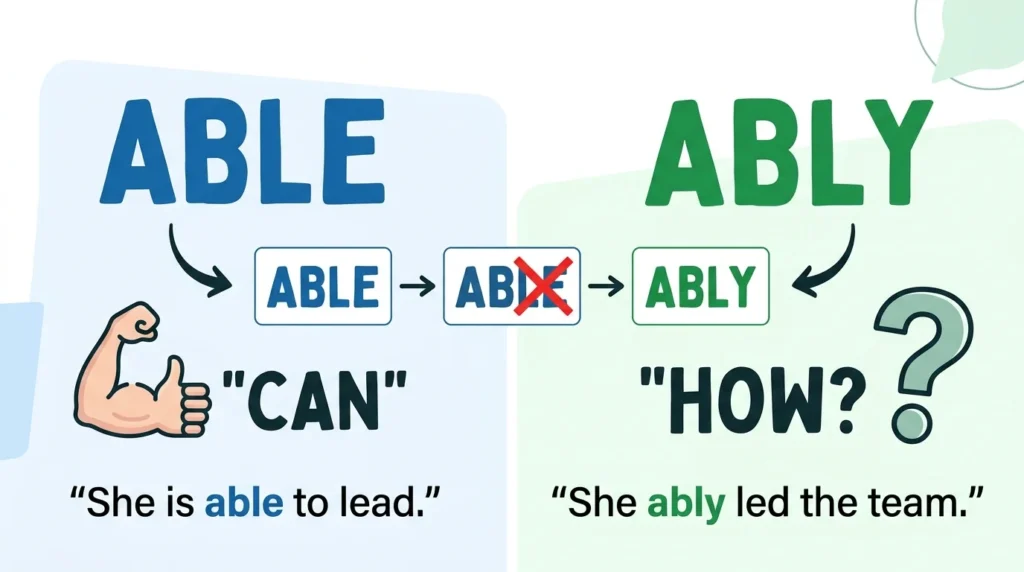
ABLE = can.
ABLY = how.
If you mean “can do something,” use able.
She is able to solve the problem.
If you mean “did it skillfully,” use ably.
She solved the problem ably.
Another useful memory line is:
Drop the E: able becomes ably.
Do not write:
able + y = abley ❌
Remember:
able → ably ✅
Real-Life Situations
Job interview
“I was able to manage the team during a difficult period.”
Here, able is correct because the speaker is talking about capability.
Performance review
“She ably managed the team during a difficult period.”
Here, ably is correct because the reviewer is describing how she performed.
Business email
“Thank you for ably handling the client presentation.”
The writer is praising the quality of the person’s performance.
Text message
“You handled that really well.”
A casual speaker may choose well instead of ably because it sounds more conversational.
University essay
“The researcher ably demonstrates how social conditions affected the outcome.”
This is an appropriate use because the sentence evaluates the quality of the researcher’s work.
Exam
If the question asks:
Choose the correct form: “The lawyer ___ defended the client.”
The answer is:
ably
The word describes how the lawyer defended the client.
Expert Tips
1. Test “ably” with “skillfully”
If you can replace the word with skillfully or competently, ably is probably the form you need.
She ably managed the team.
She skillfully managed the team.
The meaning remains close.
2. Do not confuse ability with performance
This is the most useful grammatical distinction.
He is able to lead.
This describes his capability.
He ably led the team.
This describes the quality of his performance.
3. Do not force “ably” into every sentence
A correct word can still be the wrong stylistic choice.
She ably opened the door.
There is nothing seriously wrong with the grammar, but it sounds strange because opening a door normally does not require notable skill.
Instead:
She opened the door.
Use ably when competence is meaningful to the sentence.
4. Remember that names are different
If someone is named Abley, do not “correct” the name to Ably.
Mr. Abley spoke at the conference.
That spelling identifies the person.
But:
Mr. Abley ably answered the questions.
Both words are correct because they perform different jobs: Abley is the person’s name, while ably describes his performance.
5. Learn the word as a complete unit
Instead of repeatedly calculating:
able + ? = ?
memorize:
ably = skillfully / competently
This reduces spelling errors and makes writing faster.
Quick Summary
Ably is the standard English adverb meaning “skillfully,” “competently,” or “in an able manner.” Use it when describing how someone performs an action: “She ably managed the project.” Able is different because it is an adjective meaning capable: “She is able to manage the project.” Abley is not the standard adverb spelling and should normally be corrected to ably. However, Abley can be correct when it is a proper name, such as a surname. There is no standard American-versus-British spelling difference here. Remember the simplest rule: able = can; ably = how. When you mean that someone performed something skillfully or competently, choose ably.
FAQ
Is “abley” a correct English word?
Not as the standard adverb meaning “skillfully” or “competently.” In that context, use ably.
❌ She abley handled the problem.
✅ She ably handled the problem.
Is “ably” a real word?
Yes. Ably is a standard English adverb meaning in a skilled, capable, or competent manner. It is recognized in major English dictionaries.
Is “abley” ever correct?
Yes, but not as the ordinary adverb form of able. Abley can appear as a proper name, particularly a surname. In that case, it should retain its original spelling.
Should I write “able” or “ably”?
Use able when describing someone’s capability:
She is able to finish the work.
Use ably when describing how an action was performed:
She finished the work ably.
Is “ably” formal?
It can sound somewhat formal or polished, especially compared with everyday alternatives such as well. However, it is not restricted to formal English and is fully standard.
Can I use “ably” in academic writing?
Yes. It can be useful when describing a person’s analysis, argument, explanation, research, or performance.
The author ably explains the relationship between the two theories.
Can I use “ably” in a business email?
Yes. It works naturally when praising or describing competent performance.
Thank you for ably managing the client presentation.
Is “abley” a British spelling of “ably”?
No. Ably is the standard spelling in both American and British English. Abley is not a British alternative spelling.
Why does “ably” lose the “e”?
The standard English word is historically and grammatically established as ably. It should be learned as the adverb form of able, rather than created by simply adding letters to the complete spelling of the adjective.
What is an easy synonym for “ably”?
Depending on the context, you can use skillfully, competently, capably, or sometimes well.
For example:
She ably managed the project.
She skillfully managed the project.
The alternatives are similar, but the exact tone and emphasis can differ.
What is the easiest way to remember “ably”?
Remember:
Able = can.
Ably = how.
If you are describing someone’s ability, use able. If you are describing how well or skillfully someone performed an action, use ably.
Mini Quiz
| # | Question | Answer | Explanation |
|---|---|---|---|
| 1 | Choose the correct form: “She ___ managed the negotiations.” A) abley B) ably | B) ably | Ably means skillfully or competently. |
| 2 | Fill in the blank: “He is ___ to complete the assignment.” | able | Able is the adjective used to describe capability. |
| 3 | Correct the sentence: “The manager abley handled the crisis.” | The manager ably handled the crisis. | The standard adverb is ably. |
| 4 | Which means “in a skilled manner”? A) able B) ably C) ability | B) ably | Ably is the adverb meaning skillfully or competently. |
| 5 | Fill in the blank: “The teacher ___ explained the difficult topic.” | ably | The word describes how the teacher explained it. |
| 6 | Is this correct? “She is ably to solve the problem.” | No | Use able after “is”: “She is able to solve the problem.” |
| 7 | Choose the correct sentence: A) He abley defended his argument. B) He ably defended his argument. | B | Ably is the correct adverb. |
| 8 | Correct the sentence: “Dr. Abley ably presented the report.” | The sentence is correct. | Abley is the person’s name; ably describes how the report was presented. |
| 9 | Which is more natural in casual speech? A) She ably made breakfast. B) She made breakfast. | B | Ably is possible grammatically, but it sounds unnecessarily formal for such an ordinary action. |
| 10 | Complete the memory rule: “Able = ___; Ably = ___.” | can; how | Able expresses capability; ably describes the manner of an action. |