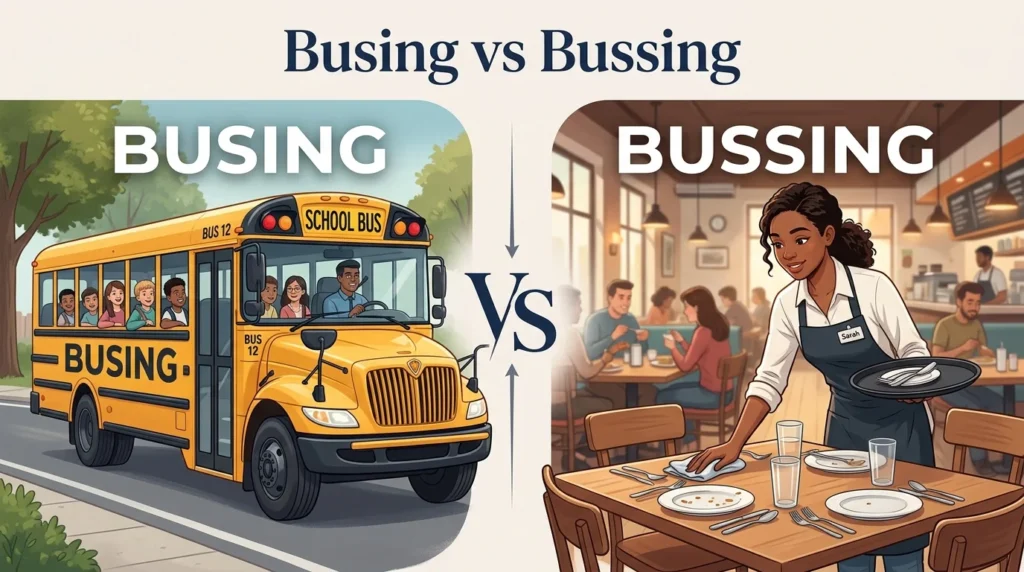

Both “busing” and “bussing” are correct spellings of the verb bus when it means transporting people by bus. In American English, busing is a common spelling for transportation, while bussing is also established and is especially familiar in restaurant contexts such as “bussing tables.” British English commonly uses bussing for the transportation sense. The choice is largely a matter of established usage and English variety, not a simple correct-versus-incorrect rule.
What Is the Difference Between Busing and Bussing?
Busing and bussing are both forms of the verb bus.
When bus means to transport people by bus, both forms can be used:
- The school is busing students to another campus.
- The school is bussing students to another campus.
The spelling difference does not automatically create a difference in meaning.
However, context and regional usage can affect which spelling feels more natural. American English often uses busing for transportation, while bussing is particularly common in restaurant expressions such as bussing tables. British English commonly uses bussing as the present participle of bus.
So the simplest rule is:
Use “busing” or “bussing” according to the English variety, context, and style you are following. Neither spelling is automatically wrong.
Why It Matters
This spelling can look like a minor detail, but it matters when you are writing for a specific audience.
Consider these situations:
- A school is busing students to a temporary campus.
- A hotel is busing guests from the airport.
- A restaurant employee is bussing tables.
- A company is busing employees to an event.
- A British publication describes bussing passengers between two locations.
A writer who assumes that one spelling is always correct may incorrectly “correct” an established form.
The bigger issue is consistency. If you are writing for an American audience and choose busing for transportation, there is usually no reason to switch randomly between busing and bussing. If you are following British usage, bussing may be the more natural choice.
Dictionary sources recognize both forms. One major American dictionary lists bused/bussed and busing/bussing as forms of bus.
Read More: Unorganized vs Disorganized: What’s the Difference?
The Core Rule
Busing and bussing are both accepted forms of the verb “bus” when it means transporting people by bus.
Busing is especially common in American English for transportation.
Bussing is also correct and is particularly familiar in restaurant language such as bussing tables. British English commonly uses bussing for the transportation sense.
Do not use the simple rule “one s is correct and two s’s are wrong.” That rule is not accurate.
Likewise, do not assume that bussing always means restaurant work. The double-s spelling can also refer to transportation.
How to Use Busing
Busing for transportation
Use busing when you are describing the act of transporting people by bus, particularly in American English.
Examples include:
- busing students to school
- busing passengers to the airport
- busing employees to an event
- busing visitors between buildings
- busing children to a temporary campus
For example:
The district is busing students to schools in neighboring areas.
Here, busing is the present participle of bus.
It can also function as a noun:
Busing students to distant schools requires careful planning.
In that sentence, busing names the activity rather than describing an action being performed at that moment.
The spelling busing is especially well established in American discussions of school transportation.
How to Use Bussing
Bussing for transportation
Bussing can also mean transporting people by bus.
For example:
The company is bussing employees to the conference center.
This is not automatically a spelling error.
British English commonly uses bussing as the present participle of bus. A learner dictionary identifies bussing as the mainly British form and busing as the US form in its treatment of the verb.
Bussing in restaurants
There is another very common use of bussing.
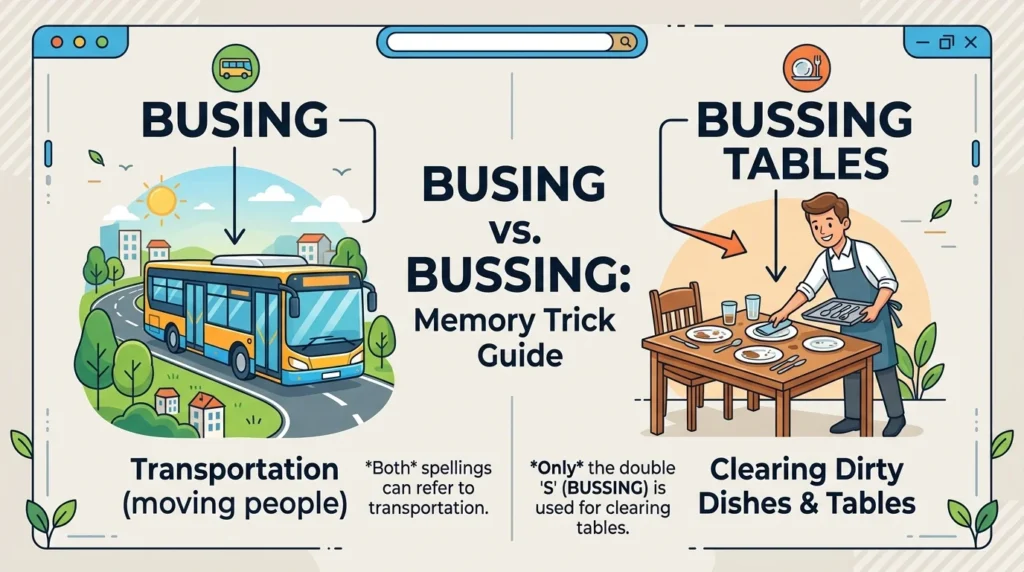
In restaurant English, to bus tables means to remove used plates, glasses, dishes, or other items from tables.
For example:
Maria is bussing tables after the dinner rush.
This meaning is particularly familiar in American English.
Importantly, this restaurant meaning does not prove that bussing is the only correct spelling for transportation. The same verb has established spelling variants, and dictionaries record both.
Correct Examples
Here are examples showing how the forms work in real situations.
- The school is busing students to a temporary campus.
- The company is bussing employees to the annual conference.
- The district has been busing children from several neighborhoods.
- The restaurant hired two people to help with bussing tables.
- We are busing guests from the hotel to the stadium.
- The British newspaper described the plan as bussing passengers between the two terminals.
- Busing students between campuses requires additional drivers.
- She spent the evening bussing tables at the restaurant.
- The hotel provides busing between the airport and the resort.
- The district changed its busing arrangements after the new school opened.
- The restaurant manager asked the staff to keep bussing tables during the busy period.
- The event organizers arranged busing for guests who did not have transportation.
Notice that the spelling depends partly on the variety of English and partly on the context. It is not accurate to treat every occurrence of bussing as an error.
Read More: Loosing vs Losing: Meaning, Difference & Correct Use.
Incorrect vs. Correct
| ❌ Incorrect assumption | ✅ Better understanding | Why |
|---|---|---|
| Bussing is always wrong. | Bussing is an accepted spelling. | Dictionaries recognize bussing as a form of bus. |
| Busing is always the only correct form. | Busing and bussing are both used. | Both forms are established in English. |
| Bussing only means clearing tables. | Bussing can also mean transporting people by bus. | The transportation sense exists as well. |
| Busing only means school transportation. | Busing can refer to transportation generally. | The verb bus can mean transporting people by bus. |
| British English must use busing. | British English commonly uses bussing. | British usage commonly doubles the final s in this verb form. |
| American English cannot use bussing for transportation. | American English also uses bussing. | The double-s form is established in American usage too. |
| The two spellings have completely different meanings. | Their meanings can overlap. | Both can describe transportation by bus. |
| Bussing tables proves bussing is a different verb. | It is a related use of the verb bus. | Bus can also mean removing used items from restaurant tables. |
| If spellcheck accepts one, the other must be wrong. | Check context and English variety. | Spellcheckers do not always explain regional or contextual variation. |
| You must change busing to bussing because the word ends in s. | Follow established spelling usage. | English spelling does not apply the consonant-doubling pattern mechanically to every word. |
Why Do People Make This Mistake?
The spelling looks unusual
Many English learners expect a final consonant to double before -ing.
They see:
- run → running
- sit → sitting
- swim → swimming
- stop → stopping
So bus → bussing looks logical.
At the same time, busing is also an established spelling. This creates a conflict between a general spelling expectation and the actual forms used in English.
The two spellings look like different words
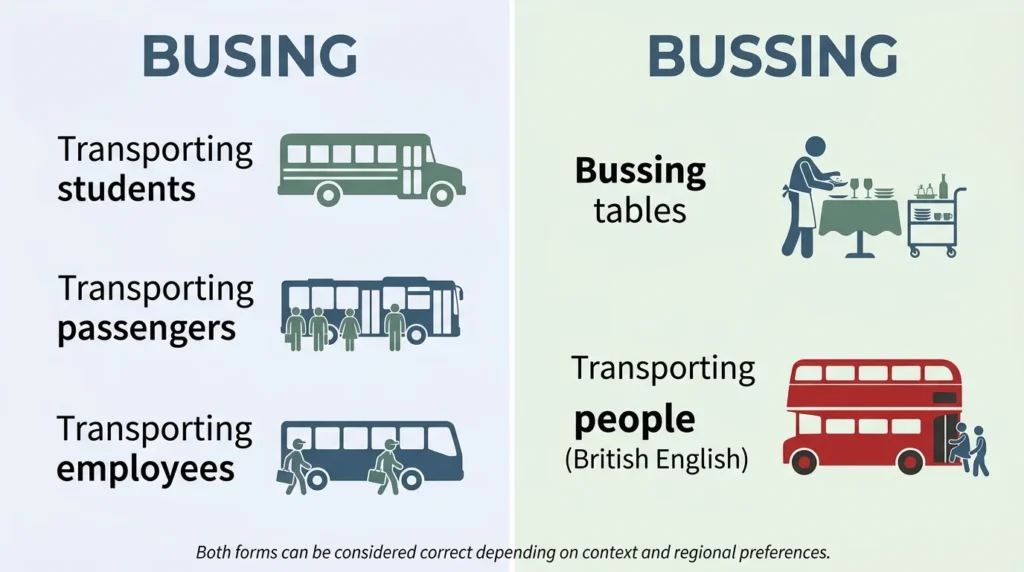
Because one form has one s and the other has two, writers sometimes assume that they have completely different meanings.
They do not.
Both can be forms of the verb bus when the verb means transporting people by bus.
Restaurant language creates extra confusion
Many American readers are very familiar with the phrase:
bussing tables
That expression is common enough that some people begin to associate bussing exclusively with restaurants.
But bussing can also refer to transportation.
Spellcheckers simplify complicated language
A spellchecker may flag one form depending on its dictionary, language setting, or surrounding context.
That does not mean the flagged form is universally incorrect.
Automated tools are useful, but they do not always explain differences between American and British usage.
Translation can interfere
Some learners translate the word directly from another language and expect English spelling to follow a predictable pattern.
English spelling often contains established forms that cannot be derived perfectly from a single spelling rule.
The safest approach is to learn the accepted forms and understand the context in which each is commonly used.
Common Mistakes Checklist
Mistake 1: Calling “bussing” a spelling error
Why it happens: The writer has learned busing as the preferred American form.
How to avoid it: Remember that bussing is also an established form.
Mistake 2: Assuming “bussing” always means restaurant work
Why it happens: “Bussing tables” is a familiar expression.
How to avoid it: Look at the object and context. Bussing tables refers to restaurant service, while bussing passengers can refer to transportation.
Mistake 3: Treating American and British English as identical
Why it happens: Learners are often taught “English” as one spelling system.
How to avoid it: Check which variety you are writing for. British English commonly favors bussing, while American English commonly uses busing for transportation.
Mistake 4: Applying consonant-doubling rules mechanically
Why it happens: Learners correctly notice patterns such as run → running.
How to avoid it: Do not assume every word ending in a consonant follows exactly the same pattern. Established spelling forms matter.
Mistake 5: Switching between forms without a reason
Why it happens: Both spellings appear in dictionaries and online.
How to avoid it: Choose the form appropriate to your audience and maintain it consistently.
Busing vs. Bussing in Real English
Busing
In American English, busing is a very natural choice when discussing transportation by bus, especially in contexts involving schools, organized transportation, or public policy.
For example:
The district is busing students to another school.
This spelling is also strongly associated with the noun busing, particularly in American discussions of transporting students to schools outside their local neighborhoods.
Bussing
Bussing is completely established English and is particularly familiar in restaurant language.
For example:
He is bussing tables during the dinner shift.
It is also used for transportation:
The company is bussing employees to the event.
In British English, bussing is a common form of the transportation verb. So calling it “wrong” simply because it contains two s’s does not reflect actual English usage.
Which sounds most natural?
For a general American audience, busing will often be the clearest default when the subject is transportation.
For restaurant work, bussing tables is a very familiar expression.
For British English, bussing is a common spelling for the transportation sense.
The important point is that these are usage preferences and established variants, not a universal rule that one spelling is correct and the other is incorrect.
American vs. British English
There is a genuine regional difference here.
| English variety | Transportation | Restaurant table service |
|---|---|---|
| American English | busing is common; bussing also occurs | bussing is very familiar |
| British English | bussing is commonly used | Restaurant usage depends on the variety and context |
| International English | Both may be encountered | bussing tables is widely recognizable |
Cambridge identifies bussing as the mainly British present participle and busing as the US form in its learner dictionary. Its main dictionary also notes -ss- or US usually -s- for the verb bus.
However, the distinction should not be turned into an absolute rule. Real usage contains overlap, and American dictionaries also recognize bussing.
Formal vs. Informal Usage
There is no major formal-versus-informal distinction between busing and bussing.
Both can appear in professional writing.
For example:
The company will provide busing for employees attending the conference.
This is perfectly suitable for a formal announcement.
Likewise:
The restaurant is hiring staff for bussing tables.
This can appear in a professional job description.
The more important choice is regional convention and meaning, not formality.
Comparison Table
| Feature | Busing | Bussing |
|---|---|---|
| Base verb | bus | bus |
| Meaning: transport by bus | Yes | Yes |
| Meaning: restaurant table service | Yes in some usage | Yes, especially familiar |
| Common in American English | Yes | Yes |
| Common transportation spelling in US English | Busing | Also used |
| Common transportation spelling in British English | Used | Bussing is common |
| Present participle | Yes | Yes |
| Gerund | Yes | Yes |
| Automatically incorrect? | No | No |
| Best approach | Match audience and context | Match audience and context |
Busing vs. Bussing vs. Buses vs. Busses
These forms are easy to mix up.
| Form | Function | Example |
|---|---|---|
| bus | Singular noun | The bus arrived early. |
| buses | Plural noun | Three buses arrived. |
| busses | Alternative plural form | Several busses were waiting. |
| busing | Present participle / gerund | The school is busing students. |
| bussing | Variant present participle / gerund | The school is bussing students. |
| bused | Past tense / past participle | The district bused students to another campus. |
| bussed | Variant past tense / past participle | The district bussed students to another campus. |
Merriam-Webster records bused/bussed and busing/bussing as forms of bus, while Cambridge notes buses and also busses as plural forms.
The key is not to assume that doubling the s automatically changes the grammatical function.
Memory Trick
Think:
One bus can go “busing”; two s’s can go “bussing.” Both can ride the same bus.
For restaurant work, remember the familiar phrase:
Bussing tables = restaurant service.
But treat this as a memory aid, not a grammar rule. Bussing is not limited to restaurants.
Real-Life Situations
At school
“The district is busing students to the new campus.”
For an American school announcement, busing is a natural choice.
At a restaurant
“Sam is bussing tables tonight.”
Here, bussing refers to clearing used items from restaurant tables.
In a company email
“The company will provide busing from the hotel to the conference center.”
This is clear and professional American English.
In British English
“The organizers are bussing passengers between the two stations.”
The double-s form is entirely reasonable in British usage.
In a text message
“They’re bussing everyone to the stadium.”
The informal setting does not make bussing wrong.
In an exam
If an English exam asks whether bussing is always incorrect, the answer should be no.
The correct form depends on the meaning and variety of English.
Expert Tips
1. Think about the audience before the spelling
If you are writing for US readers and discussing transportation, busing is a straightforward choice.
If you are writing for British readers, bussing may fit the expected spelling better.
2. Do not “correct” every double s
Seeing bussing does not give you enough information to call it a spelling mistake.
Read the whole sentence first.
3. Learn the phrase “bussing tables”
This is one of the most useful expressions associated with the double-s form.
The server was bussing tables after the lunch rush.
4. Keep your publication consistent
If your article follows American English, use the American convention consistently. If it follows British English, follow that convention throughout.
Consistency makes writing look deliberate and professional.
5. Remember that dictionaries record usage, not just spelling rules
When a form appears in reputable dictionaries, it is evidence that the form exists in standard usage.
The goal is not to force every English word into one spelling formula.
FAQ
Is busing or bussing correct?
Both are correct forms of the verb bus. Busing is especially common in American English for transportation, while bussing is also established and is particularly familiar in restaurant expressions such as “bussing tables.” British English commonly uses bussing for transportation.
Is bussing a real word?
Yes. Bussing is a real and established English word. It can be the present participle or gerund of bus, including the meanings related to transportation and restaurant service.
Is busing only used in American English?
No. Busing is particularly associated with American English, but the form is also recognized more broadly. English varieties overlap, so it should not be treated as an exclusively American word.
Is bussing British English?
Bussing is commonly used in British English as the present participle of bus. However, it is not exclusively British; it also occurs in American English.
Does bussing mean clearing tables?
It can. In restaurant English, bussing tables means removing used plates, glasses, dishes, and other items from tables. However, bussing can also refer to transporting people by bus.
Can I write “bussing students”?
Yes. Bussing students is an established construction meaning transporting students by bus. Busing students is also correct.
Which is better for American English: busing or bussing?
For transportation, busing is a common American choice. However, bussing is also accepted, so it should not automatically be treated as an error. For restaurant work, bussing tables is especially familiar in American English.
Why does bus become busing instead of bussing?
English spelling does not apply consonant-doubling rules in exactly the same way to every word. Busing became an established spelling alongside bussing, so both forms are now recognized. The spelling should be learned as an established variation rather than derived from one simple rule.
Is “bussed” or “bused” correct?
Both forms are used. Dictionaries recognize bused and bussed as past forms of bus. American English often uses bused, while bussed is also established.
Is “busses” or “buses” correct?
Buses is the usual plural spelling, while busses is also recognized, particularly in American usage. Do not confuse these plural forms with the verb forms busing and bussing.
Does busing mean school desegregation?
It can. In American English, busing is also used specifically for transporting students to schools outside their neighborhoods, including contexts involving school integration. That specialized meaning is one reason the noun busing appears frequently in American educational discussions.
Mini Quiz
| # | Question | Answer | Explanation |
|---|---|---|---|
| 1 | Which spelling is accepted for transporting students: busing or bussing? | Both | Both are established forms of bus. |
| 2 | Fill in the blank: “The district is ___ students to another campus.” | busing / bussing | Both forms can describe transporting students by bus. |
| 3 | Which phrase is especially familiar in restaurant English? busing tables or bussing tables? | Bussing tables | The double-s form is particularly familiar in restaurant usage. |
| 4 | True or false: “Bussing is always a spelling mistake.” | False | Bussing is an accepted form. |
| 5 | Correct this sentence: “The company is bussing employees to the conference.” | The sentence is already correct. | Bussing can mean transporting people by bus. |
| 6 | Which spelling is especially common in American English for transportation? | Busing | Busing is a common US form. |
| 7 | Fill in the blank: “She spent the evening ___ tables.” | bussing | Bussing tables is a familiar restaurant expression. |
| 8 | True or false: British English commonly uses “bussing” for the transportation sense. | True | British English commonly uses the double-s form. |
| 9 | Which is the usual plural of the vehicle: “buses” or “bussings”? | buses | Buses is the plural noun; busing/bussing are verb forms or gerunds. |
| 10 | Correct this statement: “Because bus ends in s, bussing must be the only correct form.” | Incorrect statement | Both busing and bussing are established forms. |
Quick Summary
Busing and bussing are both correct forms of the verb bus. When the verb means transporting people by bus, both spellings can be used. Busing is especially common in American English, while bussing is common in British English and is also widely used in American restaurant language, particularly in the phrase bussing tables. The two spellings should not be treated as completely different words, and bussing is not automatically a spelling mistake. If you are writing for a particular audience, follow its English variety and keep your spelling consistent. For US transportation writing, busing is a practical default; for restaurant table service, bussing is a familiar choice.