
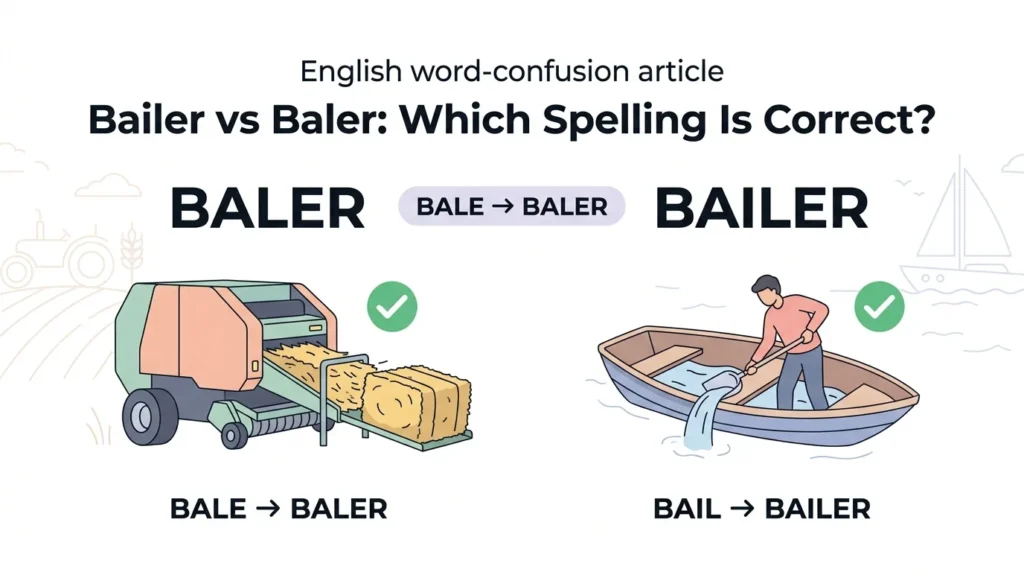

Bailer and baler are both correct words, but they have different meanings. A baler is a person or machine that makes bales, such as bales of hay, straw, paper, or cardboard. A bailer is usually a person or device that removes water, especially from a boat. The easiest way to remember the difference is bale → baler and bail → bailer.
What Is the Difference Between Bailer and Baler?
The difference between bailer and baler is mainly a difference in meaning and the base word from which each is formed.
A baler is something or someone that bales material. In everyday modern English, the word most often refers to a machine that compresses loose material into compact bundles called bales. Farmers use hay balers, while recycling facilities may use cardboard or paper balers. Dictionaries also recognize baler for a person who operates such equipment.
A bailer, on the other hand, is commonly a device used to bail out water, especially from a boat. It can also refer to a person who bails or, in specialized legal terminology, be a variant spelling of bailor.
So the simplest distinction is:
- Baler → makes bales
- Bailer → bails or removes water
The extra i in bailer is not a spelling mistake. It signals a different word and a different meaning.
Why Does the Difference Matter?
These words are easy to confuse because they look almost identical and are pronounced alike or nearly alike in ordinary English. But substituting one for the other can completely change the meaning of a sentence.
Imagine writing:
The farmer bought a new hay bailer.
A reader may understand what you mean from the context, but hay baler is the correct term because the machine makes bales of hay.
Now consider:
Keep a baler on the boat in case water gets inside.
Here, bailer is the appropriate word because the device is used to remove water.
The distinction matters especially in professional writing because these words appear in very different fields:
- Agriculture
- Recycling
- Waste management
- Boating
- Environmental testing
- Well drilling
- Technical documentation
- Equipment descriptions
A one-letter difference can therefore produce an entirely different technical meaning.
The Core Rule
Use baler for making bales. Use bailer for bailing or removing water.
Think of the base words:
BALE → BALER
A baler makes a bale.
BAIL → BAILER
A bailer helps bail something, especially water.
This connection is more reliable than trying to memorize the spelling by sound.
What Is a Baler?
A baler is a person or machine that makes bales.
In modern usage, the word most commonly refers to machinery that compresses loose material into tightly packed bundles. These machines are especially common in agriculture and recycling.
For example, a hay baler gathers and compresses hay into bales. A recycling baler can compress materials such as cardboard or paper into manageable bundles for storage and transportation. Cambridge defines baler as a machine that puts materials such as hay or paper into bales.
Common Types of Balers
You may encounter terms such as:
- Hay baler
- Straw baler
- Cotton baler
- Cardboard baler
- Paper baler
- Recycling baler
- Plastic baler
- Waste baler
The exact machine varies according to the material being processed, but the basic idea remains the same: the baler creates a bale.
Examples of “Baler”
- The farmer repaired the hay baler before the harvest began.
- The recycling center installed a new cardboard baler.
- The old baler broke down during the afternoon shift.
- The company purchased an automatic paper baler.
- The farm worker cleaned the baler after finishing the field.
- The technician inspected the hydraulic system on the baler.
- The warehouse uses a vertical baler to compress cardboard boxes.
- The cotton baler was ready for the next stage of production.
- The operator received training before using the industrial baler.
- The recycling facility sends compressed plastic from the baler to another processing plant.
Notice that all of these examples involve making or handling bales.
What Is a Bailer?
A bailer is generally a person or device involved in bailing.
One common meaning is a device used to remove water from a boat. A simple bailer might be a bucket, scoop, or purpose-built container that allows someone to remove unwanted water quickly.
Merriam-Webster defines bailer as a device used to bail out a boat.
The word can also occur in technical contexts. For example, specialized bailers may be used to retrieve liquid samples from wells or other locations. In legal language, bailer can also occur as a variant of bailor, a person who delivers personal property to another in trust.
Common Uses of “Bailer”
Depending on context, you may see bailer in:
- Boating
- Marine safety
- Water removal
- Environmental sampling
- Groundwater testing
- Well-related technical work
- Specialized legal writing
Examples of “Bailer”
- The sailor used a bailer to remove water from the boat.
- Always keep a bailer aboard a small boat.
- The canoe came with a plastic bailer.
- After the storm, they used a bailer to empty the boat.
- The technician lowered the groundwater bailer into the monitoring well.
- The crew replaced the damaged bailer before leaving the dock.
- She grabbed the bailer when water began collecting inside the canoe.
- The emergency kit included a hand bailer.
- The environmental team used a specialized bailer to collect a water sample.
- The boat’s bailer was stored beneath the seat.
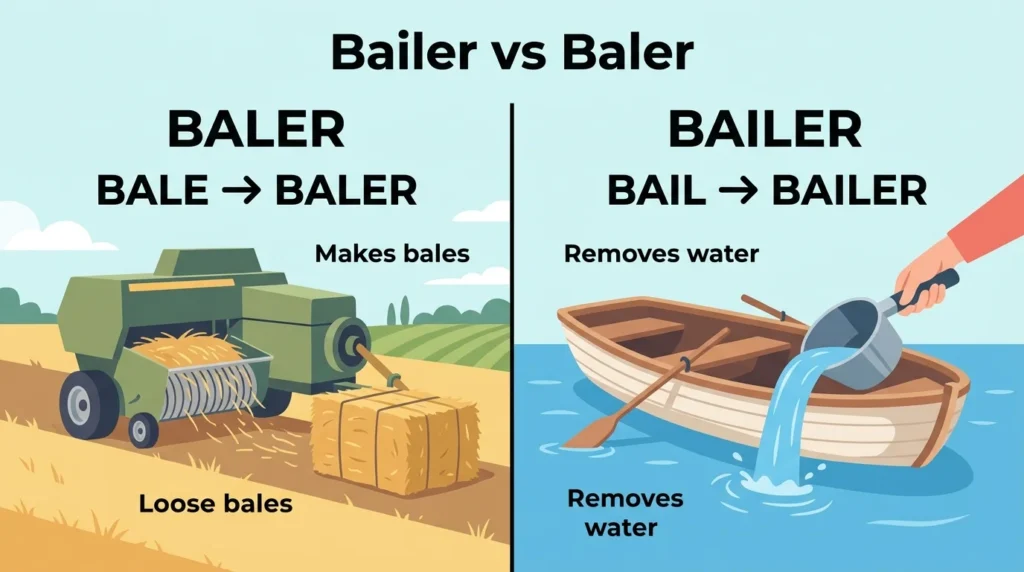
Here, the important idea is bail, not bale.
Read More: Ingage vs Engage: Which Spelling Is Correct?
Bailer vs. Baler: The Simplest Comparison
| Feature | Bailer | Baler |
|---|---|---|
| Base word | Bail | Bale |
| Main meaning | A person or device that bails | A person or machine that makes bales |
| Common use | Removing water or retrieving liquid | Compressing material into bales |
| Common field | Boating, environmental work, specialized technical contexts | Agriculture, recycling, waste management |
| Typical example | Boat bailer | Hay baler |
| Related verb | Bail | Bale |
| Related noun | Bail | Bale |
| Extra letter | i | None |
| Can they be interchanged? | No | No |
How to Use Baler and Bailer Correctly
The easiest method is to identify the action in the sentence.
Use “baler” when something makes a bale
Ask:
Is the object compressing hay, straw, paper, cardboard, cotton, or another material into a bale?
If yes, use baler.
Examples:
- hay baler
- straw baler
- cardboard baler
- paper baler
- cotton baler
Use “bailer” when something bails
Ask:
Is the person or device removing water or retrieving liquid?
If yes, use bailer.
Examples:
- boat bailer
- canoe bailer
- groundwater bailer
- sampling bailer
The surrounding noun often gives you the answer immediately.
Correct Examples in Real Situations
Conversation
“Did you remember the bailer for the canoe?”
Here, bailer is correct because the item is used to remove water.
Workplace
“The recycling center needs a larger cardboard baler.”
Baler is correct because the machine compresses cardboard into bales.
“Please arrange maintenance for the hay baler before Friday.”
The machine creates hay bales, so baler is correct.
School Writing
“The farmer used a baler to compress the dried hay.”
Again, the machine makes bales.
Social Media
“The storm left so much water in the boat that we needed the bailer.”
The object is removing water, so bailer is correct.
Academic Writing
“The groundwater sample was collected using a bailer.”
Here, bailer refers to specialized sampling equipment.
Product Description
“Heavy-duty cardboard baler for commercial recycling facilities.”
Baler is the appropriate spelling.
Safety Instructions
“Keep a bailer available when operating a small open boat.”
The device is used to remove water.
Farming Report
“The new baler reduced the time required to prepare the hay for storage.”
The machine produces bales.
Technical Report
“The sampling bailer was lowered into the monitoring well.”
The word refers to equipment used to retrieve liquid.
Incorrect vs. Correct
| ❌ Incorrect | ✅ Correct | Why |
|---|---|---|
| The farmer bought a hay bailer. | The farmer bought a hay baler. | A baler makes hay bales. |
| We kept a baler in the boat. | We kept a bailer in the boat. | A bailer can remove water from a boat. |
| The cardboard bailer is broken. | The cardboard baler is broken. | A cardboard baler compresses cardboard. |
| Use the baler to remove the water. | Use the bailer to remove the water. | Water is bailed, not baled. |
| The farm’s bailer needs repair. | The farm’s baler needs repair. | The agricultural machine makes bales. |
| The canoe needs a baler. | The canoe needs a bailer. | A boat may need a device for removing water. |
| The recycling center installed a new bailer. | The recycling center installed a new baler. | Recycling balers compress materials. |
| The sailor grabbed the baler. | The sailor grabbed the bailer. | The sailor needs a water-removal tool. |
| The hay bailer stopped working. | The hay baler stopped working. | Hay is made into bales. |
| The emergency baler removed water from the boat. | The emergency bailer removed water from the boat. | The device is used for bailing water. |
The important point is that neither word is simply the “correct spelling” of the other. Both are legitimate words. The correct choice depends on meaning.
Why People Make This Mistake
They sound almost the same
In ordinary speech, bailer and baler are pronounced alike in many varieties of English. Merriam-Webster lists bailer and baler among words that rhyme, reflecting their very similar pronunciation.
That means pronunciation usually cannot help you decide which spelling to write.
They differ by only one letter
The visual difference is tiny:
bailer
baler
The extra i is easy to overlook when typing quickly.
People remember the sound instead of the base word
If someone hears “hay baler,” they may remember the sound and later write “hay bailer.”
A better strategy is to think about the related noun:
bale → baler
rather than relying on pronunciation.
Spellcheck cannot always solve the problem
Both bailer and baler are legitimate English words. A spelling checker may therefore accept either one.
The software cannot always know whether you are discussing a boat or a farm machine.
Read More: Home Made vs Homemade: Which Spelling Is Correct?
Translation can cause interference
Learners who translate directly from another language may choose a spelling based on sound rather than English word formation. This is particularly risky when two English words sound alike but have unrelated meanings.
The solution is to learn the word together with its common context.
Common Mistakes Checklist
1. Writing “hay bailer”
Problem: A hay machine is described as a bailer.
Correct: hay baler
Why: Hay is compressed into bales.
2. Writing “boat baler”
Problem: A water-removal tool is called a baler.
Correct: boat bailer
Why: The tool is used for bailing water.
3. Assuming “bailer” is simply a misspelling
Problem: Treating bailer as an incorrect form of baler.
Correct: Recognize that both words exist.
Why: They come from different base words and have different meanings.
4. Trusting pronunciation alone
Problem: Choosing the spelling that seems right from hearing the word.
Correct: Identify the meaning first.
Why: The words are pronounced similarly.
5. Trusting spellcheck completely
Problem: Assuming an accepted spelling must be correct for the sentence.
Correct: Check the meaning and context.
Why: Spellcheck can recognize both legitimate words without understanding your intended meaning.
Bailer vs. Baler in Real English
“Baler” in everyday and professional English
Baler is natural when discussing equipment that produces bales. It is especially common in agricultural and recycling contexts. Phrases such as hay baler, straw baler, cardboard baler, and paper baler are straightforward technical combinations. Cambridge specifically gives examples involving hay and recycling equipment.
“Bailer” in everyday English
Bailer is natural when talking about a device used to remove water from a boat. A sentence such as “Keep a bailer in the canoe” fits naturally because the context makes its purpose clear. Merriam-Webster gives the core meaning as a device used to bail out a boat.
“Bailer” in technical English
In environmental and groundwater work, bailer can refer to equipment used to collect liquid samples from wells. This is a specialized meaning, so a general reader may understand the word differently unless the context makes the technical use clear.
“Bailer” in legal English
There is another specialized use worth knowing: bailer can be a variant spelling of bailor, a legal term for a person who delivers personal property to another in trust.
This meaning is uncommon in everyday English. If you encounter bailer in a legal document, do not automatically assume it refers to a boat or water.
Read More: Either vs Eather: Which Spelling Is Correct?
American vs. British English
There is no major American-versus-British spelling difference between these two words.
The basic distinction remains the same:
- American English: baler = one that makes bales; bailer = one that bails
- British English: baler = one that makes bales; bailer = one that bails
Cambridge lists baler in both US and UK pronunciation entries, while the core meaning remains the same.
So if you are wondering whether bailer is British and baler is American, the answer is no.
The choice is based on meaning, not regional spelling.
Formal vs. Informal Usage
Neither bailer nor baler is inherently informal.
Both are standard nouns when they accurately describe the intended meaning.
Baler is common in professional and technical contexts involving agriculture, recycling, and industrial equipment.
Bailer is also standard when referring to boating equipment and certain technical applications. Its specialized legal use is much less common in everyday communication.
The important distinction is not formality. It is context.
Memory Trick
Use this simple two-word memory trick:
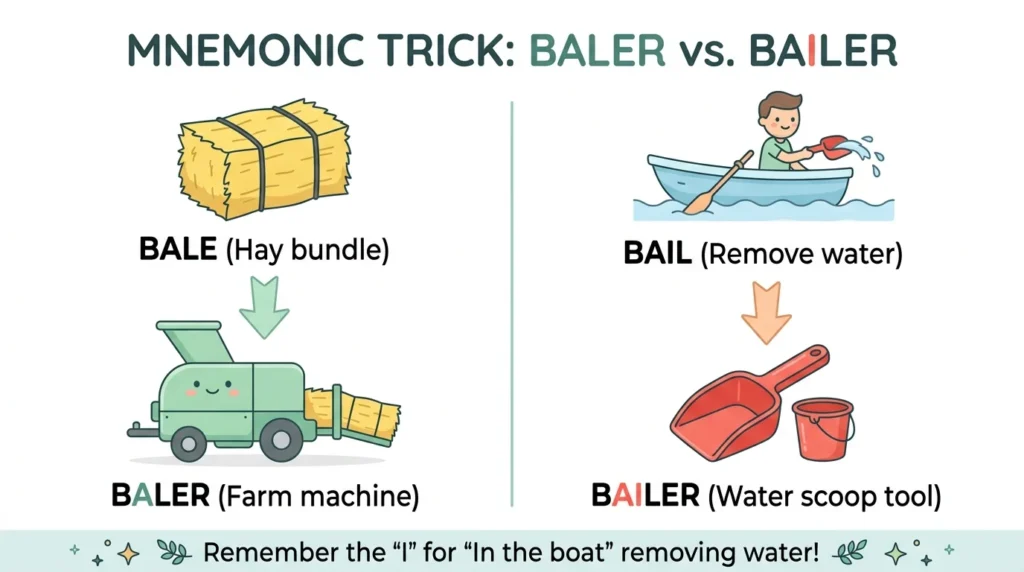
BALE → BALER
BAIL → BAILER
If you can make a bale, you need a baler.
If you bail water, you need a bailer.
Think:
Bale = bundle. Baler = bundles.
Bail = remove water. Bailer = water removal.
This works because the spelling of each noun follows the word it is related to.
Real-Life Situations
1. At a farm
You are talking about a machine that turns loose hay into compact bundles.
Correct:
“The baler needs fuel before we start.”
2. On a boat
Water has entered a small fishing boat.
Correct:
“Grab the bailer and start removing the water.”
3. At a recycling center
Workers are compressing cardboard.
Correct:
“The cardboard baler is operating at full capacity.”
4. During environmental testing
A technician is collecting groundwater from a monitoring well.
Correct:
“The technician lowered the bailer into the well.”
5. In an equipment catalog
A manufacturer sells machinery for compressing recyclable materials.
Correct:
“Industrial cardboard baler.”
6. In an emergency
A small boat is taking on water.
Correct:
“Use the bailer before the water level rises.”
7. In a farming report
A report describes equipment used to prepare hay.
Correct:
“The farm purchased a new round baler.”
8. In a legal document
A document uses bailer in the specialized sense related to property held in trust.
Correct:
Use the term according to the legal context, where bailer may be a variant of bailor.
Read More: Unenroll vs Disenroll: Meaning and Key Difference
Expert Tips
Learn the word family, not just the spelling
Memorizing baler alone is less effective than memorizing:
bale → baler → baled → baling
Likewise:
bail → bailer → bailed → bailing
This gives you a meaning-based system instead of a spelling-only rule.
Look at the noun beside the word
If you see:
- hay
- straw
- cotton
- cardboard
- paper
- recycling
you probably need baler.
If you see:
- boat
- canoe
- water
- groundwater
- sampling
- monitoring well
you probably need bailer.
Context often provides the answer faster than spelling rules do.
Do not “correct” every occurrence of bailer
If someone writes bailer, do not automatically change it to baler.
First ask:
What does this word mean in the sentence?
If it refers to a boat or water-removal device, bailer may be exactly right.
Remember that both words are nouns
In their common uses, both bailer and baler function as nouns.
The confusion is therefore not primarily a grammar problem. It is a word-choice and spelling problem caused by similar pronunciation.
Think about the action
When uncertain, turn the noun back into its verb:
- A baler → something that bales
- A bailer → something that bails
That is often the quickest test.
FAQ
Is “baler” or “bailer” the correct spelling?
Both are correct spellings. Baler refers mainly to someone or something that makes bales, while bailer commonly refers to someone or something that bails, especially a device for removing water.
Is a hay machine a baler or a bailer?
It is a baler. A hay baler compresses hay into bales for storage, handling, or transportation.
Is a boat tool called a bailer or baler?
It is generally called a bailer when it is used to remove water from a boat.
Are baler and bailer pronounced the same?
They are pronounced the same or very similarly in common English pronunciation. This is one reason the words are easy to confuse.
Is “hay bailer” correct?
No, not when you mean the agricultural machine that makes hay bales. The standard term is hay baler.
Is “boat baler” correct?
Not when you mean a device used to remove water. The appropriate word is bailer.
Does “bailer” have meanings other than removing water?
Yes. It can have specialized meanings. Merriam-Webster also lists bailer as a variant of bailor, a legal term for someone who delivers personal property to another in trust.
What is the easiest way to remember baler?
Connect it to bale:
bale → baler
A baler makes bales.
What is the easiest way to remember bailer?
Connect it to bail:
bail → bailer
A bailer can help bail water.
Is the difference between baler and bailer grammatical?
Not primarily. Both are valid nouns. The main issue is choosing the word that matches the intended meaning.
Does British English use “bailer” differently?
No major British-American spelling distinction applies here. The basic meanings remain the same in both varieties of English.
Can a person be called a baler?
Yes. The word can refer not only to a machine but also to a person who makes or handles bales. Merriam-Webster includes both a machine and a person who operates such a machine in its definition.
Mini Quiz
| # | Question | Answer | Explanation |
|---|---|---|---|
| 1 | The farmer repaired his hay ___ before harvest. A) bailer B) baler | B) baler | A hay baler makes bales of hay. |
| 2 | Keep a ___ in the canoe. A) baler B) bailer | B) bailer | A bailer can be used to remove water. |
| 3 | The recycling center bought a new cardboard ___. | baler | Cardboard is compressed into bales. |
| 4 | Correct the sentence: “She used a baler to remove water from the boat.” | She used a bailer to remove water from the boat. | A bailer is associated with bailing water. |
| 5 | The technician lowered the groundwater ___ into the well. A) baler B) bailer | B) bailer | A specialized bailer can be used for liquid sampling. |
| 6 | Which word is related to “bale”? A) bailer B) baler | B) baler | Baler is formed from the word bale. |
| 7 | Which word is related to “bail”? A) baler B) bailer | B) bailer | Bailer is associated with the verb bail. |
| 8 | Correct the sentence: “The farm purchased a new hay bailer.” | The farm purchased a new hay baler. | A machine that makes hay bales is a baler. |
| 9 | Fill in the blank: “The sailor grabbed the ___ when water entered the boat.” | bailer | The device is used to remove water. |
| 10 | True or false: “Bailer is always an incorrect spelling of baler.” | False | Both are legitimate words with different meanings. |
Quick Summary
Baler and bailer are both correct English words, but they are not interchangeable. A baler is someone or something that makes bales, especially a machine used to compress hay, straw, cardboard, paper, or similar materials. A bailer is commonly a person or device that bails, particularly a tool used to remove water from a boat. The easiest memory trick is bale → baler and bail → bailer. Because the two words sound alike or nearly alike, pronunciation is not a reliable guide. Instead, identify the action and context. If something makes a bale, use baler. If it bails water or performs another specialized bailing function, use bailer.