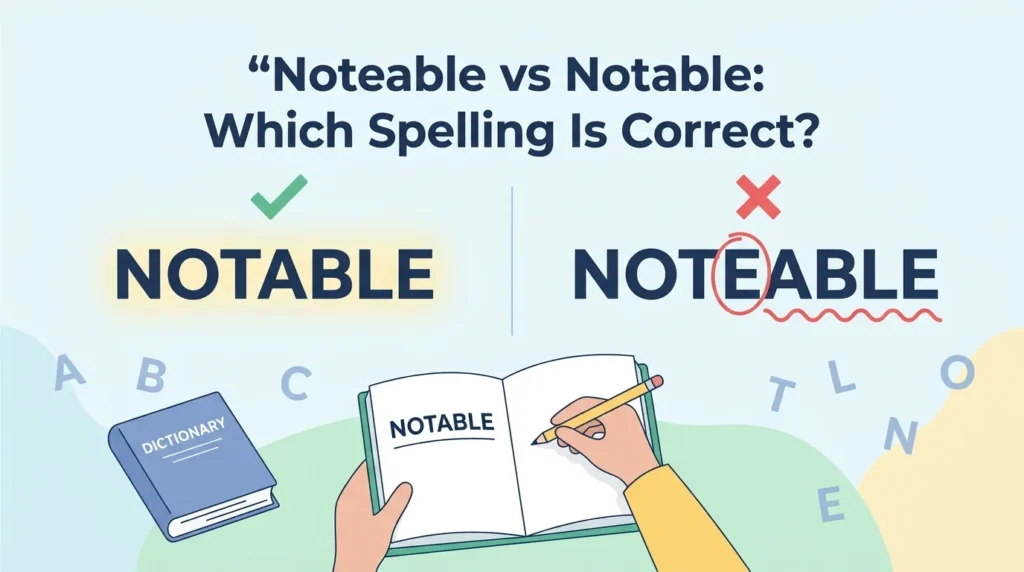

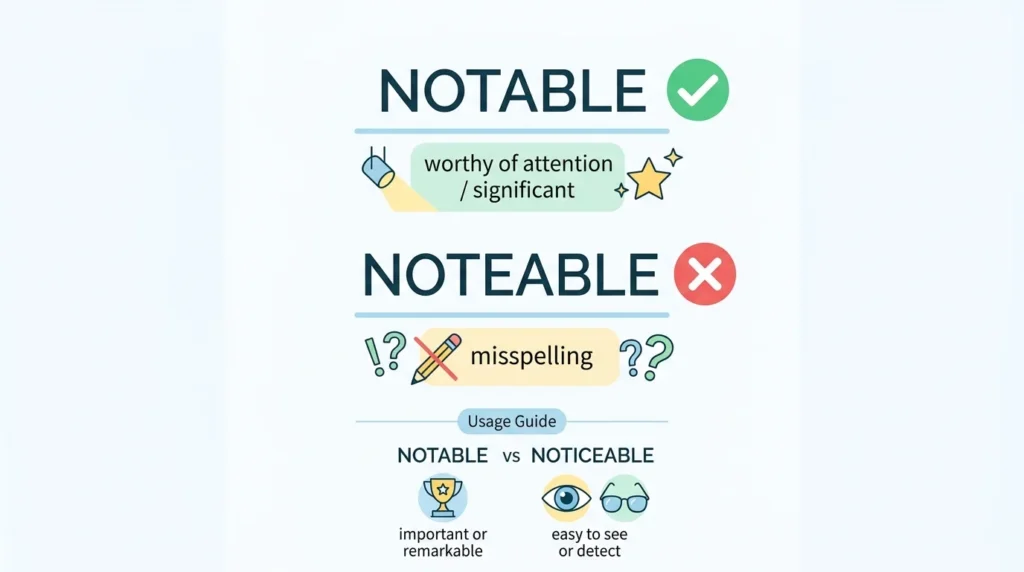
Notable is the correct spelling. Noteable is a common misspelling and should not be used in standard English. Notable is an adjective meaning worthy of attention, important, remarkable, or distinguished. For example, “She made a notable contribution to the project.” The confusion usually comes from seeing note + able and assuming the word should be spelled noteable. However, the established English spelling is notable, without the extra e.
What Is the Difference Between Noteable and Notable?
The difference is simple:
- Notable = correct spelling
- Noteable = incorrect spelling in standard English
The word notable is used when someone or something deserves attention because it is important, remarkable, distinguished, or otherwise worth mentioning. Major dictionaries define notable in terms such as “worthy of note,” “remarkable,” “important,” or “distinguished.”
Noteable, by contrast, is not the standard spelling of this adjective. It is generally treated as a misspelling of notable.
So if you are writing an email, essay, report, résumé, article, social media post, or academic paper, choose notable.
Correct: The company achieved a notable increase in sales.
Incorrect: The company achieved a noteable increase in sales.
Why Does It Matter?
A spelling error such as noteable may look small, but it can affect how polished your writing appears.
This matters especially when you are writing for:
- A job application or résumé
- A business email
- An academic assignment
- A research paper
- A professional report
- A website or blog
- A presentation
- A formal letter
Compare these two sentences:
The researcher made a notable contribution to the field.
The researcher made a noteable contribution to the field.
The first sentence uses the standard spelling. The second contains an unnecessary e, which can make the writer appear less careful with spelling.
This does not mean one spelling mistake automatically damages someone’s credibility. Context matters. But in professional or academic writing, correct spelling is part of producing clear, polished work.
The Core Rule
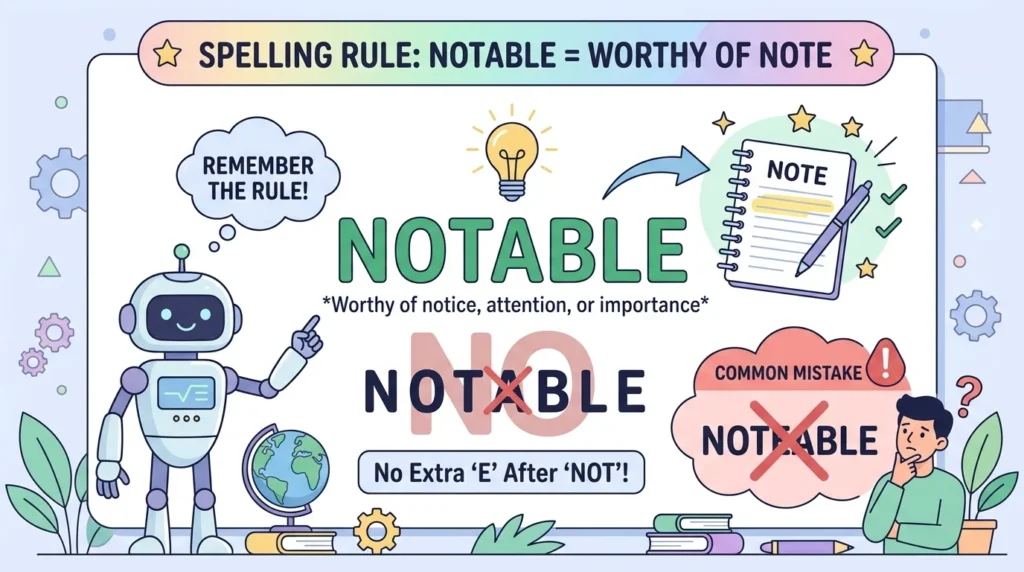
RULE: Always spell the word as NOTABLE — N-O-T-A-B-L-E.
Noteable is not the standard spelling.
The easiest way to remember it is to avoid treating the word as note + able.
Although notable looks as if it could have been formed by attaching -able to note, its established spelling is notable, with only one e before able.
Read More: Infront vs In Front: Which Is Correct?
The Correct Spelling
The Common Misspelling
N-O-T-E-A-B-L-E ❌
N-O-T-A-B-L-E
That extra e is the problem.
How to Use “Notable” Correctly
Notable is primarily an adjective. An adjective describes a person, thing, event, quality, result, or other noun.
It commonly means that something is:
- Worthy of attention
- Remarkable
- Important
- Significant
- Distinguished
- Prominent
- Worth remembering
Before a Noun
You can place notable directly before a noun.
- a notable achievement
- a notable scientist
- a notable improvement
- a notable difference
- a notable event
- a notable contribution
- a notable exception
- a notable change
For example:
The student received an award for a notable achievement.
After a Linking Verb
You can also use notable after verbs such as become, seem, or be.
Her progress was notable.
The difference became notable after several months.
With “For”
The pattern notable for is also common when explaining what makes something worthy of attention.
The region is notable for its historic architecture.
The museum is notable for its collection of rare manuscripts.
Cambridge specifically gives examples of notable for and defines the adjective as important and deserving attention because something is very good or interesting.
Correct Examples of “Notable”
Here are original examples showing how notable can work in different situations.
Conversation
“Her progress in English has been quite notable this year.”
Here, notable means impressive or worthy of attention.
We saw a notable improvement in customer response after changing the subject line.
The word describes a meaningful improvement.
School
The student’s notable performance earned praise from the teacher.
The performance was sufficiently impressive to deserve attention.
Workplace
The team made a notable improvement in productivity during the second quarter.
The improvement was significant enough to mention.
Business Report
There was a notable increase in online sales after the campaign launched.
The increase was important or significant.
Academic Writing
One notable limitation of the study is its small sample size.
Here, notable signals an important point that deserves attention.
Social Media
One of the most notable moments from the event was the final presentation.
The moment stood out as particularly important or memorable.
News Writing
The agreement represents a notable change in the country’s economic policy.
The change is significant enough to deserve attention.
Personal Writing
Her notable patience helped the children feel comfortable.
The quality was particularly worthy of recognition.
Historical Writing
The invention marked a notable development in the history of transportation.
The development was historically significant.
Read More: Challenge vs Challange: Which Is Correct?
Incorrect vs. Correct
| ❌ Incorrect | ✅ Correct | Why |
|---|---|---|
| She made a noteable contribution. | She made a notable contribution. | The standard spelling is notable, without the extra “e.” |
| It was a noteable achievement. | It was a notable achievement. | Noteable is a misspelling. |
| We saw a noteable improvement. | We saw a notable improvement. | The correct adjective is notable. |
| He is a noteable scientist. | He is a notable scientist. | Use notable for a distinguished or important person. |
| There was a noteable difference. | There was a notable difference. | The word is spelled with one “e” in this position. |
| This is a noteable exception. | This is a notable exception. | The established form is notable. |
| She achieved noteable success. | She achieved notable success. | The extra “e” does not belong in the word. |
| The museum has a noteable collection. | The museum has a notable collection. | Notable is the correct adjective. |
| His career was noteable for its longevity. | His career was notable for its longevity. | The standard construction is notable for. |
| The report contains several noteable findings. | The report contains several notable findings. | The correct spelling is notable. |
Why Do People Make This Mistake?
The spelling noteable is understandable as a mistake because it looks logical at first.
English has many words ending in -able, and writers may unconsciously try to build notable from the familiar word note:
note + able = noteable
That looks reasonable.
But English spelling does not always work by simply joining recognizable pieces of words. The established spelling of this particular word is notable.
Phonetic Similarity
When spoken, notable and the imagined spelling noteable do not provide a useful visual clue for the writer.
You hear a pronunciation and have to decide how to represent it on the page. If you already know the word note, it is easy to insert its full spelling into the imagined compound.
Spelling Overlap
The words note and notable look closely related:
note
notable
That visual relationship can encourage the incorrect form:
note + able → noteable ❌
The correct spelling does not preserve the full spelling of note.
Overgeneralization
Learners often apply a pattern that works in some words to another word where it does not.
For example, English has many adjectives ending in -able:
- readable
- understandable
- comfortable
- dependable
- reasonable
A writer may assume every similar-looking word follows the same spelling pattern. That assumption can produce noteable.
Autocomplete and Spellcheck
Spellcheck tools are useful, but they should not replace knowledge of the word.
Some typing systems may flag noteable, while others may suggest alternatives. Autocomplete can also behave differently depending on the software, language settings, or context.
The safest solution is to recognize the standard spelling yourself:
notable
Translation Interference
English learners may also transfer spelling patterns from another language.
For example, a learner may know a word that looks similar to noteable in another language and assume English follows the same spelling pattern. This is one reason spelling errors can persist even when the writer understands the meaning perfectly.
Common Mistakes Checklist
1. Adding the Extra “E”
Mistake:
noteable
Correct:
notable
Why it happens: The writer mentally separates the word into note + able.
How to avoid it: Memorize notable as one complete spelling.
2. Assuming “Notable” Means “Noticeable”
These words are related in meaning but are not identical.
Notable generally focuses on significance, distinction, or importance.
Noticeable focuses on something being easy to see, hear, detect, or perceive.
The scientist made a notable discovery.
The discovery was significant.
There was a noticeable change in temperature.
The change could easily be detected.
3. Treating “Notable” as Exactly the Same as “Famous”
Someone can be notable without being famous.
For example:
She made a notable contribution to the local community.
This does not necessarily mean she is internationally famous. It means her contribution deserves attention or recognition.
4. Using “Notable” for Every Visible Change
If your main idea is simply that something can be detected, noticeable may be more precise.
There was a noticeable stain on the wall.
The stain is easy to see.
Calling it notable would suggest more than simple visibility.
Read More: Parents vs Parent: What Is the Difference?
5. Adding an Extra “E” Because of “Note”
Remember that the spelling of the noun note does not determine the spelling of notable.
Do not write:
note + able = noteable
Write:
notable
Notable in Real English
When “Notable” Sounds Natural
Notable is very natural when you are pointing out something significant, impressive, distinguished, or worthy of mention. Common combinations include notable achievement, notable contribution, notable difference, notable exception, notable increase, and notable figure. It is especially common in journalism, academic writing, business reports, and thoughtful everyday descriptions when the writer wants to emphasize importance rather than simple visibility.
When “Notable” Is Grammatically Possible but Another Word Is Better
Sometimes notable is grammatically possible but does not express the intended idea as precisely as noticeable. If you mean that something can easily be seen, heard, smelled, felt, or otherwise detected, noticeable is often the better choice. For example, a stain can be noticeable without being important. The key question is whether you mean worthy of attention or simply easy to perceive.
When “Notable” Is Especially Natural
Notable works particularly well when discussing achievements, people, historical events, discoveries, changes, exceptions, contributions, and characteristics that stand out because they matter. In these contexts, the word carries an idea of significance or distinction. It does not necessarily mean “famous,” and it does not automatically imply that something is positive. A notable decline, for example, can describe a significant negative change.
American vs. British English
There is no spelling difference between American and British English for this word.
Both use:
notable
The pronunciation can differ slightly between American and British English, but the written form remains the same. Cambridge gives separate American and British pronunciations while using the same spelling.
So you do not need to change notable to another spelling when switching between American and British English.
| English Variety | Correct Spelling |
|---|---|
| American English | notable |
| British English | notable |
| International English | notable |
Formal vs. Informal Usage
Notable is a standard word that works in both everyday and formal English.
It is particularly common in:
- Academic writing
- Business reports
- Journalism
- Professional communication
- Historical writing
- Reviews and commentary
It can also appear naturally in conversation:
“There was a notable improvement in his pronunciation.”
The word is therefore not restricted to formal writing. However, in very casual conversation, speakers may often choose simpler alternatives such as important, big, significant, impressive, or obvious, depending on what they mean.
Comparison Table
| Feature | Notable | Noteable | Noticeable |
|---|---|---|---|
| Standard English spelling | ✅ Yes | ❌ No | ✅ Yes |
| Main meaning | Worthy of attention or significant | Misspelling | Easy to perceive or detect |
| Part of speech | Adjective; sometimes noun | Not standard English | Adjective |
| Describes importance | ✅ Yes | ❌ | Sometimes indirectly |
| Describes visibility/detectability | Sometimes | ❌ | ✅ Yes |
| Example | a notable achievement | a noteable achievement ❌ | a noticeable change |
| Used in professional writing | ✅ | ❌ | ✅ |
| Used in academic writing | ✅ | ❌ | ✅ |
Notable vs. Noticeable: The Difference You Should Know
The most useful related distinction is between notable and noticeable.
Notable
Notable means worthy of attention because something is important, remarkable, distinguished, or significant.
She made a notable contribution to environmental research.
The contribution deserves recognition.
Noticeable
Noticeable means easy to see, hear, recognize, or detect.
There was a noticeable change in his voice.
The change could easily be detected.
A thing can be noticeable without being notable.
For example:
The small scratch on the table was noticeable.
You could see it easily, but that does not mean the scratch was important or remarkable.
The distinction is also recognized in grammar resources that contrast notable as worthy of comment or distinction with noticeable as detectable.
Memory Trick
Use this simple mnemonic:
NOTABLE = Worthy of NOTE
If something is important enough to deserve a note, it can be notable.
Remember:
notable = worthy of note
Not:
noteable = note + able
Another quick reminder:
Notable things are worth noting.
Both notable and noting connect naturally to the idea of giving something attention.
Real-Life Situations
Job Interview
You want to describe an important achievement:
“One of my most notable achievements was increasing customer retention.”
Here, notable highlights the achievement’s importance.
Business Meeting
A manager summarizes company performance:
“There was a notable improvement in customer satisfaction this month.”
The improvement is significant enough to mention.
A colleague reports a change:
“One notable difference is the reduction in response time.”
The writer is pointing to an important difference.
Text Message
A friend talks about someone’s progress:
“Her improvement this year has been notable.”
The improvement is impressive or significant.
Academic Exam
A student writes:
“One notable feature of the experiment was the unexpected result.”
The feature deserves special attention.
Social Media
A person summarizes an event:
“A notable moment from today’s conference was the final discussion.”
The moment stood out as meaningful.
Expert Tips
Tip 1: Think “worthy of note”
When you see notable, mentally replace it with:
worthy of attention
or
worth mentioning
If the replacement makes sense, notable is probably the right word.
Tip 2: Do not build the spelling from “note”
The visual connection between note and notable is misleading.
Treat notable as its own established spelling.
Tip 3: Check whether you mean “important” or “detectable”
This is the fastest way to distinguish notable from noticeable.
Ask:
Is it important or remarkable?
Use notable.
Ask:
Can it easily be seen or detected?
Use noticeable.
Tip 4: “Notable” does not always mean positive
Consider:
The company experienced a notable decline in revenue.
Here, notable means significant. The decline itself is negative.
Tip 5: Learn common word combinations
Remembering natural combinations makes the word easier to use.
Common examples include:
- notable achievement
- notable contribution
- notable difference
- notable exception
- notable increase
- notable decrease
- notable figure
- notable event
- notable change
- notable improvement
Mini Quiz
| # | Question | Answer | Explanation |
|---|---|---|---|
| 1 | Choose the correct spelling: noteable / notable | notable | Notable is the standard spelling. |
| 2 | Fill in the blank: She made a ______ contribution to the project. | notable | The contribution was important or worthy of attention. |
| 3 | Correct the sentence: “He is a noteable scientist.” | He is a notable scientist. | Noteable is a misspelling. |
| 4 | Which word means “easy to detect”: notable / noticeable? | noticeable | Noticeable focuses on perception or detectability. |
| 5 | Fill in the blank: There was a ______ improvement in sales. | notable | The improvement was significant enough to mention. |
| 6 | Correct the sentence: “The stain was very notable on his shirt.” | The stain was very noticeable on his shirt. | If the meaning is easy to see, noticeable is more precise. |
| 7 | Which spelling is correct: notable / noteable? | notable | There is no extra “e” after “not.” |
| 8 | Fill in the blank: One ______ exception should be mentioned. | notable | A notable exception is one that deserves attention. |
| 9 | Which word better describes an important achievement: notable / noticeable? | notable | Notable emphasizes importance or distinction. |
| 10 | Correct the sentence: “Her progress was noteable this year.” | Her progress was notable this year. | The correct spelling is notable. |
FAQ
Is “noteable” a correct English spelling?
No. Noteable is generally treated as a misspelling of notable. The standard spelling is notable.
What does “notable” mean?
Notable means worthy of attention, important, remarkable, distinguished, or significant. Dictionaries also record a noun use for a notable or important person.
Why do people spell “notable” as “noteable”?
The mistake probably looks logical because writers can see the word note inside notable and may mentally form note + able. English spelling does not always preserve the full spelling of a related word when another word is formed.
Is “notable” an adjective?
Yes. Notable is commonly used as an adjective.
For example:
She made a notable achievement.
It can also function as a noun in certain contexts, especially in formal or literary usage, referring to an important or distinguished person.
Is “notable” the same as “famous”?
Not exactly. Famous emphasizes being widely known. Notable emphasizes being worthy of attention, significant, distinguished, or remarkable. Someone can be notable without being widely famous.
Is “notable” the same as “noticeable”?
No. Notable usually emphasizes importance, significance, or distinction. Noticeable emphasizes something being easy to perceive or detect.
a notable achievement
a noticeable stain
Is “notable” used in American and British English?
Yes. Notable is spelled the same in both American and British English. The pronunciation may differ slightly, but there is no separate British spelling.
What is the easiest way to remember “notable”?
Remember:
Notable = worthy of note.
If something is worth noting, it is notable.
Can “notable” describe a negative change?
Yes. Notable does not automatically mean positive. It means significant or worthy of attention.
For example:
The company reported a notable decline in revenue.
The decline is negative, but it is significant.
What is the noun form of “notable”?
Notable can itself be a noun when referring to an important or distinguished person. Notability is also a noun meaning the quality or condition of being notable, while notably is the adverbial form.
Should I use “notable” in academic writing?
Yes. Notable is perfectly appropriate in academic writing when you want to identify something significant, important, or worthy of attention.
For example:
One notable limitation of the study is its small sample size.
Quick Summary
Notable is the correct spelling; noteable is a misspelling. Notable is an adjective meaning worthy of attention, important, remarkable, significant, or distinguished. The spelling mistake often happens because people see note and assume the word should be formed as note + able, producing the incorrect noteable. Remember the correct form as notable = worthy of note. Do not confuse notable with noticeable: notable emphasizes importance or distinction, while noticeable emphasizes something that can easily be detected or perceived. Notable is spelled the same in American and British English and works in both everyday and formal writing.
Final Answer
If you are choosing between noteable and notable, choose:
✅ NOTABLE
Not:
❌ NOTEABLE
Notable is the standard English spelling.
Use it when you mean worthy of attention, significant, remarkable, important, or distinguished.
She made a notable contribution to the project.
The simplest memory trick is:
Notable things are worth noting.