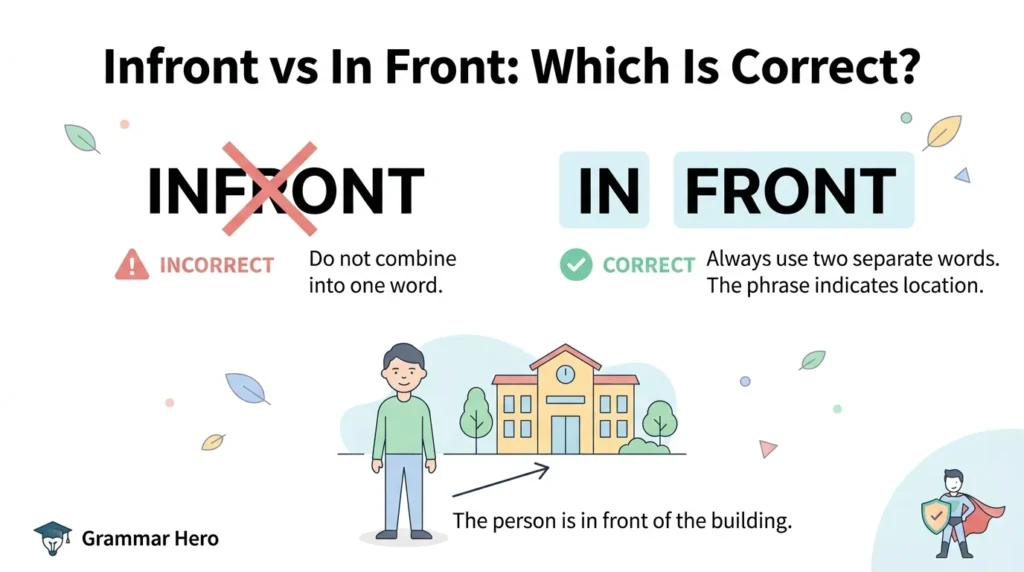

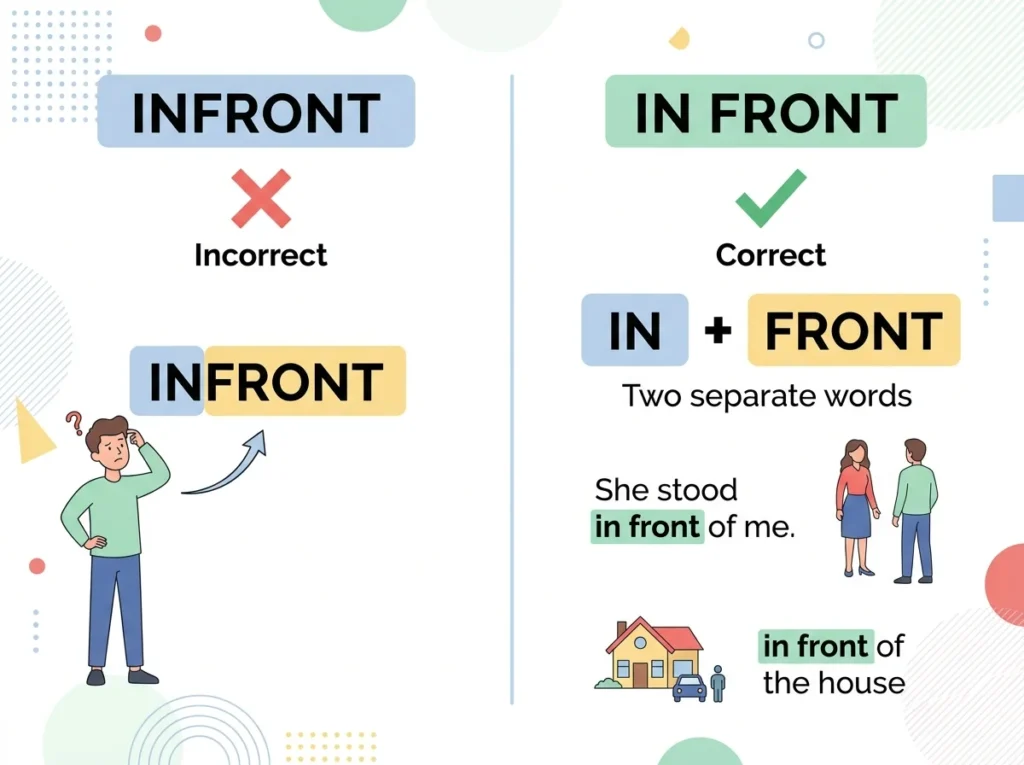
In front is correct. Infront is incorrect in standard English.
Write the phrase as two separate words when you mean “ahead,” “before,” or “in a position facing or near the front of something.” For example, She stood in front of me. Do not write She stood infront of me. The same spelling applies in American and British English.
What Is “In Front”?
In front is a standard English expression used mainly to describe position, direction, or relative location.
It can mean that someone or something is:
- farther forward than another person or thing
- positioned ahead of something
- located near the forward-facing side of something
- leading in a competition
- visible or present before other people
For example:
The blue car is in front.
Here, in front means the car is farther forward.
When another person or thing is named, English commonly uses in front of:
The blue car is in front of our house.
The distinction is important because in front does not have to be followed by of. It can stand on its own when the context already makes the comparison clear.
Cambridge and Merriam-Webster both recognize in front as an established expression, including meanings related to forward position.
Why It Matters
At first glance, the difference between infront and in front looks like a tiny spacing issue.
It is. But small spelling mistakes can still affect how polished your writing appears.
Consider these situations:
- a job application
- a business email
- an academic assignment
- a website
- a report
- a presentation
- a professional social media post
Compare:
Please wait infront of the office.
with:
Please wait in front of the office.
The meaning is easy to understand in both cases, but only the second follows standard English spelling.
The problem becomes especially noticeable when the same mistake appears repeatedly. A reader may begin to question the accuracy of the rest of the document.
So the practical rule is simple: always write “in front” as two words.
The Core Rule
RULE: Write “in front” as two separate words. Never write “infront” in standard English.
The phrase consists of separate words functioning together.
- in is a preposition.
- front is a noun in the underlying structure.
- in front functions as a fixed expression.
- in front of commonly functions as a prepositional expression.
English has many expressions that remain open, meaning their component words are written separately.
For example:
- in front
- in line
- in time
- in place
- in fact
- at least
The fact that two words are frequently spoken together does not automatically turn them into one word.
Read More: Challenge vs Challange: Which Is Correct?
How to Use “In Front”
There are several common ways to use in front correctly.
1. Use “in front” for a position ahead
The runner is still in front.
Here, the listener already understands what the runner is ahead of.
2. Use “in front of” before a person or thing
The teacher stood in front of the class.
A taxi stopped in front of the hotel.
This is one of the most common structures.
3. Use “in front of” for visibility or presence
The phrase can also mean that something happens while another person is present or able to see it.
Don’t argue in front of the children.
She became nervous in front of the audience.
Cambridge specifically recognizes this use for actions or speech occurring where someone can see or hear you.
4. Use “in front” for a leading position
The expression can also describe being ahead in a competition.
Our team is still in front.
The blue car moved in front.
Merriam-Webster and Cambridge both record in front with a meaning connected to being in the leading position.
5. Use “in front of” for physical placement
Put the chair in front of the desk.
The sign is in front of the entrance.
This is the basic spatial meaning most learners encounter first.
Correct Examples
Here are original examples showing how in front and in front of work in different situations.
- Conversation:
“Your keys are right in front of you.” - Email:
“Please wait in front of the main entrance until I arrive.” - Workplace:
“The manager stood in front of the team and explained the new procedure.” - School:
“Mia chose a seat in front of the teacher.” - Academic writing:
“The diagram in front of the reader illustrates the relationship between the two variables.” - Social media:
“I finally found the answer that was right in front of me.” - Directions:
“The pharmacy is directly in front of the bus station.” - Meeting:
“He placed the presentation screen in front of the audience.” - Everyday conversation:
“There is someone standing in front of us.” - Competition:
“After the final lap, the red team was still in front.” - Public speaking:
“She feels comfortable speaking in front of large groups.” - Home:
“Someone left a package in front of our door.”
Notice that the phrase remains in front, never infront.
Incorrect vs. Correct
| ❌ Incorrect | ✅ Correct | Why |
|---|---|---|
| He stood infront of me. | He stood in front of me. | In front is written as two words. |
| The car is infront of the house. | The car is in front of the house. | The standard phrase requires a space. |
| Please sit infront. | Please sit in front. | Infront is not the standard spelling. |
| The answer is infront of you. | The answer is in front of you. | The expression is an open phrase. |
| She walked infront of the camera. | She walked in front of the camera. | The words remain separate. |
| He was standing infront. | He was standing in front. | The expression is spelled with two words. |
| Put the box infront of the door. | Put the box in front of the door. | Use in front of for relative position. |
| They waited infront of the gate. | They waited in front of the gate. | Infront is a spelling error. |
| The teacher moved infront of the class. | The teacher moved in front of the class. | Standard English keeps in and front separate. |
| The solution was right infront of us. | The solution was right in front of us. | The correct expression is in front of. |
Why People Make This Mistake
The mistake is understandable because in front behaves like a single unit in speech.
When people say:
“She is standing in front of me.”
the words in front can sound closely connected. There is no obvious pause between them.
Several factors make the mistake more likely.
Phonetic similarity
Spoken English does not provide a visual space between words. When a phrase is pronounced quickly, listeners may process it as one sound unit.
That can encourage spelling by sound:
in-front-of
and eventually:
infront of
Spelling patterns
English contains many words beginning with in-, such as:
- inside
- into
- indeed
- instead
- informal
- incorrect
Learners may therefore assume that in front should also be one word.
But English spelling does not work by applying one pattern to every phrase.
Overgeneralization
A learner may notice that some expressions have become single words and conclude that other frequent combinations should behave the same way.
That is not reliable.
Frequency alone does not determine whether words are written together.
Fast typing
Digital communication makes the mistake easier to create.
When someone types quickly, a space can disappear without the writer noticing. If the sentence is not proofread, infront may remain.
Autocomplete and spellcheck limits
Spellcheckers can catch many errors, but writers should not assume that every incorrect form will always be flagged.
Technology is useful for proofreading, but knowing the rule is more reliable.
Translation interference
Learners whose first language expresses the same idea with a single word may naturally expect English to do the same.
That does not mean the English phrase should be joined.
The safest approach is to learn in front as one fixed expression consisting of two written words.
Common Mistakes Checklist
Mistake 1: Writing “infront”
Problem: The two words are incorrectly joined.
Why it happens: The phrase sounds like one unit in rapid speech.
Fix: Memorize the visual form:
in front
Mistake 2: Writing “in-front”
Problem: A hyphen is added even though no compound modifier requires it.
Fix: Write:
in front
not:
in-front
Mistake 3: Dropping “of”
Writers sometimes produce:
She stood in front the building.
The standard construction is:
She stood in front of the building.
When in front introduces the object that follows, of is normally required.
Mistake 4: Assuming “in front” always needs “of”
This is the opposite error.
For example:
The blue car is in front.
This is perfectly grammatical when the context already identifies what it is ahead of.
Mistake 5: Confusing “in front of” with “opposite”
These expressions are not always interchangeable.
The café is in front of the hotel.
usually places the café on the forward side or near the front of the hotel.
The café is opposite the hotel.
usually indicates that the café is facing the hotel from the other side.
Cambridge explicitly distinguishes opposite from in front of in this way.
“In Front” in Real English
In front
In front sounds completely natural when the object being compared with is already understood.
“The blue car is in front.”
“Move the chair forward. It should be in front.”
The expression is common in everyday speech and writing. It can describe physical position, relative order, or being ahead in a competition. Cambridge and Merriam-Webster both document these uses, so there is no need to replace in front with a more complicated expression simply to sound formal.
Read More: Parents vs Parent: What Is the Difference?
In front of
In front of is the natural choice when you identify the person, object, place, or group that serves as the reference point.
“The bus is in front of the school.”
“She stood in front of the audience.”
It is extremely common in ordinary conversation, instructions, workplace communication, and formal writing. It can describe physical position as well as something happening in another person’s presence. Cambridge gives both meanings as standard uses.
Infront
Infront may appear in informal online writing, messages, comments, or quickly typed text, but its appearance does not make it a standard spelling. Wiktionary explicitly labels infront as a misspelling of in front. For edited writing, including professional, academic, and published content, use the two-word form in front.
In Front vs. In the Front vs. At the Front
This is a more useful distinction than simply memorizing that infront is wrong.
| Expression | Main idea | Example |
|---|---|---|
| in front of | position relative to something else | The car is in front of the house. |
| in front | farther forward / ahead | The car in front stopped. |
| in the front of | the forward part of something | There is a map in the front of the book. |
| at the front of | located at the foremost part | She sat at the front of the classroom. |
Oxford explains the distinction between in front of and in/at the front of: in front of can refer to a position outside or ahead of something, while in/at the front of refers to the most forward part of something.
Example
The students are in front of the school.
They are outside, positioned ahead of the school.
The students are at the front of the classroom.
They are inside the classroom, in its forward section.
That small difference can change the mental picture.
In Front vs. Opposite
These expressions are sometimes confused.
In front of generally describes a position ahead of or near the front-facing side of something.
Opposite usually means facing something from the other side.
Compare:
The car is parked in front of the hotel.
The car may be on the same side of the road as the hotel.
The restaurant is opposite the hotel.
The restaurant is across from the hotel.
This distinction is particularly useful when giving directions.
Read More: Well Deserved vs. Well-Deserved: Which Is Correct?
In Front vs. Before
Before and in front of can overlap in some contexts, but they are not interchangeable everywhere.
Use in front of naturally for physical position:
The woman was standing in front of me.
Use before naturally for time:
The meeting started before noon.
Before can also refer to order or position in certain contexts:
Your name appears before mine on the list.
But this does not mean you can replace every instance of in front of with before.
The meaning and context determine the better choice.
Merriam-Webster records before with meanings relating to both position and time, which explains why the two expressions can occasionally overlap.
American vs. British English
There is no meaningful American-versus-British spelling difference for this issue.
In both varieties, the standard form is:
in front
and:
in front of
The incorrect form infront does not become correct simply because the writer is using American English or British English.
There can be regional differences in related expressions. For example, Oxford notes some differences around expressions such as out front, but those do not change the spelling of in front itself.
Formal vs. Informal Usage
In front is suitable in both formal and informal English.
You can use it in:
- casual conversation
- text messages
- business emails
- academic writing
- reports
- presentations
- professional websites
There is no need to replace in front with a more formal expression merely because you are writing professionally.
The important distinction is between in front and infront:
Formal: The vehicle was parked in front of the building.
Informal: Meet me in front of the store.
Both are correct.
But:
Incorrect: The vehicle was parked infront of the building.
The issue is spelling, not register.
Comparison Table
| Feature | In front | Infront |
|---|---|---|
| Standard English | ✅ Yes | ❌ No |
| Number of words | Two | One |
| Spelling | in front | infront |
| Meaning | Ahead / farther forward | No separate standard meaning |
| Can be used in formal writing? | Yes | No |
| Can be used in academic writing? | Yes | No |
| Can be used in conversation? | Yes | Not as standard written spelling |
| Hyphenated? | No | No |
| Example | The car is in front. | ❌ The car is infront. |
| Recommended form | Use it | Avoid it |
Memory Trick
Use this simple rule:
If you can see “in” and “front” as two ideas, give them two spaces in your mind.
Or remember:
You stand in front of something, not infront of it.
A useful visual trick is to imagine the phrase written on a sign:
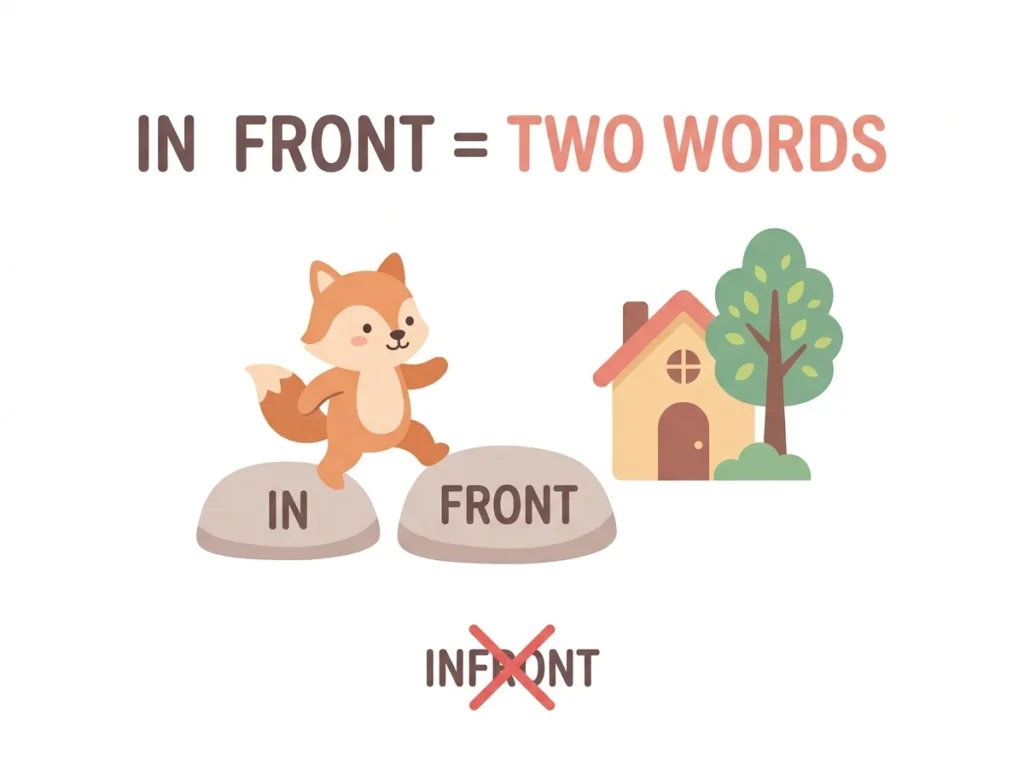
IN FRONT
The space is part of the form you need to remember.
Do not try to memorize a complicated grammatical explanation. For everyday writing, one rule is enough:
In front = two words.
Real-Life Situations
Interview
“I waited in front of the office for ten minutes before my interview.”
Correct because the speaker is describing a physical location.
Meeting
“Please place the projector in front of the screen.”
Correct because the phrase identifies the position of the projector relative to the screen.
“I will meet you in front of the main entrance at 9:00.”
Correct and perfectly suitable for professional communication.
Text Message
“I’m in front of the café.”
Correct. Of is not necessary because the location is already understood.
Exam
“The teacher stood in front of the class.”
Correct. The phrase describes physical position.
Presentation
“She was nervous speaking in front of hundreds of people.”
Correct. Here in front of means in the presence or view of an audience.
Directions
“Turn left when you see the building in front of you.”
Correct. The phrase identifies something positioned ahead of the listener.
Competition
“Our team is now in front.”
Correct. Here in front means leading.
Expert Tips
1. Learn the phrase visually
Do not memorize only the pronunciation.
Memorize:
in front
Seeing the two words together repeatedly helps prevent the spacing error.
2. Do not invent a hyphen
Some writers see a phrase functioning as one unit and assume a hyphen is needed.
It is not.
Write:
in front
not:
in-front
3. Remember that “in front” can stand alone
Do not automatically add of.
“Who is leading?”
“Maria is in front.”
That is complete and natural.
4. Add “of” when naming the reference point
Maria is in front of James.
The car is in front of the house.
5. Do not confuse “in front of” with “at the front of”
Compare:
I am in front of the classroom.
This suggests a position outside or ahead of the classroom.
I am at the front of the classroom.
This suggests a position within the classroom’s forward section.
6. Do not rely only on spellcheck
If a form looks suspicious, learn the correct phrase rather than depending entirely on software.
7. Use “opposite” carefully
If two places face each other across a road, opposite may be more precise than in front of.
Read More: Parents vs Parent: What Is the Difference?
8. Read the entire sentence
The correct choice is sometimes determined by meaning, not spelling.
For example:
The restaurant is opposite the bank.
and:
The restaurant is in front of the bank.
can create different mental pictures.
FAQ
Is “infront” a real English word?
Infront is not the standard spelling of the expression. In standard English writing, use in front. It may appear online as a misspelling, but that does not make it an accepted alternative. Wiktionary specifically identifies infront as a misspelling of in front.
Is “in front” one word or two?
It is two words: in front.
There is a space between in and front.
Is “in-front” correct?
No. The normal expression is in front, without a hyphen.
Is “in front of” grammatically correct?
Yes. In front of is a standard prepositional expression used to describe position and, in some contexts, something happening in another person’s presence.
Can I say “I am in front”?
Yes. In front can stand alone when the reference point is clear from context.
For example:
“Where are you?”
“I’m in front.”
What does “in front of you” mean?
It generally means that something is positioned ahead of you or within the area directly before you.
“The document is in front of you.”
It can also be used figuratively:
“The answer is right in front of you.”
Is “in front of” formal or informal?
It is both. You can use it in everyday speech, professional emails, academic writing, reports, and formal communication.
What is the opposite of “in front”?
The most direct opposite is behind.
The car is in front of the house.
The garage is behind the house.
What is the difference between “in front of” and “at the front of”?
In front of describes a position relative to something else, often outside or ahead of it.
At the front of usually refers to the foremost part of something.
The taxi is in front of the hotel.
She is sitting at the front of the classroom.
What is the difference between “in front of” and “opposite”?
In front of usually indicates a position ahead of or near the front side of something. Opposite usually indicates a position facing something from the other side.
The bus is in front of the hotel.
The bank is opposite the hotel.
Cambridge and Oxford both make this distinction.
Can “in front” describe a competition?
Yes. In front can mean leading a race or competition.
Our team is currently in front.
Both Cambridge and Merriam-Webster record this meaning.
Quick Summary
The correct form is in front, not infront. Write it as two separate words in standard English. Use in front when the reference point is already clear, as in The blue car is in front. Use in front of when you name the person or thing that something is positioned ahead of, as in The car is in front of the house. The phrase works in casual, professional, academic, and formal writing. There is no American-versus-British spelling difference for this rule. Also remember that in front of, at the front of, and opposite can describe different relationships. If you remember only one thing, remember this: in front always has a space.
Quiz
Test yourself before looking at the answers.
| # | Question | Answer | Explanation |
|---|---|---|---|
| 1 | Choose the correct form: A) infront B) in front C) in-front | B) in front | The standard spelling uses two separate words. |
| 2 | Complete: “The car is ___ the house.” | in front of | Of introduces the reference point. |
| 3 | Correct the sentence: “She stood infront of me.” | She stood in front of me. | Infront must be separated into in front. |
| 4 | Which is correct? A) The blue team is in front. B) The blue team is infront. | A | In front can describe a leading position. |
| 5 | Complete: “Please wait ___ the entrance.” | in front of | The entrance is the reference point. |
| 6 | Which sentence is correct? A) He sat in-front of me. B) He sat in front of me. | B | The phrase has no hyphen. |
| 7 | What is the opposite of “in front”? A) behind B) beside C) above | A) behind | Behind expresses the opposite relative position. |
| 8 | Which is more appropriate for two buildings facing each other across a road? A) opposite B) in front of | A) opposite | Opposite normally expresses a position facing something from the other side. |
| 9 | Correct the sentence: “The teacher is at in front of the class.” | The teacher is in front of the class. | Do not combine at with in front of in this structure. |
| 10 | Choose the correct sentence: A) “The answer is right infront of you.” B) “The answer is right in front of you.” | B | The correct expression is always in front, with a space. |