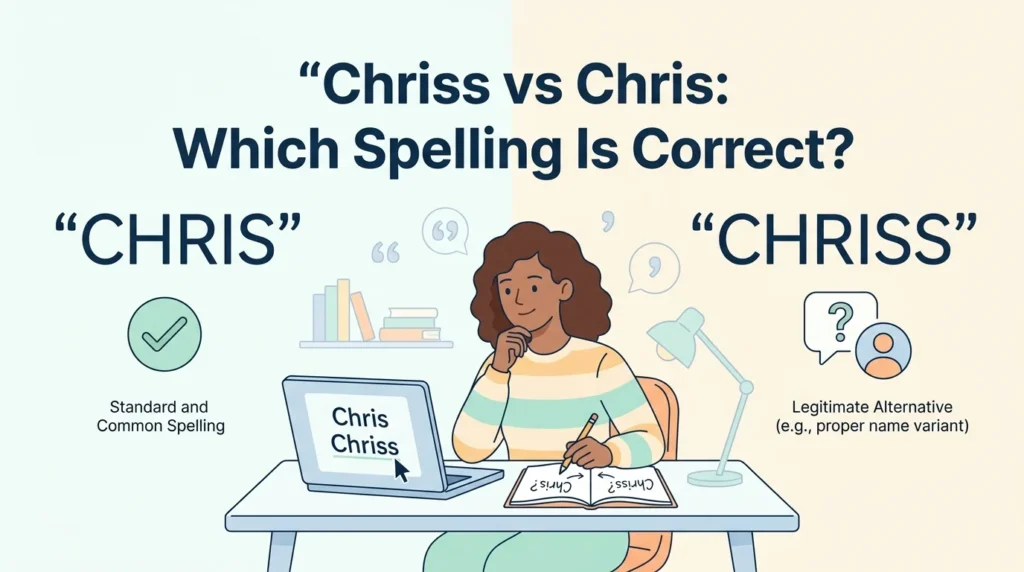

If you are wondering whether the correct spelling is Chris or Chriss, the answer depends on whose name you are writing. Chris is the standard and much more common spelling of the short name, especially as a shortened form of Christopher, Christina, or Christine. Chriss is also a real name spelling and is found as a variant given name and as a surname. However, you should never change a person’s name from Chriss to Chris simply because Chris is more common.
What Is the Difference Between Chriss and Chris?
Chris and Chriss are names, not two ordinary English vocabulary words that follow a normal spelling rule.
Chris is an established first name and short form. Major learner-dictionary sources define Chris as a first name and a shortened form of names such as Christopher, Christina, and Christine.
Chriss, on the other hand, is a recognized variant spelling. It is also found as a surname. Genealogical sources describe Chriss as an English surname variant and as a form connected with names derived from Christos.
The important point is that Chriss is not simply a spelling mistake every time you see it.
It can be a person’s actual name.
The simplest distinction
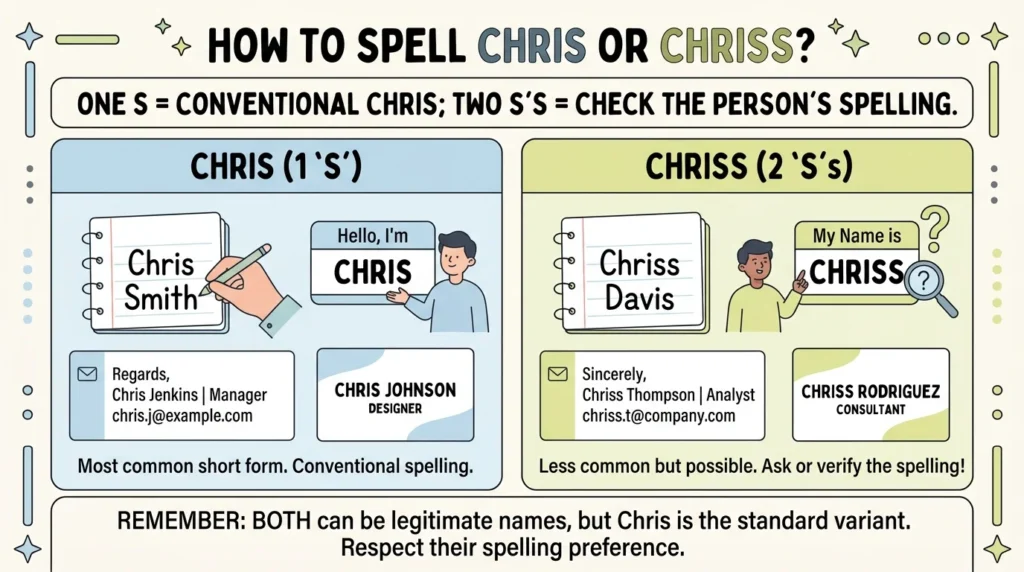
- Chris = the standard, familiar spelling.
- Chriss = a legitimate but less common spelling or surname.
- Chris and Chriss are pronounced essentially the same in ordinary English usage.
- If you know the person’s name is spelled Chriss, do not “correct” it to Chris.
- If you are choosing the conventional spelling for a nickname such as Christopher, Chris is normally the appropriate choice.
Why It Matters
Names are different from ordinary words because spelling is part of a person’s identity.
If someone’s name is Chris, writing Chriss can make their name look incorrect. If their name is Chriss, changing it to Chris can be equally incorrect.
This matters in everyday situations such as:
- Writing someone’s name in an email
- Addressing a customer
- Preparing a business document
- Creating a certificate
- Completing a school record
- Writing a social-media post
- Sending an invitation
- Referring to an employee
- Booking a reservation under someone’s name
- Citing a person in an academic or professional document
For example:
Please send the report to Chris.
If the person’s actual name is Chriss, however, the correct sentence is:
Please send the report to Chriss.
The grammar has not changed. The person’s name has.
The Core Rule
Use Chris as the normal spelling of the common short name. Use Chriss when that is the person’s established spelling or when the name itself is specifically written that way.
There is no general English spelling rule saying that Chriss is always wrong.
Likewise, there is no rule saying that every person whose full name is Christopher must use Chris. A person’s chosen or legal name takes priority.
How to Use Chris
Chris is widely used as a standalone first name and as a short form of longer names.
Oxford’s learner dictionary lists Chris as a first name for boys or girls and identifies it as short for Christopher, Christina, or Christine. Cambridge likewise identifies Chris as a short form associated with Christopher.
Chris as a short form
The most familiar use is as a shortened form of Christopher:
Christopher arrived early.
Chris arrived early.
Both refer to the same person if Christopher prefers the short form Chris.
Chris can also be associated with feminine names such as Christina and Christine:
Christina prefers to be called Chris.
The important point is that a shortened name is not automatically informal in every situation. If a person introduces themselves as Chris, you can normally address them as Chris unless there is a reason to use their full name.
Chris as a standalone name
Chris can also be the person’s actual first name rather than merely a nickname.
For example:
Chris joined the company in 2024.
You do not need to expand Chris to Christopher unless you know that Christopher is the person’s full name.
How to Use Chriss
Chriss is less common than Chris, but it is a real spelling.
Name references identify Chriss as a variant spelling of Chris, while surname sources document Chriss as an established family name.
For that reason, treating every occurrence of Chriss as a typographical error would be inaccurate.
For example:
Marquese Chriss is the correct spelling of the basketball player’s surname.
In this case, changing Chriss to Chris would change the person’s name.
Similarly:
Ms. Chriss will lead the meeting.
If her name is officially spelled Chriss, the double s must remain.
Correct Examples
Here are examples showing how the two spellings work in real situations.
- Chris will call you after the meeting.
- Please send the document to Chris before Friday.
- I met Chris at the conference last week.
- Chris is responsible for the marketing presentation.
- Could you ask Chris to review this email?
- Thank you, Chris, for helping with the project.
- The certificate was issued to Chriss Johnson.
- Please make sure Chriss’s name is spelled correctly on the form.
- I noticed that her email signature says “Chriss,” not “Chris.”
- If the employee’s official name is Chriss, use that spelling in company records.
- Christopher introduced himself as Chris during the interview.
- Chris asked the teacher a question after class.
The important lesson is that context does not determine the spelling of a person’s name; the person’s established spelling does.
Incorrect vs. Correct
| ❌ Incorrect | ✅ Correct | Why |
|---|---|---|
| I spoke with Chriss yesterday. | I spoke with Chris yesterday. | Use Chris if that is the person’s actual spelling. |
| Chris Johnson asked me to call him. | Chriss Johnson asked me to call him. | If his name is officially Chriss, the extra s must remain. |
| Christopher is usually written as Chriss. | Christopher is usually shortened to Chris. | Chris is the conventional short form. |
| Please send this to Chriss. | Please send this to Chris. | Correct only if the person’s name is Chris. |
| Please change Chriss to Chris. | Keep Chriss as written. | A person’s chosen spelling should not be “corrected.” |
| Dear Chriss, | Dear Chris, | Use the spelling the recipient actually uses. |
| Her name is Chris, but I wrote Chriss. | Her name is Chris, and I wrote Chris. | Chriss adds an s that is not part of her name. |
| His surname is Chris. | His surname is Chriss. | Use the documented family name. |
| I met Chris Chriss at the event. | I met Chris Chriss at the event. | Both forms can legitimately appear in the same person’s full name. |
| Chriss is always wrong. | Chriss is a legitimate name spelling. | Chriss exists as both a variant given-name spelling and surname. |
Why People Make This Mistake
The confusion is understandable because Chris and Chriss look almost identical.
1. The pronunciation is similar
In normal English pronunciation, the two spellings do not provide an obvious spoken distinction.
That means listeners cannot necessarily tell whether someone spells their name Chris or Chriss.
You may hear:
“My name is Chris.”
But you cannot safely infer the spelling from the sound alone.
2. The extra s looks like a spelling variation
English contains many names with spelling variants. Once people see Chriss, they may assume that the extra s is either a mistake or a deliberate variation.
In some cases, it is indeed a person’s established spelling.
3. Autocorrect can create confusion
Spellcheckers are designed to identify patterns that look unusual.
Because Chris is much more familiar than Chriss, software may flag or change Chriss even when Chriss is a person’s correct name.
This is one reason you should not blindly accept every spelling suggestion involving proper names.
4. People overgeneralize spelling rules
Learners sometimes assume that adding s makes a name possessive or changes its pronunciation.
That is a separate issue.
Chris, Chriss, and possessive forms such as Chris’s belong to different questions.
5. Translation can add another layer
Different languages may use forms such as Cris or Kris for names related to Christopher or Christian. This can make the spelling landscape even more confusing.
The key is to reproduce the spelling used by the person or source you are referring to.
Read More: Infront vs In Front: Which Is Correct?
Common Mistakes Checklist
Mistake 1: Assuming Chriss is always a typo
It is not.
Chriss is a documented spelling and surname.
How to avoid it: Check the person’s actual name before changing it.
Mistake 2: Assuming Chris is always short for Christopher
Chris can also be associated with Christina and Christine, and it can function as a person’s established first name.
How to avoid it: Do not automatically expand someone’s name.
Mistake 3: Changing a person’s spelling to the “common” version
Common does not mean universally correct.
How to avoid it: Treat a proper name as a fixed identifier.
Mistake 4: Trusting spellcheck more than the person
A software dictionary may recognize Chris while failing to recognize Chriss.
How to avoid it: Add unusual but legitimate names to your personal or company dictionary when appropriate.
Mistake 5: Confusing spelling with possessive grammar
The question Chris or Chriss? is different from Chris’ or Chris’s?
The first concerns the spelling of a name. The second concerns how to form a possessive.
How to avoid it: Identify the actual grammar question before applying a rule.
Chriss vs. Chris in Real English
Chris: grammatically possible, natural, and conventional
Chris is the familiar spelling most readers will expect when encountering the shortened name associated with Christopher. It is also recognized as a first name in its own right. In ordinary English writing, there is nothing unusual about using Chris as a person’s name. It is the safest conventional spelling when you are choosing the common short form yourself.
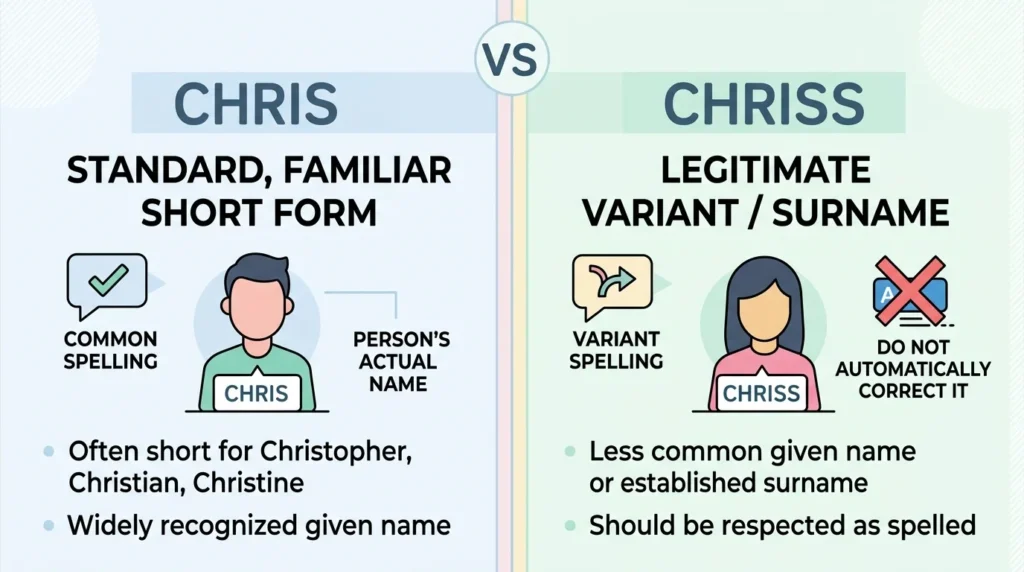
Chriss: grammatically possible and natural when it is someone’s name
Chriss is not the conventional spelling most people would choose when shortening Christopher, but it can be completely natural when it is someone’s established name. It is also documented as a surname. Therefore, calling Chriss “incorrect English” would be misleading. The right question is not whether the spelling looks unusual, but whether it accurately represents the person’s name.
Writing Chriss when you mean the usual short form
If you are simply writing a nickname for Christopher and have no reason to use an unusual spelling, Chris is the natural choice.
For example:
Christopher → Chris
rather than:
Christopher → Chriss
However, this does not mean you can correct an individual named Chriss.
American vs. British English
There is no meaningful American-versus-British spelling rule that changes Chris into Chriss.
The difference here is primarily about the individual spelling of a name, not a standard regional English rule.
Oxford lists Chris as a first name in its English learner dictionary, while surname sources document Chriss independently.
So it would be inaccurate to say:
“Chris is American English, while Chriss is British English.”
That is not a reliable distinction.
Formal vs. Informal Usage
The spelling Chris itself is not simply an informal spelling.
It is a recognized first name and can be used in professional contexts when that is the person’s name.
For example:
Dear Chris,
is perfectly appropriate in a professional email if the recipient uses Chris.
Similarly:
Chris Patel, Managing Director
is entirely appropriate if that is the person’s professional name.
The same principle applies to Chriss.
If someone’s professional name is Chriss, use:
Dear Chriss,
Do not change it to Chris merely because Chris is more common.
The distinction between Chris and Chriss is therefore not fundamentally a formal-versus-informal distinction.
Comparison Table
| Feature | Chris | Chriss |
|---|---|---|
| Standard common spelling | Yes | No |
| Recognized as a first name | Yes | Yes |
| Common short form of Christopher | Yes | Less conventional |
| Associated with Christina/Christine | Yes | Can occur as a variant |
| Can be a surname | Yes | Yes |
| Double s | No | Yes |
| Pronunciation normally distinguishes it | No | No |
| Can be a person’s official spelling | Yes | Yes |
| Should you change it automatically? | No | No |
| Best choice when choosing the conventional short form | Chris | Usually not |
| Correct when that is the person’s actual name | Yes | Yes |
What About Chris, Chriss, Cris, and Kris?
You may encounter several related spellings.
| Spelling | Typical status |
|---|---|
| Chris | Standard and very familiar form |
| Chriss | Variant spelling and established surname |
| Cris | Variant spelling used as a personal name |
| Kris | Another established variant |
| Christopher | Full given name commonly shortened to Chris |
These forms should not be treated as interchangeable when referring to a particular person.
For example, if someone’s passport, professional profile, or published work says Kris, you should not change it to Chris simply because Chris is more familiar.
Memory Trick
Remember:
One S? Think standard Chris.
Two S’s? Think specific person.
If you are choosing the ordinary short form of Christopher, remember Chris.
If you see Chriss, stop before correcting it. It may be the person’s actual spelling.
Real-Life Situations
1. In an email
You receive an email signature reading:
Chriss Ahmed
Your reply should begin:
Hi Chriss,
not:
Hi Chris,
The signature gives you the person’s preferred spelling.
2. In a workplace directory
The employee’s official record says:
Chris Wilson
Use Chris consistently throughout company documents.
3. In a school assignment
A student writes:
Chris Evans gave the presentation.
Do not change Chris to Christopher unless the assignment requires the person’s full name.
4. In a social-media post
A friend uses the username and displayed name Chriss.
If you tag or mention them, preserve the spelling they use.
5. In an interview
A candidate says:
“My name is Christopher, but everyone calls me Chris.”
In ordinary conversation, Chris is appropriate.
Read More: Challenge vs Challange: Which Is Correct?
6. On an official form
If an identification document gives the name as Chriss, reproduce Chriss exactly when the form requires the legal name.
7. In academic writing
If you are citing a researcher whose surname is Chriss, preserve the published spelling.
8. In casual conversation
If your friend introduces themselves as Chris, there is no reason to write Chriss.
9. When creating a character
If you are inventing a character and want the conventional short form of Christopher, Chris is the familiar choice.
10. When checking someone else’s spelling
Do not assume the unusual-looking version is wrong. Ask:
“Could you confirm how you spell your name?”
That is safer than guessing.
Expert Tips
Tip 1: Proper names are not ordinary spelling exercises
A spelling that looks unusual can still be correct because names are often inherited, chosen, or officially recorded in specific forms.
Tip 2: Check the person’s own spelling
For emails, business documents, social profiles, and publications, the person’s own spelling is the strongest practical guide.
Tip 3: Do not confuse frequency with correctness
Chris is more familiar and conventional. That does not make every occurrence of Chriss incorrect.
Tip 4: Preserve surnames exactly
If a person’s surname is Chriss, changing it to Chris is not an improvement in English. It is an error in identification.
Tip 5: Do not rely completely on spellcheck
A name can be legitimate even if your word processor marks it as unfamiliar.
Tip 6: Ask when accuracy matters
If a name appears on a certificate, contract, academic publication, legal document, or professional profile, verify the spelling rather than guessing.
Tip 7: Keep the question separate from possessives
If you are asking whether to write Chris or Chriss, you are dealing with the name’s spelling.
If you are asking whether to write Chris’ or Chris’s, you are dealing with possession.
Those are different questions.
Read More: Parents vs Parent: What Is the Difference?
FAQ
Is Chris the correct spelling?
Chris is the standard and most familiar spelling of the short name associated with Christopher and can also be associated with Christina or Christine.
Is Chriss a real name?
Yes. Chriss is a documented variant spelling and is also an established surname.
Is Chriss a misspelling of Chris?
Not necessarily. If someone intentionally has the name Chriss, then Chriss is the correct spelling of that person’s name.
Should Christopher be shortened to Chris or Chriss?
The conventional short form is Chris. Oxford and Cambridge both recognize Chris as a short form associated with Christopher.
Are Chris and Chriss pronounced differently?
They are not normally distinguished by pronunciation in ordinary English. The main difference is their written form.
Can Chriss be a surname?
Yes. Chriss is an established surname documented in genealogical and surname sources.
Is Chris a male or female name?
It can be used for both. Oxford describes Chris as a first name for boys or girls and associates it with Christopher, Christina, and Christine.
Should I correct someone who writes Chriss?
No. First determine whether Chriss is their actual name. If it is, preserve their spelling.
Is Chriss more formal than Chris?
No. The extra s does not automatically make a name more formal. The difference is primarily spelling.
Is Chriss a British spelling of Chris?
No. It is misleading to treat the two as a simple British-versus-American spelling pair. Chriss exists as a variant and surname, while Chris is the standard familiar form.
Which spelling should I use for a character named Christopher?
If you want the conventional nickname, use Chris unless the character is specifically intended to use another spelling.
What is the easiest way to remember Chris vs. Chriss?
Remember: Chris is the conventional short form; Chriss is a legitimate variant that should be preserved when it belongs to a specific person.
Mini Quiz
| # | Question | Answer | Explanation |
|---|---|---|---|
| 1 | Which is the conventional short form of Christopher: Chris or Chriss? | Chris | Chris is the established short form of Christopher. |
| 2 | True or false: Chriss is always a spelling mistake. | False | Chriss is a legitimate name spelling and surname. |
| 3 | Fill in the blank: “Please ask ___ to call me.” The person’s name is Chris. | Chris | Use the person’s actual spelling. |
| 4 | Fill in the blank: “The customer’s surname is ___.” Their official record says Chriss. | Chriss | Preserve the documented surname. |
| 5 | Which is correct if someone introduces herself as “Chriss”? | Chriss | A person’s established spelling takes priority. |
| 6 | Correct this sentence: “Christopher is usually shortened to Chriss.” | Christopher is usually shortened to Chris. | Chris is the conventional short form. |
| 7 | True or false: Chris can be used as a first name in its own right. | True | Chris is recognized as a first name as well as a short form. |
| 8 | Which spelling should you use if a colleague’s email signature says “Chriss”? | Chriss | Use the spelling the person uses. |
| 9 | Is Chris vs. Chriss mainly an American-versus-British spelling difference? | No | The distinction is not a standard regional English spelling rule. |
| 10 | Complete the rule: “Use Chris for the conventional short form; use Chriss when ___.” | it is the person’s established spelling | Names should be reproduced accurately. |
Quick Summary
Chris is the standard and familiar spelling of the short name associated with Christopher, Christina, and Christine. Chriss is also a legitimate spelling, but it is less common and is documented both as a variant personal name and as a surname. The most important rule is simple: if you are choosing the conventional short form yourself, Chris is normally the right choice. If you are referring to a person whose name is officially or consistently spelled Chriss, keep the double s. Do not treat unusual names as automatic spelling errors. Names belong to individuals, so the person’s established spelling matters more than which version is more common.