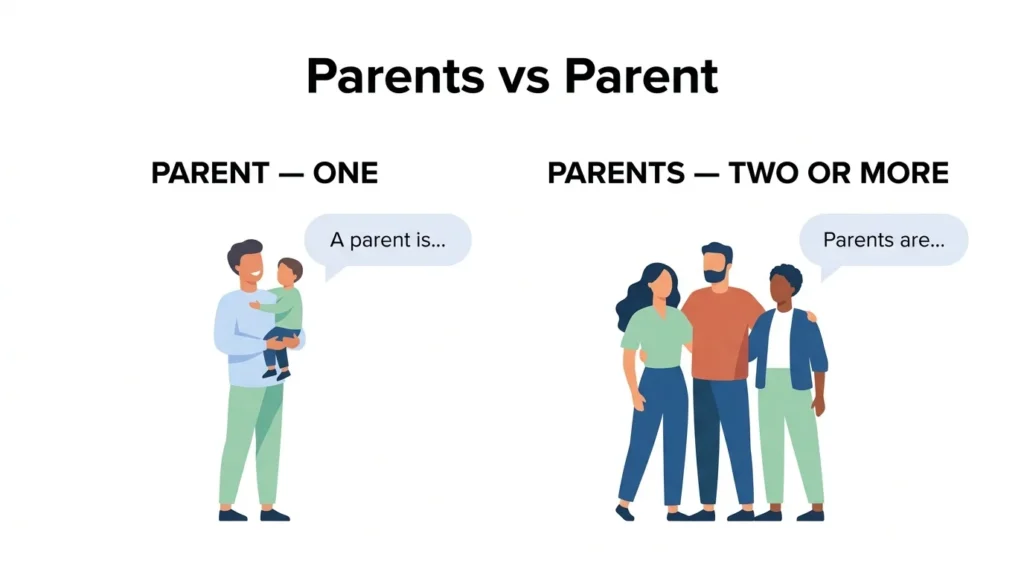

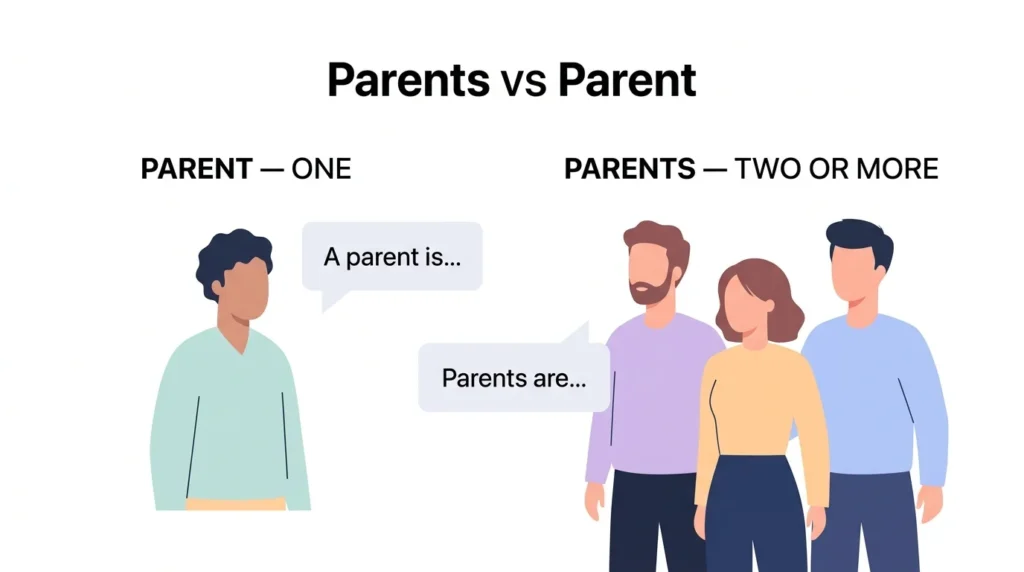
Parent means one parent, while parents means more than one parent. For example, “A parent must sign the form” refers to one parent, while “The parents must sign the form” refers to two or more parents. The choice affects the verb, pronoun, and meaning of the sentence. If possession is involved, use parent’s for one parent and parents’ for two or more parents.
What Is the Difference Between Parent and Parents?
Parent is a singular countable noun. It refers to one person who is a mother, father, adoptive parent, foster parent, or another person who performs a parental role. Parents is the plural form and refers to two or more parents.
A dictionary definition describes a parent as a mother or father, or someone who cares for another person in a parental role. The noun is countable, so it can have both singular and plural forms.
Compare:
- one parent
- two parents
- a parent
- several parents
- the parent
- the parents
The key difference is number.
When you are talking about one person, use parent. When you are talking about more than one person, use parents.
Parent
Use parent when you mean one person.
A parent should attend the meeting.
Here, the sentence refers to one parent at a time or requires only one parent.
Parents
Use parents when you mean two or more people.
The parents attended the meeting.
Here, more than one parent attended.
Importantly, parents does not always mean a child’s biological mother and father specifically. It can refer to multiple people who have parental responsibility or perform a parental role. The exact meaning comes from context.
Why It Matters
Choosing between parent and parents is not just a spelling choice. It changes the number of people your sentence refers to and can change the verb that follows.
Compare:
A parent is responsible for completing the form.
The parents are responsible for completing the form.
The first sentence has a singular subject, so it uses is. The second has a plural subject, so it uses are.
This matters in:
- school notices
- permission forms
- workplace policies
- legal documents
- academic writing
- emails
- applications
- social media posts
- family communication
- professional instructions
A sentence such as “Parents is responsible” contains a subject-verb agreement error. The plural noun parents requires a plural verb: “Parents are responsible.”
The Core Rule
Use parent for one person and parents for two or more people.
Parent → singular
Parents → plural
The same distinction applies to verbs:
- A parent is attending.
- Parents are attending.
- The parent has signed the form.
- The parents have signed the form.
- A parent does not need to attend.
- Parents do not need to attend.
Because parent is a countable noun, English allows singular and plural forms.
How to Use Parent and Parents
Use “parent” for one person
Use parent when the sentence describes one specific parent or one parent as a general example.
The parent called the teacher.
Only one parent is being discussed.
Every parent should check the school calendar.
Here, every takes a singular noun, so parent is correct.
A parent must sign the permission slip.
The article a can only be used with a singular countable noun.
Use “parents” for two or more people
Use parents when the sentence refers to multiple parents.
The parents attended the ceremony.
Many parents have complained about the schedule.
Both parents signed the document.
Several parents volunteered for the event.
Words such as both, many, several, these, those, and numbers greater than one commonly signal a plural noun.
Be careful with “each” and “every”
Each parent and every parent are singular.
Correct:
Each parent is responsible for one form.
Every parent receives an email.
Incorrect:
Each parents is responsible for one form.
The words each and every refer to members individually, so they take a singular countable noun.
Correct Examples
Here are examples from everyday conversation, school, work, email, social media, and academic contexts.
- My parent is waiting outside the school.
One parent is waiting. - My parents are visiting this weekend.
More than one parent is visiting. - A parent must sign the permission form.
One parent is required to sign it. - Both parents attended the graduation ceremony.
Two parents attended. - The teacher spoke with the parent after class.
The teacher spoke with one parent. - The teacher emailed the parents about the exam.
The email was sent to multiple parents. - Every parent should read the school policy.
“Every” requires the singular noun parent. - Several parents joined the meeting online.
“Several” requires the plural parents. - Please ask a parent or guardian to sign the form.
One parent is sufficient. - Parents are encouraged to attend the annual meeting.
The invitation is addressed to multiple parents generally. - One parent raised an important question during the meeting.
The sentence identifies one person. - The parents discussed the issue with the principal.
Multiple parents discussed it.
Read More: Well Deserved vs. Well-Deserved: Which Is Correct?
Incorrect vs. Correct
| ❌ Incorrect | ✅ Correct | Why |
|---|---|---|
| My parents is here. | My parents are here. | Parents is plural, so it takes are. |
| A parents is required to sign. | A parent is required to sign. | A must be followed by a singular countable noun. |
| Every parents should attend. | Every parent should attend. | Every takes a singular noun. |
| The parent are waiting. | The parent is waiting. | Parent is singular, so use is. |
| Both parent attended. | Both parents attended. | Both refers to two people and requires a plural noun. |
| Several parent complained. | Several parents complained. | Several requires a plural noun. |
| My parents was happy. | My parents were happy. | A plural subject takes were in the past tense of be. |
| One of my parent lives abroad. | One of my parents lives abroad. | The phrase one of is followed by a plural noun. |
| The parents has arrived. | The parents have arrived. | Parents is plural, so use have. |
| A parents meeting is tomorrow. | A parent meeting is tomorrow. | Here parent is functioning as a modifier, not as a plural noun. |
Why People Make This Mistake
The words look almost identical
The only visible difference between parent and parents is the final s. That small change carries an important grammatical meaning: singular versus plural.
Speech can make the distinction less obvious
In normal conversation, the final sound in parents may be easy to miss, especially when people speak quickly. Learners may therefore rely on context rather than clearly hearing the plural ending.
People overgeneralize the plural
A common mistake is assuming that talking about children automatically means talking about parents.
But that is not always true.
A parent must sign the form.
A child may have two parents, but the school may require only one signature. The correct noun depends on what the sentence actually means.
Possessives add another layer
The forms parent, parents, parent’s, and parents’ look similar but have different grammatical functions.
For example:
My parent is here.
My parents are here.
My parent’s car is outside.
My parents’ car is outside.
The apostrophe is especially confusing because it can indicate possession rather than plurality. Standard possessive rules use ’s after a singular noun and an apostrophe after a regular plural noun ending in s.
Spellcheck cannot always understand your intended meaning
Grammar software can identify some agreement errors, but it cannot always know whether you mean one parent or multiple parents.
For example:
I spoke with my parent.
I spoke with my parents.
Both are grammatically correct. The intended meaning determines the correct choice.
Common Mistakes Checklist
1. Using “parents” after “a”
❌ a parents
✅ a parent
The indefinite article a is used with a singular countable noun.
2. Using “parent” after “both”
❌ both parent
✅ both parents
Both refers to two people or things, so the noun should be plural.
3. Using a singular verb with “parents”
❌ My parents is coming.
✅ My parents are coming.
The subject parents is plural.
4. Using a plural noun after “every”
❌ Every parents
✅ Every parent
Every focuses on people individually and takes a singular countable noun.
5. Confusing “parent” with “parent’s”
❌ My parent car is outside.
✅ My parent’s car is outside.
If the car belongs to one parent, parent’s is the singular possessive form.
6. Confusing “parents” with “parents’”
❌ My parents house is large.
✅ My parents’ house is large.
If the house belongs to both parents, use the plural possessive parents’.
7. Using “one of my parent”
❌ One of my parent
✅ One of my parents
The structure one of + plural noun is standard English.
8. Assuming “parents” always means two people
Parents means two or more parents. It can refer to a larger group, not only a particular mother and father.
The parents at the meeting had different concerns.
This could refer to many parents.
Parent vs. Parents in Real English
Parent: grammatically correct and natural
I spoke to a parent after the meeting.
This is completely natural when one parent is involved or when the speaker means any one member of a group. The singular form is especially common after words such as a, one, each, every, another, and one particular.
Parents: grammatically correct and natural
The parents are waiting outside.
This is natural when more than one parent is involved. It is also common when referring generally to parents as a group.
Parents often want clear information from schools.
Here, parents refers to parents in general.
“A parent” can describe a general situation
A parent should listen carefully to a child’s concerns.
This does not necessarily mean one particular parent. It can describe what any parent should do.
This is an important point for learners: singular does not always mean one specific person. English can use a singular countable noun after a to make a general statement.
“Parents” can also be general
Parents should communicate with teachers.
This refers to parents as a general group.
Both forms can therefore express general ideas:
A parent should communicate with teachers.
Parents should communicate with teachers.
Both can be grammatically correct. The choice depends partly on how the writer wants to frame the generalization.
American vs. British English
There is no meaningful American-versus-British difference in the basic singular/plural rule for parent and parents.
Both varieties use:
- parent for singular
- parents for plural
- parent’s for singular possession
- parents’ for plural possession
Pronunciation can vary between American and British English, but the grammatical distinction remains the same. Cambridge gives different UK and US pronunciation forms while treating parent as a countable noun meaning a mother, father, or equivalent caregiver.
Formal vs. Informal Usage
The basic forms parent and parents work in both formal and informal English.
Formal:
Parents are required to submit the completed form by Friday.
Informal:
My parents are coming over tonight.
The difference is not in the word itself. Formality usually comes from the surrounding vocabulary, sentence structure, and situation.
In professional or institutional writing, parent or guardian is also common when the writer wants to make clear that the responsible adult does not necessarily have to be a biological parent.
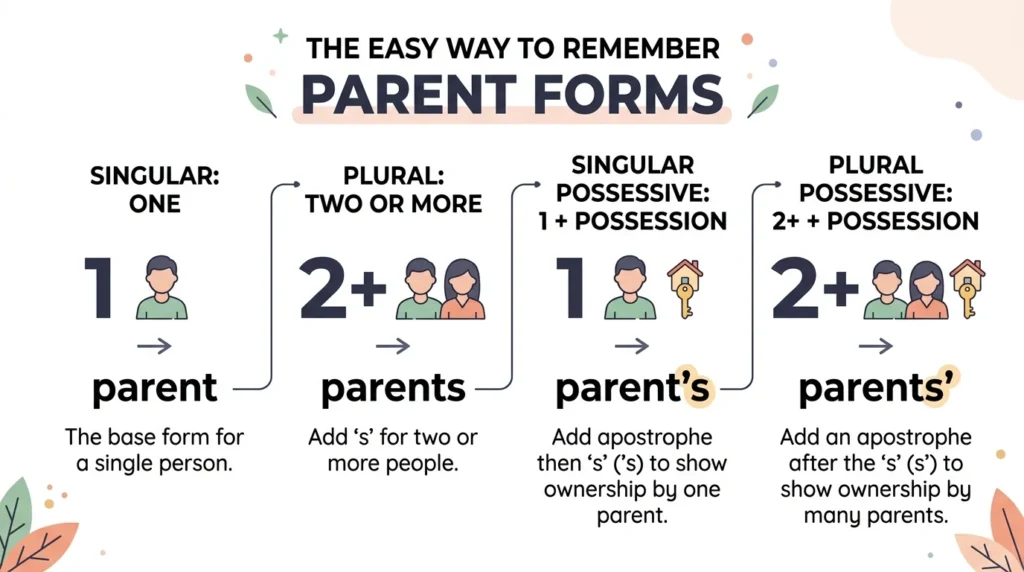
Parent, Parents, Parent’s, and Parents’: Comparison Table
| Form | Number | Possession? | Example | Meaning |
|---|---|---|---|---|
| parent | Singular | No | A parent called. | One parent |
| parents | Plural | No | The parents called. | Two or more parents |
| parent’s | Singular | Yes | The parent’s phone rang. | Something belonging to one parent |
| parents’ | Plural | Yes | The parents’ phones rang. | Something belonging to two or more parents |
The most useful question is:
How many parents are you talking about?
If the answer is one, start with parent.
If the answer is two or more, start with parents.
If you are showing possession, then add the appropriate apostrophe:
- one parent → parent’s
- two or more parents → parents’
Read More: Onethird vs One Third: Which Is Correct?
Parent’s vs. Parents’: The Apostrophe Rule
This is one of the most common sources of confusion.
Parent’s
Parent’s is the singular possessive form.
The parent’s signature is required.
The signature belongs to one parent.
I found the parent’s phone number.
The phone number belongs to or is associated with one parent.
Parents’
Parents’ is the plural possessive form.
The parents’ meeting begins at 6 p.m.
The meeting involves or is associated with multiple parents.
The parents’ concerns were discussed.
The concerns belong to or are associated with multiple parents.
Cambridge’s possessive guidance follows the standard distinction: singular nouns generally take ’s, while plural nouns ending in s take an apostrophe after the s.
Parent’s and parents’ can sound the same
In many varieties of English, parent’s and parents’ are pronounced alike or nearly alike in ordinary speech.
That means you cannot always determine the spelling from sound alone.
You need to ask:
Is the possession connected to one parent or multiple parents?
Memory Trick
Use this simple four-step memory trick:
Parent = one.
Parents = more than one.
Parent’s = one owns or is connected to something.
Parents’ = more than one owns or is connected to something.
Think of the apostrophe as showing possession, not plurality.
The s in parents already makes the noun plural.
So:
parent → parents → parents’
But:
parent → parent’s
Real-Life Situations
At school
A parent must sign the permission form.
Use parent because one signature is sufficient.
In a school announcement
Parents are invited to attend the open house.
Use parents because the invitation is directed to multiple parents.
In an email
Dear Parents,
This is appropriate when writing to a group of parents.
In a conversation
My parent is picking me up today.
Use parent if only one parent is doing the pickup.
My parents are picking me up today.
Use parents if more than one parent is involved.
In a workplace
Employees may request parental leave according to company policy.
Here, parental is an adjective meaning related to a parent or parents. It is not the plural form of parent.
In an academic paper
The study examined how parents influence children’s reading habits.
The plural form is appropriate because the study discusses parents as a group.
In a text message
My parents said I can come.
The plural form refers to more than one parent.
On social media
Parents often worry about how much screen time their children get.
The plural noun can refer to parents generally.
Expert Tips
Tip 1: Look at the word before the noun
Words such as a, an, each, every, one normally point you toward a singular noun:
every parent
one parent
a parent
Words such as both, many, several, these, those normally point you toward a plural noun:
both parents
many parents
several parents
Tip 2: Check the verb
If you see is, was, has, does, a singular subject may be required.
The parent is here.
If you see are, were, have, do, a plural subject may be required.
The parents are here.
This is not an absolute rule for every sentence because verbs can agree with other subjects, but it is a useful editing check.
Tip 3: Do not use an apostrophe to make a plural
❌ parent’s = not the normal plural of parent
✅ parents = plural
The apostrophe in parent’s changes the function of the word by marking possession or, in other contexts, a contraction.
Tip 4: Ask “one or more than one?”
When you are unsure, forget the spelling for a moment.
Ask:
How many parents do I mean?
One → parent
More than one → parents
Then check whether possession is involved.
Tip 5: Watch “one of”
The structure is:
one of + plural noun
So:
one of my parents
not:
one of my parent
This is a useful pattern well beyond this particular word.
Tip 6: “Parent” can be a general noun
Do not assume that a parent always identifies one specific individual.
A parent needs to be patient.
This can express a general idea about parents.
FAQ
Is “parents” the plural of “parent”?
Yes. Parents is the regular plural form of parent. Use parent for one person and parents for two or more.
Is “parent” always singular?
When parent is being used as a noun, it is grammatically singular. However, a singular expression such as a parent can describe a general class of people rather than one particular individual.
Should I say “my parent” or “my parents”?
Both can be correct. Use my parent when referring to one parent and my parents when referring to two or more parents.
Is “my parents are” correct?
Yes. Parents is plural, so it normally takes the plural verb are.
My parents are at home.
Is “each parents” correct?
No. Use each parent.
Each parent receives a separate form.
Each takes a singular countable noun.
Is “one of my parent” correct?
No. Use one of my parents.
The structure one of + plural noun is required here.
Is “parent’s” the plural of “parent”?
No. Parent’s is normally the singular possessive form.
The parent’s car
means the car associated with one parent.
Is “parents’” correct?
Yes. Parents’ is the plural possessive form.
The parents’ car
normally means the car associated with two or more parents.
What is the difference between “parent’s” and “parents’”?
Parent’s refers to one parent possessing or being associated with something. Parents’ refers to two or more parents.
one parent’s decision
the parents’ decision
Can “parents” refer to more than two people?
Yes. Parents means two or more parents. It can refer to a group of many parents, not just a mother and father.
Is “parental” the same as “parents”?
No. Parental is an adjective meaning related to a parent or to parents.
parental responsibility
parental guidance
It is not simply another plural form of parent.
Quiz
| # | Question | Answer | Explanation |
|---|---|---|---|
| 1 | Choose: “A ___ must sign the form.” parent / parents | parent | “A” requires a singular countable noun. |
| 2 | Choose: “The ___ are waiting outside.” parent / parents | parents | “Are” agrees with the plural subject. |
| 3 | Fill in the blank: “Every ___ should register.” | parent | “Every” takes a singular noun. |
| 4 | Fill in the blank: “Both ___ attended the meeting.” | parents | “Both” refers to two people, so the noun is plural. |
| 5 | Correct the sentence: “My parents is coming tomorrow.” | My parents are coming tomorrow. | “Parents” is plural and takes “are.” |
| 6 | Choose: “I need my ___ signature.” parent’s / parents’ | parent’s | The sentence refers to one parent’s signature. |
| 7 | Choose: “The ___ meeting starts at six.” parent’s / parents’ | parents’ | The meeting is associated with multiple parents. |
| 8 | Fill in the blank: “One of my ___ lives abroad.” | parents | “One of + plural noun” is the required structure. |
| 9 | Correct the sentence: “Several parent complained about the schedule.” | Several parents complained about the schedule. | “Several” requires a plural noun. |
| 10 | Choose: “The ___ car is parked outside.” If the car belongs to both parents: parent’s / parents’ | parents’ | The plural possessive form shows association with multiple parents. |
Quick Summary
Parent is the singular form, while parents is the plural form. Use parent when you mean one person and parents when you mean two or more. The difference also affects verb agreement: a parent is, but parents are. When possession is involved, use parent’s for one parent and parents’ for multiple parents. Remember that parent’s is not the plural of parent; the plural is simply parents. Likewise, parents’ is not the same as parents because the apostrophe marks possession. The easiest way to remember the rule is: one parent, two parents; one parent’s, two parents’.