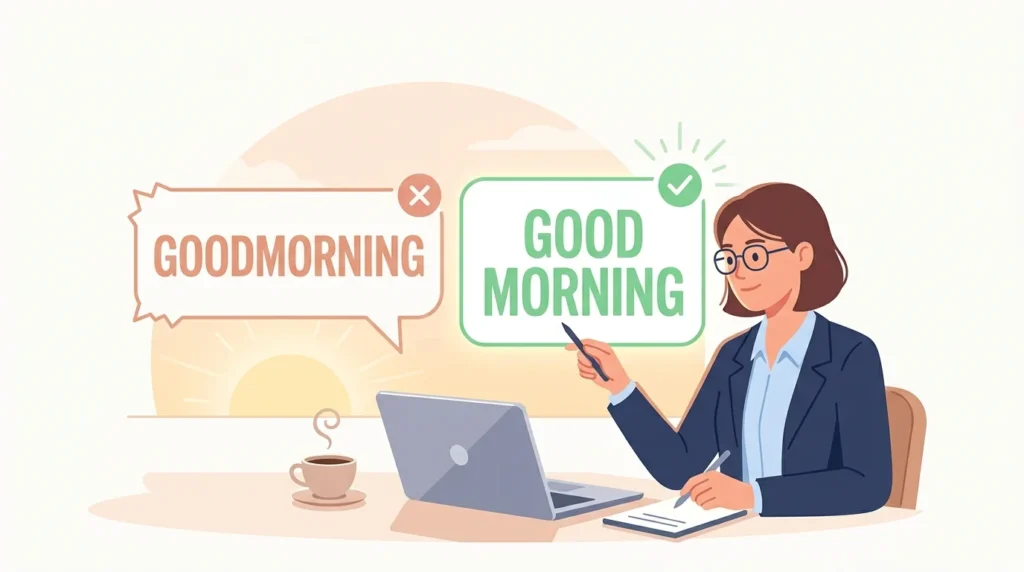

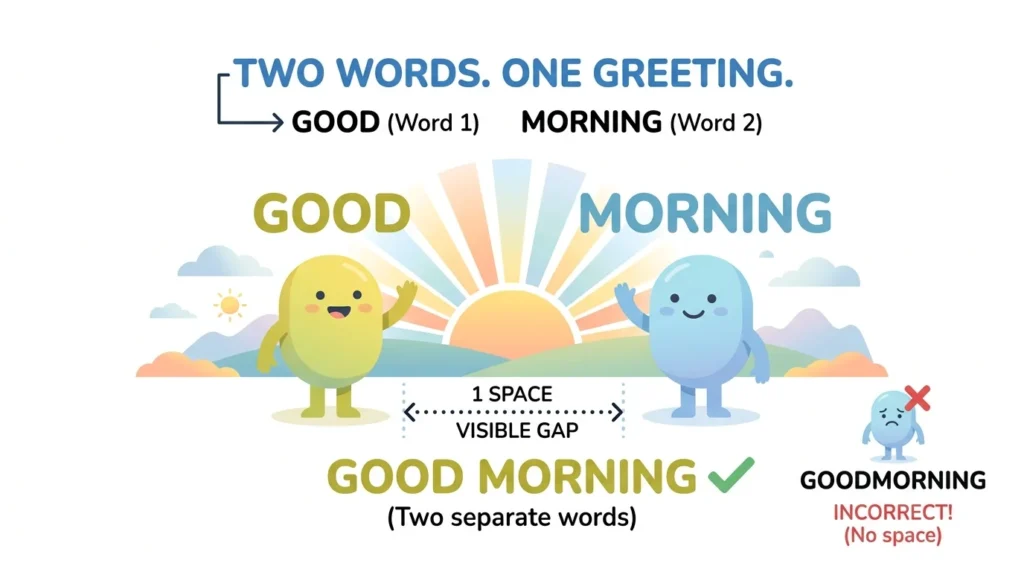
Good morning is the correct standard form. Write it as two words, not goodmorning. For example, write “Good morning, Sarah.” rather than “Goodmorning, Sarah.” The phrase can be used in both casual and professional English. In informal conversation, “Morning!” is also possible, but it does not change the standard spelling of good morning.
What Is “Good Morning”?
Good morning is a conventional greeting used when you meet or address someone during the morning. It can be used as a complete greeting or as the opening of a longer sentence.
For example:
- Good morning!
- Good morning, everyone.
- Good morning, Professor.
- Good morning. How are you today?
- Good morning, team. Let’s get started.
English dictionaries classify good morning as an exclamation or greeting expression rather than as a single closed word.
The important point is simple: good morning is written with a space.
Why Does the Spelling Matter?
A missing space may look like a tiny error, but small spelling and punctuation mistakes can become noticeable when you are writing for an employer, customer, teacher, client, or professional audience.
Compare:
Good morning, Mr. Ahmed.
with:
Goodmorning, Mr. Ahmed.
Both are understandable, but the first follows standard written English. The second looks like a typing or spacing mistake.
This matters especially in:
- Job applications
- Business emails
- Customer communication
- School assignments
- Reports
- Presentations
- Formal messages
- Professional social media posts
In a casual text between close friends, readers will probably understand goodmorning immediately. But understanding a nonstandard form does not make it the preferred spelling.
The Core Rule
Write “good morning” as two words when you mean the morning greeting.
The easiest rule is:
good + morning = good morning
Do not combine the two words into goodmorning in standard writing.
Why Are They Separate Words?
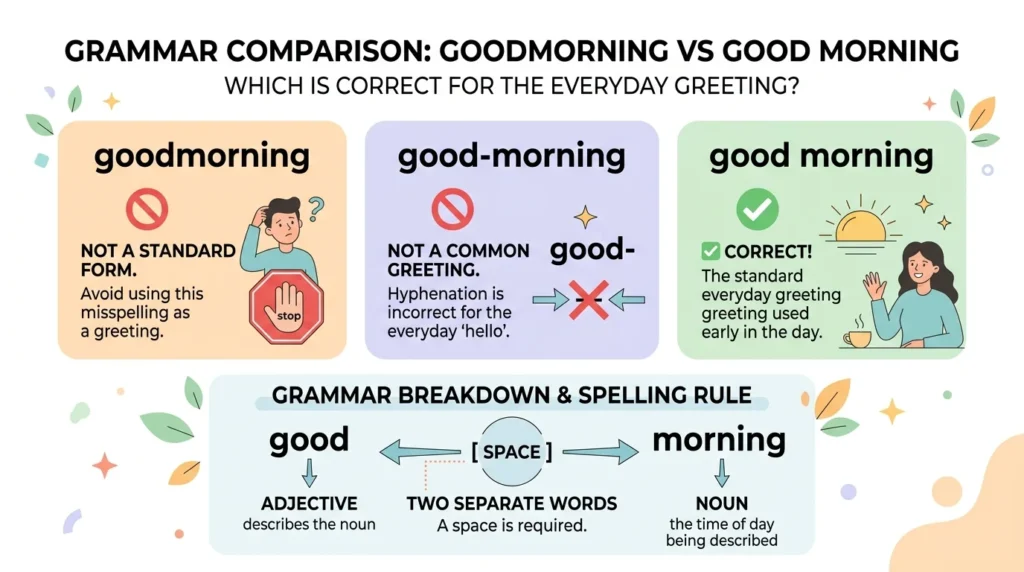
In the ordinary expression, good and morning are separate words with separate grammatical functions.
- Good is an adjective.
- Morning is a noun.
Together, they form the familiar expression good morning.
However, it is important not to oversimplify the rule by saying that every adjective + noun combination must always remain separate. English has many compounds that have developed into closed words. The spelling of a particular expression depends on established usage.
For this greeting, established standard usage is good morning.
Read More: In Line vs Inline: Which One Is Correct?
How to Use “Good Morning”
There are several common ways to use the expression.
1. As a Standalone Greeting
You can use it by itself.
Good morning!
This is perfectly natural in conversation.
2. Before a Person’s Name
When directly addressing someone, use a comma before the name.
Good morning, David.
Good morning, Maria.
The comma helps show that David or Maria is the person being addressed.
3. Before a Group
The same principle applies to groups.
Good morning, everyone.
Good morning, team.
Good morning, students.
4. At the Beginning of an Email
Good morning works well as an email greeting when you are writing during the morning.
Good morning, James,
I’m writing to follow up on yesterday’s meeting.
For professional communication, it is often a good choice when you know the recipient will receive the message in the morning.
5. In a Meeting
It is common to begin a meeting with:
Good morning, everyone. Thank you for joining us.
It can sound polite, professional, and welcoming without being overly formal.
6. In a Classroom
Teachers and students can use it naturally:
Good morning, class.
Good morning, Professor.
7. In Customer Service
A customer-service employee might say:
Good morning. How may I help you?
The phrase works because it is polite without sounding excessively formal.
Correct Examples
Here are original examples covering different situations.
Conversation
- Good morning! Did you sleep well?
- Good morning, Mom. I’ll have breakfast in a few minutes.
- Good morning, Daniel. I’ve attached the revised proposal.
- Good morning, Ms. Patel. Thank you for your response.
Workplace
- Good morning, team. Our meeting will begin at nine.
- Good morning, everyone. Let’s review yesterday’s results.
School
- Good morning, Professor. I have a question about the assignment.
- Good morning, class. Please open your books to page twenty.
Social Media
- Good morning, everyone! Wishing you a productive day.
- Good morning from Karachi!
Academic Writing
- The researcher greeted the participants with a polite “good morning.”
- She said “good morning” before beginning the interview.
Notice that the expression remains good morning even when it appears inside a sentence.
Incorrect vs. Correct
| ❌ Incorrect | ✅ Correct | Why |
|---|---|---|
| Goodmorning, everyone. | Good morning, everyone. | The standard greeting is written as two words. |
| Goodmorning, Sarah. | Good morning, Sarah. | A space is required between good and morning. |
| I said goodmorning to him. | I said good morning to him. | The greeting remains an open two-word expression. |
| Goodmorning team! | Good morning, team! | The greeting needs a space and the direct address is set off with a comma. |
| She sent me a goodmorning text. | She sent me a good morning text. | The standard phrase is two words. |
| GoodMorning everyone. | Good morning, everyone. | Joining the words and using internal capitalization are unnecessary. |
| goodmorning, Professor. | Good morning, Professor. | The greeting begins the sentence, so Good is capitalized. |
| I wished her a Good Morning. | I wished her a good morning. | Inside a sentence, the phrase normally stays lowercase. |
| Goodmorning. How are you? | Good morning. How are you? | The standard spelling uses a space. |
| We exchanged several goodmornings. | We exchanged several good mornings. | Even when used as a noun phrase, the standard form remains open. |
Why People Make the “Goodmorning” Mistake
The mistake is easy to understand because several factors work together.
1. Speech Does Not Show Spaces
When people speak, they do not hear spaces between words.
Good morning is normally pronounced as one smooth phrase. A learner may therefore assume that it is written as one word.
The same problem happens with many other expressions.
2. Fast Typing
When people type quickly, they sometimes remove spaces accidentally.
This is particularly common on phones, where people type with their thumbs and send messages without proofreading.
3. Familiar Compound Words
English contains many closed compounds:
- bedroom
- notebook
- football
- classroom
- afternoon
This can make goodmorning look plausible.
But English spelling cannot always be predicted by logic. Established usage determines whether a word is open, hyphenated, or closed.
Read More: Stigmatism vs. Astigmatism: Which Word Is Correct?
4. Social Media
Online content often uses compressed forms for visual style.
You may see:
- #goodmorning
- goodmorning
- GoodMorning
- GOODMORNING
A hashtag is a special case because spaces cannot normally be used inside a hashtag. Therefore, #goodmorning can function as a hashtag even though goodmorning is not the standard spelling of the greeting in ordinary prose.
5. Autocomplete and Spellcheck
Digital tools are useful, but they do not replace proofreading.
A spelling tool may recognize what you intended without teaching you why the form is correct. Some platforms also treat usernames, hashtags, or informal text differently from standard prose.
6. Translation Interference
Learners sometimes transfer word patterns from another language into English. If a learner’s first language commonly combines an equivalent expression into one word, goodmorning may feel more natural.
The safest approach is to learn the English expression as a complete unit:
good morning
Common Mistakes Checklist
Mistake 1: Joining the Words
Wrong: Goodmorning, John.
Correct: Good morning, John.
Why it happens: The phrase sounds like one continuous unit when spoken.
How to avoid it: Remember that the standard greeting has two visible words.
Mistake 2: Using a Capital “M”
Wrong: Good Morning, John.
Correct: Good morning, John.
When the greeting begins a sentence, capitalize Good, not automatically every word.
Mistake 3: Forgetting the Comma Before a Name
Wrong: Good morning Sarah.
Better: Good morning, Sarah.
The comma separates the greeting from the person being directly addressed.
Mistake 4: Writing “Goodmorning” in a Professional Email
Even if the recipient understands it, it can look like an unchecked typo.
Use:
Good morning, Mr. Khan.
Mistake 5: Assuming Online Frequency Means Standard Usage
Seeing a form repeatedly online does not automatically make it standard English.
Usernames, hashtags, branding, captions, and casual messages often follow different conventions.
“Good Morning” in Real English
Grammatically Correct
Good morning is grammatically correct and is the standard written form of the greeting. It works naturally in conversation, emails, meetings, classrooms, customer service, and many other settings. You can use it alone or before a person’s name or group. Dictionaries consistently list it as a morning greeting.
Grammatically Possible but Unnatural
Goodmorning may be understandable and may appear in informal digital contexts, usernames, hashtags, captions, or creative styling. However, that does not make it the normal spelling of the greeting in standard prose. If your goal is conventional English rather than branding or deliberate styling, there is no practical reason to remove the space.
Natural, Everyday English
Good morning is completely natural in everyday English. In very casual conversation, speakers may shorten it to “Morning!” Oxford specifically notes this informal shortening. The shorter form is a conversational alternative, not a spelling of goodmorning.
Is “Good-Morning” Correct?
For the ordinary greeting, good morning is the form you should use.
You may occasionally encounter good-morning in older texts or in specialized word formations. Historical and dictionary records show hyphenated and closed variants in some noun or verb uses, but these are not the normal modern spelling of the everyday greeting.
So if you are writing:
Good-morning, everyone.
do not use the hyphen.
Write:
Good morning, everyone.
American vs. British English
There is no important American-versus-British spelling difference for the ordinary greeting.
Both varieties use:
Good morning
The pronunciation differs somewhat between regional accents, but the standard written form remains the same. Cambridge provides both UK and US pronunciations while listing the same two-word expression.
There is also a small usage point worth knowing: in informal English, Morning! can be used as a shortened greeting. This is not a different American or British spelling of good morning.
Read More: Breakroom vs Break Room: Which Spelling Is Correct?
Formal vs. Informal Usage
Good morning works across a very wide range of situations.
| Situation | Recommended Form | Tone |
|---|---|---|
| Job interview | Good morning. | Professional |
| Business email | Good morning, Mr. Ali. | Professional |
| Meeting | Good morning, everyone. | Professional |
| Classroom | Good morning, class. | Respectful |
| Customer service | Good morning. How may I help you? | Polite |
| Friend | Good morning! | Casual |
| Text message | Good morning 😊 | Casual |
| Very casual conversation | Morning! | Informal |
The phrase itself is not restricted to formal English. Its tone depends heavily on the situation and what you say around it.
Good Morning vs. Morning
These expressions are related but not identical in tone.
Good morning is the complete conventional greeting.
Morning! is a shortened, informal greeting.
Compare:
Good morning, David. How are you?
with:
Morning, David!
Both can sound natural, but the second is more casual.
If you are writing to a client, professor, interviewer, senior colleague, or unfamiliar person, Good morning is usually the safer choice.
Good Morning vs. Good Afternoon vs. Good Evening
These expressions follow a similar pattern.
| Greeting | Typical Use | Spelling |
|---|---|---|
| Good morning | Morning greeting | Two words |
| Good afternoon | Afternoon greeting | Two words |
| Good evening | Evening greeting | Two words |
| Good night | Usually a farewell or wish for sleep | Two words |
Do not assume that because some other English words are closed compounds, these greetings should be combined.
Write:
- Good morning
- Good afternoon
- Good evening
- Good night
Not:
- Goodmorning
- Goodafternoon
- Goodevening
Read More: Unkept vs Unkempt: What Is the Difference?
What About “Good Morning” in an Email?
Good morning is a useful professional email opening when the timing makes sense.
For example:
Good morning, Ms. Ahmed,
I’m following up on the proposal we discussed yesterday.
Or:
Good morning, team,
Please find the updated schedule attached.
However, you do not have to use Good morning in every email sent before noon. If you want a greeting that works regardless of when the recipient reads the message, Hello is often a more time-neutral choice.
For example:
Hello, Ms. Ahmed,
This can be especially useful when you are communicating across different time zones.
Capitalization Rules for “Good Morning”
Capitalization depends on where the phrase appears.
At the Start of a Sentence
Capitalize Good:
Good morning, everyone.
In the Middle of a Sentence
Use lowercase unless another style rule requires capitalization:
She said good morning before taking her seat.
In a Heading
If you use title case for headings, you may see:
Good Morning: A Simple Greeting
But this is a heading-style decision, not evidence that morning should normally be capitalized in a sentence.
In All Caps
You may write:
GOOD MORNING!
for emphasis, design, signage, or visual effect.
That does not change the underlying spelling.
Real-Life Situations
Job Interview
Interviewer: Good morning. Please have a seat.
Candidate: Good morning. Thank you for having me.
Both speakers use the standard form.
Business Meeting
Good morning, everyone. Let’s begin with the sales report.
The greeting is professional and natural.
Good morning, Mr. Hassan,
I wanted to confirm our appointment for Thursday.
The two-word spelling is appropriate.
Text Message
Good morning! Hope you have a great day 😊
The same spelling works in casual communication.
School
Good morning, Professor. Could you explain question four?
Again, good morning remains two words.
Social Media
Good morning, everyone! What are you working on today?
The same standard spelling works even in a casual post.
Memory Trick
Use this simple mnemonic:
Good morning needs a little morning space.
Imagine the word morning arriving after good with enough space to breathe:
GOOD → space → MORNING
Or remember:
Two words. One greeting.
If you remember only one thing, remember that.
Expert Tips
1. Learn the Phrase, Not Just the Spelling
Do not memorize good and morning separately. Memorize the complete expression:
Good morning
This makes the correct spacing automatic.
2. Do Not Copy Social Media Spelling Blindly
Online language often removes spaces for hashtags, usernames, branding, or visual design.
Standard prose follows different conventions.
3. Use a Comma for Direct Address
If you greet a particular person, use a comma:
Good morning, Sarah.
Not:
Good morning Sarah.
4. Consider the Reader’s Time Zone
If you are sending an international email, the recipient may read it at a different time.
Hello can be useful when the exact time of reading is uncertain.
5. “Morning!” Is Not the Same as “Goodmorning”
If you want a casual shortened greeting, use:
Morning!
Do not create goodmorning as a shortcut.
6. Do Not Overthink the Greeting
The standard form is simple. You do not need a special spelling for professional, casual, academic, or personal use.
The same basic spelling works:
Good morning
Internal Linking Opportunities
Use these as natural internal-link anchors when the corresponding pages exist on your site:
- in front vs. infront
- in line vs. inline
- at least vs. atleast
- break room vs. breakroom
- midday vs. mid day
For a broader confused-words cluster, additional contextual anchors can include:
- common English spelling mistakes
- word vs. word differences
- English grammar rules
- common grammar mistakes
- correct word usage
- English punctuation rules
- capitalization rules
- professional English writing
- English writing tips
- confusing English words
- common mistakes in English
- ESL English grammar
- English vocabulary mistakes
- formal vs. informal English
- English proofreading tips
These anchors should point to genuinely relevant pages rather than unrelated articles. Avoid forcing an internal link simply to increase link count.
Mini Quiz
| # | Question | Answer | Explanation |
|---|---|---|---|
| 1 | Choose the correct form: Goodmorning / Good morning, everyone. | Good morning | The standard greeting is written as two words. |
| 2 | Fill in the blank: “_____ , Maria.” | Good morning | The greeting requires a space between good and morning. |
| 3 | Which is correct? A) GoodMorning B) Good morning C) Goodmorning | B | Good morning is the standard form. |
| 4 | Correct the sentence: “Goodmorning, team.” | Good morning, team. | Add the required space. |
| 5 | Which is more informal? A) Good morning! B) Morning! | B | Morning! is a shortened casual greeting. |
| 6 | Fill in the blank: “I said _____ to my neighbor.” | good morning | Inside a sentence, the phrase is normally lowercase. |
| 7 | Correct the punctuation: “Good morning Sarah.” | Good morning, Sarah. | A comma separates the direct address. |
| 8 | True or false: American English normally writes the greeting as goodmorning. | False | American English uses good morning. |
| 9 | Which is standard? A) Good-morning B) Good morning C) Goodmorning | B | The ordinary greeting is written as two words. |
| 10 | Correct the sentence: “She said Good Morning before class.” | She said good morning before class. | The phrase is inside the sentence, so it normally uses lowercase letters. |
FAQ
Is “goodmorning” a real English word?
Goodmorning can be found in some historical or specialized dictionary records, but it is not the standard spelling of the ordinary greeting. For normal modern writing, use good morning.
Can I use “goodmorning” in a text message?
You may see people use it in casual texts, captions, usernames, or stylized posts, and readers will usually understand it. However, if you want standard English, write good morning.
Is “good morning” one word or two?
It is two words in the standard greeting: good morning.
Should I capitalize “Morning” in “Good Morning”?
Normally, no. At the beginning of a sentence, capitalize Good and keep morning lowercase:
Good morning, everyone.
In a title using title case, capitalization may differ according to the title style being used.
Do you put a comma after “Good morning”?
If you are directly addressing someone, put a comma before the person’s name or title:
Good morning, Sarah.
Good morning, Professor.
If Good morning stands alone, no comma is needed:
Good morning!
Is “good-morning” correct?
Not for the ordinary modern greeting. Use good morning. Hyphenated forms can occur in historical or specialized uses, but they are not what you normally want when greeting someone.
Is “Morning!” grammatically correct?
Yes. Morning! is an informal shortened greeting. It is common in casual speech and is not the same thing as writing goodmorning.
Is “Good morning” formal or informal?
It can be either. It works in professional emails and meetings, but it is also completely normal when greeting friends or family.
Can I say “Good morning” to a group?
Yes. Common examples include:
Good morning, everyone.
Good morning, team.
Good morning, students.
Is “Good morning” used in both American and British English?
Yes. The standard written form is the same in both varieties. Regional pronunciation may differ, but the spelling does not.
What should I write instead of “Goodmorning” in a professional email?
Write:
Good morning, [Name],
For example:
Good morning, Ahmed,
I’m writing to confirm tomorrow’s meeting.
Can “good morning” appear inside a sentence?
Yes.
She smiled and said good morning.
It can also function as a noun phrase:
We exchanged good mornings before the meeting.
The ordinary greeting itself remains good morning.
Quick Summary
The correct standard form is good morning, written as two separate words. Goodmorning is not the normal spelling of the greeting in standard English, even though you may encounter it in informal digital communication, usernames, hashtags, or creative designs. Good morning works in almost any setting, from a friendly text to a business meeting or professional email. When directly addressing someone, use a comma: Good morning, Sarah. When the phrase appears in the middle of a sentence, it normally remains lowercase: She said good morning. In very casual speech, you can shorten it to Morning! The simplest memory trick is: two words, one greeting. When in doubt, always choose good morning.