
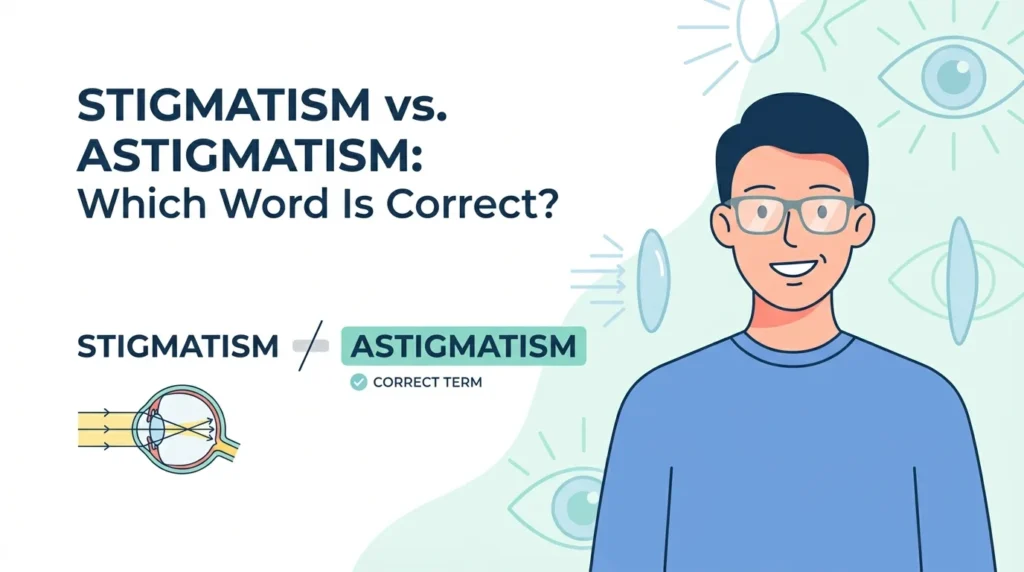

Astigmatism is the correct word for the common eye condition in which the cornea or lens has an uneven curvature, causing blurry or distorted vision. Stigmatism is a legitimate technical term in optics describing an optical system that forms a point image from a point source. In everyday health or vision writing, use astigmatism, not stigmatism.
What Is Stigmatism vs. Astigmatism?
The two words look and sound very similar, which makes them easy to confuse.
But they are not interchangeable.
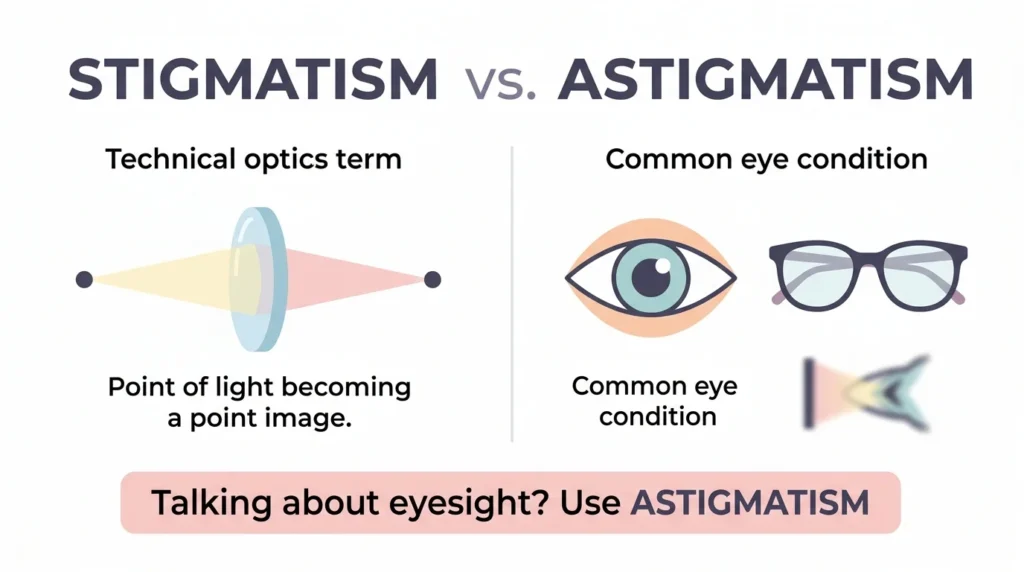
Astigmatism is the familiar medical and vision term. It describes a type of refractive error in which the eye does not bend light evenly because the cornea or lens has different curvatures in different directions. This can result in blurred or distorted vision.
Stigmatism, on the other hand, is a specialized optical term. In optics, a stigmatic system is one in which light from a single object point is focused onto a single image point. Dictionaries also record stigmatism in other specialized senses, including a condition involving stigmata.
That distinction matters because many online explanations oversimplify the issue by saying:
Stigmatism is wrong; astigmatism is right.
That is useful as a quick correction for someone talking about eyesight, but it is not the whole linguistic story.
The more accurate rule is:
Use astigmatism when you mean the common eye condition. Use stigmatism only when its specific technical meaning is intended.
Why It Matters
Using the wrong word can cause confusion, especially when you are discussing health, vision, education, or professional information.
Compare these sentences:
- “My eye doctor said I have astigmatism.”
- “My eye doctor said I have stigmatism.”
The first sentence uses the standard medical term for the refractive error. The second is likely to be understood as a mistaken version of astigmatism, even though stigmatism itself is a legitimate technical word.
The distinction becomes even more important in writing for:
- medical or health websites
- school assignments
- academic papers
- workplace communication
- emails to an eye-care professional
- patient information
- search queries
- educational materials
A single missing a can change the word you are using.
The Core Rule
Rule: If you mean the common eye condition that can cause blurred or distorted vision, spell it astigmatism.
Astigmatism = the eye condition.
Stigmatism = a real but specialized term relating to point-to-point image formation in optics, among other dictionary senses.
The important point is that stigmatism is not simply a “bad spelling” of astigmatism. The words are related, but their meanings are different.
Read More: Breakroom vs Break Room: Which Spelling Is Correct?
How to Use It
Use “astigmatism” for the eye condition
When you are talking about someone’s vision, an eye examination, glasses, contact lenses, symptoms, or an eye-care diagnosis, astigmatism is normally the word you want.
Examples:
- “She was diagnosed with astigmatism.”
- “My glasses correct my astigmatism.”
- “The eye examination showed mild astigmatism.”
- “Astigmatism can cause blurry vision.”
- “He has both nearsightedness and astigmatism.”
Astigmatism is a type of refractive error. It can occur when the cornea or lens has an uneven or differently curved shape, causing light to bend differently in different directions.
Use “stigmatism” only when its technical meaning is intended
In optics, stigmatism refers to an optical property in which a point object produces a point image. A system with this property can be described as stigmatic.
For example:
- “The lens is designed to produce stigmatic imaging.”
- “The optical system exhibits stigmatism.”
- “The study examines stigmatic optical systems.”
These are specialized uses. They are not ordinary ways of describing someone’s vision problem.
Do not automatically replace every use of “stigmatism”
Because stigmatism is a real word, replacing it mechanically with astigmatism is not always correct.
For example:
“The optical system has stigmatism.”
This may be technically appropriate in an optics context.
But:
“I have stigmatism and need glasses.”
If the speaker means the common refractive error, astigmatism is the appropriate term.
Context determines which word belongs.
Correct Examples
Here are examples from different types of real-world communication.
| Situation | Correct Example |
|---|---|
| Conversation | “My optometrist said I have astigmatism.” |
| Text message | “I need new glasses because my astigmatism has been bothering me.” |
| “Could you send me a copy of my prescription, including the astigmatism correction?” | |
| Workplace | “The employee’s presentation mentioned how astigmatism can affect vision.” |
| School | “Astigmatism is a type of refractive error.” |
| Academic writing | “Astigmatism occurs when the eye’s refractive power varies between different meridians.” |
| Social media | “I finally got glasses that correct my astigmatism.” |
| Health article | “Astigmatism may cause blurred or distorted vision.” |
| Eye-care discussion | “The examination showed that the patient has astigmatism.” |
| Optics research | “The experiment examines the stigmatism of the optical system.” |
Notice the important distinction: the first nine examples use astigmatism because they concern the eye condition. The final example uses stigmatism because it belongs to technical optics.
Incorrect vs. Correct
| ❌ Incorrect | ✅ Correct | Why |
|---|---|---|
| “I was diagnosed with stigmatism.” | “I was diagnosed with astigmatism.” | Astigmatism is the standard medical term for the refractive error. |
| “My doctor said I have stigmatism.” | “My doctor said I have astigmatism.” | The missing a changes the word to a different technical term. |
| “These glasses correct my stigmatism.” | “These glasses correct my astigmatism.” | In ordinary vision contexts, the condition is called astigmatism. |
| “She has severe stigmatism in both eyes.” | “She has severe astigmatism in both eyes.” | Astigmatism is the appropriate term for the eye condition. |
| “Does stigmatism cause blurry vision?” | “Does astigmatism cause blurry vision?” | Astigmatism is associated with blurred or distorted vision. |
| “I need an exam for stigmatism.” | “I need an exam for astigmatism.” | The standard term in eye care is astigmatism. |
| “My contact lenses treat stigmatism.” | “My contact lenses correct my astigmatism.” | The condition being corrected is astigmatism. |
| “The optometrist found stigmatism.” | “The optometrist found astigmatism.” | The medical diagnosis is astigmatism. |
| “He was born with stigmatism.” | “He was born with astigmatism.” | Astigmatism can be present from birth. |
| “My prescription includes a stigmatism correction.” | “My prescription includes an astigmatism correction.” | Eye prescriptions use astigmatism-related correction. |
Why People Make This Mistake
Phonetic similarity
The biggest reason for the confusion is probably the sound of the words.
Astigmatism is pronounced approximately:
uh-STIG-muh-tiz-um
The beginning can be easy to miss when the word is spoken quickly. Once someone has heard the word incorrectly several times, the shorter form stigmatism can feel natural.
This is a common pattern in language: people sometimes reconstruct unfamiliar words from the sounds they think they heard.
Read More: Unkept vs Unkempt: What Is the Difference?
Spelling overlap
The two words share most of their letters:
- stigmatism
- astigmatism
The second word essentially contains the first word with an additional initial a.
That visual similarity makes the distinction easy to overlook when writing quickly.
Overgeneralization
A learner may hear astigmatism and assume that stigmatism is simply a shorter form.
That assumption makes sense from a spelling perspective, but it does not work here because stigmatism already has its own established meanings.
Autocomplete and spellcheck
Typing tools can make the confusion worse.
If someone begins typing stigmatism, an autocomplete system may complete the word based on frequency, context, or previous searches. Spellcheckers are also not perfect semantic editors. A word can be spelled correctly and still be the wrong word for the intended meaning.
That is an important lesson:
Spellcheck can detect spelling errors more easily than word-choice errors.
Translation interference
Some English learners may encounter a different equivalent for the condition in their first language. When they later hear the English term, they may simplify or reshape it according to familiar sound patterns.
This varies by language, so it should not be treated as a universal explanation. The safer general rule is to learn the complete English term:
astigmatism
rather than trying to reconstruct it from sound.
Common Mistakes Checklist
Mistake 1: Treating “stigmatism” as the normal name for the eye condition
Why it happens: The word sounds like a shortened version of astigmatism.
How to avoid it: Associate astigmatism directly with eyesight, glasses, lenses, and refractive error.
Mistake 2: Assuming “stigmatism” is not a real word
Why it happens: Many correction articles oversimplify the distinction.
How to avoid it: Remember that stigmatism is a legitimate technical word in optics. It simply does not normally mean the common refractive error.
Mistake 3: Trusting spellcheck completely
Why it happens: Both words can be valid dictionary entries.
How to avoid it: Check the meaning, not just the spelling.
Mistake 4: Using the shorter word in medical writing
Why it happens: Casual speech sometimes encourages shortened forms.
How to avoid it: In health, medical, academic, and professional writing, use astigmatism when referring to the eye condition.
Mistake 5: Thinking the initial “a” is optional
Why it happens: The two words look almost identical.
How to avoid it: Memorize the complete word: a-stigmatism.
Stigmatism vs. Astigmatism in Real English
1. Grammatically correct but medically inappropriate
“I have stigmatism.”
The sentence is grammatically formed correctly. The problem is word choice, not grammar. If the speaker means the common eye condition, the standard term is astigmatism. In everyday health communication, most readers will interpret stigmatism as a mistaken or incomplete form of astigmatism. The sentence therefore sounds incorrect for the intended meaning even though its grammar is fine.
2. Technically possible and correct in optics
“The optical system has stigmatism.”
In a specialized optics discussion, this can be a legitimate use. Here, stigmatism describes the point-to-point image-forming property of an optical system. It is therefore not correct to label the word itself an error. The technical meaning is simply different from the everyday medical meaning people usually have in mind when they search for this pair.
3. Natural everyday English for the eye condition
“I have astigmatism.”
This is the natural and standard choice when discussing the common refractive error. Medical and educational sources use astigmatism for the condition associated with uneven curvature of the cornea or lens and resulting problems with focusing light.
4. Natural technical English
“The lens is stigmatic.”
In optics, stigmatic is the adjective related to stigmatism. It describes an optical system capable of forming a point image from a point object under the relevant definition. This is specialized terminology and is unlikely to appear in ordinary conversations about eyesight.
American vs. British English
There is no meaningful American-versus-British spelling difference between these two terms.
Both varieties use:
- astigmatism for the common eye condition
- stigmatism for its specialized dictionary meanings
The pronunciation can have normal regional variation, but neither American nor British English changes astigmatism into stigmatism as an alternative standard spelling.
Cambridge lists astigmatism as a specialized medical noun in both UK and US English.
So this is not a case like:
- color / colour
- center / centre
- realize / realise
There is no standard British spelling stigmatism for the medical condition.
Read More: Mama vs. Momma: Which Spelling Is Correct?
Formal vs. Informal Usage
The distinction is more about meaning and context than formality.
Formal and medical
Use astigmatism when discussing the eye condition in:
- medical documents
- school assignments
- academic writing
- health articles
- professional emails
- eye-care appointments
Informal conversation
People may occasionally say stigmatism when they mean astigmatism. You may hear it in casual speech, especially when someone has learned the word by sound rather than spelling.
However, hearing a form does not make it the preferred standard term for the medical condition.
Technical optics
Stigmatism belongs naturally in specialized optical terminology when its technical meaning is intended.
That means the best choice is not simply “formal = astigmatism” and “informal = stigmatism.”
Instead:
Medical eye condition → astigmatism
Optical point-to-point imaging → stigmatism
Comparison Table
| Feature | Stigmatism | Astigmatism |
|---|---|---|
| Standard spelling | Yes | Yes |
| Real English word | Yes | Yes |
| Common eye condition | No | Yes |
| Technical optics term | Yes | Yes, but with a different meaning |
| Usually used by patients | Rarely | Commonly |
| Used in medical discussions of the refractive error | No | Yes |
| Can refer to point-to-point optical imaging | Yes | No, not in the same sense |
| Common source of confusion | Yes | Yes |
| Best choice when discussing blurry vision caused by uneven eye curvature | No | Yes |
| Initial “a” important? | N/A | Yes |
Memory Trick
Here is an easy way to remember the difference:
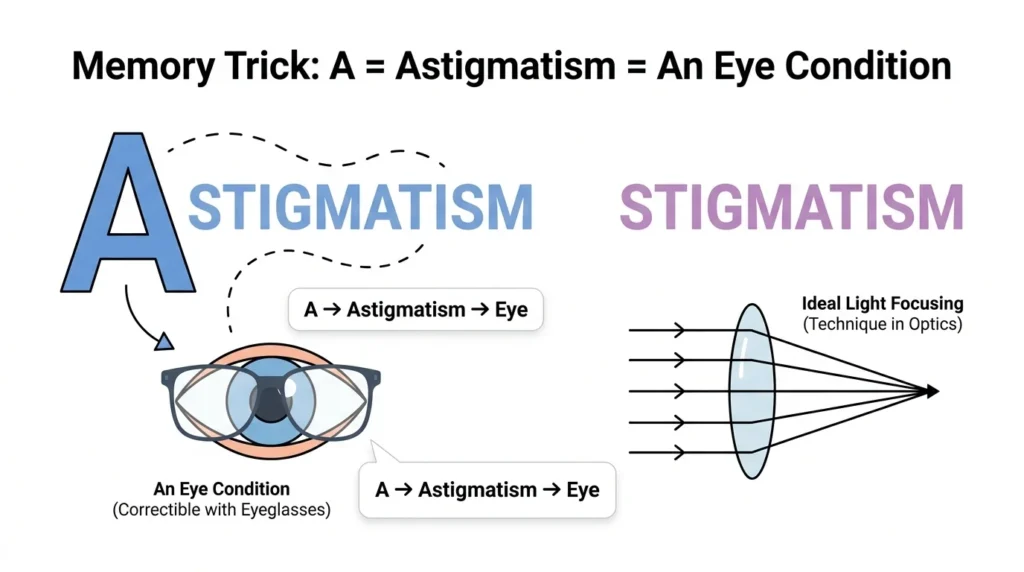
A = Astigmatism = An Eye condition.
Both A words belong together:
Astigmatism → Affects eyesight.
If you are talking about glasses, contacts, blurry vision, an eye exam, or a vision prescription, think:
A + stigmatism = astigmatism.
For the technical optical meaning, remember:
stigmatism = single point → single point
That reflects the optical concept behind a stigmatic system.
Real-Life Situations
At the eye doctor’s office
Doctor: “Your examination shows some astigmatism.”
Patient: “Will my new glasses correct the astigmatism?”
Here, astigmatism is the correct term because the conversation concerns a refractive error of the eye.
In a text message
Wrong: “I think I have stigmatism.”
Better: “I think I have astigmatism.”
The second version uses the standard term.
In a school assignment
Correct: “Astigmatism is a type of refractive error that can affect the clarity of vision.”
This is appropriate educational wording.
In a research paper about optics
Correct: “The optical system was evaluated for stigmatism.”
Here, stigmatism can be appropriate because the subject is optical image formation rather than the common eye condition.
In an email
Correct: “My prescription has been updated to include correction for astigmatism.”
The medical term is clear and professional.
In a social media post
Correct: “I finally found glasses that make my vision much clearer. Astigmatism was making things harder to see.”
The wording is natural for everyday communication.
Expert Tips
Learn the word as a whole
Do not try to memorize astigmatism by repeatedly adding an a to stigmatism.
Instead, memorize:
ASTIGMATISM
as one complete word.
Connect the word to a mental image
Imagine a pair of glasses whenever you see astigmatism.
This creates a stronger association than memorizing the spelling alone.
Use context to check yourself
Ask:
“Am I talking about a person’s eyesight?”
If yes, you almost certainly want astigmatism.
Ask:
“Am I discussing the optical property of forming a point image from a point source?”
If yes, stigmatism may be the technical term you need.
Read More: Taught vs Tought: Which Spelling Is Correct?
Do not confuse spelling with validity
A useful vocabulary lesson comes from this pair:
A word can be:
- spelled correctly,
- present in dictionaries,
- grammatically usable,
- but still be the wrong word for the context.
That is exactly what can happen with stigmatism.
Remember the adjective
The related adjective astigmatic means relating to or affected by astigmatism.
For example:
- “The patient has an astigmatic eye condition.”
- “The prescription includes an astigmatic correction.”
In technical optics, stigmatic has a different meaning related to point-to-point image formation.
FAQ
Is “stigmatism” a real word?
Yes. Stigmatism is a real English word. In optics, it describes the property of an optical system in which light from a point source is focused to a point image. Dictionaries also record other specialized meanings.
Is “stigmatism” the same as “astigmatism”?
No. They are related terms, but they are not interchangeable. Astigmatism is the standard medical term for the common refractive error. Stigmatism has specialized meanings in optics and elsewhere.
Is “stigmatism” a misspelling?
Not always. If someone writes stigmatism when they mean the eye condition, it is a word-choice error. But stigmatism itself is a legitimate dictionary word.
Why do people say “stigmatism” instead of “astigmatism”?
The words are very similar in sound and spelling. When people learn astigmatism by hearing it rather than reading it, the initial a can be overlooked.
Which is correct: “I have stigmatism” or “I have astigmatism”?
If you mean the common eye condition, “I have astigmatism” is the correct standard expression.
Can stigmatism affect eyesight?
The word stigmatism has technical optical meanings, but it should not be used as the ordinary name of the refractive error commonly discussed in eye care. That condition is astigmatism.
Does astigmatism mean you need glasses?
Not necessarily. Some people have mild astigmatism and may not require treatment. When correction is needed, eyeglasses or contact lenses are common options, and some people may be candidates for surgery. An eye-care professional determines the appropriate approach.
Is astigmatism a disease?
Astigmatism is generally described as a refractive error, not simply as an infection or disease. It occurs when the eye’s cornea or lens has an uneven curvature that affects how light is focused.
Is “astigmatic” the correct adjective?
Yes. Astigmatic is the adjective associated with astigmatism. It can describe something relating to or affected by astigmatism.
What is the easiest way to remember astigmatism?
Remember:
A = Astigmatism = An eye condition.
If the subject is your eyes, glasses, contacts, or blurred vision, choose astigmatism.
Do British people spell it “stigmatism”?
No. British English does not use stigmatism as an alternative spelling for the medical condition. Astigmatism is the standard term in both British and American English.
Mini Quiz
| # | Question | Answer | Explanation |
|---|---|---|---|
| 1 | Which word describes the common refractive error: stigmatism or astigmatism? | Astigmatism | Astigmatism is the standard medical term for the condition. |
| 2 | Fill in the blank: “My eye doctor diagnosed me with ______.” | astigmatism | The sentence refers to the eye condition. |
| 3 | Choose the correct sentence: A) “I have stigmatism.” B) “I have astigmatism.” | B | Astigmatism is the appropriate term for the common vision condition. |
| 4 | Is stigmatism a real English word? | Yes | It has established technical and other specialized meanings. |
| 5 | Fill in the blank: “The optical system was studied for ______.” | stigmatism | In an optics context, stigmatism can describe point-to-point image formation. |
| 6 | Which spelling is correct for the eye condition? A) stigmatism B) astigmatism C) astigmitism | B | The standard spelling is astigmatism. |
| 7 | Correct this sentence: “My glasses correct my stigmatism.” | My glasses correct my astigmatism. | The sentence refers to the eye condition. |
| 8 | True or false: “Stigmatism is never a real word.” | False | Stigmatism is a legitimate technical term. |
| 9 | Fill in the blank: “Astigmatism can cause ______ or distorted vision.” | blurred | Blurred or distorted vision is a common symptom associated with astigmatism. |
| 10 | Which word should you normally use in an email to your eye doctor about your vision condition? | astigmatism | It is the standard medical term and is clear to patients and professionals. |
Quick Summary
Astigmatism is the correct word when you mean the common eye condition that can cause blurry or distorted vision because the eye does not focus light evenly. Stigmatism is also a legitimate English word, but it has specialized meanings, especially in optics, where it describes point-to-point image formation. Therefore, stigmatism should not simply be labeled a misspelling, but it is usually the wrong word when discussing a patient’s vision. If you are talking about glasses, contact lenses, eye examinations, blurry vision, or a refractive error, use astigmatism. The easiest memory trick is A = Astigmatism = An eye condition.