
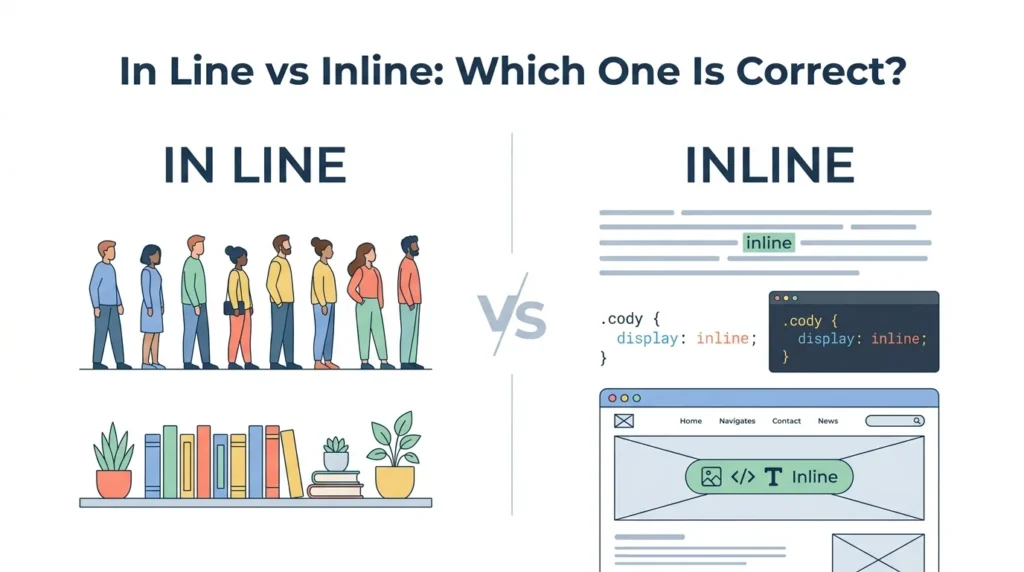

In line and inline are both correct, but they have different meanings. Use in line when you mean waiting in a queue, being arranged in a row, or being consistent with something: “We stood in line” or “The results are in line with expectations.” Use inline when something is embedded, integrated, or placed within the normal flow of text, code, or another system: “The page contains an inline image.”
What Is the Difference Between In Line and Inline?
The difference between in line and inline is mainly about meaning and grammatical structure.
In line is normally a two-word phrase. It commonly describes a position, arrangement, queue, or relationship of agreement.
Inline is a closed compound word. It commonly describes something that is built into, placed within, or arranged as part of another structure. It is especially common in technology, publishing, web design, programming, engineering, and sports.
The easiest distinction is:
- in line = in a row, waiting, aligned, or consistent with something
- inline = inserted or integrated within something else
However, the distinction is not simply “everyday English versus technical English.” Inline also has established uses such as inline skates and inline engines, while in line can describe physical alignment in ordinary English.
Why It Matters
The difference may look like a minor spacing issue, but the meaning can change completely.
Consider these two sentences:
The report is in line with company policy.
The report contains an inline citation.
The first sentence says that the report agrees with or follows company policy. The second says that the citation is placed within the main text.
Using the wrong form can therefore make a sentence confusing, particularly in professional, academic, technical, and digital writing.
For example, writing “inline with expectations” when you mean “consistent with expectations” changes the established phrase. The standard expression is “in line with expectations.”
Similarly, writing “in line CSS” when you mean CSS written directly inside an HTML element is not the normal technical term. The established term is “inline CSS.”
The Core Rule
Use “in line” for a queue, physical alignment, or agreement with something. Use “inline” for something placed or integrated within text, code, content, or another structure.
A quick test can help:
- Are people waiting or objects arranged in a row? → in line
- Does it mean consistent with, according to, or matching something? → in line
- Is something inserted directly into text, code, or another system? → inline
- Is it an established compound such as “inline skates”? → inline
Context, rather than pronunciation, determines the correct form.
Read More: Stigmatism vs. Astigmatism: Which Word Is Correct?
How to Use In Line
In line for a queue
Use in line when people are waiting for their turn.
- We stood in line for coffee.
- Several customers were waiting in line at the checkout.
- Please remain in line until your number is called.
- I was already in line when the store opened.
In American English, in line is the normal expression for waiting in a queue. British English commonly uses in a queue for the same situation.
In line for physical arrangement
In line can also describe people or objects positioned in a row or alignment.
- The chairs were arranged in line with the windows.
- The runners stood in line before the race.
- The three posts are in line with the gate.
Here, in line describes physical position rather than digital or technical embedding.
In line with for agreement or consistency
One of the most important uses is the phrase in line with.
It means consistent with, in agreement with, or following something.
- The decision is in line with company policy.
- The results are in line with our expectations.
- The new plan is in line with the team’s objectives.
- Her actions were not in line with the rules.
This is especially common in business, academic, government, and professional writing.
In line for something
In line for can mean that someone is likely to receive or achieve something.
- She is in line for a promotion.
- The company is in line for a major contract.
- He is in line for the leadership position.
This meaning is different from inline.
How to Use Inline
Inline text
Use inline when something appears within the normal flow of written material instead of being separated from it.
For example:
- The article includes inline citations.
- The editor allows inline comments.
- The website displays inline images.
- The definition appears as an inline note.
Dictionaries specifically recognize inline for material incorporated into the main text rather than placed in a separate section.
Inline in web development
Inline is common in web development.
You may encounter:
- inline CSS
- inline HTML
- inline elements
- inline styles
- inline scripts
- inline SVG
For example:
The developer used inline CSS to apply a quick style directly to the HTML element.
Here, inline describes where the styling instructions are placed.
Inline in programming
Programming also uses inline in several established terms.
For example:
- inline function
- inline comment
- inline code
- inline expression
The exact technical meaning can vary between programming languages and contexts, so it is better not to assume that every use of inline has exactly the same technical definition.
In general, though, the word suggests that something is inserted directly into the surrounding code or handled at the point where it is used.
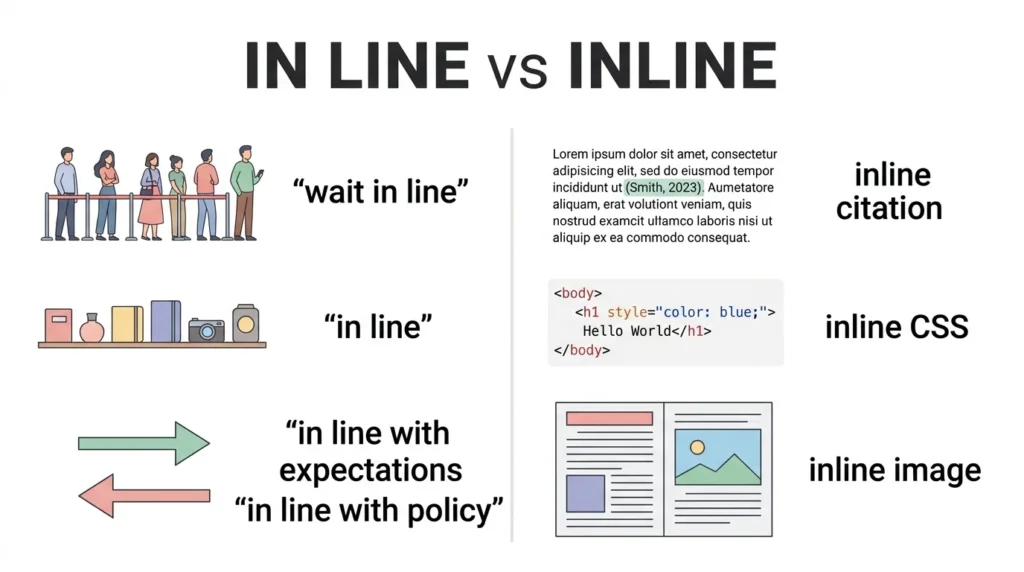
Inline in publishing and editing
Writers and editors frequently encounter inline comments, inline citations, and inline editing.
An inline comment appears directly alongside or within the material being discussed rather than in a completely separate document.
Likewise, inline editing allows changes to be made directly within the displayed content.
Inline in other established terms
The word is not limited to computers.
English has established compounds such as:
- inline skates
- inline skating
- inline engine
- inline six-cylinder engine
Cambridge lists inline for things arranged in a line, for material included within main text, and for terminology associated with inline skating and engines.
Read More: Breakroom vs Break Room: Which Spelling Is Correct?
Correct Examples
Here are examples from different areas of real writing.
| Situation | Correct Example |
|---|---|
| Conversation | “We waited in line for nearly twenty minutes.” |
| Shopping | “There were ten people in line at the register.” |
| Workplace | “The proposal is in line with our current strategy.” |
| Business report | “Revenue was in line with expectations.” |
| “The revised schedule is in line with the agreed plan.” | |
| School | “The students stood in line outside the classroom.” |
| Academic writing | “The study includes inline citations.” |
| Website | “The article contains several inline links.” |
| Programming | “The developer added an inline comment.” |
| Web design | “The button uses inline CSS for testing.” |
| Publishing | “The editor added an inline note.” |
| Sports | “He bought a new pair of inline skates.” |
Incorrect vs. Correct
| ❌ Incorrect | ✅ Correct | Why |
|---|---|---|
| We waited inline for tickets. | We waited in line for tickets. | The sentence describes people waiting for their turn. |
| The report is inline with the policy. | The report is in line with the policy. | The established phrase is “in line with,” meaning consistent with. |
| Add in line CSS to the element. | Add inline CSS to the element. | “Inline CSS” is the established technical term. |
| The customers stood inline outside. | The customers stood in line outside. | The customers are waiting in a queue. |
| Sales were inline with forecasts. | Sales were in line with forecasts. | The meaning is that sales matched expectations. |
| The page contains in line citations. | The page contains inline citations. | “Inline” describes citations placed within the main text. |
| She is inline for promotion. | She is in line for a promotion. | “In line for” is a phrase meaning likely to receive something. |
| The developer used in line styling. | The developer used inline styling. | “Inline styling” is the standard technical compound. |
| The chairs were inline with the wall. | The chairs were in line with the wall. | This describes physical alignment. |
| The editor added an in line comment. | The editor added an inline comment. | The comment is integrated into the surrounding content or code. |
| The proposal is inline with our goals. | The proposal is in line with our goals. | The meaning is agreement or consistency. |
| The website displays an in line image. | The website displays an inline image. | “Inline image” is an established digital/publishing term. |
Why People Make This Mistake
They sound the same
In line and inline are normally pronounced alike. That makes the difference invisible when someone hears the words in conversation.
A learner may know the correct meaning but still choose the wrong spelling when writing.
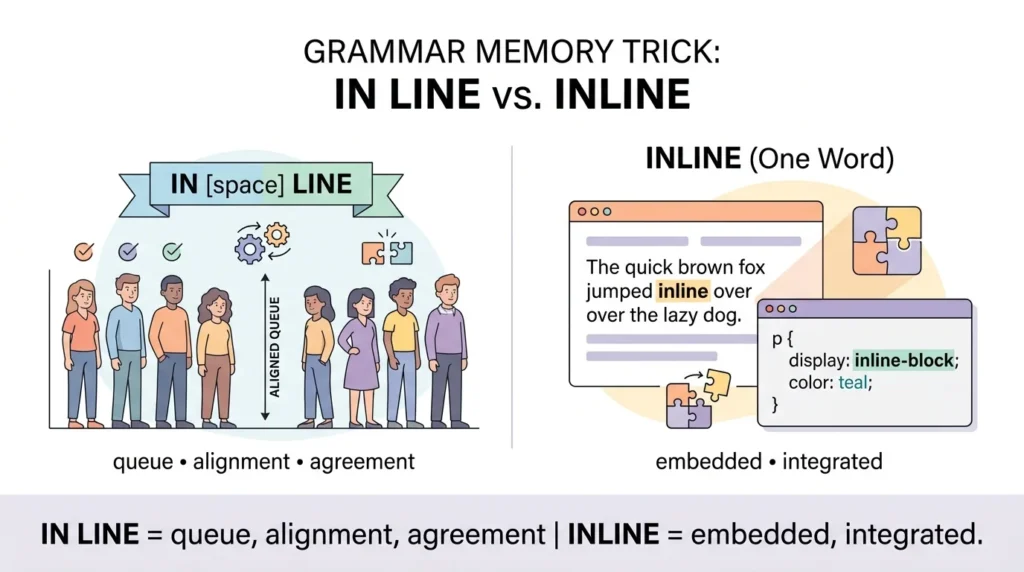
The spelling looks almost identical
The only visible difference is the space.
That creates a strong temptation to treat the forms as interchangeable. They are not interchangeable in every context.
Technology has made “inline” much more common
Modern writers regularly encounter terms such as inline CSS, inline links, inline comments, inline editing, and inline elements.
Someone who sees the closed form frequently may begin using inline in unrelated expressions such as “inline with expectations.”
Spellcheck cannot always solve the problem
Both in line and inline are legitimate English forms.
A spellchecker may therefore accept either one without understanding what you intended.
The problem is semantic: the software may recognize that the spelling exists without knowing whether your sentence means “consistent with” or “embedded within.”
Translation can interfere
Some languages use one word for concepts that English expresses with a phrase, while others make different distinctions.
If English is your second language, translating word-for-word can therefore lead to forms such as “inline with the rules” even when the intended meaning is “in line with the rules.”
The safest approach is to learn the whole expression, not just the individual word.
Common Mistakes Checklist
Mistake 1: Writing “inline with expectations”
Problem: You are using the technical compound inline in an expression that means “consistent with.”
Correct:
The results were in line with expectations.
Avoid it by: Memorizing in line with as a complete phrase.
Mistake 2: Using “in line” for technical embedding
Problem: You are describing something inserted directly into text, HTML, or another technical structure.
Correct:
The developer used inline CSS.
Avoid it by: Treating established technical compounds as individual terms.
Mistake 3: Using “inline” for a queue
Problem: You are describing people waiting for their turn.
Correct:
We stood in line for the concert.
Avoid it by: Thinking of the physical queue as a literal line.
Mistake 4: Assuming “inline” always means technology
Problem: The word also appears in non-digital terms.
Correct examples:
inline skates
inline engine
Avoid it by: Looking at the actual meaning rather than automatically labeling the word “technical.”
Read More: Unkept vs Unkempt: What Is the Difference?
Mistake 5: Assuming the hyphenated form is always wrong
You may also encounter in-line.
Some dictionaries recognize in-line as an alternative form in certain meanings, particularly as an adjective. Oxford lists in-line with inline as an alternative for references, links, or images placed within written text.
Modern style guides may nevertheless prefer inline in technical writing. For example, Google’s developer style guide explicitly recommends inline rather than “in line” or “in-line” for the adjective in “inline link.”
So the practical rule is to follow the style guide of the publication, organization, or technical system you are writing for.
In Line vs. Inline in Real English
“In line” for everyday physical situations
In ordinary conversation, in line is the natural choice when people are waiting for their turn or are arranged in a sequence. A speaker would normally say, “I’m standing in line,” rather than using inline as one word. The phrase is also natural when describing physical alignment: “The chairs are in line with the windows.”
“In line with” for agreement and expectations
In line with is a well-established expression in professional and everyday English. It means that something agrees with, follows, or is consistent with another thing. For example, “The decision is in line with company policy” sounds natural in workplace writing. The same applies to common expressions such as in line with expectations, in line with the law, and in line with our goals.
“Inline” for integrated content
Inline is natural when something is incorporated into the surrounding material rather than separated from it. This is why writers use expressions such as inline citation, inline image, inline link, and inline comment. In these contexts, replacing inline with the two-word in line would make the terminology less natural or incorrect.
“Inline” beyond technology
It would be misleading to say that inline is exclusively a computing word. English also uses it in established terms involving sports and engineering, including inline skates and inline engines. The broader idea is usually that components are arranged in a line or that something is incorporated into an existing structure.
“In-line” as a variant
The hyphenated in-line is not simply a misspelling. Major dictionaries record it as an alternative form in some adjective uses. However, spelling conventions vary by field and style guide, and modern technical writing often favors inline. When writing for a particular publication or organization, consistency with its style guide should take priority.
American vs. British English
There is a genuine regional difference worth knowing, but it is narrower than many learners expect.
For the queue meaning, in line is especially associated with American English, while British English commonly uses in a queue.
For example:
- American English: “We waited in line for the tickets.”
- British English: “We waited in a queue for the tickets.”
The distinction does not mean that every British speaker avoids in line, nor does it change the spelling rule for inline.
The technical spelling also has some variation. Cambridge records inline with in-line as an alternative, while Oxford similarly lists in-line and inline for certain adjective uses.
Formal vs. Informal Usage
Both forms can appear in formal and informal writing.
In line is completely appropriate in professional writing when you mean alignment, agreement, or conformity:
The recommendation is in line with current policy.
Inline is also appropriate in formal writing when it is the correct technical term:
The paper uses inline citations.
The important issue is not formality. It is meaning.
Avoid changing in line to inline simply because you want your writing to look more technical or concise.
Comparison Table
| Feature | In line | Inline |
|---|---|---|
| Basic form | Two words | One word |
| Main role | Phrase | Compound word |
| Queue | Yes | No |
| Physical alignment | Yes | Sometimes, in established compounds |
| Agreement/conformity | Yes | No |
| “___ with expectations” | in line with | Generally not inline with |
| Embedded text | Usually no | Yes |
| Inline citations | No | Yes |
| Inline CSS | No | Yes |
| Inline comments | No | Yes |
| Inline skates | No | Yes |
| Common in business English | Yes | Only in relevant technical terms |
| Common in web development | Less common | Very common |
| Hyphenated variant | — | in-line may occur in some styles |
Memory Trick
Think of the space as a physical gap.
In line has a space because you are thinking about a line, position, queue, or relationship:
in line at the store
in line with the rules
in line with expectations
Inline has no space because the thing is inside or integrated into another structure:
inline code
inline CSS
inline citation
inline image
The three-second test
Ask:
“Am I talking about agreement or a queue, or am I talking about something embedded?”
- Queue/alignment/agreement → in line
- Embedded/integrated/technical compound → inline
Real-Life Situations
Job interview
You are discussing a company’s hiring process:
“My experience is in line with the requirements listed in the job description.”
Here, the meaning is consistent with, so use two words.
Business meeting
A manager says:
“The latest sales figures are in line with our forecast.”
Again, the phrase means that the figures match expectations.
You write:
“The revised proposal is in line with the changes we discussed.”
The phrase expresses agreement with a previous plan.
Website project
A developer writes:
“The designer requested an inline image beside the product description.”
Here, the image is integrated into the surrounding content.
Coding
A programmer writes:
“I added an inline comment to explain the calculation.”
The comment appears directly alongside the relevant code.
Shopping
You tell a friend:
“I had to stand in line for half an hour.”
This is the everyday queue meaning.
Academic writing
A student writes:
“The paper uses inline citations to identify its sources.”
The citations are placed within the body of the text.
Social media
A content editor says:
“The platform lets users make inline edits without opening another page.”
The editing happens directly within the existing interface.
Expert Tips
Learn phrases, not isolated spellings
Instead of memorizing that in line has two words and inline has one, learn the expressions around them.
High-value combinations include:
- in line with expectations
- in line with policy
- in line with regulations
- in line for a promotion
- stand in line
- wait in line
- inline citation
- inline image
- inline link
- inline CSS
- inline comment
- inline editing
This makes correct usage much easier because you recognize the phrase as a unit.
Read More: Mama vs. Momma: Which Spelling Is Correct?
Be careful with “in line with”
This is probably the most useful expression to memorize.
If you can replace the phrase with “consistent with” or “in accordance with,” you almost certainly want:
in line with
For example:
The policy is consistent with our objectives.
becomes:
The policy is in line with our objectives.
Not:
The policy is inline with our objectives.
Do not overapply the technical rule
It is tempting to memorize:
“Every technical meaning uses inline.”
That is too broad.
Technical English has its own established compounds, but in line remains correct in technical contexts when the meaning is alignment or conformity.
For example:
The two components must remain in line with each other.
Here, the technical setting does not turn in line into inline.
Check the noun after “inline”
If you are writing a technical compound, ask whether inline is an established term in that field.
Inline CSS is established.
Inline citation is established.
Inline comment is established.
But you should not automatically join in and line simply because the sentence sounds technical.
FAQ
Is “in line” or “inline” correct?
Both are correct. In line is used for queues, physical alignment, and agreement or conformity. Inline is used for things embedded or integrated within text, code, content, or established compounds such as inline skates.
Is “inline with expectations” correct?
For the normal meaning of “consistent with expectations,” use in line with expectations. The word inline does not normally replace the phrase in line with.
Is “in line with” always written as two words?
Yes, when it means “consistent with,” “in agreement with,” or “according to.” For example: “The decision is in line with company policy.”
Is “inline” always a technical word?
No. It is common in technical and digital language, but it also occurs in established non-digital terms such as inline skates and inline engine.
Is “in-line” wrong?
Not necessarily. In-line is recorded as an alternative spelling in some dictionary entries. However, style conventions vary, and some modern technical style guides prefer inline.
Should I write “in line” for a queue?
Yes. In American English, in line is the standard expression for waiting in a queue. British English commonly uses in a queue.
What is an inline citation?
An inline citation is a reference placed within the main body of a text rather than separated into a completely different section. The term is common in academic and digital publishing.
What is inline CSS?
Inline CSS is CSS applied directly to an HTML element rather than placed in a separate stylesheet. The word inline describes the placement of the styling information.
Can “inline” mean arranged in a straight line?
Yes. Inline can describe things arranged in a line. This meaning appears in established expressions such as inline engine and inline skates.
What is the easiest way to remember the difference?
Remember:
In line = queue, alignment, or agreement.
Inline = embedded or integrated.
Then check the actual meaning of the sentence rather than relying on how the word sounds.
Why does spellcheck sometimes accept the wrong form?
Because in line and inline are both legitimate English forms. Basic spellcheck can recognize a correctly spelled word without understanding the meaning you intended.
Mini Quiz
| # | Question | Answer | Explanation |
|---|---|---|---|
| 1 | We waited ___ for the bus. A) inline B) in line | B) in line | The sentence describes people waiting in a queue. |
| 2 | The results were ___ with expectations. A) inline B) in line | B) in line | “In line with” means consistent with or matching. |
| 3 | The developer used ___ CSS. A) in line B) inline | B) inline | “Inline CSS” is an established web-development term. |
| 4 | Correct the sentence: “The proposal is inline with our strategy.” | The proposal is in line with our strategy. | The meaning is agreement or consistency. |
| 5 | The article contains ___ citations. A) in line B) inline | B) inline | The citations appear within the main text. |
| 6 | She is ___ for a promotion. A) inline B) in line | B) in line | “In line for” means likely to receive something. |
| 7 | Correct the sentence: “We stood inline outside the theater.” | We stood in line outside the theater. | The people are waiting in a queue. |
| 8 | The programmer added an ___ comment. A) in line B) inline | B) inline | “Inline comment” is a standard technical expression. |
| 9 | Which sentence is correct? A) The figures are inline with the forecast. B) The figures are in line with the forecast. | B | “In line with” expresses consistency with a forecast. |
| 10 | Fill in the blank: “The website displays an ___ image beside the paragraph.” | inline | The image is integrated into the surrounding content. |
Quick Summary
In line and inline are both correct, but they are not interchangeable. Use in line when talking about waiting in a queue, physical alignment, or agreement with something. Common expressions include stand in line, in line with company policy, and in line with expectations. Use inline when something is embedded or integrated into text, code, content, or another structure. Common terms include inline citation, inline image, inline CSS, and inline comment. The hyphenated in-line also exists in some dictionary and style contexts, although many modern technical style guides prefer inline. When unsure, focus on meaning: queue, alignment, or agreement = in line; embedded or integrated = inline.