
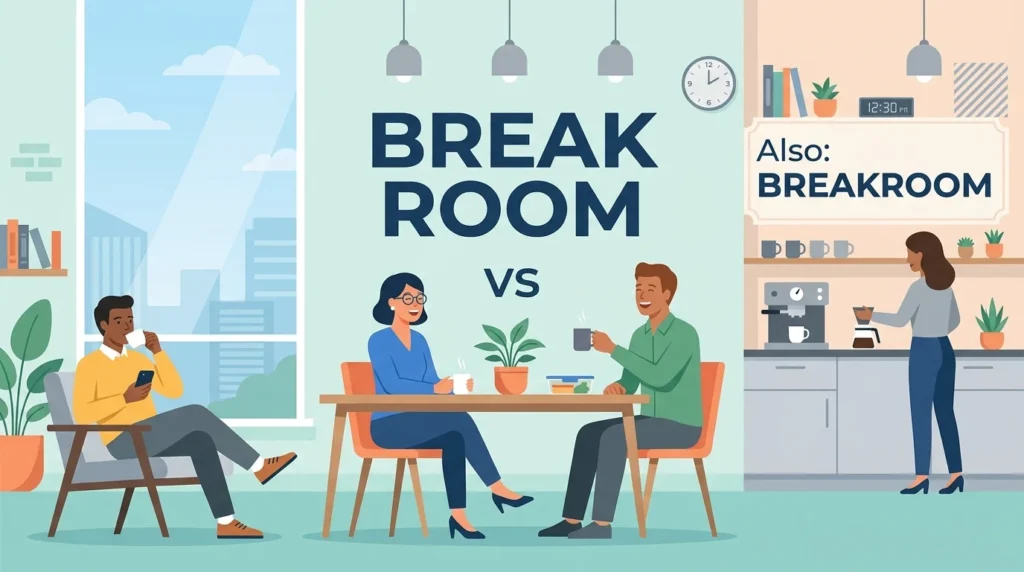

Break room and breakroom have the same meaning: a room in a workplace where employees can rest, eat, drink coffee, or socialize during a break. Break room is the safer and more widely preferred form for general and professional writing. Breakroom is also a recognized variant, especially in American English. If you are unsure which form to choose, write break room.
What Is a Break Room?
A break room is a designated room in a workplace where employees can take a short break from their regular duties. It may contain chairs, tables, a refrigerator, microwave, coffee maker, vending machine, or other facilities for eating and relaxing.
The term is a compound noun. A compound noun is a noun made from two or more words that work together as one idea. In this case, break describes the purpose of the room.
For example:
- Employees are having lunch in the break room.
- The company renovated its break room last month.
- Please keep the break room clean.
- I left my coffee mug in the breakroom.
The important point is that break room and breakroom refer to the same type of workplace space. The spelling is different, but the basic meaning is not. Merriam-Webster lists break room as the main form and breakroom as a less common variant.
Why It Matters
This may look like a tiny spelling choice, but small choices can affect how polished your writing appears.
Consider where the phrase might appear:
- An employee handbook
- A company policy
- A workplace email
- Office signage
- A school assignment
- A business website
- A safety document
- A social media post
- An internal communication
- A professional report
If you are writing for a broad audience, break room is usually the safest choice because it is the primary dictionary form and is immediately familiar.
The bigger lesson is that English compound nouns do not always follow a simple “two words become one word” rule. Some compounds remain open, some become hyphenated, and some become closed.
That is why break room can coexist with breakroom without the two forms having different meanings.
The Core Rule
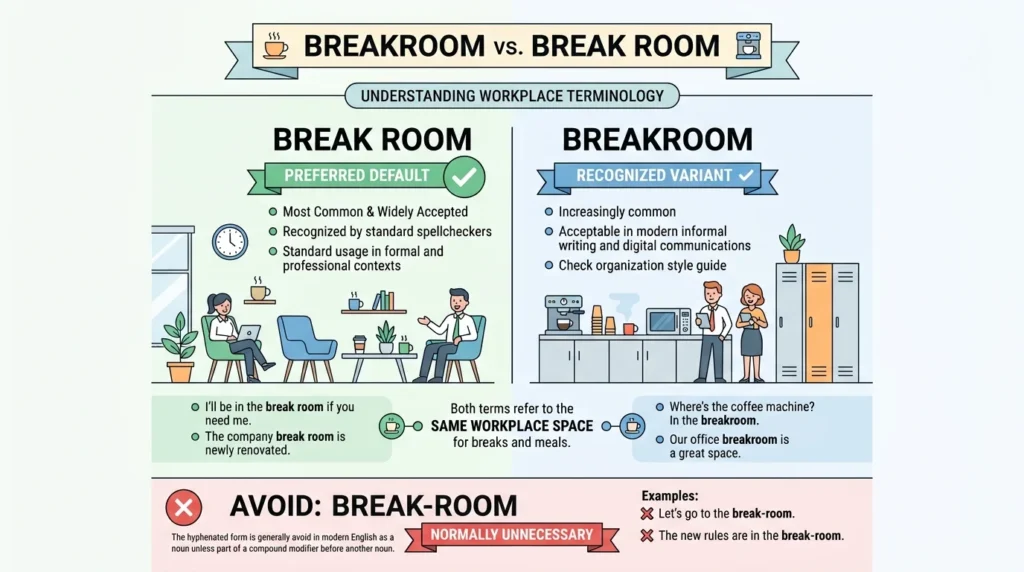
Use “break room” as your default spelling. “Breakroom” is an accepted variant with the same meaning, so it is not automatically a spelling error.
For professional, academic, or broadly distributed writing, choose break room unless your organization’s established style uses breakroom.
Do not normally write break-room. The standard forms are break room and breakroom. Merriam-Webster recognizes both the two-word form and the less common closed form.
Read More: Unkept vs Unkempt: What Is the Difference?
How to Use It
Use “break room” as the default
Choose break room when you are writing something that needs a conventional, broadly accepted form.
Examples include:
- Formal business documents
- Workplace policies
- Academic writing
- Professional emails
- Public-facing websites
- General educational material
- Reports
- Manuals
For example:
Please return all shared dishes to the break room after use.
This is a straightforward, conventional choice.
“Breakroom” is not automatically wrong
It is important not to turn a usage preference into a false grammar rule.
Breakroom is an established variant. It appears in real English and is recognized by dictionaries. Dictionary.com lists breakroom as an American noun and gives break room as an alternative. Merriam-Webster similarly lists breakroom as a less common variant.
So this sentence is understandable and established:
The new breakroom has a larger refrigerator.
You do not need to treat every occurrence of breakroom as an error.
Follow an organization’s house style when one exists
Suppose a company consistently calls its employee space the Breakroom in its internal software, signs, employee handbook, and website.
Changing every instance to break room may actually create inconsistency.
A house style is the set of writing conventions an organization chooses to follow. If that style deliberately uses breakroom, consistency can be more useful than changing isolated instances.
The same principle applies to branded names.
Correct Examples
Here are examples from different situations.
Conversation
- I’ll meet you in the break room after lunch.
Workplace email
- The new coffee machine has been installed in the break room.
Employee handbook
- Employees should clean the break room after using shared appliances.
Office announcement
- The break room will be unavailable from 2:00 to 4:00 p.m. for maintenance.
School writing
- The staff members gathered in the break room during their afternoon break.
Academic writing
- The survey examined how employees used the break room during scheduled rest periods.
Social media
- Someone left a box of doughnuts in the break room this morning.
Workplace conversation
- I think Sarah is in the break room getting coffee.
Company policy
- Food stored in the break room refrigerator must be labelled with the owner’s name.
General business writing
- The redesigned office includes a larger break room and additional meeting spaces.
Using the variant
- The breakroom was recently renovated.
This last example shows why it is inaccurate to call breakroom simply “wrong.” It is a recognized variant, although break room is the safer default.
Read More: Mama vs. Momma: Which Spelling Is Correct?
Incorrect vs. Correct
| ❌ Incorrect / Less Suitable | ✅ Correct / Preferred | Why |
|---|---|---|
| Please clean the break-room. | Please clean the break room. | The hyphen is normally unnecessary when the phrase is used as a noun. |
| The employees ate in the break room. | The employees ate in the break room. | This is the standard two-word form. |
| The company renovated its break room. | The company renovated its break room. | The open compound is the preferred general form. |
| Meet me in the break-room. | Meet me in the break room. | Do not add a hyphen simply because the words function together. |
| The break room is closed. | The break room is closed. | This is the conventional spelling. |
| I left my lunch in the breakroom. | I left my lunch in the break room. | Breakroom is possible, but break room is the safer default. |
| Please keep the break-room tidy. | Please keep the break room tidy. | The phrase is normally written open. |
| The manager posted it in the breakroom. | The manager posted it in the break room. | Use the preferred form when no house style requires the closed form. |
| Employees may eat in the break-room. | Employees may eat in the break room. | The hyphen is unnecessary here. |
| Our new breakroom is spacious. | Our new break room is spacious. | Breakroom is recognized, but break room is the more conventional choice. |
The important distinction is that breakroom should not be placed in the same category as a genuinely misspelled word. It is a recognized variant. The hyphenated break-room, however, is not the normal form for this noun.
Why People Make This Mistake
Compound-word confusion
English has thousands of compounds, but they are not all spelled in the same way.
Compare:
- bedroom
- bathroom
- classroom
- living room
- dining room
- meeting room
- break room
A writer may reasonably ask:
“If bedroom is one word, why isn’t breakroom?”
There is no universal rule saying that every compound must eventually become one word. English spelling develops through usage, convention, dictionaries, publishing practices, and time.
Visual similarity
Words such as bedroom, classroom, and bathroom make breakroom look perfectly natural.
That visual pattern encourages writers to close break room automatically.
Autocomplete and spellcheck
Digital tools can make the problem worse.
If your keyboard, browser, word processor, or company’s internal software frequently sees breakroom, it may accept or suggest it. But spellcheck acceptance does not necessarily mean that a particular form is the best choice for your audience or style.
Likewise, seeing a word underlined does not always mean the word is objectively wrong.
Workplace signage
Employees often see phrases such as:
BREAKROOM
on office signs.
After seeing the closed form repeatedly, they naturally carry it into emails and documents.
This is a good example of why real-world usage and preferred editorial usage are not always identical.
Translation interference
Some English learners expect compound nouns to follow a consistent pattern from their first language. English does not always behave that way.
The safest approach is not to translate the phrase word-for-word. Learn the conventional English form used for the particular context.
Common Mistakes Checklist
Mistake 1: Treating “breakroom” as completely wrong
What happens: A writer sees the one-word form and assumes it is a spelling error.
Why it happens: They learned break room as the standard form and may not realize that breakroom is recognized as a variant.
How to avoid it: Remember that break room is preferred, while breakroom is an established alternative.
Mistake 2: Assuming the two forms have different meanings
They do not normally have different meanings.
Break room and breakroom both refer to a workplace room used for rest or refreshment.
Mistake 3: Adding a hyphen
Writers sometimes produce break-room because they know compound expressions can be hyphenated.
In ordinary noun use, that is unnecessary.
Use:
break room
rather than:
break-room
Mistake 4: Switching forms randomly
A document that begins with break room, changes to breakroom, and then returns to break room may look poorly edited.
Choose a form and use it consistently.
Mistake 5: Assuming every company must follow the dictionary’s preferred form
A company may have a house style, product name, sign, or internal terminology that uses Breakroom.
In that situation, consistency with the established name may matter more than imposing a different spelling.
Read More: Taught vs Tought: Which Spelling Is Correct?
Breakroom vs. Break Room in Real English
Break room: natural, neutral, and safest
Break room is the natural default for general writing. It is especially suitable when you do not know the reader’s preferred style. A sentence such as “The employees gathered in the break room after the meeting” sounds completely ordinary and needs no special explanation. It works in workplace documents, everyday communication, and public-facing writing. The main dictionary entry also uses this two-word form.
Breakroom: grammatically possible and established
Breakroom is not merely a typo created by careless writers. It is a recognized variant, and real publications use it. Dictionary.com labels it American and gives break room as an alternative, while Merriam-Webster calls it a less common variant. Therefore, “The employees gathered in the breakroom” is understandable and established English, even though the open form remains the safer general choice.
Break-room: generally avoid it
Break-room is not the normal spelling when the phrase is being used as an ordinary noun. There is usually no grammatical reason to insert a hyphen between break and room. If you are writing “The printer is in the break room,” use the open form. Unless a particular publication, brand, or house style specifically requires another treatment, the hyphenated form is best avoided.
American vs. British English
There is a genuine regional nuance, but it should not be overstated.
Breakroom is specifically labelled American by Dictionary.com, while Merriam-Webster recognizes it as a less common variant. Break room remains the safest form when writing for an international audience.
For practical purposes:
- American English: break room is the safest default; breakroom is also established.
- British English: break room can be used, although other workplace terms such as staff room or canteen may be more natural depending on the setting.
- International English: choose break room for maximum clarity and conventionality.
Do not claim that breakroom is universally “American only.” English usage is more flexible than that.
Formal vs. Informal Usage
The difference is mainly one of preference and convention, not grammar.
Formal and professional writing
Prefer:
break room
This is a good choice for:
- Policies
- Reports
- Academic assignments
- Employee handbooks
- Formal emails
- Public-facing content
- Professional documentation
Informal workplace writing
You may encounter:
breakroom
especially in American workplace communication.
For example:
I’ll leave the snacks in the breakroom.
This is perfectly understandable and reflects established usage.
Branding and internal terminology
If a company officially calls its employee space the Breakroom, preserve that name.
Proper names and branded terms do not have to follow the same conventions as ordinary prose.
Comparison Table
| Feature | Break room | Breakroom |
|---|---|---|
| Number of words | Two | One |
| Meaning | Workplace room for breaks | Same |
| Dictionary status | Main/preferred form | Recognized variant |
| Professional default | Best choice | Less preferred |
| American English | Common | Established variant |
| International writing | Recommended | Less safe |
| Meaning difference | None | None |
| Hyphen required? | No | No |
| Plural | break rooms | breakrooms |
| Best advice | Use by default | Use when appropriate or required by house style |
Merriam-Webster specifically gives break room as the main entry and identifies breakroom as a less common variant.
Memory Trick
Use this simple mnemonic:
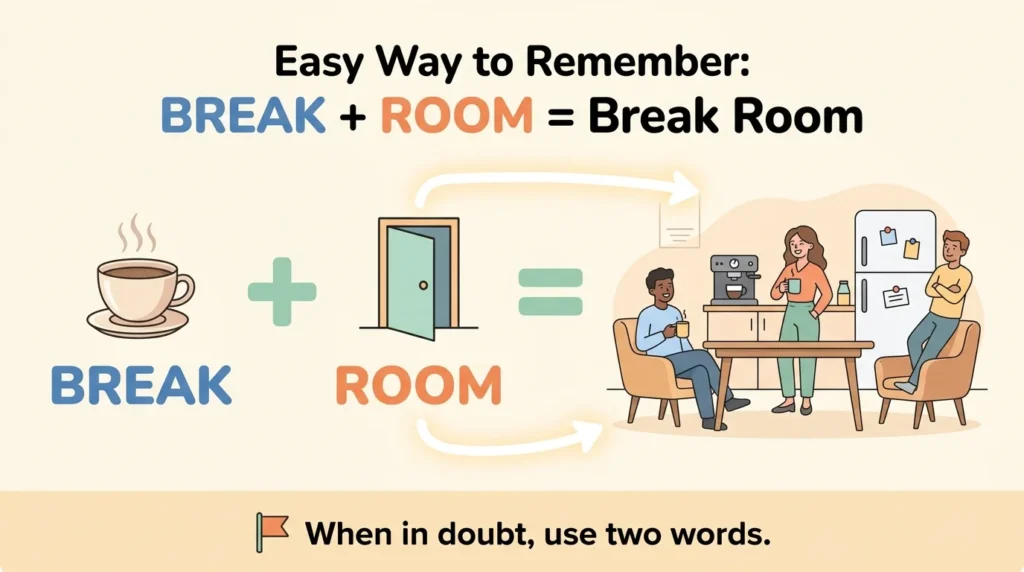
A break happens in a room → break room.
Picture the phrase literally:
BREAK + ROOM = a room for a break.
If you are unsure, keep the two words separate.
And remember the exception:
Breakroom exists, but break room is the safe default.
This is better than memorizing an absolute rule such as “breakroom is wrong,” because that rule is not accurate.
Read More: Shinning vs Shining: Which Is Correct?
Real-Life Situations
1. Writing an employee handbook
Best choice:
Employees must keep the break room clean and free of personal belongings.
The handbook is formal and company-wide, so the conventional two-word form is appropriate.
2. Sending a quick message to a colleague
I’m in the break room if you need me.
The same form works naturally in casual communication.
3. Creating office signage
Either BREAK ROOM or BREAKROOM may be encountered.
If your organization already has a naming convention, follow it consistently.
4. Writing an academic assignment
The study examined employee interactions in the break room.
Use break room as the safe formal choice.
5. Writing a social media post
Someone brought fresh cookies to the breakroom today.
The closed variant can occur naturally in informal American workplace writing.
6. Writing a safety notice
Do not leave electrical equipment unattended in the break room.
Because safety communication benefits from conventional, immediately recognizable wording, break room is a strong choice.
Expert Tips
1. Do not confuse “preferred” with “correct”
This is the most important lesson.
A form can be less common without being an outright error.
Calling breakroom “wrong” ignores dictionary evidence that recognizes it as a variant.
2. Use the dictionary’s main form when in doubt
If you have no house style and no reason to choose otherwise, use:
break room
It is the simplest decision.
3. Do not overcorrect someone else’s writing
If a colleague writes breakroom, you do not necessarily need to mark it as a spelling mistake.
If editing for a publication, you may change it to break room to follow the publication’s preferred style.
4. Consistency matters
If your workplace uses breakroom throughout its official materials, changing only one occurrence can create inconsistency.
Choose deliberately rather than randomly.
5. Don’t assume English compounds follow one formula
Bedroom is one word.
Living room is two.
Break room is normally two, while breakroom is also recognized.
English compound spelling is conventional rather than perfectly predictable.
FAQ
Is breakroom one word?
Yes. Breakroom is an established one-word variant of break room. It is less commonly preferred than the two-word form in dictionary-style usage.
Is break room one word or two words?
Break room is two words. This is the safest and most conventional form to use when you are unsure.
Is breakroom grammatically correct?
Yes, it can be considered correct as a recognized variant. It should not automatically be treated as a spelling error. Major dictionary evidence recognizes the closed form.
Does breakroom mean something different from break room?
No. In ordinary use, both forms refer to a workplace room where employees can take breaks, eat, drink, or relax.
Should I use break room in a formal email?
Yes. Break room is the safest choice for a formal or professional email.
Should break room be hyphenated?
Normally, no. Write break room, not break-room, when using the phrase as a noun.
What is the plural of break room?
The usual plural is break rooms. The closed variant can also form breakrooms. Merriam-Webster lists both plural patterns.
Is breakroom American English?
It is particularly associated with American usage. Dictionary.com labels breakroom as American, while break room is the safer form for broad international writing.
Can I use breakroom in a professional document?
You can, especially if it follows an established company style. However, if you are choosing freely, break room is the more conservative professional choice.
Why do some people write breakroom?
English compounds can exist in both open and closed forms. In this case, breakroom developed as a closed variant of break room and is now recognized in dictionary usage.
Which is better for SEO: breakroom or break room?
For an article targeting the phrase breakroom vs break room, use both naturally because they represent the actual search question and both forms occur in English. Do not force either spelling into every paragraph. Clear, useful content matters more than repeating the keyword.
Mini Quiz
| # | Question | Answer | Explanation |
|---|---|---|---|
| 1 | Which form is the safest default? A) breakroom B) break room C) break-room | B) break room | The two-word form is the main and preferred dictionary form. |
| 2 | Fill in the blank: “The employees are eating lunch in the ___.” | break room | This is the conventional open form. |
| 3 | Is “breakroom” automatically incorrect? | No | It is a recognized variant. |
| 4 | Choose the best formal version: “The notice is posted in the breakroom.” / “The notice is posted in the break room.” | The notice is posted in the break room. | The two-word form is the safer formal choice. |
| 5 | Correct the sentence: “Please keep the break-room clean.” | Please keep the break room clean. | The hyphen is normally unnecessary. |
| 6 | Do breakroom and break room normally have different meanings? | No | They refer to the same workplace space. |
| 7 | Fill in the blank: “The company renovated its ___ last year.” | break room | This is the preferred general form. |
| 8 | A company officially brands its employee space “Breakroom.” Should you automatically change it? | No | Established names and house styles should be respected. |
| 9 | Which is normally preferred for international professional writing? A) break-room B) breakroom C) break room | C) break room | It is the clearest and safest conventional choice. |
| 10 | Correct this sentence: “I’ll meet you in the break-room after the meeting.” | I’ll meet you in the break room after the meeting. | The ordinary noun phrase does not normally need a hyphen. |
Quick Summary
Break room and breakroom mean the same thing: a workplace room where employees can rest, eat, drink, or socialize during a break. The main difference is spelling and usage preference. Break room, written as two words, is the safest and most conventional form, especially in formal, professional, academic, and international writing. Breakroom is not simply a spelling mistake; it is a recognized variant, particularly associated with American usage. If you are following a company style, publication style, or established brand name, consistency may justify using the closed form. Otherwise, remember the simple rule: when in doubt, write break room. Avoid the unnecessary hyphenated form break-room.