
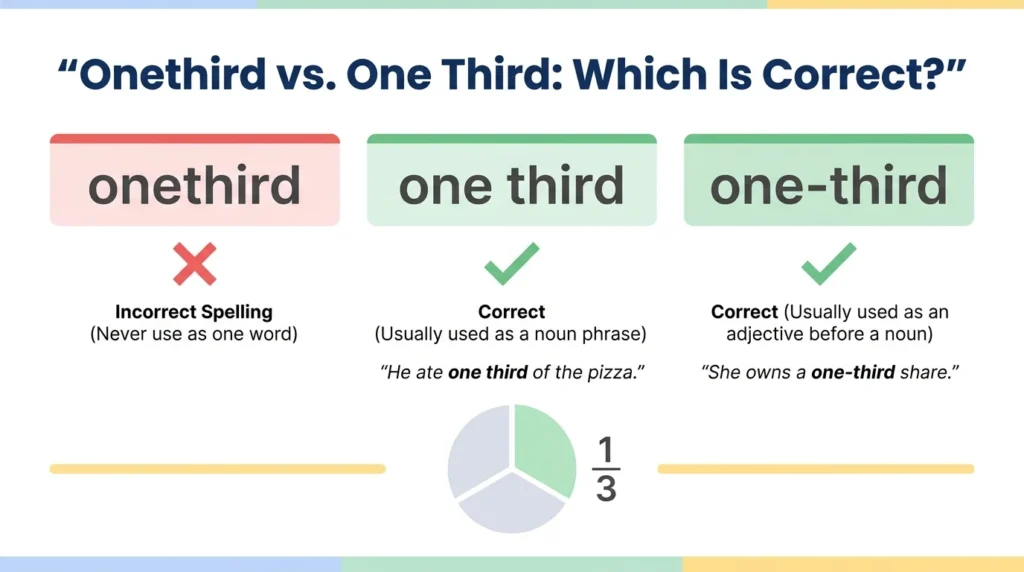

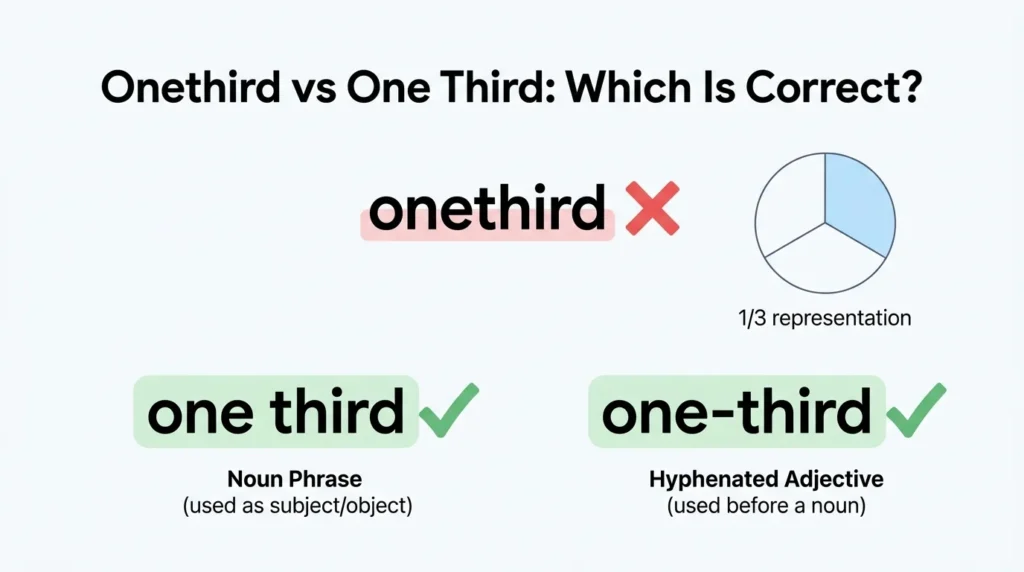
“Onethird” is incorrect as a standard spelling. Write one third or one-third instead. Use one-third when it works as a compound modifier, as in “a one-third share.” When it functions as a noun phrase, many style guides write one third, as in “one third of the class.” Other style guides routinely hyphenate spelled-out fractions, so one-third of the class can also be acceptable depending on your chosen style. The important rule is to avoid onethird as one word.
What Is “One Third”?
One third represents one of three equal parts. Mathematically, it is 1/3, or approximately 33.33%.
The expression can appear in several grammatical roles:
- One third of the cake was left.
- She received one-third ownership of the company.
- The project is one-third complete.
- One third of the employees work remotely.
- We reduced the budget by one-third.
The spelling becomes confusing because the same fraction can appear with or without a hyphen.
The important point is that “one third” and “one-third” do not represent different fractions. Both refer to the same mathematical quantity. The hyphen is a punctuation choice that helps show how the words function together.
And “onethird” is not the standard form. Unlike established compounds such as “another” or “someone,” the words one and third are not normally joined into a single word.
Why It Matters
A missing or unnecessary hyphen rarely changes the mathematical meaning of a sentence, but it can affect grammatical clarity and consistency.
Compare:
- a one-third share
- one third of the company
In the first sentence, one-third works together as a modifier of share. The hyphen signals that the two words belong together as one descriptive unit.
In the second sentence, one third identifies a portion of the company. It functions as a noun phrase.
This distinction matters in academic writing, business reports, contracts, instructions, journalism, emails, and professional documents, where consistent punctuation makes writing easier to read.
It also matters because different style guides handle spelled-out fractions differently. Some recommend hyphenating fractions whether they function as nouns or modifiers, while others reserve the hyphen for fractions used as modifiers.
The Core Rule
Never write “onethird” as one word.
Use “one-third” when the fraction directly modifies a noun.
Use “one third” when it functions as a noun phrase if your chosen style follows the open form.
Examples:
- a one-third share → hyphenated modifier
- a one-third reduction → hyphenated modifier
- one third of the population → open noun phrase
- one third of the budget → open noun phrase
However, there is an important style variation: some authorities recommend one-third even when the fraction functions as a noun. Chicago-based guidance, for example, recommends hyphenating simple fractions for readability, while other major style resources distinguish between noun and modifier uses.
So the safest practical approach is to follow the style guide required by your school, employer, publisher, or publication. If no specific style guide applies, the modifier-based distinction is a clear and widely used convention.
Read More: Goodmorning vs Good Morning: Which One Is Correct?
How to Use It
Use “one-third” before a noun
When the fraction forms part of a descriptive phrase immediately before a noun, hyphenate it.
Examples:
- a one-third share
- a one-third reduction
- a one-third increase
- a one-third portion
- a one-third majority
- a one-third ownership stake
Here, one-third works as a single compound modifier.
The hyphen tells the reader that one and third should be understood together.
Use “one third” as a noun phrase
When the expression identifies a portion or quantity rather than directly modifying a noun, the open form is commonly used by styles that distinguish noun and modifier functions.
Examples:
- One third of the class passed.
- She donated one third of her salary.
- One third of the cake remains.
- We used one third of the available space.
Here, one third names the portion itself.
Use “one-third” in styles that hyphenate fractions routinely
Some style guides take a broader approach and hyphenate spelled-out fractions regardless of whether they function as nouns or modifiers. Cengage, for example, gives “one-third of the page,” while Chicago-related guidance also favors hyphenated fractions.
That means you may encounter both:
- One third of the students attended.
- One-third of the students attended.
Neither should automatically be treated as a spelling error. The difference can reflect style preference rather than a fundamental difference in meaning.
Do not write “onethird”
Avoid:
- onethird
- one-thirded
- one thirds
- one-third of the three parts when the construction is being forced into a compound unnecessarily
The standard fraction is one third or one-third, depending on context and style.
Correct Examples
Here are examples from everyday, academic, professional, and digital communication.
- One third of the students passed the final exam.
- The company owns a one-third share of the property.
- She donated one third of her monthly income to the project.
- The manager approved a one-third reduction in operating costs.
- One third of the meeting was devoted to customer feedback.
- The report recommends a one-third increase in the training budget.
- I ate one third of the pizza and saved the rest.
- The researcher examined a one-third portion of the original dataset.
- Please leave one third of the page blank for notes.
- The project is now one-third complete.
- About one third of our customers responded to the survey.
- The contract gives the partner a one-third ownership interest.
Notice that the hyphen is especially useful when the fraction sits directly before a noun:
one-third reduction
one-third share
one-third portion
When the fraction identifies a portion using of, the open form is also common:
one third of the employees
one third of the budget
Incorrect vs. Correct
| ❌ Incorrect | ✅ Correct | Why |
|---|---|---|
| onethird of the cake | one third of the cake | “Onethird” is not the standard spelling of the fraction. |
| a one third share | a one-third share | The fraction directly modifies share, so the hyphen joins the compound modifier. |
| a onethird reduction | a one-third reduction | The fraction must not be written as one word. |
| one-third of the students passed | one third of the students passed | In styles that keep noun fractions open, the fraction is not directly modifying a following noun. |
| a one third increase | a one-third increase | The fraction modifies increase, so the hyphen clarifies the compound. |
| onethird of my salary | one third of my salary | “Onethird” is not standard English spelling. |
| a onethird portion | a one-third portion | The fraction is a compound modifier before portion. |
| one thirds of the money | one third of the money | One takes the singular denominator third. |
| one-thirds of the budget | one third of the budget | The fraction is singular; one-thirds is not standard. |
| a one-thirds share | a one-third share | The denominator remains singular after one. |
One important correction to a common oversimplification: “one third” is not automatically wrong whenever there is no hyphen. Style authorities differ over whether noun fractions should be hyphenated. Canada’s language guidance explicitly notes that usage is divided, while its traditional recommendation is to hyphenate fractions; other official guidance recommends leaving noun fractions open.
Read More: Goodmorning vs Good Morning: Which One Is Correct?
Why People Make This Mistake
Phonetic similarity
When people say one third aloud, there is no audible hyphen. The words flow together naturally.
That makes it easy to wonder whether they should also be written as one word.
But punctuation and pronunciation do not always work the same way. A hyphen is a written device. It does not mean that the words must be pronounced separately.
Spelling overlap
English contains many compounds that have become single words over time:
- somebody
- another
- nonetheless
- everyday
Learners may therefore assume that frequently used combinations should eventually become one word.
But one third has not become the standard single word “onethird.”
Overgeneralisation
A learner may learn that compound adjectives often use hyphens and then apply the rule everywhere:
one-third of the students
That can be acceptable under some style systems, but it is not universally required. The better approach is to ask what grammatical job the fraction is performing and then check the style being followed.
Autocomplete and spellcheck
Digital writing tools are not perfect authorities on punctuation. A spellchecker may flag a form because it is unfamiliar, while another program may allow it.
Spellcheck can help detect obvious errors, but it should not replace knowledge of grammar and style.
Translation interference
Learners whose first language uses a single word or a different punctuation system for fractions may naturally transfer that structure into English.
That can lead to forms such as onethird.
The solution is to learn the English pattern as a whole:
one + third
or
one-third
—not to translate the individual parts mechanically.
Common Mistakes Checklist
- Writing “onethird”
This is the clearest error. Keep one and third separate or connect them with a hyphen. - Hyphenating automatically without checking style
Some style guides hyphenate all spelled-out fractions; others distinguish noun and modifier uses. Follow the style required for your writing. - Removing the hyphen before a noun
Write a one-third share, not a one third share, when following the compound-modifier convention. - Writing “one-thirds”
After one, the denominator is singular: one third. - Assuming “one third” is always wrong
It is commonly accepted when the fraction functions as a noun phrase, depending on style. - Mixing styles in the same document
If you choose one third for noun usage and one-third for modifiers, apply that pattern consistently. - Confusing a fraction with a percentage
One third is approximately 33.33%, but the two expressions are not interchangeable in every context.
One Third vs. One-Third in Real English
Grammatically correct
Both “one third” and “one-third” can be grammatically correct. The choice depends on grammatical function and editorial style. “A one-third share” is clearly appropriate with a hyphen because the fraction modifies share. “One third of the employees” is also standard in styles that leave noun fractions open. Other style guides hyphenate the fraction routinely.
Grammatically possible but style-dependent
“One-third of the employees passed” may look unusual to writers who use the noun-form convention, but it is not automatically an error. Some established style systems recommend hyphenating spelled-out fractions whether they function as nouns or adjectives. The important lesson is that this is partly a style-guide question, not simply a right-versus-wrong grammar question. Choose one recognized convention and use it consistently.
Natural everyday English
In ordinary conversation, people often say “a third” rather than “one third.” For example, “I ate a third of the pizza” sounds completely natural. “One third” is also normal when the speaker wants to emphasize the exact fraction. In writing, however, the choice between one third and one-third is more visible because punctuation has to represent the relationship between the words.
American vs. British English
There is no major American-versus-British vocabulary difference in the meaning of one third and one-third.
The more important difference is between individual style guides, publishers, institutions, and editorial traditions.
For example, one official Canadian language resource says usage is divided over hyphenating fractions used as nouns, while another official U.S. government writing resource recommends hyphenating spelled-out fractions only when they modify a noun.
So it would be misleading to say:
“Americans always write one-third, while British writers always write one third.”
English usage is not that simple.
Read More: Stigmatism vs. Astigmatism: Which Word Is Correct?
Formal vs. Informal Usage
In formal writing, consistency matters more than choosing one universally “correct” version.
For a professional or academic document:
- Follow the required style guide.
- Hyphenate compound modifiers consistently.
- Do not write onethird.
- Avoid switching randomly between one third and one-third when the same grammatical construction appears repeatedly.
- Use 1/3 when the document’s numerical style calls for figures, especially in technical or mathematical contexts.
In informal writing, phrases such as “a third of the time” are often more natural than “one-third of the time.”
Comparison Table
| Feature | One third | One-third | Onethird |
|---|---|---|---|
| Meaning | 1/3 | 1/3 | Intended to mean 1/3 |
| Standard spelling | Yes | Yes | No |
| Two words | Yes | No | No |
| Hyphenated | No | Yes | No |
| Before a noun | Usually not preferred under the noun-phrase convention | Preferred as a compound modifier | Incorrect |
| Example | one third of the class | a one-third share | onethird of the class |
| Used in formal writing | Yes | Yes | No |
| Used in everyday writing | Yes | Yes | No |
| Main issue | Style/function | Style/function | Nonstandard spelling |
What About “One-Third of the Students”?
This is one of the most confusing cases.
You may see:
One third of the students passed.
You may also see:
One-third of the students passed.
Both forms occur in edited English because style guides do not all handle noun fractions in exactly the same way. Canada’s official language guidance explicitly describes the usage as divided, while other style systems recommend routine hyphenation.
If your house style says hyphenate spelled-out fractions, use:
One-third of the students passed.
If your house style distinguishes noun phrases from compound modifiers, use:
One third of the students passed.
What you should not write is:
Onethird of the students passed.
What About “One-Third Complete”?
Here, the hyphenated form is particularly useful:
The project is one-third complete.
The fraction describes the degree to which the project is complete. It functions in a compound descriptive construction.
Similarly:
- The tank is one-third full.
- The report is one-third finished.
- The building is one-third occupied.
This is different from:
One third of the building is occupied.
The first construction describes a degree or state. The second identifies a portion of the building.
What About “One-Third Share”?
This is straightforward:
She purchased a one-third share of the business.
Here, one-third directly modifies share. The hyphen connects the words into a single compound modifier.
The same pattern appears in:
- a one-third stake
- a one-third interest
- a one-third reduction
- a one-third increase
- a one-third portion
- a one-third majority
This is one of the safest situations in which to use the hyphen.
Read More: Breakroom vs Break Room: Which Spelling Is Correct?
Fractions Similar to One Third
The same issue applies to other fractions.
| Fraction | Common compound-modifier form | Example |
|---|---|---|
| one half | one-half | a one-half share |
| one quarter | one-quarter | a one-quarter portion |
| one third | one-third | a one-third reduction |
| two thirds | two-thirds | a two-thirds majority |
| three quarters | three-quarters | a three-quarters majority |
| four fifths | four-fifths | a four-fifths majority |
| five eighths | five-eighths | a five-eighths portion |
The denominator changes according to the numerator:
- one third
- two thirds
- three thirds
But the third form has a different mathematical meaning because three thirds make a whole.
The key spelling point remains the same: do not join the numerator and denominator into one word.
Memory Trick
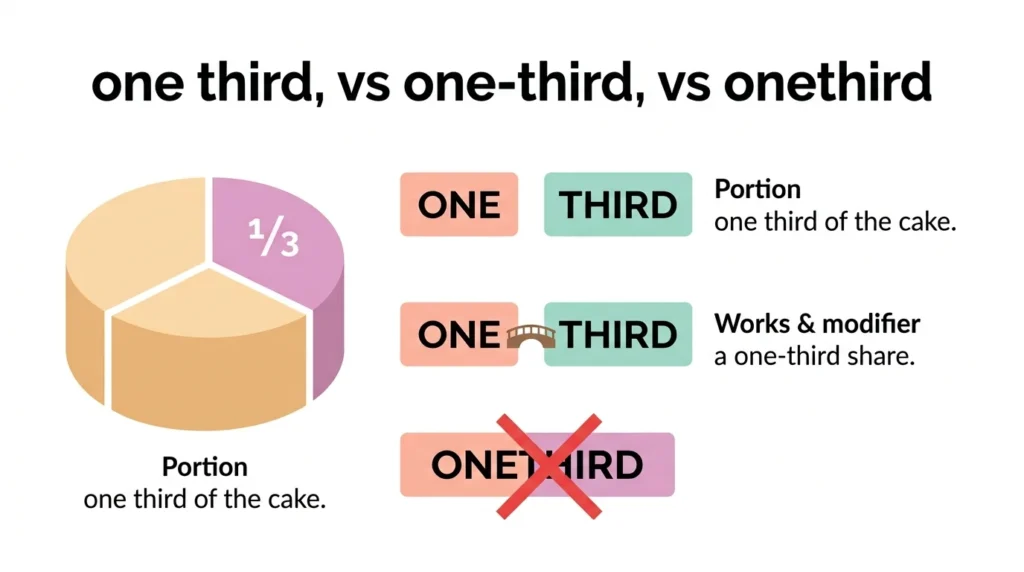
Think of the hyphen as a bridge.
When one and third need to work together as one descriptive unit before a noun, build the bridge:
one-third share
one-third reduction
one-third increase
When they function as a portion or noun phrase, the words can remain open under the noun-phrase convention:
one third of the cake
one third of the budget
And remember the red line:
Never build a single-word bridge: onethird.
Real-Life Situations
Job interview
“I have completed one-third of the certification.”
The fraction identifies a portion of the certification.
Business meeting
“We need a one-third reduction in expenses.”
The fraction modifies reduction, so the hyphen is appropriate.
“About one third of the team will attend the event.”
This is a noun phrase under the open-form convention.
Academic paper
“A one-third increase in sample size was observed.”
The fraction directly modifies increase.
Text message
“I’ve eaten a third of it already.”
This is especially natural in everyday speech.
Exam
If the question asks you to choose the standard spelling, eliminate onethird immediately.
Then decide between one third and one-third according to the grammatical construction or style instructions.
Expert Tips
1. Do not treat every hyphen question as a spelling question
The difference between one third and one-third is often about hyphenation, not spelling.
The underlying words remain one and third.
2. Look at the word after the fraction
If the fraction directly describes a noun, the hyphen is usually the safest choice:
a one-third reduction
a one-third share
3. Check the style guide before declaring an error
Different reputable style systems make different recommendations for noun fractions. Treating one convention as the only possible English rule can give learners a misleading picture of real usage.
4. Never use “onethird”
This is the easiest rule to remember.
one third ✓
one-third ✓
onethird ✗
5. “A third” is often the most natural conversational choice
If exact wording is not important, native speakers frequently say:
“I ate a third of the cake.”
rather than:
“I ate one third of the cake.”
Both communicate the same basic fraction.
6. Use numerals when the context demands them
Technical, scientific, mathematical, or data-heavy writing may prefer 1/3, ⅓, or 33.3% according to the document’s style. Do not force a spelled-out fraction into every numerical context.
7. Consistency beats guesswork
If your article begins with one third for noun phrases and one-third for modifiers, maintain that pattern throughout.
Read More: Unkept vs Unkempt: What Is the Difference?
FAQ
Is “onethird” a word?
No. “Onethird” is not the standard English spelling of the fraction 1/3. Use one third or one-third depending on the sentence and style guide.
Is “one third” grammatically correct?
Yes. One third is grammatically correct when it functions as a noun phrase under style systems that leave noun fractions open. For example: “One third of the class was absent.”
Is “one-third” grammatically correct?
Yes. One-third is correct when the fraction functions as a compound modifier, such as “a one-third share.” Some style guides also use the hyphen when the fraction functions as a noun.
Should I write “one-third of the population”?
It depends on the style guide. Some guides recommend one-third of the population, while others recommend one third of the population because the fraction functions as a noun phrase. Both conventions occur in edited English.
Is “one-third” an adjective?
It can function as a compound modifier when it describes a noun, as in a one-third share. Calling it simply an adjective in every context is too broad because fractions can also function as noun phrases or express degree.
Is “one third” one word?
No. It is written as two words when the open form is used. The alternative is one-third, with a hyphen. It is not written as onethird.
Is “one thirds” correct?
No. When the numerator is one, the denominator is singular: one third. You use the plural denominator with numbers greater than one, such as two thirds or three quarters.
Is “one-third” more formal than “one third”?
Not necessarily. The hyphen does not automatically make writing more formal. The choice depends mainly on grammatical function and the style guide being followed.
Can I write “a one-third”?
Usually, no. A fraction modifying a noun normally needs the noun:
a one-third share
not:
a one-third
However, a fraction can stand alone in other constructions depending on context.
Is “a third” better than “one third”?
Not always, but a third is often very natural in everyday English. One third can emphasize the exact fraction or sound more deliberate in formal or numerical contexts.
Should I use “1/3” instead?
Use 1/3, ⅓, or another numerical form when your context or style guide calls for numerical fractions. In ordinary prose, spelled-out simple fractions are also common. Different organizations have different preferences for presenting fractions.
Mini Quiz
| # | Question | Answer | Explanation |
|---|---|---|---|
| 1 | Which is standard? A) onethird B) one third C) onethird | B) one third | “Onethird” is not standard English. |
| 2 | Complete: “She owns a ___ share of the company.” | one-third | The fraction modifies share, so the hyphenated compound modifier is appropriate. |
| 3 | Correct the sentence: “Onethird of the students were absent.” | One third of the students were absent. | Replace the nonstandard single word with the open form. |
| 4 | True or false: “One-third” and “one third” always have different meanings. | False | They refer to the same fraction; the difference is grammatical function or style. |
| 5 | Choose the better compound modifier: “a one third reduction” / “a one-third reduction.” | a one-third reduction | The fraction directly modifies reduction. |
| 6 | Fill in the blank: “I ate ___ of the cake.” | one third | The fraction functions as a noun phrase in the open-form convention. |
| 7 | Which is wrong? A) one-third share B) one third of the share C) onethird share | C) onethird share | “Onethird” is not a standard spelling. |
| 8 | Correct the sentence: “The machine is one third full.” | The machine is one-third full. | The hyphenated form clearly expresses the degree or extent. |
| 9 | Which is correct? A) one-thirds B) one third C) onethirds | B) one third | The denominator is singular after one. |
| 10 | Choose the natural everyday version: “I ate ___ of the pizza.” A) a third B) onethird | A) a third | “A third” is a very natural conversational way to express the fraction. |
Quick Summary
“Onethird” is not the standard English form. The correct choices are one third and one-third. Use one-third when the fraction directly modifies a noun, as in “a one-third share” or “a one-third reduction.” Use one third when it functions as a noun phrase if you are following a style that leaves noun fractions open, as in “one third of the class.” However, some respected style guides hyphenate spelled-out fractions more broadly, so one-third of the class can also be correct. The most important rule is to avoid onethird and follow one consistent style throughout your document. In everyday speech, a third is often the most natural expression.