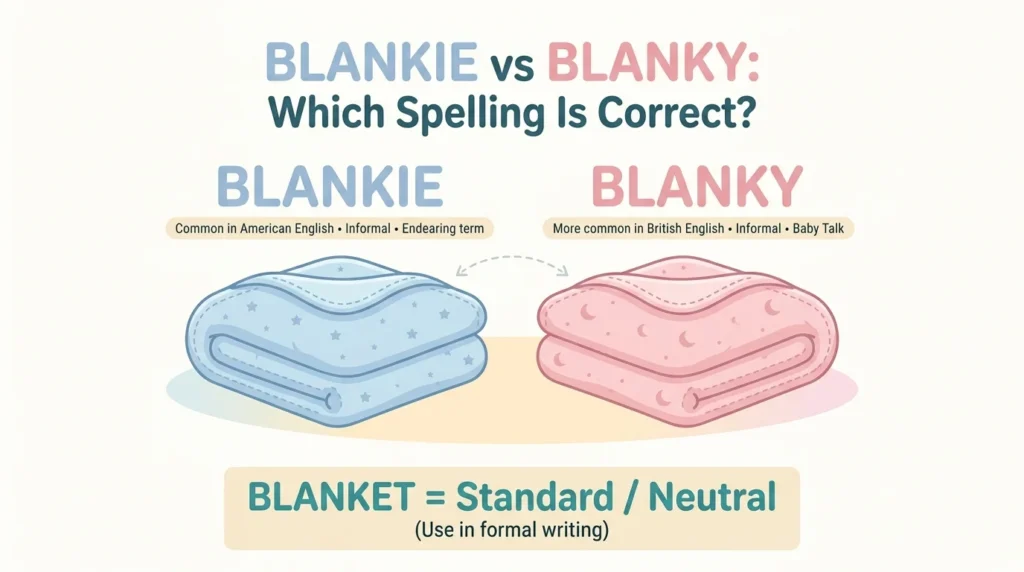

Blankie and blanky are both used for a small or comforting blanket, especially one associated with a child. Blankie is the more established choice in American English, while blanky is also recognized, particularly in British English, where it is described as baby talk. Both are informal nouns. If you want the safest choice for a general American or international audience, use blankie. For formal writing, use blanket or comfort blanket instead.
What Is “Blankie” or “Blanky”?
Blankie and blanky are informal, affectionate words for a blanket, especially a small blanket that a child uses for comfort or security.
The words do not normally describe two different objects. The main difference is spelling and regional usage, not meaning.
Blankie is a well-established informal English noun. Major dictionary evidence defines it as a child’s blanket, while Cambridge specifically describes it as a small blanket or part of a blanket that a young child uses to feel safe and happy.
Blanky is also a real word. It is listed in British English as baby talk for a comfort blanket. It is therefore too strong to call blanky simply “wrong.”
The important distinction is this:
- blankie — informal, affectionate, especially familiar in American English
- blanky — informal, affectionate, recognized particularly in British English
- blanket — neutral and standard
- comfort blanket — neutral and descriptive
So if someone asks, “Which is correct: blankie or blanky?” the best answer is both can be correct, but blankie is generally the safer choice for American English, while blanky has established British usage.
Why It Matters
This may look like a tiny spelling question, but choosing the right form helps you match your audience, tone, and purpose.
If you are writing a text message to a parent, a children’s story, or a casual social media post, blankie can sound warm and natural.
If you are writing a research paper about childhood development, blankie may sound too informal. In that setting, comfort blanket, security blanket, or simply blanket is usually better.
For example:
The child refused to sleep without her blankie.
That sounds natural in a casual parenting context.
But:
The study examined children’s attachment to familiar comfort objects.
That sounds more appropriate in academic writing.
The issue is therefore not just “correct versus incorrect.” Good English also depends on register, meaning the level of formality appropriate for a particular situation.
The Core Rule
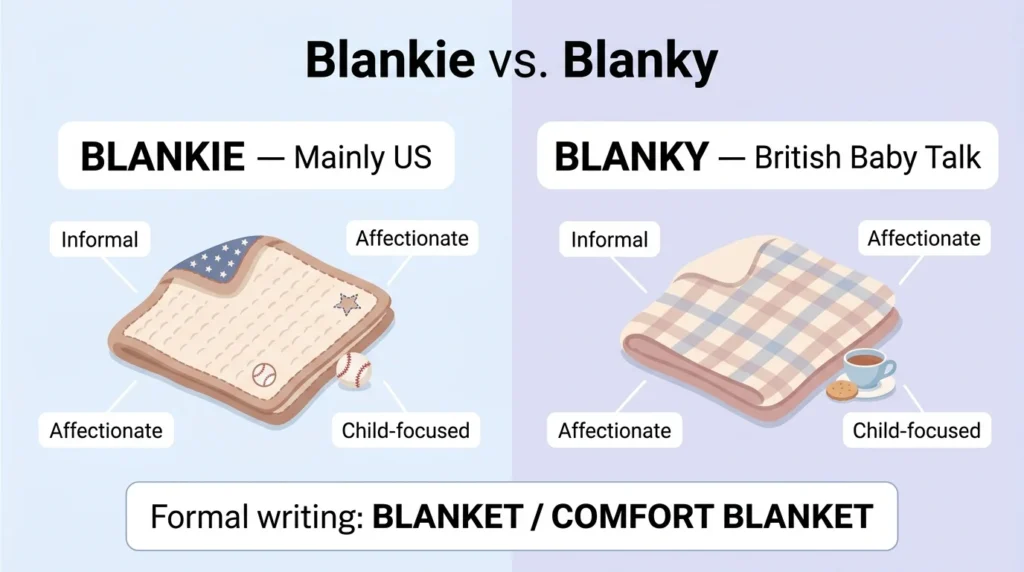
Use “blankie” when you want the familiar informal word for a child’s comfort blanket, especially in American English. “Blanky” is also a legitimate informal form, particularly in British English. In formal writing, use “blanket” or “comfort blanket.”
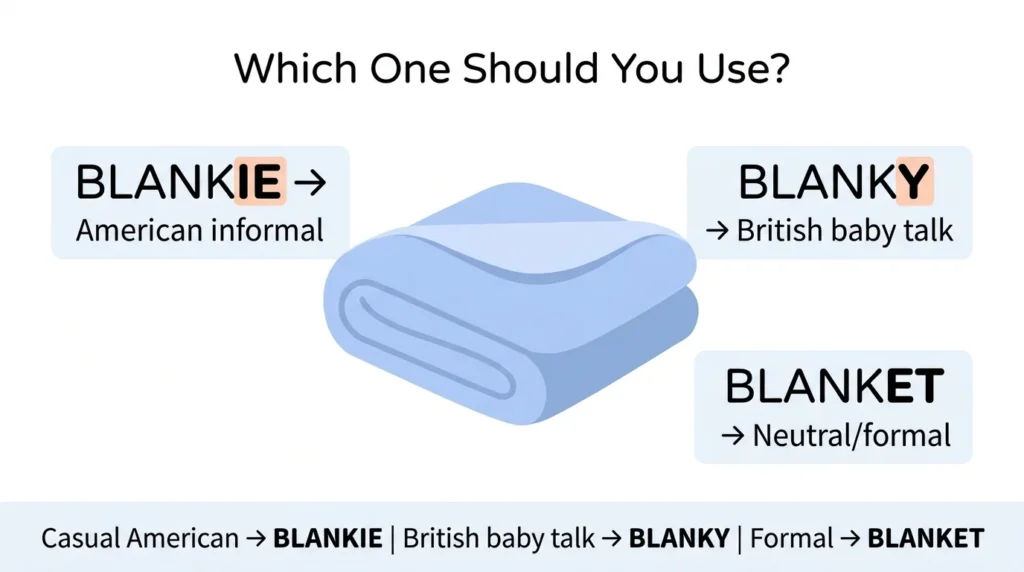
A simple decision rule is:
- Casual American English: choose blankie.
- British English or British-style baby talk: blanky can be appropriate.
- Formal or academic writing: choose blanket, comfort blanket, or security blanket.
- Writing for a child: either informal form may work if it matches the voice of the text.
Read More: Wise vs Wize: Which Spelling Is Correct?
How to Use “Blankie”
Use blankie as an informal noun when referring to a child’s familiar or comforting blanket.
The word is especially useful when the emotional relationship with the blanket matters.
Normal uses
- “Where is your blankie?”
- “She sleeps with her blankie every night.”
- “Don’t forget his blankie for daycare.”
- “The toddler carried her blankie around the house.”
- “His old blankie is falling apart.”
You can also use the plural blankies:
The daycare room was full of children and their favorite blankies.
The plural follows the normal spelling pattern for a noun ending in -ie: blankie → blankies. Dictionary evidence also records this plural form.
When “blankie” is especially natural
Blankie works particularly well when the word is part of:
- conversation with children
- parenting content
- children’s books
- family conversations
- affectionate storytelling
- casual social media posts
- informal messages
It can also be used humorously or affectionately by adults. Informal does not mean “incorrect.”
How to Use “Blanky”
Use blanky in the same broad semantic area: a small or comforting blanket, especially one associated with a child.
Its strongest dictionary distinction is regional. It is listed as British English baby talk for a comfort blanket.
For example:
The little boy wouldn’t leave his blanky behind.
She took her blanky with her when she visited Grandma.
His favorite blanky was soft and yellow.
If you are deliberately writing in a British voice, blanky can be a perfectly reasonable choice.
If you are writing for a broad international audience and do not have a reason to choose the British form, blankie is usually the less risky spelling because it has particularly strong recognition in American English. Cambridge labels blankie “mainly US,” while also recording its use in English more broadly.
Correct Examples
Here are examples showing how the words work in different situations.
- Conversation:
“Did you bring your blankie?” - Parenting:
“Mia refuses to sleep without her favorite blankie.” - Daycare message:
“Please remember to send Noah’s blankie tomorrow.” - Children’s story:
“Lily hugged her blankie and closed her eyes.” - Social media:
“After twenty years, I still have my childhood blankie.” - Casual text message:
“Can you wash the baby’s blankie before bedtime?” - British-style dialogue:
“Where’s your blanky?” Mum asked. - Family conversation:
“That little blankie has been with him everywhere.” - Product description with a playful tone:
“A soft little blankie made for bedtime cuddles.” - Personal memory:
“My old blankie was faded, torn, and completely irreplaceable.” - Children’s dialogue:
“I can’t go to sleep! I need my blankie!” - Casual storytelling:
“Her blankie went missing just before bedtime, creating a full-scale household search.”
Notice that these examples are informal by nature. That is not a weakness. The word is designed for informal contexts.
Incorrect vs. Correct
| ❌ Incorrect or Less Suitable | ✅ Better Choice | Why |
|---|---|---|
| My daughter sleeps with her blankie. | My daughter sleeps with her blankie. | This is already correct; the word is informal but appropriate in casual English. |
| The research investigated the child’s blankie attachment. | The research investigated the child’s attachment to a comfort blanket. | The problem is register, not spelling. Academic writing normally favors neutral terminology. |
| Please bring your child’s comfort blanket. | Please bring your child’s blankie. | If the message is friendly and informal, blankie is perfectly suitable. |
| My son lost his blanky. | My son lost his blankie. | In general American English, blankie is the more familiar choice. |
| My son lost his blanky. | My son lost his blanky. | In British English, blanky is a recognized informal form, so it is not inherently wrong. |
| The infant’s blankie was analyzed in the experiment. | The infant’s comfort blanket was analyzed in the experiment. | A formal scientific context calls for neutral vocabulary. |
| Her favorite blankee is blue. | Her favorite blankie is blue. | Blankee is not the established spelling of this word. |
| She sleeps with her blanky. | She sleeps with her blankie. | This is a safer choice for a general American audience. |
| The child carried his blankie into the classroom. | The child carried his blankie into the classroom. | The original sentence is already correct. Informal vocabulary is allowed in ordinary narration. |
| The report recommends that children use a blankie during treatment. | The report recommends that children use a comfort blanket during treatment. | Formal reports usually benefit from neutral terminology. |
The table highlights an important point: not every use of the less-preferred form is a grammatical error.
Sometimes the real issue is regional preference. Sometimes it is formality. Sometimes there is no error at all.
Read More: Trek vs Treck: Which Spelling Is Correct?
Why People Make This Mistake
Phonetic similarity
Blankie and blanky are pronounced very similarly, and in many contexts they sound identical or nearly identical.
When people hear the word rather than see it, there is no obvious clue about whether the ending should be spelled -ie or -y.
That makes this primarily a spelling-and-usage question rather than a pronunciation problem.
Spelling overlap
English has many words ending in -ie and -y, and there is no universal rule saying that affectionate forms must use one spelling.
Compare:
- doggie
- kitty
- birdie
- sweetie
- baby
- puppy
- bunny
Because both -ie and -y occur naturally in informal English, writers cannot always predict the spelling from sound alone.
Overgeneralization
A learner may assume that because baby becomes babyish or because many familiar words end in -y, blanky must be the standard spelling.
Another learner may see the common affectionate pattern in doggie, birdie, or sweetie and assume that blankie must be the only possible form.
Neither assumption is reliable.
Autocomplete and spellcheck
Digital tools can make the problem worse.
A keyboard may recognize blankie because it appears frequently in dictionaries or user-generated text. Another system may accept blanky because it is also a legitimate word.
Spellcheck acceptance does not automatically tell you which form best fits your audience.
Translation interference
Learners translating from another language may look for a single exact equivalent of a child-directed word.
But English often has several informal forms whose differences involve tone, region, and family usage rather than a completely different dictionary meaning.
That is why context matters.
Common Mistakes Checklist
1. Treating “blanky” as automatically wrong
What happens: A writer assumes that only blankie is correct.
Why: Many American English references are more familiar with blankie.
How to avoid it: Remember that blanky has established British dictionary usage as baby talk for a comfort blanket.
2. Treating “blankie” as formal vocabulary
What happens: A writer uses blankie in an academic report.
Why: The writer knows it is a dictionary word and assumes dictionary-listed words are automatically formal.
How to avoid it: Separate correctness from register. A word can be correct and still be too informal for a particular setting.
3. Calling every variation an error
What happens: A regional spelling is labeled incorrect.
Why: The writer is using one variety of English as the only standard.
How to avoid it: Check whether the form has established regional or dictionary usage before calling it wrong.
4. Assuming “informal” means “incorrect”
What happens: The writer avoids blankie because it sounds childish.
Why: Informal words can feel less serious.
How to avoid it: Understand that informal describes register, not grammatical validity.
5. Using “blankie” when “blanket” is clearer
What happens: A formal document refers repeatedly to a “blankie.”
Why: The writer wants to sound friendly.
How to avoid it: Use blanket, comfort blanket, or security blanket when precision and neutrality matter more than affection.
Blankie and Blanky in Real English
Blankie: grammatically correct and naturally informal
Blankie is a natural informal noun when the speaker is talking about a child’s favorite or comforting blanket. It has strong recognition in American English, and dictionary sources explicitly define it in this sense. The word can sound affectionate, playful, or child-focused, which is exactly why it works well in family conversation and children’s language. It is not a spelling error simply because it is informal.
Blanky: grammatically possible and genuinely established
Blanky is not merely a random misspelling invented by people who cannot remember blankie. It has dictionary support as a British English baby-talk noun meaning a comfort blanket. Therefore, calling it universally “wrong” gives learners an inaccurate picture of English usage. It is less suitable if you are deliberately following a general American style, but it is a legitimate form in the right context.
Read More: Stared vs. Starred: Which Word Is Correct?
“Blankie” in formal English: possible, but usually unnatural
A sentence containing blankie can be grammatically correct in a formal document, but the word may sound out of place because it carries an informal, child-focused tone. For example, a scientific paper can technically mention a child’s “blankie,” especially when quoting a participant, but the writer would normally choose comfort blanket or security blanket in neutral exposition.
“Blanky” in American everyday English: understandable, but less safe
An American reader will generally understand blanky from context. However, blankie is the more familiar choice when you want the common American informal form. If the goal is natural, broadly recognizable American English, blankie is usually the better option.
American vs. British English
There is a genuine regional distinction worth knowing.
| Feature | Blankie | Blanky |
|---|---|---|
| Basic meaning | A child’s or comforting blanket | A comfort blanket, especially in child-directed language |
| Part of speech | Informal noun | Informal noun |
| American English | Strongly established | Understandable but less typical |
| British English | Used | Recognized and established |
| Register | Informal/affectionate | Informal/baby talk |
| Formal writing | Usually avoid | Usually avoid |
| Safer general choice | Yes | Depends on audience |
Cambridge labels blankie as an informal noun used mainly in US English, while Collins identifies blanky as British English baby talk meaning “a comfort blanket.”
This does not mean British speakers never say blankie or American speakers never say blanky. Real English is not divided into two perfectly sealed boxes.
It means that if you are choosing a form deliberately, blankie is the safer American choice, while blanky has particularly clear British usage.
Formal vs. Informal Usage
Both blankie and blanky are informal.
Use them when the conversational or emotional tone calls for them:
- talking to a child
- writing children’s fiction
- writing a casual parenting post
- sending a family text
- describing a childhood memory
- creating playful dialogue
Prefer blanket, comfort blanket, or security blanket when writing:
- academic papers
- medical or psychological reports
- formal business documents
- technical reports
- official policies
- professional research
For example:
Informal:
The toddler won’t sleep without her blankie.
Neutral:
The toddler will not sleep without her comfort blanket.
Both communicate the basic idea. The second simply fits a more formal register.
Comparison Table
| Feature | Blankie | Blanky |
|---|---|---|
| Word type | Informal noun | Informal noun |
| Meaning | A small or comforting blanket | A comfort blanket |
| Child-focused | Yes | Yes |
| Affectionate tone | Yes | Yes |
| American English | More familiar | Less common |
| British English | Used | Established |
| Dictionary recognition | Yes | Yes |
| Formal English | Usually unsuitable | Usually unsuitable |
| Pronunciation | Typically /ˈblæŋki/ | Typically /ˈblæŋki/ |
| Plural | blankies | blankies |
| Best general advice | Use for informal American English | Use when British usage or personal style fits |
Memory Trick
Remember:
Blankie = the “ie” spelling you are most likely to see in American informal English.
Blanky = the “y” form you can associate with British baby talk.
Another quick memory aid:
Blankie = blanket + “ie” → familiar American informal form.
But do not turn the mnemonic into an absolute rule. English usage is more flexible than a spelling trick.
Real-Life Situations
Interview
If you are discussing childhood memories in an interview, either informal form may appear naturally:
“I carried my blankie everywhere when I was little.”
If you are writing the interview transcript for publication, keep the speaker’s original wording when appropriate.
Meeting
In a professional meeting, you would normally avoid both forms unless they are relevant to the topic.
Instead of:
“The customer wants a blankie for her child.”
A more neutral sentence might be:
“The customer wants a comfort blanket for her child.”
A casual email to another parent can comfortably use blankie:
“Could you please send Emma’s blankie with her tomorrow?”
A formal institutional email would usually use comfort blanket or blanket.
Text Message
“Did you pack his blankie?”
This is completely natural in an informal family conversation.
Exam
If an English exam asks for formal vocabulary, blanket or comfort blanket is usually the better choice.
If the exam is testing informal dialogue, blankie may be appropriate if the context supports it.
Children’s Story
Both can work:
“Ben hugged his blankie and climbed into bed.”
or:
“Ben hugged his blanky and climbed into bed.”
The best choice depends on the variety of English and the voice you want the story to have.
Expert Tips
Tip 1: Do not confuse correctness with formality
This is the most important lesson.
Blankie is correct. Blanky can also be correct. Both are informal.
A word does not become incorrect because it sounds childish.
Tip 2: Think about your reader before your dictionary
If you are writing for American readers, blankie is usually the straightforward choice.
If you are deliberately writing British English, blanky is a recognized option.
Tip 3: Use “comfort blanket” when precision matters
If your reader may not understand the affectionate term, comfort blanket immediately explains the object.
Tip 4: Do not overcorrect children’s language
Children and families naturally create affectionate vocabulary.
A child’s use of blanky or blankie does not need to be “corrected” unless the task specifically requires standard or formal vocabulary.
Tip 5: Preserve regional voice
If a character is British and naturally says blanky, changing it automatically to blankie can remove part of the character’s voice.
Good editing is not about forcing every speaker into one variety of English.
FAQ
Is “blankie” a real word?
Yes. Blankie is an established informal English noun meaning a child’s blanket, especially a blanket used for comfort. It is recorded by major dictionaries and has a long history of use.
Is “blanky” a real word?
Yes. Blanky is also an established word. It is listed in British English as baby talk for a comfort blanket.
Is blankie or blanky more common?
Blankie is generally the safer and more familiar choice in American English. Blanky has established British usage and may be the better choice when deliberately writing British English. The two forms should not be treated as completely unrelated words.
Does blankie mean the same thing as blanket?
Not exactly in tone. A blanket is the neutral general word. A blankie is an informal, affectionate term, usually suggesting a small or comforting blanket, especially one associated with a child.
Is blankie childish?
It can sound childlike or affectionate, but that does not make it incorrect. Adults may use the word when talking to children, discussing childhood, or using playful language.
Can adults use the word blankie?
Yes. Adults can use blankie in casual conversation, storytelling, parenting contexts, humor, or when referring to a childhood comfort object. The word’s informality is a matter of tone, not an age restriction.
Should I use blankie in an academic paper?
Usually not unless the word is part of a quotation, a participant’s speech, or a specific discussion of informal language. Comfort blanket or security blanket will usually sound more appropriate in academic prose.
Is “blankee” a correct spelling?
Blankee is not the established spelling of this informal noun. If you mean the affectionate word derived from blanket, choose blankie or, depending on regional usage, blanky.
What is the plural of blankie?
The plural is blankies.
The children brought their blankies to daycare.
What is the plural of blanky?
The plural form recorded for blanky is also blankies. This is one reason the spelling can feel confusing: the singular forms differ, but the plural converges on blankies.
Is blankie more American than British?
Yes, in dictionary labeling blankie is particularly associated with American English. Cambridge describes it as “mainly US,” while blanky has a specific British English dictionary entry. This is a tendency, not a rule that every American or British speaker must follow.
What should I use if I am unsure?
For general informal American English, choose blankie. If you are writing formal English, choose blanket or comfort blanket. If you are intentionally using British English, blanky is a valid informal option.
Mini Quiz
| # | Question | Answer | Explanation |
|---|---|---|---|
| 1 | Which is the safer informal choice for general American English: blankie or blanky? | Blankie | Blankie is the more established American choice. |
| 2 | Fill in the blank: “The child cannot sleep without her ___.” | blankie | The sentence is informal and refers to a child’s comfort blanket. |
| 3 | Is blanky automatically incorrect? | No | It is an established informal form, particularly in British English. |
| 4 | Which is more suitable for a formal report: “blankie” or “comfort blanket”? | comfort blanket | The latter has a more neutral, formal register. |
| 5 | Correct the sentence: “She took her blankee to bed.” | She took her blankie to bed. | Blankie is the established spelling. |
| 6 | Which word is labeled mainly US by Cambridge? | blankie | Cambridge identifies blankie as an informal noun, mainly US. |
| 7 | Which form is specifically listed as British English baby talk? | blanky | The British dictionary entry identifies blanky as baby talk for a comfort blanket. |
| 8 | Fill in the blank: “The children packed their ___ for the sleepover.” | blankies | Blankies is the plural form. |
| 9 | Is this sentence appropriate in a casual family text? “Did you pack the baby’s blankie?” | Yes | Blankie fits naturally in informal family communication. |
| 10 | Correct the register: “The clinical report examined the child’s attachment to her blankie.” | The clinical report examined the child’s attachment to her comfort blanket. | The original is understandable, but the revised version is more suitable for formal writing. |
Quick Summary
Blankie and blanky are both informal words for a small or comforting blanket, especially one associated with a child. The main difference is not meaning but usage and regional preference. Blankie is the safer and more familiar choice for American English, while blanky has established British English usage as baby talk for a comfort blanket. Neither should automatically be labeled wrong. Both are informal, so formal writing usually calls for blanket, comfort blanket, or security blanket instead. If you are writing casually for a general American audience, choose blankie. If you are deliberately using British English, blanky can be a natural choice.
FAQ
Which should I choose: blankie or blanky?
Choose blankie for most informal American English. Choose blanky when British usage or a particular character’s voice makes it appropriate.
Can I use blankie in a children’s book?
Yes. It is especially suitable for child-focused dialogue and storytelling because it has an affectionate, familiar tone.
Does blanky sound wrong to Americans?
It may sound less familiar to some American readers, but that does not make it inherently wrong. It is an established informal form.
Is comfort blanket better than blankie?
For formal or neutral writing, yes. For casual family language, blankie may be warmer and more natural.
Why do blankie and blanky sound so similar?
They are closely related informal forms derived from blanket, and their pronunciations are typically very similar. The spelling difference is therefore easy to miss in speech.
Quiz
1. Choose the best option for general American informal English.
A. blankee
B. blankie
C. blanky only
Answer: B. blankie
Blankie is the most familiar choice among these options. Blanky can also be valid, but blankee is not the established spelling.
2. Fill in the blank.
“Where did you put the baby’s ___?”
Answer: blankie
The sentence is a casual family question, so the informal word fits naturally.
3. True or false: “Blanky is always incorrect.”
Answer: False
Blanky is a recognized informal form, especially in British English.
4. Choose the best word for an academic paper.
The child developed a strong attachment to her ___.
Answer: comfort blanket
The neutral phrase is more appropriate for academic writing.
5. Correct the spelling.
“My daughter loves her blankee.”
Answer: “My daughter loves her blankie.”
Blankie is the established spelling of the informal American form.
6. Which form is particularly associated with British baby talk?
Answer: blanky
It is listed as British English baby talk meaning a comfort blanket.
7. Choose the natural casual sentence.
A. The toddler lost her blankie.
B. The toddler lost her blankee.
Answer: A
Blankie is the established spelling.
8. What is the plural of “blankie”?
Answer: blankies
For example:
The children brought their blankies to daycare.
9. Is this sentence suitable for a casual text?
“Don’t forget Mia’s blankie!”
Answer: Yes
The informal tone makes blankie appropriate.
10. Rewrite this formal sentence more appropriately.
“The researcher examined the child’s dependence on her blankie.”
Answer: “The researcher examined the child’s dependence on her comfort blanket.”
The revised sentence uses neutral vocabulary suitable for formal academic writing.