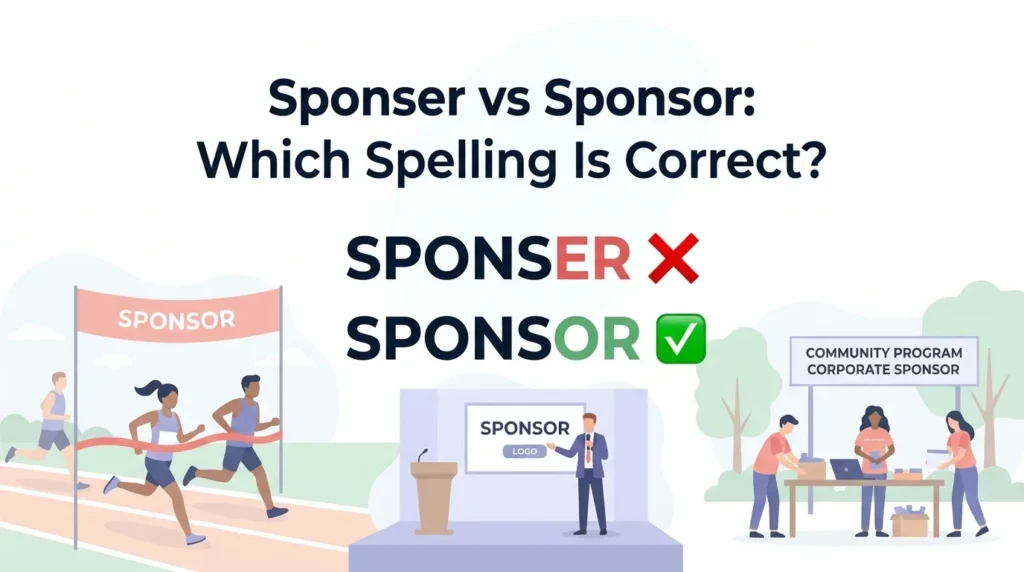

Sponsor is the correct spelling in standard English. Sponser is a misspelling and should not be used in normal English writing. The word sponsor can be a noun meaning a person or organization that provides support, or a verb meaning to support or fund someone or something. The spelling stays s-p-o-n-s-o-r, even though its pronunciation can sound like “spon-ser.”
What Is Sponser vs Sponsor?
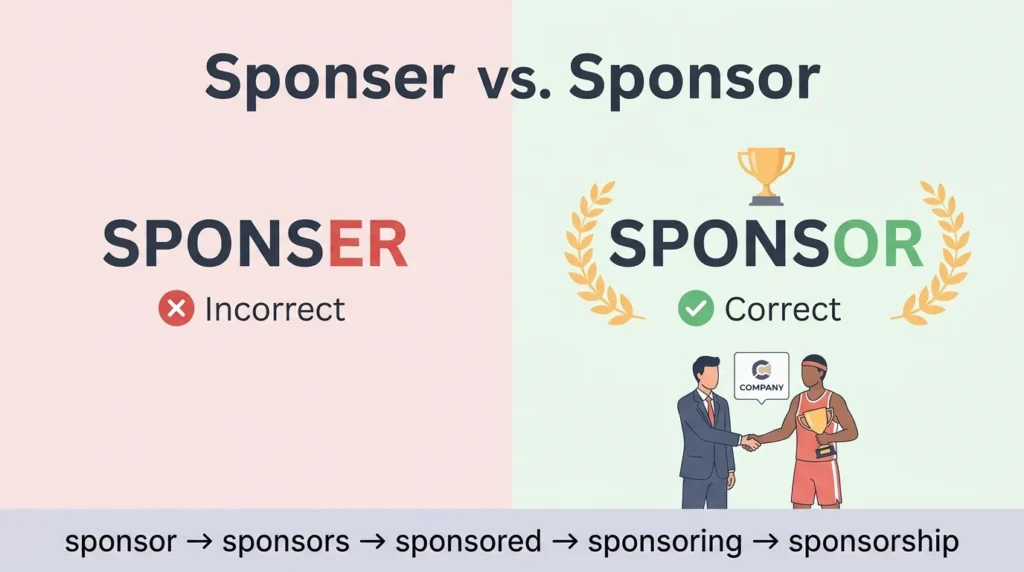
The difference between sponser vs sponsor is simple: sponsor is the standard English spelling, while sponser is an incorrect spelling.
The confusion is understandable because the pronunciation of sponsor can make the final part sound like “-ser.” In both American and British English, the spoken word can encourage writers to spell it the way it sounds.
But pronunciation does not determine the spelling.
The correct form is:
S-P-O-N-S-O-R → sponsor
The incorrect form is:
S-P-O-N-S-E-R → sponser
So if you are writing an email, application, assignment, business proposal, social media post, or academic paper, choose sponsor.
Why It Matters
A one-letter spelling error may seem minor, but spelling becomes especially important when the word appears in professional or public writing.
Consider these situations:
- You are asking a company to sponsor an event.
- You are writing a proposal for a potential sponsor.
- You are describing a sponsored research project.
- You are looking for corporate sponsorship.
- You are explaining that a business sponsors a sports team.
Writing sponser in these situations can make the document look less carefully edited.
The problem is not that readers cannot understand you. Most readers will understand what you mean. The problem is that sponser is not the standard spelling of the English word.
The Core Rule
Use sponsor, never sponser, when you mean a person or organization that supports, funds, or backs someone or something.
Remember:
Sponsor = correct
Sponser = incorrect
There is no American-versus-British spelling distinction here. Both varieties use sponsor.
How to Use Sponsor
Sponsor has two common grammatical roles: it can be a noun or a verb.
As a noun, it refers to the person or organization providing support.
The company became the main sponsor of the tournament.
As a verb, it describes the act of providing support or funding.
The company agreed to sponsor the tournament.
This distinction is useful because the spelling does not change simply because the grammatical role changes.
Sponsor as a Noun
A sponsor can be an individual, company, organization, or other entity that provides support.
The university found a sponsor for the student competition.
Several corporate sponsors supported the conference.
We thanked every sponsor at the end of the event.
Depending on the context, sponsorship may involve money, services, resources, promotion, or another form of support.
Sponsor as a Verb
As a verb, sponsor means to support, fund, or back someone or something.
The company will sponsor the annual conference.
A local business sponsored our football team.
The foundation sponsors educational programs.
The verb can also appear in different grammatical forms:
- sponsor — base form
- sponsors — third-person singular present
- sponsored — past tense and past participle
- sponsoring — present participle
- sponsorship — noun referring to the arrangement or support
Notice that all these forms retain the sponsor spelling.
Correct Examples
Here are examples from everyday, professional, academic, and online English.
- The company agreed to sponsor our annual conference.
- We are looking for a sponsor for the university sports event.
- The charity received support from several corporate sponsors.
- A local business sponsored the school’s science competition.
- The research project was sponsored by an independent foundation.
- She contacted several companies to ask whether they would sponsor the event.
- The football club announced a new shirt sponsor.
- Our organization is seeking sponsorship for its community program.
- The company sponsors scholarships for talented students.
- The event organizers thanked every sponsor in their closing speech.
- The conference was sponsored by several technology companies.
- He mentioned the sponsor in his social media post.
- The university is seeking sponsors for its student innovation program.
- The brand agreed to sponsor the athlete for the next season.
- The study was supported through sponsorship from a private foundation.
Incorrect vs. Correct
| ❌ Incorrect✅ CorrectWhy | ||
| The company will sponser the event. | The company will sponsor the event. | Sponsor is the standard English spelling. |
| We need a sponser for the tournament. | We need a sponsor for the tournament. | The noun is spelled with -or, not -er. |
| She contacted the event sponser. | She contacted the event sponsor. | The person or organization providing support is a sponsor. |
| The business sponsered the program. | The business sponsored the program. | The past tense is sponsored. |
| Several companies sponser local teams. | Several companies sponsor local teams. | The verb remains sponsor. |
| We are seeking sponserhip. | We are seeking sponsorship. | The noun is formed from sponsor, giving sponsorship. |
| The event is sponsered by a bank. | The event is sponsored by a bank. | The correct past participle is sponsored. |
| Who is the main sponser? | Who is the main sponsor? | The standard noun is sponsor. |
| The company is sponsering the team. | The company is sponsoring the team. | The -ing form is sponsoring, not sponsering. |
| We thanked our sponsers. | We thanked our sponsors. | The plural of sponsor is sponsors. |
Why People Make This Mistake
The mistake is mostly a spelling-and-pronunciation problem rather than a grammar problem.
Phonetic Similarity
Sponsor is pronounced roughly like “spon-ser” in ordinary speech. That can make sponser look logical when someone tries to spell the word from its sound.
English frequently creates this problem because the relationship between pronunciation and spelling is not perfectly predictable.
The important lesson is:
Hear the word → recognize the word → use its established spelling.
Do not reconstruct its spelling entirely from pronunciation.
Spelling Overlap
Many common English words end in -er:
- teacher
- writer
- manager
- worker
- player
- speaker
Because sponsor describes a person or organization that performs a supporting role, it can feel as though it should follow the same pattern.
But English has many words ending in -or, including:
- actor
- editor
- creator
- director
- investor
- donor
- sponsor
The ending has to be learned as part of the individual word.
Read More: Wise vs Wize: Which Spelling Is Correct?
Overgeneralization
English learners often learn a useful spelling pattern and then apply it too widely.
For example:
“A person who does something often ends in -er.”
That pattern works for many words, but it is not a universal spelling rule.
Sponsor is one of the words that must be learned with -or.
Autocomplete and Spellcheck
Spellcheck can help, but it should not be treated as a substitute for knowing the word.
Some writing tools will flag sponser and suggest sponsor. Other systems may behave differently depending on language settings, dictionaries, or the context in which the word appears.
If the word matters in a formal document, proofread it yourself.
Translation Interference
Learners who use English alongside another language may encounter similar-looking or similar-sounding forms in another language. That can reinforce a spelling that is not standard in English.
The safest approach is to check the English word itself rather than translating its spelling from another language.
Common Mistakes Checklist
Mistake 1: Writing “sponser”
What happens: You hear the final sound as “-ser” and write sponser.
How to avoid it: Memorize the final four letters:
S-O-R
Mistake 2: Writing “sponsered”
What happens: You create the past tense from the misspelled form.
Correct form: sponsored
Mistake 3: Writing “sponsering”
What happens: You change sponsor to sponser before adding -ing.
Correct form: sponsoring
Mistake 4: Writing “sponserhip”
What happens: You build the noun from the incorrect spelling.
Correct form: sponsorship
Mistake 5: Assuming pronunciation determines spelling
What happens: You write the word exactly as you think it sounds.
How to avoid it: Treat pronunciation and spelling as related but separate skills.
Sponsor in Real English
Grammatically Correct and Natural
Sponsor is completely natural when referring to a person or organization that supports an event, activity, project, person, or cause.
The company sponsors several community events.
This is ordinary English in business, education, sports, fundraising, media, and many other contexts. The word can be used naturally as both a noun and a verb.
Grammatically Possible but Context-Dependent
The word sponsor can describe several kinds of support, so its exact meaning depends on the situation.
For example, a sponsor may provide money for an event, support a person, back a project, or formally support a proposal. The surrounding words tell the reader what kind of sponsorship is involved.
The senator sponsored the bill.
Here, sponsored does not mean paid for an advertising opportunity. It means formally supported or introduced the legislative proposal.
Natural Everyday English
In everyday English, phrases such as event sponsor, corporate sponsor, main sponsor, sponsor an event, and sponsored by are natural and widely understood.
Who is sponsoring the event?
The event is sponsored by a local company.
These forms work naturally in conversation, emails, websites, advertisements, reports, and professional communication.
American vs. British English
There is no spelling difference between American and British English for this word.
Both use:
sponsor
Both also use the related forms:
- sponsored
- sponsoring
- sponsorship
- sponsors
Pronunciation can differ slightly between British and American English, but that does not change the spelling.
So:
American English: sponsor
British English: sponsor
Read More: Trek vs Treck: Which Spelling Is Correct?
Formal vs. Informal Usage
The word sponsor works in both formal and informal English.
Formal
The organization is seeking corporate sponsors for the annual conference.
The research was sponsored by an independent foundation.
Informal
Do you know who is sponsoring the event?
We still need a sponsor for the team.
The spelling does not change according to formality.
The main issue is simply choosing sponsor rather than sponser.
Comparison Table
| FeatureSponsorSponser | ||
| Standard English spelling | ✅ Yes | ❌ No |
| Correct noun | ✅ Yes | ❌ No |
| Correct verb | ✅ Yes | ❌ No |
| Used in professional writing | ✅ Yes | ❌ No |
| Used in academic writing | ✅ Yes | ❌ No |
| Used in British English | ✅ Yes | ❌ No |
| Used in American English | ✅ Yes | ❌ No |
| Past tense | sponsored | Incorrect: sponsered |
| -ing form | sponsoring | Incorrect: sponsering |
| Related noun | sponsorship | Incorrect: sponserhip |
Memory Trick
Use this simple mnemonic:
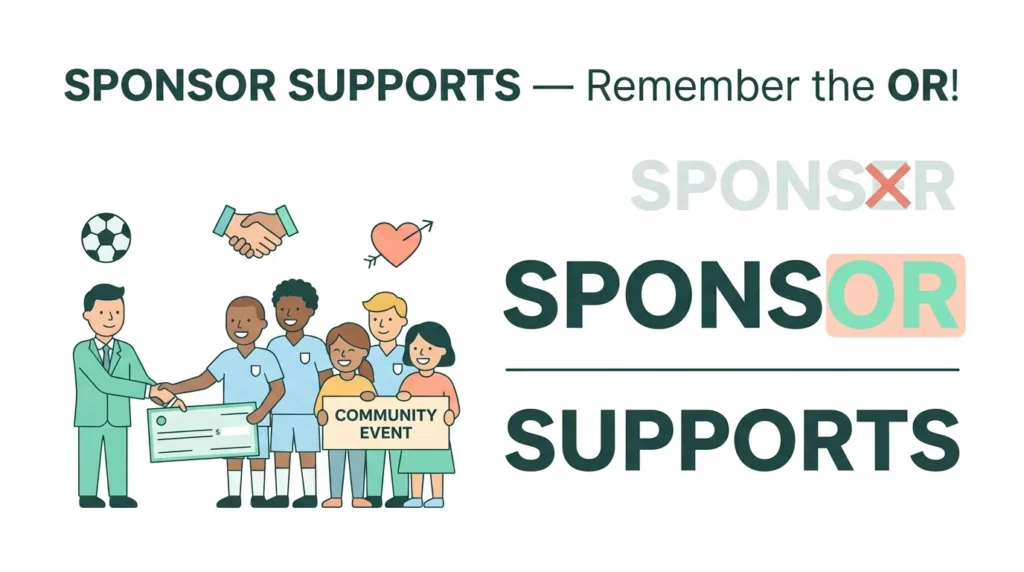
Sponsor supports — both end with “or.”
Think:
SponsOR → suppORt
The connection is not a grammar rule. It is simply a memory aid.
Another useful visual trick is to remember the final four letters:
S P O N S O R
The ending is:
O-R
not:
E-R
If you can remember “sponsor ends with OR,” you can eliminate the most common spelling mistake.
Real-Life Situations
In an Interview
Interviewer: “Have you worked with sponsors before?”
Candidate: “Yes. I managed relationships with several sponsors during our annual events.”
Here, sponsors is the plural noun.
In a Business Email
We would like to invite your company to sponsor our upcoming conference.
Here, sponsor is a verb.
In a Meeting
“Who is the main sponsor of this year’s event?”
Here, sponsor is a noun.
In a Text Message
“Do we have a sponsor for the tournament yet?”
The same standard spelling applies in casual messages.
In an Academic Paper
“The research project was sponsored by an independent educational foundation.”
Here, sponsored is the past participle of the verb sponsor.
On Social Media
“Proud to announce our newest sponsor for this season.”
Again, sponsor is the correct noun.
Expert Tips
Learn the Word Family
Do not memorize only sponsor. Learn its common forms together:
sponsor → sponsors → sponsored → sponsoring → sponsorship
This makes it much harder to accidentally create forms such as sponsered or sponsering.
Read More: Stared vs. Starred: Which Word Is Correct?
Check the Root Before Adding an Ending
When you are unsure about sponsored, first return to the base word:
sponsor + ed = sponsored
For sponsoring:
sponsor + ing = sponsoring
For sponsorship:
sponsor + ship = sponsorship
The correct base helps you build the related forms correctly.
Do Not Create a Spelling Rule From One Word
You may notice that many people-related words end in -er, but that does not mean every role word does.
English spelling contains many historical patterns and exceptions. Learn common words as complete spelling units when necessary.
Proofread High-Visibility Writing
A misspelling in a private note may have little consequence. A misspelling in a proposal to a potential sponsor is different.
Before sending professional writing, scan specifically for words you often confuse.
Remember the Meaning and Spelling Together
A sponsor is someone who supports.
Link these mentally:
Sponsor → support → sponsorship
This makes the word easier to recall than simply repeating its letters.
FAQ
Is “sponser” a correct English word?
No. In standard English, sponser is treated as a misspelling of sponsor. The correct spelling is sponsor. A separate spelling may appear as a word in other languages, but that does not make it an accepted English spelling.
Why do people spell sponsor as sponser?
The main reason is pronunciation. Sponsor can sound like “spon-ser,” so writers may naturally choose -er instead of the correct -or ending. Similarity to many familiar -er words can reinforce the mistake.
How do you spell sponsor correctly?
Spell it:
S-P-O-N-S-O-R
The final two letters are O-R.
Is sponsor a noun or a verb?
It can be both.
As a noun:
The company is our main sponsor.
As a verb:
The company will sponsor the event.
This noun-and-verb flexibility is common in modern English.
What is the past tense of sponsor?
The past tense is sponsored.
The company sponsored the event last year.
The incorrect form sponsered should be avoided.
What is the -ing form of sponsor?
The -ing form is sponsoring.
The company is sponsoring the tournament.
Do not write sponsering.
What is the noun form of sponsor?
The common noun referring to the act or arrangement of sponsoring is sponsorship.
The organization received corporate sponsorship.
Is sponsor spelled differently in British English?
No. British English and American English both spell the word sponsor. Pronunciation can vary, but the spelling remains the same.
Is “sponsored by” correct?
Yes. Sponsored by is a standard construction used to identify the person or organization providing support.
The event is sponsored by a local business.
Can a person be a sponsor?
Yes. A sponsor does not have to be a company. Depending on the context, an individual can provide financial, practical, professional, or other forms of support.
Is “sponsee” a real word?
Yes, sponsee is used in some contexts for a person who receives support or guidance from a sponsor. Its use is more specialized than the everyday word sponsor, so the exact meaning depends on the context.
Quick Summary
Sponsor is the correct spelling, while sponser is a misspelling in standard English. The confusion usually happens because sponsor can sound like “spon-ser” when spoken, encouraging writers to choose -er instead of -or. Sponsor works as both a noun and a verb: a sponsor provides support, while to sponsor means to provide or arrange that support. Its common forms include sponsors, sponsored, sponsoring, and sponsorship. The spelling is the same in American and British English. When writing an email, assignment, business proposal, social media post, or academic paper, always use sponsor. The easiest memory trick is simple: Sponsor supports — remember the “or.”
FAQ
Is “sponser” ever correct in standard English?
No. For ordinary English writing, use sponsor.
Why does “sponser” look correct?
It reflects the way sponsor can sound when spoken, especially quickly.
What is the correct spelling: sponser or sponsor?
Sponsor is correct.
What does sponsor mean?
A sponsor is a person or organization that supports someone or something, often through money, resources, or other forms of backing.
Is sponsor used as a verb?
Yes. For example: “The company will sponsor the event.”
Is sponsorship spelled with an e?
No. The correct spelling is sponsorship.
What is the plural of sponsor?
The plural is sponsors.
What is the past tense of sponsor?
The past tense is sponsored.
What is the correct spelling in British English?
Sponsor.
What is the correct spelling in American English?
Sponsor.
Mini Quiz
| #QuestionAnswerExplanation | |||
| 1 | Which spelling is correct? A) sponser B) sponsor | B) sponsor | The standard English spelling ends in -or. |
| 2 | Fill in the blank: The company agreed to ___ the event. | sponsor | Here, sponsor is used as a verb. |
| 3 | Correct the sentence: “We need a sponser for the tournament.” | We need a sponsor for the tournament. | Sponsor is the correct noun. |
| 4 | What is the past tense of sponsor? A) sponsered B) sponsored | B) sponsored | The past form retains the sponsor spelling. |
| 5 | Fill in the blank: The event was ___ by a local business. | sponsored | Sponsored is the past participle used after “was.” |
| 6 | Which is correct? A) sponsorship B) sponserhip | A) sponsorship | The noun is formed from sponsor + ship. |
| 7 | Correct the sentence: “The company is sponsering the team.” | The company is sponsoring the team. | The -ing form is sponsoring. |
| 8 | Is “sponsor” a noun, a verb, or both? | Both | It can name a supporter or describe the act of supporting. |
| 9 | Which spelling is correct in British English? A) sponser B) sponsor | B) sponsor | British English uses the same spelling as American English. |
| 10 | Complete the memory trick: “Sponsor ___.” | supports | “Sponsor supports” links the meaning with the correct -or spelling. |