
Usable is the preferred spelling in modern English. Useable is also a recognized variant, but it is much less common. Both mean “able to be used” or “fit for use.” If you are writing an email, essay, report, website, or professional document, usable is the safest and most natural choice.
What Is the Difference Between Useable and Usable?
Usable and useable are two spellings of the same adjective. Both describe something that can be used or is suitable for use.
The important difference is not meaning. It is modern usage and spelling preference.
Usable is the form you will normally want in contemporary writing. Major dictionaries list it as the main form, while useable is generally treated as a variant or less common spelling. Merriam-Webster, for example, defines usable as “capable of being used” and lists useable as a less common variant.
So:
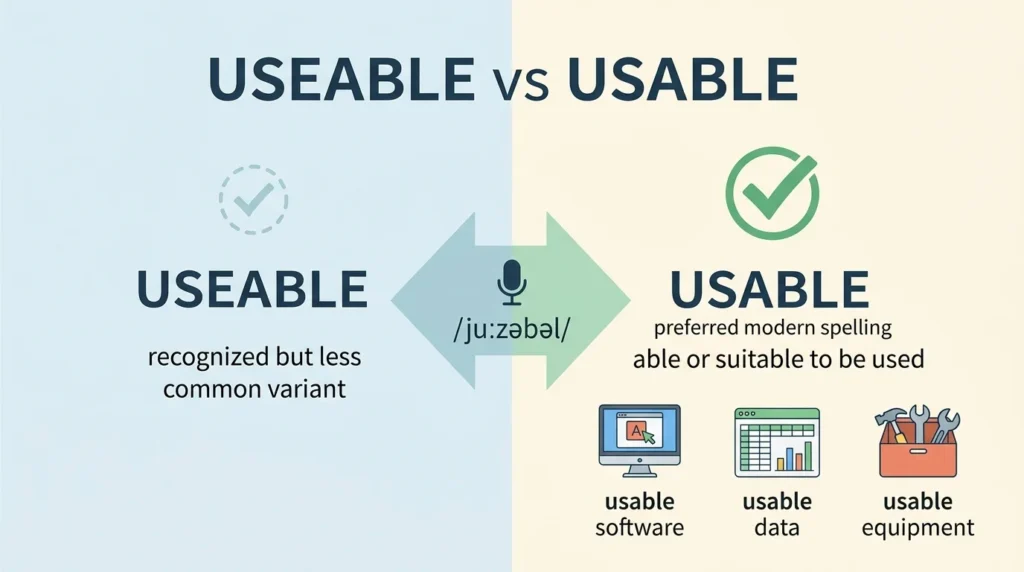
- usable = preferred modern spelling
- useable = recognized alternative spelling
- Both = able to be used
For most writers, the practical answer is simple: write usable.
Why It Matters
A one-letter difference can make a writer stop and question whether a word is correct. That uncertainty becomes especially noticeable in professional and academic writing.
Consider these sentences:
The software is highly usable for new employees.
and:
The software is highly useable for new employees.
The second sentence is understandable, and useable is not simply meaningless or automatically ungrammatical. However, usable is the more conventional choice.
That matters because readers expect familiar spelling patterns in polished writing.
Choosing usable can help you:
- avoid unnecessary spelling questions
- follow the dominant modern form
- maintain consistency in professional documents
- make your writing look more familiar to readers
- avoid distracting readers with a less common variant
The goal is not to declare every alternative spelling “wrong.” The goal is to choose the form that best fits contemporary standard usage.
The Core Rule
Use “usable” when you mean “able to be used,” “fit for use,” or “suitable for use.”
Useable has the same basic meaning, but it is less common.
If you are unsure which spelling to choose, choose usable.
The simplest rule to remember
Use + able → usable
Do not treat this as an absolute spelling formula for every English word ending in -able. English spelling has many exceptions and historical variations. Instead, learn usable as the standard spelling for this particular word.
How to Use “Usable” Correctly
Usable is an adjective. An adjective describes a noun.
It commonly describes objects, information, space, equipment, software, materials, data, and other things that can be put to practical use.
Usable for physical objects
The old printer is still usable.
The printer does not have to be new or perfect. It simply needs to work well enough to be used.
Usable for information
We collected enough usable information to prepare the report.
Here, usable means the information is suitable or practical for the intended purpose.
Usable for technology
The new interface is much more usable than the previous version.
Here, usable refers to how practical or easy the interface is for people to use.
Usable for space
The renovation created more usable space in the office.
Here, usable means space that can actually be put to practical use.
Usable for materials
Only usable materials should be sent to the production team.
The materials are suitable for the intended task.
Correct Examples
Here are examples from different areas of everyday and professional English.
- Conversation:
“Is this phone still usable?” - Email:
“Please send me a usable copy of the document.” - Workplace:
“We need a usable solution before Friday.” - School:
“The teacher gave us a usable framework for the assignment.” - Academic writing:
“The study produced usable data for further analysis.” - Technology:
“The application is simple and usable on smaller screens.” - Business:
“We need usable customer data before making a decision.” - Social media:
“This template is actually usable for small businesses.” - Everyday life:
“Most of the furniture was damaged, but the table was still usable.” - Professional report:
“The inspection identified several usable components.” - Design:
“The new layout is cleaner and more usable.” - Education:
“The guide contains several usable strategies for new teachers.”
Notice that usable does not necessarily mean excellent.
Something can be usable and still be old, imperfect, basic, or inconvenient.
Incorrect vs. Correct
Because useable is a recognized variant, the examples below need a little more nuance than a simple “wrong versus right” table.
| Less Preferred | Preferred | Why |
|---|---|---|
| The software is useable. | The software is usable. | Usable is the conventional modern form. |
| Is this equipment useable? | Is this equipment usable? | The preferred spelling is usable. |
| We need a useable format. | We need a usable format. | Usable is more familiar in contemporary writing. |
| The room has more useable space. | The room has more usable space. | The shorter form is standard in modern usage. |
| This data is useable. | This data is usable. | Usable is the usual editorial choice. |
| The tool is still useable. | The tool is still usable. | Both can be understood, but usable is preferred. |
| The document must be useable. | The document must be usable. | Usable is the dominant spelling. |
| We found some useable materials. | We found some usable materials. | Usable is more conventional. |
| The website is useable on mobile devices. | The website is usable on mobile devices. | Modern technical writing normally favors usable. |
| The old machine remains useable. | The old machine remains usable. | Usable is the safer standard form. |
Why call the first column “less preferred” instead of “incorrect”?
Because useable is attested English.
That distinction is important.
Calling every occurrence of useable a spelling error would be too strong. Dictionaries continue to record it as a variant. Merriam-Webster explicitly gives useable as a less common variant, while Collins also records both forms.
So the practical editing rule is:
Replace “useable” with “usable” when you want the standard, modern, widely preferred spelling.
Why Do People Make This Mistake?
The confusion is easy to understand.
The base word is use.
Add -able, and a writer may naturally think:
use + able = useable
That spelling looks completely logical.
English spelling, however, does not always work by simply attaching a suffix without changing the base word.
The conventional spelling is:
use → usable
This is one reason spelling cannot always be predicted perfectly from pronunciation or from a mechanical “base word + suffix” formula.
Phonetic similarity
When you hear usable and useable, the difference is not obvious in normal speech.
Both are pronounced essentially the same.
That means listening cannot reliably tell you which spelling to type.
Visual similarity
The words look almost identical:
- usable
- useable
Only one letter separates them.
That makes the less common form feel plausible.
Overgeneralization
Writers may learn a rule such as “keep the final e before a suffix” or simply assume that suffixes are added mechanically.
English has too many historical spelling patterns for such a simple rule to work universally.
Autocomplete and spellcheck
Modern writing tools can help, but they are not perfect judges of style.
A spellchecker may accept useable because it is a recognized variant.
That does not necessarily mean it is the best choice for your particular audience.
A word can be valid but less preferred.
Translation interference
Learners may also choose useable because their first language represents suffix formation differently.
The safest approach is not to translate the spelling rule directly. Learn the English form as a complete word:
usable = preferred spelling
Common Mistakes Checklist
Mistake 1: Treating “useable” as the best modern choice
What happens:
A writer assumes that because useable looks logically constructed, it must be preferable.
Why it happens:
The word use visibly ends in e.
How to avoid it:
Remember that usable is the standard form you should normally choose.
Mistake 2: Calling “useable” completely wrong
What happens:
A writer sees useable and assumes it is a non-word.
Why it happens:
Many spelling guides simplify the issue to “usable is correct.”
How to avoid it:
Remember the more accurate distinction: useable is a recognized variant, but usable is preferred.
Mistake 3: Assuming British English requires “useable”
What happens:
A writer believes useable is specifically British.
Why it happens:
Some sources present the two spellings as an American/British difference.
How to avoid it:
Do not treat this as a clean regional spelling pair. Current dictionary evidence supports usable as the main form while also recognizing useable as a variant. Collins, for example, records useable alongside usable rather than presenting the pair as a simple US-versus-UK rule.
Mistake 4: Changing the meaning
What happens:
A writer assumes usable and useable have different meanings.
Why it happens:
The spelling difference makes the words look like separate vocabulary items.
How to avoid it:
They have the same basic meaning: able or suitable to be used.
Mistake 5: Confusing “usable” with “useful”
These words are related but not identical.
Usable focuses on whether something can be used.
Useful focuses on whether something provides value or helps achieve a purpose.
For example:
The broken laptop is no longer usable.
It cannot function properly for the intended task.
But:
The manual is useful.
It provides helpful information.
Something can be usable without being especially useful.
Useable vs Usable in Real English
Grammatically correct
Usable is unquestionably standard English.
The equipment is usable.
This sentence is straightforward, natural, and appropriate in virtually any modern context.
Useable can also be grammatically valid because dictionaries recognize it as a variant.
The equipment is useable.
The sentence is understandable and can be found in published English, but the spelling is less common.
Grammatically possible but less conventional
Useable falls into this category for most modern writing.
It is not necessary to pretend that the word does not exist. The better explanation is that it is a legitimate but less common variant.
This distinction is useful for editors and advanced learners because English contains many variants that are recognized without being equally preferred.
Natural everyday English
For contemporary everyday writing, usable is the form most writers should reach for automatically.
You are unlikely to gain anything by choosing useable. It does not provide a different meaning, pronunciation, or grammatical function.
So if your goal is natural, current, professional English:
Choose usable.
The dictionary evidence supports that practical recommendation. Merriam-Webster lists usable as the main entry and useable as a less common variant. Collins similarly gives usable as the principal form while recording useable as an alternative.
American vs. British English
There is not a simple American-versus-British rule here.
Some online explanations claim that American English prefers usable while British English prefers useable. That is too broad.
Current dictionary evidence does not support presenting the pair as a straightforward regional spelling distinction.
Collins lists usable in both American and British English and also records useable as an alternative. Merriam-Webster lists useable as a less common variant.
What should American writers use?
Use usable.
What should British writers use?
Use usable as the normal modern form.
What should international writers use?
Use usable.
It is the clearest choice when your audience includes readers from different English-speaking backgrounds.
Read More: Wise vs Wize: Which Spelling Is Correct?
Formal vs. Informal Usage
There is no major meaning difference between the two forms based on formality.
However, usable is the better choice in formal and professional writing simply because it is the more conventional spelling.
Use usable in:
- academic papers
- business reports
- professional emails
- technical documentation
- websites
- applications
- resumes and cover letters
- educational materials
- marketing copy
Useable may still appear in informal writing, older material, quotations, or writing that follows a particular house style.
The key point is not that useable becomes “informal.” It is that usable is the safer default across registers.
Useable vs. Usable: Comparison Table
| Feature | Usable | Useable |
|---|---|---|
| Part of speech | Adjective | Adjective |
| Basic meaning | Able or suitable to be used | Able or suitable to be used |
| Pronunciation | Essentially the same | Essentially the same |
| Standard modern choice | Yes | No |
| Recognized English form | Yes | Yes |
| Frequency | More common | Less common |
| Professional writing | Preferred | Usually avoid if you can |
| Academic writing | Preferred | Less conventional |
| American English | Preferred | Recognized variant |
| British English | Preferred | Recognized variant |
| International English | Safest choice | Less common |
| Meaning difference | None | None |
Usable vs. Useful
Another important distinction is between usable and useful.
They overlap, but they answer different questions.
Usable asks:
Can this be used?
Useful asks:
Does this provide value or help?
Compare:
The old computer is still usable.
The computer works sufficiently for some purpose.
The old computer is useful for editing documents.
Now the sentence tells us that the computer provides practical value for a particular task.
A thing can be:
- usable but not very useful
- useful because of the information it provides
- both usable and useful
- neither usable nor useful
Keeping this distinction clear makes your writing more precise.
Memory Trick
Use this simple mnemonic:
USABLE = USE it + ABLE to work
If something is usable, you are saying that it is able to be used.
And when you are unsure about the spelling, remember:
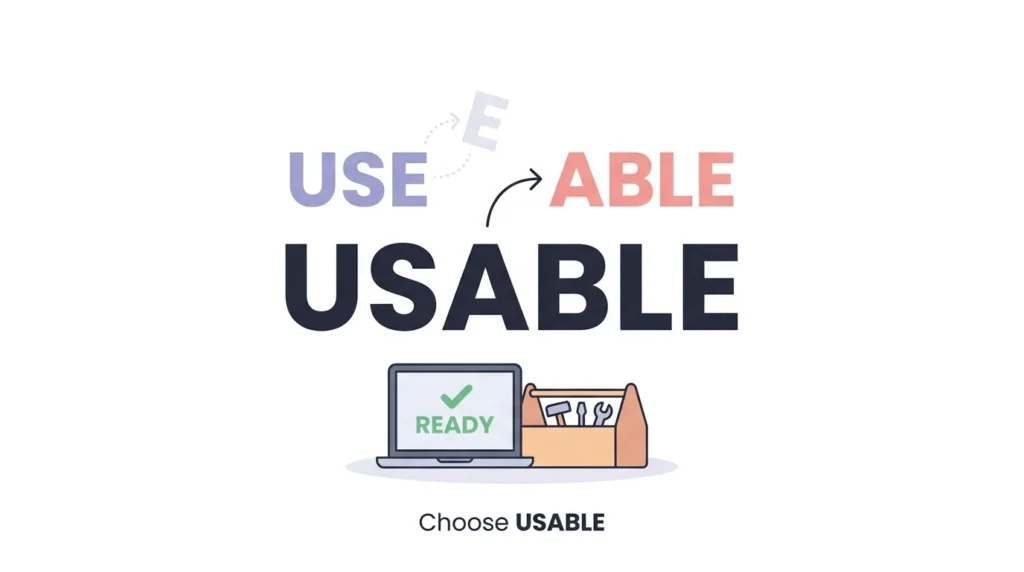
Drop the extra e: use → usable.
Do not turn this memory trick into a universal spelling rule for every -able word. It is simply the easiest way to remember the preferred spelling of this particular word.
Real-Life Situations
Job interview
You are describing a software project you worked on:
“I redesigned the interface to make it more usable for first-time users.”
That sounds natural and professional.
Workplace meeting
Your manager asks whether the old equipment can still be used:
“Yes, most of it is still usable.”
Business email
You need a document in a practical format:
“Could you send me a usable version of the file before the meeting?”
Text message
A friend asks whether an old phone still works:
“It’s old, but it’s still usable.”
Academic writing
You are describing research results:
“The study produced usable data for the final analysis.”
Website design
A designer discusses a new interface:
“The new navigation is much more usable on mobile devices.”
Exam
If you are asked to choose between useable and usable, the safest answer in a standard spelling exercise is:
usable
Expert Tips
1. Do not confuse “recognized” with “preferred”
This is one of the most useful lessons from this word pair.
A dictionary may record a form because people use it. That does not mean both forms are equally common or equally advisable.
Useable exists.
Usable is preferred.
Both facts can be true at the same time.
2. Do not rely entirely on spellcheck
If your software accepts useable, that does not settle the style question.
Spellcheckers often identify whether a word exists, not whether it is the best choice for your audience.
3. Learn words as complete forms
Instead of mentally constructing:
use + able
learn:
usable = able to be used
This reduces hesitation.
4. Choose consistency
If you have a long document and your preferred house style is usable, use that form throughout.
Do not alternate between usable and useable without a reason.
5. Be careful when editing older texts
If you are proofreading a historical document, quotation, or archival material, do not automatically change every useable to usable.
The original spelling may be intentional or historically appropriate.
Read More: Trek vs Treck: Which Spelling Is Correct?
FAQ
Is “useable” a correct English word?
Yes. Useable is a recognized variant spelling of usable. It is less common, however, so usable is the preferred choice in modern writing.
Is “usable” or “useable” more common?
Usable is more common and is the preferred modern spelling. Useable survives as an alternative form.
Do usable and useable mean the same thing?
Yes. Both mean that something is able or suitable to be used.
Is “useable” a British spelling?
It is too simplistic to call useable the British spelling. Modern British English uses usable, while British dictionaries may also recognize useable as a variant.
Is “usable” correct in American English?
Yes. Usable is the standard choice in American English, and American dictionaries also recognize useable as a less common variant.
Should I use “useable” in academic writing?
You generally should choose usable. It is the more conventional spelling and avoids unnecessary attention to a less common variant.
Why does “useable” look so natural?
Because the base word is use, and adding -able visually suggests useable. English spelling does not always form words by simply attaching suffixes without modifying the base spelling.
Does “usable” mean “useful”?
Not exactly. Usable means something can be used or is fit for use. Useful means something provides practical value or helps accomplish something.
Can I use “useable” in a quote?
Yes. If you are reproducing an original quotation, you should normally preserve the source’s wording and spelling unless your publication’s editorial policy says otherwise.
Is “usable” more professional than “useable”?
In contemporary professional writing, usable is the better choice because it is the conventional modern form. The issue is mainly spelling preference, not a difference in grammatical correctness.
Quick Summary
Usable is the preferred modern spelling of the adjective meaning “able to be used,” “fit for use,” or “suitable for use.” Useable is also a recognized English variant, but it is less common. The two forms have essentially the same meaning and pronunciation, so there is no important difference in what they communicate. For everyday writing, school assignments, academic work, business communication, websites, and professional documents, choose usable. Do not describe useable as completely incorrect, and do not assume it is specifically British English. The safest practical rule is simple: if you mean able to be used, write usable.
FAQ
Is “useable” ever the better choice?
Only when you have a specific reason to preserve that variant, such as following an existing house style, historical spelling, or quoted source. Otherwise, usable is the better default.
Why do dictionaries include both spellings?
Dictionaries describe language as it is used. If a variant has established usage, it may be recorded even when another form is much more common.
Does changing useable to usable change the pronunciation?
No. The two spellings are pronounced essentially the same.
Is usable an adjective?
Yes. Usable is an adjective because it describes a noun.
What is the noun form of usable?
The common noun is usability, as in “The website’s usability has improved.”
What is the opposite of usable?
The most direct opposite is unusable, meaning not capable of being used or not suitable for use.
Can I say “very usable”?
Yes.
“The new interface is very usable.”
This is grammatically normal. Depending on context, easy to use, practical, or user-friendly may sometimes communicate the idea more precisely.
Is “useability” also possible?
Yes, but usability is the much more common noun form. Collins records both usability and useability.
Mini Quiz
| # | Question | Answer | Explanation |
|---|---|---|---|
| 1 | Choose the preferred spelling: “The software is ___.” A) useable B) usable | B) usable | Usable is the preferred modern spelling. |
| 2 | Fill in the blank: “Is this old printer still ___?” | usable | The printer is capable of being used. |
| 3 | Which form is a recognized variant? A) useable B) usible | A) useable | Useable is a recognized variant of usable. |
| 4 | Correct the sentence: “We need a useable copy of the report.” | We need a usable copy of the report. | Usable is the conventional modern form. |
| 5 | True or false: “Useable” and “usable” have different basic meanings. | False | Both mean able or suitable to be used. |
| 6 | Choose the better professional form: “The new layout is more ___.” A) useable B) usable | B) usable | Usable is the safer professional choice. |
| 7 | Correct the sentence: “The data is no longer useable.” | The data is no longer usable. | Usable is the preferred spelling. |
| 8 | Which word means “providing value”: usable or useful? | useful | Useful focuses on benefit or value. |
| 9 | Choose the correct form: “The equipment remained ___ after the repair.” | usable | The equipment could still be used. |
| 10 | True or false: “Useable” is completely nonexistent in English. | False | Dictionaries recognize it as a variant, although it is less common. |