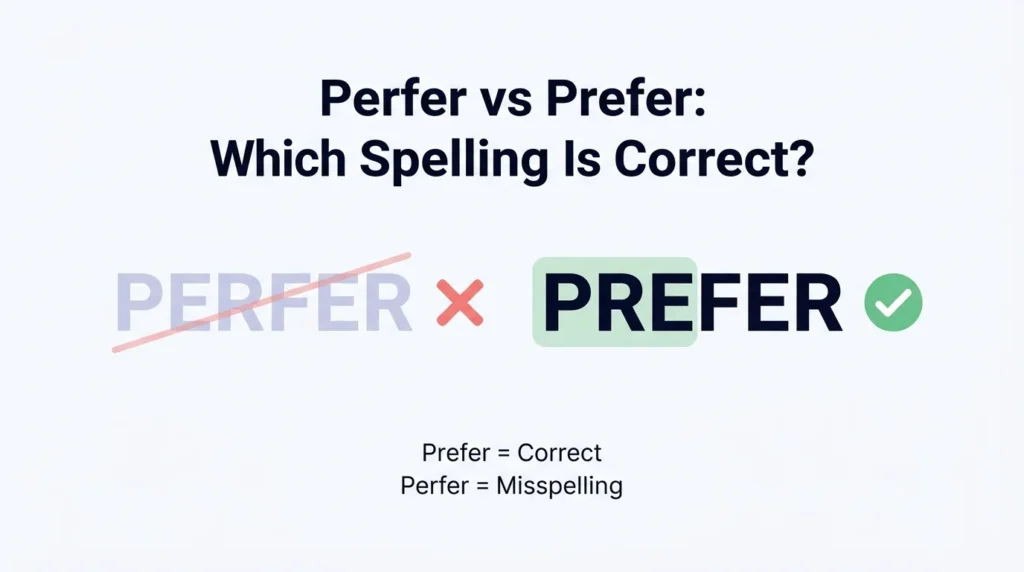

Prefer is the correct spelling. Perfer is a misspelling and should not be used in standard English. Prefer is a verb meaning to like, choose, or want one thing more than another. For example, “I prefer tea to coffee.” The same spelling is used in American and British English.
What Is the Difference Between Perfer and Prefer?
The difference is simple:
- Prefer = correct English word
- Perfer = incorrect spelling
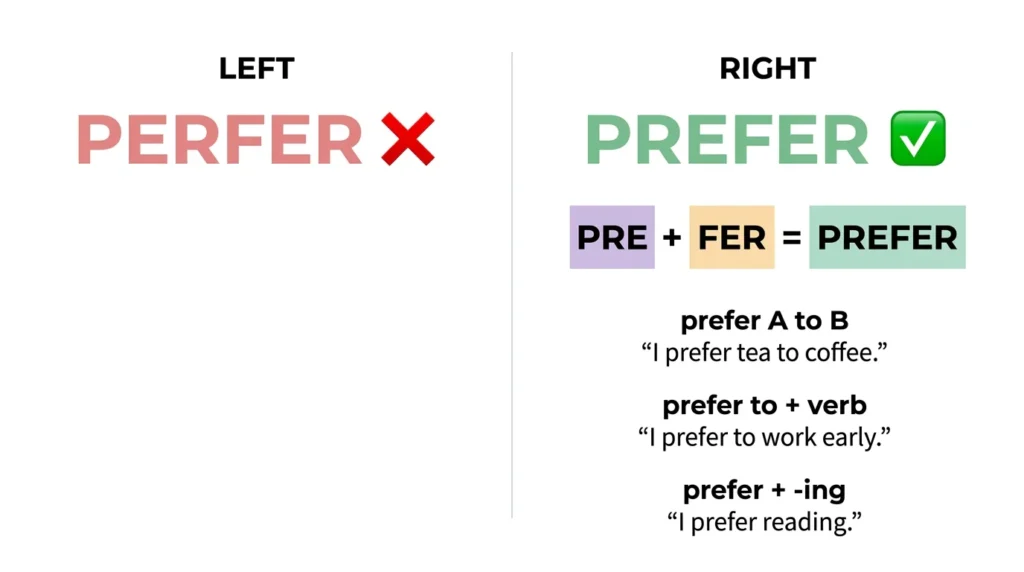
Prefer is a verb used when you like, choose, or want one option more than another. Dictionaries record prefer as a standard English verb, with common structures such as prefer A to B, prefer doing something, and prefer to do something.
Perfer, by contrast, is not an alternative spelling of prefer. If you write “I perfer coffee,” the intended word is almost certainly prefer.
So if you are wondering whether to write perfer or prefer, there is no spelling choice to make:
Always write: prefer.
Why It Matters
A one-letter spelling mistake may seem minor, but prefer is a very common word. It appears in emails, conversations, school assignments, business documents, applications, reviews, messages, and academic writing.
Compare:
- ❌ I perfer working from home.
- ✅ I prefer working from home.
The meaning is obvious in both sentences, but the first version contains a spelling error.
In professional or academic writing, frequent small errors can distract readers from your actual message. Correct spelling also makes proofreading easier because the wrong form stands out immediately.
If you are building your wider English accuracy, it is useful to distinguish spelling mistakes from genuine word-choice differences. For example, some pairs really do have two accepted forms, while others have only one standard form.
The Core Rule
Rule: The correct spelling is prefer. “Perfer” is a misspelling, not a second form of the word.
Remember the sequence:
P-R-E-F-E-R
Not:
P-E-R-F-E-R
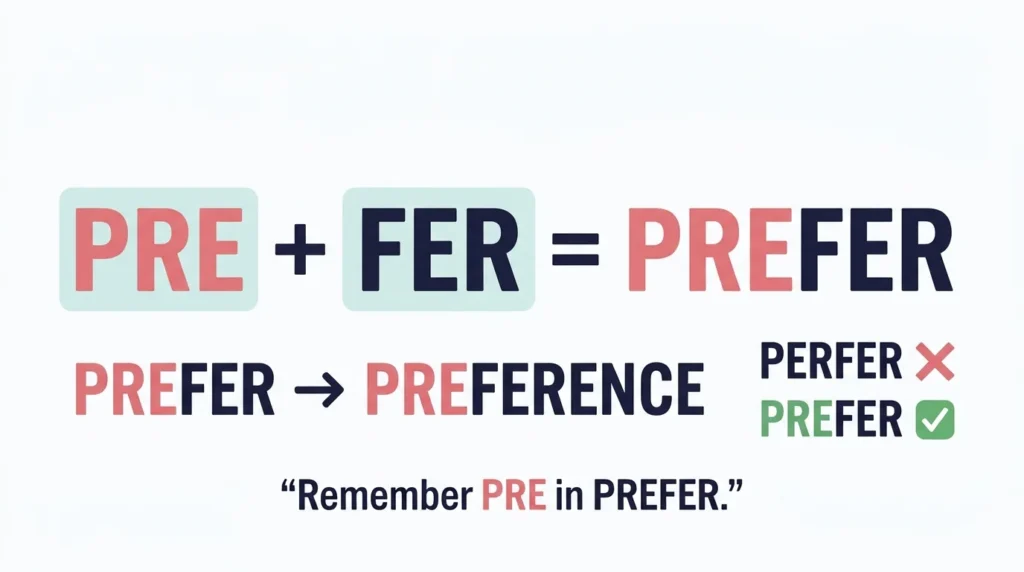
The easiest visual check is to notice that prefer begins with “pre-”:
PRE + FER → PREFER
What Does “Prefer” Mean?
Prefer is a verb that expresses a choice, liking, or desire for one thing rather than another.
In plain English, it means:
- to like one thing more than another
- to choose one option over another
- to consider one option more suitable or desirable
For example:
I prefer tea to coffee.
This tells us that tea is the speaker’s preferred choice when the two are compared.
You can also use prefer when the alternative is understood rather than directly stated:
I prefer working early.
The sentence does not name the alternative, but it implies that working early is more desirable to the speaker than another possible schedule.
Merriam-Webster similarly defines prefer around the ideas of liking something better, choosing, and giving something priority.
How to Use “Prefer”
There are several useful structures to learn. Knowing these patterns helps you avoid a spelling mistake while also avoiding a grammar mistake.
Prefer One Noun to Another
The classic comparison pattern is:
prefer + A + to + B
Examples:
I prefer tea to coffee.
She prefers quality to quantity.
We prefer trains to buses.
Cambridge specifically identifies prefer something to something as a standard construction.
Prefer One Activity to Another
When comparing activities, use -ing forms naturally:
prefer + verb-ing + to + verb-ing
Examples:
I prefer reading to watching television.
She prefers walking to driving.
They prefer working remotely to commuting every day.
Cambridge gives the same pattern in examples such as preferring one activity to another.
Prefer to Do Something
You can also use:
prefer + to + base verb
Examples:
I prefer to work alone.
She prefers to study at night.
We prefer to arrive early.
Cambridge notes that prefer can be followed by a to-infinitive.
Would Prefer to Do Something
Would prefer is especially useful when talking about a particular present or future choice.
Examples:
I would prefer to meet tomorrow.
She’d prefer to stay home tonight.
Would you prefer to sit near the window?
The structure is:
would prefer + to + base verb
Cambridge describes would prefer as a way to express what someone wants or to ask about someone’s choice.
Prefer Someone to Do Something
You can also use prefer when expressing what you want another person to do:
I’d prefer you to arrive before noon.
Would you prefer me to call later?
This construction is useful in professional communication because it can express a preference without sounding unnecessarily forceful.
Correct Examples
Here are examples across everyday, professional, academic, and digital communication.
- Conversation: “Do you prefer tea or coffee?”
- Email: “I would prefer to discuss the details tomorrow.”
- Workplace: “Our team prefers working with a clear deadline.”
- School: “I prefer studying in the library.”
- Academic writing: “The researchers preferred this method to the alternative.”
- Interview: “I prefer collaborative work because it allows ideas to develop quickly.”
- Social media: “I prefer the original version of this design.”
- Customer service: “Would you prefer a refund or an exchange?”
- Travel: “We prefer traveling by train.”
- Daily life: “My brother prefers spicy food to mild food.”
- Business: “Most customers prefer a simple checkout process.”
- Personal choice: “I prefer to finish important tasks in the morning.”
Notice that the spelling stays prefer regardless of the context.
Incorrect vs. Correct
| ❌ Incorrect | ✅ Correct | Why |
|---|---|---|
| I perfer tea. | I prefer tea. | Perfer is a spelling error. |
| She perfer working at home. | She prefers working at home. | The spelling must be prefer, and third-person singular takes -s. |
| We perfer quiet places. | We prefer quiet places. | Perfer is not the standard spelling. |
| I prefer tea than coffee. | I prefer tea to coffee. | The standard comparison pattern is prefer A to B. |
| She prefer to reading. | She prefers reading. | After prefer, an -ing form can be used; subject-verb agreement also requires prefers. |
| He prefer drive. | He prefers to drive. | The infinitive pattern requires to + verb. |
| They perfered the first plan. | They preferred the first plan. | The past form is preferred, with double r. |
| I prefered the blue one. | I preferred the blue one. | Preferred has two rs. |
| She is preferring tea today. | She prefers tea today. | Prefer is generally not used in the progressive form. |
| I perfer to stay home. | I prefer to stay home. | Only the spelling needs correction in the original structure. |
The important lesson is that spelling and grammar are two separate issues. A sentence can contain the correct word prefer but still use the wrong grammatical structure.
Why Do People Write “Perfer”?
The mistake is easy to understand because perfer looks plausible at a glance.
Several factors can contribute to it.
Phonetic Guessing
English spelling cannot always be predicted perfectly from pronunciation.
Prefer is pronounced approximately pri-FUR, with the main stress on the second syllable. Cambridge gives UK and US pronunciations with this same basic stress pattern.
Someone who relies heavily on sound may mentally reconstruct the spelling incorrectly.
Letter Transposition
When people type quickly, letters can be switched.
The intended sequence:
P-R-E-F-E-R
may accidentally become:
P-E-R-F-E-R
This is a simple spelling or typing error rather than a meaningful variation.
Visual Familiarity
The two forms are visually similar:
prefer
perfer
Because the words are almost identical, a writer may read the incorrect version without noticing the missing r-e sequence.
Related Words Can Add Confusion
The prefer word family contains forms such as:
- prefer
- prefers
- preferred
- preferring
- preference
- preferable
- preferably
Seeing different forms can make spelling patterns harder for learners to remember.
Oxford lists preferred and preferring as the past and -ing forms of prefer.
Autocomplete Is Not a Grammar Teacher
Spellcheck and autocomplete are useful, but they are not substitutes for understanding.
A tool can often identify perfer as an error. But it may not explain why the correct form is prefer, or whether the rest of your sentence uses prefer naturally.
That distinction matters when you are learning rather than simply correcting.
Common Mistakes Checklist
Mistake 1: Writing “perfer”
Problem: The letters are in the wrong order.
Fix: Remember PRE-FER.
Mistake 2: Writing “prefered”
Problem: The past form is misspelled.
Fix: Write preferred with two rs.
Mistake 3: Using “prefer … than …”
Problem: Learners often transfer the pattern used with comparative adjectives.
Fix: Use prefer A to B in the standard comparison structure.
I prefer tea to coffee.
Cambridge explicitly identifies to, rather than than, in this construction.
Mistake 4: Writing “prefer to doing”
Problem: Two different patterns have been mixed together.
Fix: Choose one:
I prefer reading.
or:
I prefer to read.
When comparing activities:
I prefer reading to watching television.
Mistake 5: Forgetting the third-person “s”
Incorrect:
She prefer tea.
Correct:
She prefers tea.
The spelling of the base word is prefer, but ordinary subject-verb agreement still applies.
Mistake 6: Assuming “prefer” must always have two choices
A comparison can be explicit or implied.
I prefer working early.
The alternative does not have to appear in the sentence.
“Prefer” in Real English
Grammatically correct and natural
I prefer tea to coffee.
This is a standard, clear way to express a preference between two things. The comparison is explicit, and the to construction is conventional. It works in conversation, professional writing, and formal writing without sounding unusual.
Grammatically possible but context-dependent
I prefer coffee over tea.
This construction is widely used, especially in contemporary American English, and major learner dictionaries document prefer something over something. Oxford, for example, includes prefer something over something among its usage patterns.
However, if you are learning the safest traditional comparison pattern, prefer A to B is an excellent default.
Natural everyday English
I’d prefer to leave early.
This sounds natural when talking about a particular choice or situation. Would prefer is especially useful for expressing what you want now or in the future. It can also make a request or preference sound more measured than a blunt command.
Natural but not necessarily comparative
I prefer working in the morning.
This is completely natural even though the alternative is unstated. The listener understands that the speaker favors morning work over another possible time or arrangement. You do not need to force a second option into every sentence.
American vs. British English
There is no American-versus-British spelling difference between prefer and perfer.
Both varieties use:
prefer
The pronunciation can vary slightly because American and British accents have different vowel realizations, but the spelling remains the same. Cambridge provides both UK and US pronunciations for the word.
So:
- American English: prefer
- British English: prefer
- International English: prefer
The related word preferred is also spelled with two rs in both varieties.
Formal vs. Informal Usage
Prefer works comfortably in both formal and informal English.
Informal
I prefer pizza.
I’d prefer to stay home tonight.
Professional
We would prefer to receive the documents by Friday.
Academic
Participants preferred the first method to the second.
The word itself does not sound excessively formal. What changes the register is usually the surrounding sentence.
For example, “I’d rather stay home” may sound more conversational in some situations, while “I would prefer to remain at home” sounds more formal or deliberate.
Prefer vs. Perfer: Comparison Table
| Feature | Prefer | Perfer |
|---|---|---|
| Standard English word | ✅ Yes | ❌ No |
| Correct spelling | ✅ Yes | ❌ No |
| Meaning | To like or choose one thing more than another | None as a standard English word |
| Part of speech | Verb | Not a standard English word |
| Used in formal writing | ✅ Yes | ❌ No |
| Used in everyday English | ✅ Yes | ❌ No |
| Used in American English | ✅ Yes | ❌ No |
| Used in British English | ✅ Yes | ❌ No |
| Example | I prefer tea to coffee. | ❌ I perfer tea to coffee. |
| Correct past form | preferred | — |
Prefer vs. Related Words
Understanding nearby words can prevent another kind of confusion: replacing prefer with a word that does not mean exactly the same thing.
| Word | Main idea | Example |
|---|---|---|
| prefer | Like or choose one option more | I prefer tea to coffee. |
| like | Enjoy or have a positive feeling toward something | I like tea. |
| choose | Make a decision between options | I chose tea. |
| favor/favour | Support or prefer something | I favor the first proposal. |
| would rather | Express a particular preference | I would rather stay home. |
Prefer and choose are related, but they are not identical. You can prefer something without actually choosing it.
For example:
I prefer the red car, but I chose the blue one because it was cheaper.
Your preference and your final decision are not always the same.
Memory Trick
Use this simple mnemonic:
“PRE is before FER: I PREFER the PRE spelling.”
Or connect prefer with its noun:
PREFER → PREFERENCE
Both begin with PRE.
If you remember preference, the spelling of prefer becomes easier to reconstruct:
PREference → PREfer
Another quick visual check:
PRE + FER = PREFER
If you see PERFER, stop and check the middle letters.
Real-Life Situations
In an Interview
Interviewer: “Do you prefer working independently or as part of a team?”
Candidate: “I prefer working as part of a team because I enjoy exchanging ideas.”
In a Meeting
“Would you prefer to discuss the budget first?”
This politely asks about someone’s preference.
In an Email
“I would prefer to schedule the meeting for Thursday.”
This is professional and clear.
In a Text Message
“I’d prefer to eat at home tonight.”
Natural and conversational.
In an Exam
If the question asks you to choose the correct spelling:
A. perfer
B. prefer
C. preffer
D. preferr
The answer is:
B. prefer
Expert Tips
- Learn the word family together.
Remember prefer, preference, preferable, and preferred as related forms. - Do not memorize “perfer” as a possible alternative.
Treat it as an error every time. - Remember the comparison pattern.
The safest standard pattern is prefer A to B. - Separate spelling from grammar.
Correcting perfer to prefer does not automatically make the entire sentence grammatically correct. - Watch the past form.
The base verb has one r: prefer.
The past form has two: preferred. - Use “would prefer” for specific choices.
“I would prefer to leave early” is especially useful for a particular situation. - Do not force a comparison when none is needed.
“I prefer working alone” is already complete. - Use context to choose between similar verbs.
Prefer describes a favored option; choose focuses more directly on the decision.
Read More: Wise vs Wize: Which Spelling Is Correct?
FAQ
Is “perfer” a real English word?
No. In standard English, perfer is a misspelling of prefer. It should not be used as an alternative spelling.
How do you spell “prefer”?
The correct spelling is:
P-R-E-F-E-R
A useful way to remember it is PRE + FER.
Is “I prefer tea to coffee” correct?
Yes. Prefer A to B is a standard comparison structure.
I prefer tea to coffee.
Cambridge specifically gives prefer something to something as a standard construction.
Is “I prefer tea over coffee” correct?
Yes. Prefer A over B is also used in contemporary English, and Oxford documents this construction. If you want a particularly straightforward traditional pattern, prefer A to B is a reliable choice.
Is “prefer than” correct?
Usually, no, when you are using the standard comparative structure.
Use:
I prefer tea to coffee.
Not:
I prefer tea than coffee.
Is “I prefer to read” correct?
Yes.
I prefer to read in the morning.
Prefer can be followed by a to-infinitive.
Is “I prefer reading” correct?
Yes.
I prefer reading before bed.
Prefer can also be followed by an -ing form.
Why is “preferred” spelled with two r’s?
The past form is preferred, not prefered. The final consonant is doubled when the suffix is added under the relevant English spelling pattern. Major dictionaries list preferred as the past form of prefer.
Is “preferring” spelled with two r’s?
Yes.
The correct form is:
preferring
Oxford lists preferring as the -ing form of prefer.
Is “prefer” used in both American and British English?
Yes. Prefer is standard in both varieties. The spelling does not change between American and British English.
What is an easy way to remember “prefer”?
Think:
PRE + FER = PREFER
You can also connect it to preference:
PREFER → PREFERENCE
Both begin with PRE.
Mini Quiz
| # | Question | Answer | Explanation |
|---|---|---|---|
| 1 | Choose the correct spelling: perfer / prefer | prefer | Prefer is the standard English spelling. |
| 2 | Fill in the blank: “I ___ tea to coffee.” | prefer | Use prefer A to B for the comparison. |
| 3 | Correct the sentence: “She perfer working alone.” | She prefers working alone. | Correct perfer to prefer and add -s for she. |
| 4 | Choose: “I prefer tea ___ coffee.” than / to | to | The standard structure is prefer A to B. |
| 5 | Choose the correct past form: prefered / preferred | preferred | The past form has two rs. |
| 6 | Complete: “Would you ___ to sit here?” | prefer | Would prefer to + verb is correct. |
| 7 | Is this correct? “I prefer to reading.” | No | Use prefer reading or prefer to read. |
| 8 | Correct the sentence: “They prefered the first plan.” | They preferred the first plan. | The past form is preferred. |
| 9 | Choose the natural comparison: “She prefers walking ___ driving.” to / than | to | Use prefer + -ing + to + -ing. |
| 10 | Which is correct? perfer / prefer / preffer / preferr | prefer | Prefer is the only standard spelling among these forms. |
Quick Summary
Prefer is the correct spelling; perfer is a misspelling. Prefer is a verb used to express a liking, choice, or desire for one thing over another. The standard comparison pattern is prefer A to B, as in “I prefer tea to coffee.” You can also use prefer + -ing, prefer + to-infinitive, and would prefer + to-infinitive. American and British English use the same spelling. Be especially careful with related forms: preferred and preferring contain two rs. The easiest memory trick is PRE + FER = PREFER, or simply connect prefer with preference. When in doubt, never choose perfer.
That gives you both parts of the solution: spelling the word correctly and using it naturally.