

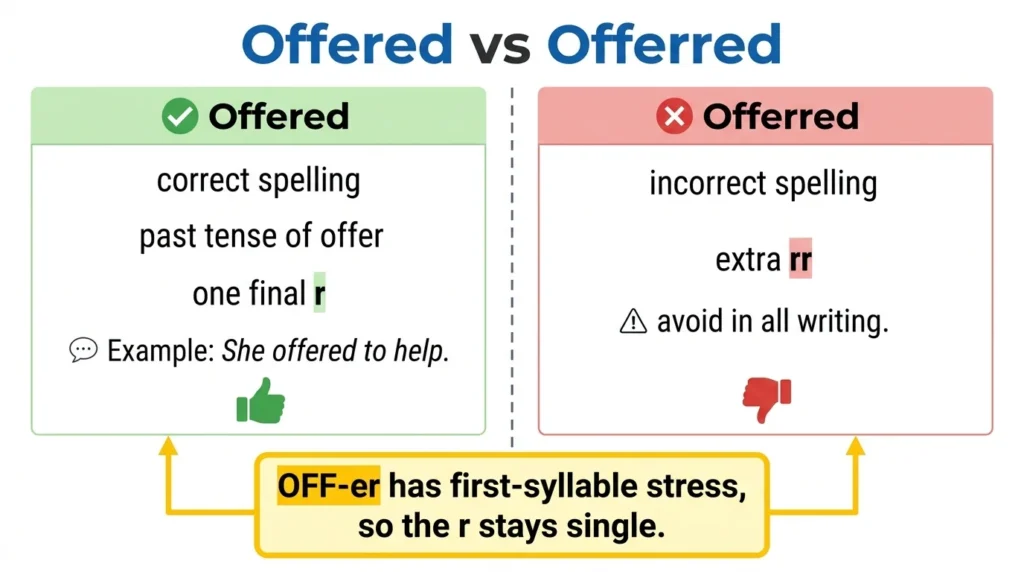
Offered is the correct spelling. It is the simple past tense and past participle of the verb offer. Offerred, with two r’s, is a spelling mistake in standard English. The final r is not doubled because the stress in offer falls on the first syllable: OFF-er, not of-FER. Therefore, write offer + ed = offered.
What Is the Difference Between Offered and Offerred?
The difference is simple: offered is a correct English word, while offerred is not a standard spelling.
What Does Offered Mean?
Offered is the simple past tense and past participle of offer.
The verb offer means to present, provide, suggest, or make something available for another person to accept or reject. Depending on the sentence, someone can offer help, advice, money, food, a job, an opportunity, or a solution.
Examples:
She offered me a glass of water.
The company has offered him a permanent position.
In the first sentence, offered is in the simple past tense. In the second, it is a past participle used with has. Standard dictionary entries list the verb forms as offer, offered, and offering.
Is Offerred a Word?
Offerred is not the correct spelling of the past tense or past participle of offer in standard modern English.
It usually appears when a writer incorrectly applies the consonant-doubling pattern found in words such as:
- prefer → preferred
- refer → referred
- occur → occurred
- infer → inferred
Those verbs stress their final syllables. Offer does not, so it follows a different spelling pattern.
Why Correct Spelling Matters
Writing offerred instead of offered may seem like a small mistake, but it can reduce the credibility of an otherwise professional message.
The error is especially noticeable in:
- Job applications
- Business emails
- Academic assignments
- Examination answers
- Client proposals
- Product descriptions
- Social media advertisements
- Legal or financial documents
Imagine receiving an employment email that says:
We are pleased to inform you that you have been offerred the position.
The meaning is clear, but the spelling error makes the message look less carefully reviewed. Using offered helps your writing appear accurate and professional.
The Core Spelling Rule
Correct: offer + ed = offered
Incorrect: offer + r + ed = offerred
For a verb with more than one syllable, the final consonant is generally doubled before -ed or -ing only when the final syllable is stressed and the word ends in a single vowel followed by a single consonant.
The word offer is pronounced OFF-er. Because the stress falls on the first syllable, its final r remains single:
- offer → offered
- offer → offering
- offer → offers
This is the same general pattern seen in visit → visited and enter → entered.
Why Is It Offered and Not Offerred?
The spelling depends on word stress, which means the syllable pronounced with the strongest emphasis.
Compare these pronunciations:
- OFF-er
- re-FER
- pre-FER
Although all three verbs end in -fer, they do not form their past tenses in the same way.
The final syllable of offer is unstressed, so the r is not doubled:
offer → offered
The final syllables of refer and prefer are stressed, so their r is doubled:
refer → referred
prefer → preferred
The spelling difference reflects the stress pattern, not simply the final letters of the base word.
How to Use Offered Correctly
Offered as the Simple Past Tense
Use offered for an action that happened and finished in the past.
Daniel offered to drive us home.
The shop offered a discount last weekend.
I offered her some advice, but she declined it.
The action occurred before the present moment.
Offered as a Past Participle
Use offered after helping verbs such as has, have, had, is, was, were, or been.
They have offered me a better contract.
Several solutions were offered during the meeting.
She had already offered to help.
In these sentences, offered forms a perfect tense or passive construction.
Offer Someone Something
The verb can take two objects:
The company offered Sarah a promotion.
Here, Sarah is the person receiving the offer, and a promotion is the thing being offered.
You can also write:
The company offered a promotion to Sarah.
Both structures are correct.
Offer to Do Something
Use offer + to-infinitive when someone volunteers to perform an action.
He offered to carry my bags.
Mia offered to edit the report.
The manager offered to extend the deadline.
Do not normally place an object between offered and the infinitive in this structure.
Be Offered Something
Use the passive voice when the receiver or opportunity is more important than the person making the offer.
I was offered a full-time position.
Customers were offered a refund.
The scholarship was offered to three students.
Verb Forms of Offer
| Form | Correct Spelling | Example |
|---|---|---|
| Base form | offer | They may offer you a discount. |
| Third-person singular | offers | The company offers flexible hours. |
| Simple past | offered | She offered me a seat. |
| Past participle | offered | We have offered several solutions. |
| Present participle | offering | They are offering free delivery. |
| Noun | offer | I accepted the job offer. |
Correct Examples of Offered
Conversation
- My neighbour offered to collect the parcel for me.
- I offered him some coffee, but he asked for tea.
- She offered to explain what had happened.
- Thank you for the assistance you offered yesterday.
- We have offered the client an alternative payment plan.
- The supplier offered to replace the damaged items.
School and Education
- The teacher offered extra support before the examination.
- The university offered Nadia a place in its engineering programme.
- Several explanations were offered during the class discussion.
Workplace
- My manager offered me the opportunity to lead the project.
- The company offered flexible working hours to new employees.
- We offered to revise the proposal before Friday.
Social Media
- The brand offered free samples to its first 100 followers.
- I was offered a collaboration after sharing my latest video.
Academic Writing
- The researchers offered two possible explanations for the results.
- Participants were offered the option to withdraw from the study.
- The theory offered a useful framework for interpreting the evidence.
Incorrect vs. Correct Examples
| ❌ Incorrect | ✅ Correct | Why |
| She offerred me a drink. | She offered me a drink. | The past tense of offer has one r before -ed. |
| They have offerred us a refund. | They have offered us a refund. | Offered is the correct past participle. |
| I was offerred a new position. | I was offered a new position. | Passive constructions also use offered. |
| He offered helping me. | He offered to help me. | Use offer + to-infinitive for a volunteered action. |
| The company offer me a job yesterday. | The company offered me a job yesterday. | A completed past action requires offered. |
| She has offered to helped. | She has offered to help. | The infinitive after to uses the base form. |
| They offered a discount me. | They offered me a discount. | Put the person before the thing in the two-object structure. |
| They offered to me a discount. | They offered a discount to me. | When using to, place the thing before the recipient. |
| He was offered with a scholarship. | He was offered a scholarship. | The verb does not require with in this structure. |
| The role has been offerred to Maria. | The role has been offered to Maria. | The correct spelling contains only one final r. |
| She offered that she would drive. | She offered to drive. | An offer to perform an action normally uses to + verb. |
| I accepted what she had offer. | I accepted what she had offered. | Had requires the past participle. |
| We are offered free delivery this week. | We are offering free delivery this week. | The business is performing an ongoing action, so use offering. |
| He offerred his resignation. | He offered his resignation. | The spelling rule does not double the final r in offer. |
Also Read: Unenroll vs Disenroll: Meaning and Key Difference
Why People Write Offerred
It Looks Similar to Preferred and Referred
The strongest source of confusion is the appearance of words such as preferred, referred, and transferred.
Writers notice their double r and assume that every verb ending in -fer follows the same pattern. However, the spelling depends on syllable stress:
- OFF-er → offered
- pre-FER → preferred
- re-FER → referred
- trans-FER → transferred
The final r doubles only in the words whose final syllable receives the main stress.
Both Spellings Sound the Same
You cannot hear whether offered contains one r or two r’s. English does not pronounce a doubled r as a separate sound in this word.
Learners who have heard the word more often than they have read it may therefore guess the spelling.
Writers Overgeneralise the Doubling Rule
Students often learn that a final consonant doubles before -ed:
- stop → stopped
- plan → planned
- regret → regretted
They may then apply this rule to every verb ending in a vowel and consonant. However, multisyllable words also require attention to stress.
Also Read: Taught vs Tought: Which Spelling Is Correct?
The Word Already Contains a Double Letter
Offer begins with off-, which contains two f’s.
Because the word already has a doubled consonant, writers may assume its r must also double when a suffix is added:
off + err + ed
That visual division is incorrect. The base word remains offer, and -ed is added directly.
Autocorrect Is Not Always Available
Most modern spelling tools will flag offerred, but corrections are not guaranteed in every form, application, content-management system, or examination.
Autocorrect may also replace the word without explaining why it is wrong, so the writer repeats the mistake later.
Translation Interference Can Contribute
Some languages have highly phonetic spelling systems in which written letters closely match spoken sounds. English spelling is less predictable.
Because offered and the incorrect offerred would be pronounced alike, learners cannot reliably select the spelling through pronunciation alone. They need to recognise the base verb and its stress pattern.
Common Mistakes Checklist
Doubling the Final R
Mistake: Writing offerred.
Why it happens: The writer copies the pattern used in preferred or referred.
How to avoid it: Say the word aloud as OFF-er and keep the final r single.
Writing Offerd
Mistake: Removing the e before adding -ed.
Why it happens: Some verbs drop a silent e before certain suffixes.
How to avoid it: The base word is offer, and it does not end in a silent e. Add -ed directly: offered.
Writing Offerring
Mistake: Doubling the r in the present participle.
Why it happens: The same misunderstanding affects both -ed and -ing forms.
How to avoid it: Use the same stress rule:
offer → offered → offering
Confusing Offer and Offered
Mistake: Using offer for a completed past action.
Yesterday, she offer me a ride.
How to avoid it: Use offered with a finished past-time expression:
Yesterday, she offered me a ride.
Using Offered After Did
Mistake:
Did they offered you the job?
Why it happens: The writer marks the past tense twice.
How to avoid it: After did, use the base form:
Did they offer you the job?
Using Offerred in Informal Writing
Some writers believe spelling standards matter only in school or professional documents.
However, offerred remains a misspelling in text messages, captions, comments, and informal emails. Informality can change vocabulary and punctuation, but it does not make the extra r standard.
Also Read: Protestors or Protesters: Which Spelling Is Correct?
Offered vs Offerred in Real English
Grammatically Correct
Offered is the simple past and past participle of offer. It can appear in active sentences, passive constructions, perfect tenses, and infinitive patterns. Natural structures include “She offered me help,” “Help was offered,” “They have offered a refund,” and “He offered to stay.” The spelling remains the same regardless of the sentence structure or level of formality.
Grammatically Possible but Unnatural
A sentence may contain offered correctly but still sound awkward. For example, “She offered that she would assist me” is understandable, but native and proficient speakers normally say, “She offered to assist me.” Similarly, “The shop offered to customers a discount” is structurally possible but unnatural. “The shop offered customers a discount” is clearer and more natural.
Natural Everyday English
In everyday English, offered commonly introduces help, food, drinks, transport, opportunities, prices, advice, and jobs. Natural examples include “He offered me a lift,” “They offered to help,” and “I was offered the job.” The incorrect spelling offerred does not belong to a special informal or conversational style. It is simply a spelling error in standard written English.
Also Read: Shinning vs Shining: Which Is Correct?
Offered vs Similar Spellings
| Feature | Offered | Offerred |
| Standard spelling | Yes | No |
| Base verb | Offer | No valid base form |
| Number of r’s before -ed | One | Two |
| Grammatical function | Simple past and past participle | None in standard English |
| Accepted in American English | Yes | No |
| Accepted in British English | Yes | No |
| Accepted in formal writing | Yes | No |
| Accepted in informal writing | Yes | No |
| Example | She offered to help. | She offerred to help. |
| Spellcheck result | Normally accepted | Normally flagged |
Offer, Refer, Prefer, and Suffer
| Base Verb | Stress Pattern | Correct Past Form | Explanation |
| offer | OFF-er | offered | Final syllable is unstressed. |
| suffer | SUFF-er | suffered | Final syllable is unstressed. |
| differ | DIFF-er | differed | Final syllable is unstressed. |
| refer | re-FER | referred | Final syllable is stressed. |
| prefer | pre-FER | preferred | Final syllable is stressed. |
| infer | in-FER | inferred | Final syllable is stressed. |
| confer | con-FER | conferred | Final syllable is stressed. |
| transfer | trans-FER | transferred | Final syllable is stressed in the verb. |
Memory Trick
Remember this sentence:
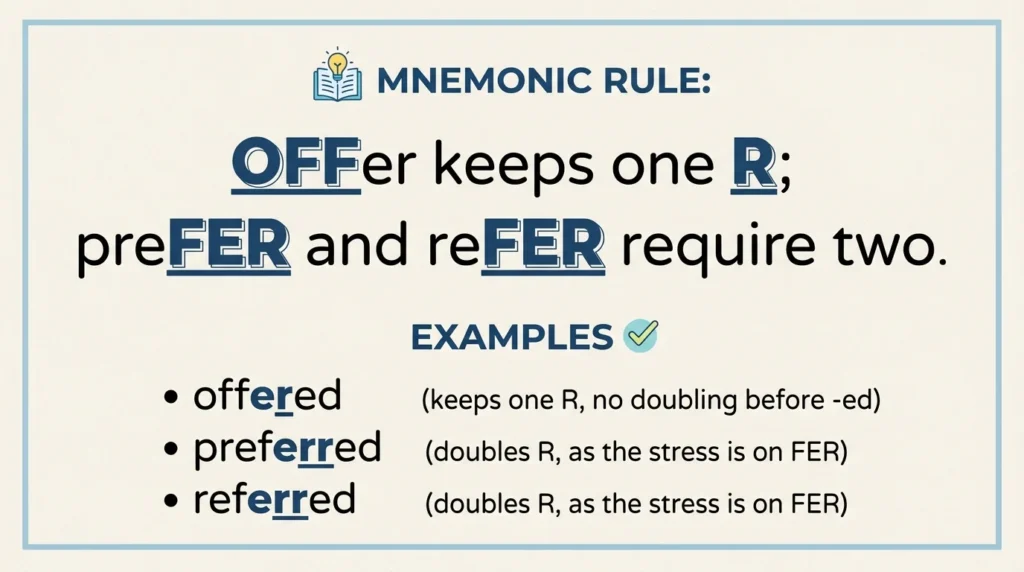
OFFer keeps one R; preFER and reFER require two.
Look at the capital letters:
- OFFer stresses the beginning, so write offered.
- preFER stresses the end, so write preferred.
- reFER stresses the end, so write referred.
You can also remember the visual formula:
OFFER + ED = OFFERED
The base word already contains everything it needs. Do not insert an extra r.
Also Read: Emaculate vs Immaculate: Correct Spelling & Meaning
Real-Life Situations
In a Job Interview
My previous employer offered me the opportunity to supervise a small team.
This sentence correctly describes a professional opportunity presented in the past.
In a Business Meeting
The supplier offered to reduce the price if we increased the order quantity.
Use offered to + base verb when someone volunteered or proposed an action.
In an Email
Thank you for the support you offered during the project.
The spelling offered is appropriate in both formal and informal emails.
In a Text Message
Sam offered to pick us up after dinner.
Informal writing still uses the standard spelling.
In an Examination
Question: Complete the sentence: “The school _____ her a scholarship.”
Correct answer: offered
The sentence describes a completed past action and requires the simple past tense.
In a Property Purchase
We offered $350,000 for the house, but the seller declined.
Here, offered means proposed a particular amount of money.
In Customer Service
The representative offered me a full refund.
The person receiving something can appear directly after offered.
Expert Tips
Find the Base Word First
Before adding a suffix, identify the complete base verb:
offer + ed
Do not build the spelling from sound alone.
Use Stress to Compare Similar Verbs
Ask which syllable is stronger:
- OFF-er
- re-FER
- pre-FER
This explains why offered has one r while referred and preferred have two.
Check the Whole Verb Phrase
Sometimes the spelling is correct but the tense is not.
Compare:
She offered yesterday.
She has offered before.
She did offer yesterday.
After has, use offered. After did, use the base form offer.
Do Not Depend Entirely on Autocorrect
A spelling tool may fix offerred, but learning the stress rule helps with other words, including:
- visited
- admitted
- entered
- referred
- suffered
- regretted
Remember the Pronunciation of the Ending
Offered is normally pronounced with two syllables: OFF-erd.
The -ed ending sounds like d, not like a separate id syllable. This is because the base verb does not end in a t or d sound.
Keep the Spelling in Quoted Search Terms
When discussing the error itself, you may write “offerred” inside quotation marks:
Many learners search for “offered vs offerred.”
In that sentence, you are mentioning the misspelling rather than using it as a correct verb.
Also Read: Emersion vs Immersion: Difference and Which One Is Correct?
Quick Summary
Offered is the only correct standard spelling of the simple past tense and past participle of offer. Offerred, with two r’s, is a misspelling. The r remains single because offer is stressed on its first syllable: OFF-er. In multisyllable verbs, a final consonant usually doubles before -ed or -ing only when the final syllable is stressed. This is why we write offered and offering, but preferred and referring. Offered can describe presenting help, food, advice, money, a job, a price, or an opportunity. It is correct in American, British, formal, informal, active, and passive writing. Remember: offer + ed = offered.
Frequently Asked Questions
Is offered or offerred correct?
Offered is the correct spelling. It is the simple past tense and past participle of the verb offer. The spelling offerred is incorrect in standard English because the final r in offer is not doubled before adding -ed.
Is offerred a real word?
No, offerred is not accepted as the standard past-tense form of offer. It is a common spelling mistake caused by confusion with words such as preferred, referred, and transferred, which do double their final consonant because their last syllables are stressed.
Why is offered spelled with only one r?
Offered has only one r before -ed because the main stress in offer falls on the first syllable: OFF-er. In multisyllable verbs, the final consonant is usually doubled only when the final syllable is stressed. Since the second syllable of offer is unstressed, the r stays single.
What is the past tense of offer?
The simple past tense of offer is offered. For example, “The company offered me a new position” describes an action that happened in the past. The past participle is also offered, as in “The company has offered me a new position.”
Is it offering or offerring?
Offering is the correct spelling, while offerring is incorrect. The same spelling rule applies to both offered and offering. Because the final syllable of offer is not stressed, the final r is not doubled before adding -ing.
Why is it “preferred” but “offered”?
The difference comes from syllable stress. Prefer is pronounced pre-FER, with stress on the final syllable, so the final r doubles before -ed, producing preferred. Offer is pronounced OFF-er, with stress on the first syllable, so it becomes offered without an extra r.
Is offered correct in both American and British English?
Yes, offered is the standard spelling in both American and British English. Unlike words such as traveled and travelled, which may differ by regional spelling conventions, offered does not have a valid regional variation with two r letters.
Can offered be used in the passive voice?
Yes, offered is commonly used in passive sentences. For example, “She was offered a promotion” focuses on the person who received the opportunity rather than the company that made the offer. Other correct examples include “Customers were offered refunds” and “The position was offered to two candidates.”
Is I was offered a job grammatically correct?
Yes, “I was offered a job” is completely correct. It is a passive construction meaning that a company, employer, or individual gave you the opportunity to accept a job. The active version would be “The company offered me a job.”
Should I say offered me or offered to me?
Both forms can be correct, but they use different word orders. “They offered me a discount” is the more common and natural structure. You can also say, “They offered a discount to me,” although this version may place more emphasis on the recipient.
Is offered to help correct?
Yes, offered to help is a natural and grammatically correct structure. Use offer + to + base verb when someone volunteers to perform an action. For example, “She offered to help with the report” means she willingly said that she would provide assistance.
Can I say offered helping?
In most situations, offered helping is not natural or grammatically appropriate. When describing an action someone volunteered to perform, use an infinitive: “He offered to help.” The -ing form may appear only when offering is used as a noun in a different structure, such as “His offering of help was appreciated.”
What is the difference between offer and offered?
Offer is the base form or present-tense form of the verb, while offered describes a completed past action or functions as a past participle. For example, “They offer free delivery” describes a present service, while “They offered free delivery last week” describes a past situation.
What are some synonyms for offered?
Possible synonyms for offered include provided, presented, proposed, suggested, gave, volunteered, extended, and made available. The best alternative depends on the sentence. For example, someone may offer advice, propose a price, provide support, or volunteer to help.
How can I remember the correct spelling of offered?
Remember the phrase: “OFFer keeps one R.” Because the stress falls on OFF, the final r does not double. You can also break the word into its parts: offer + ed = offered. Simply add -ed to the complete base word without inserting another letter.