
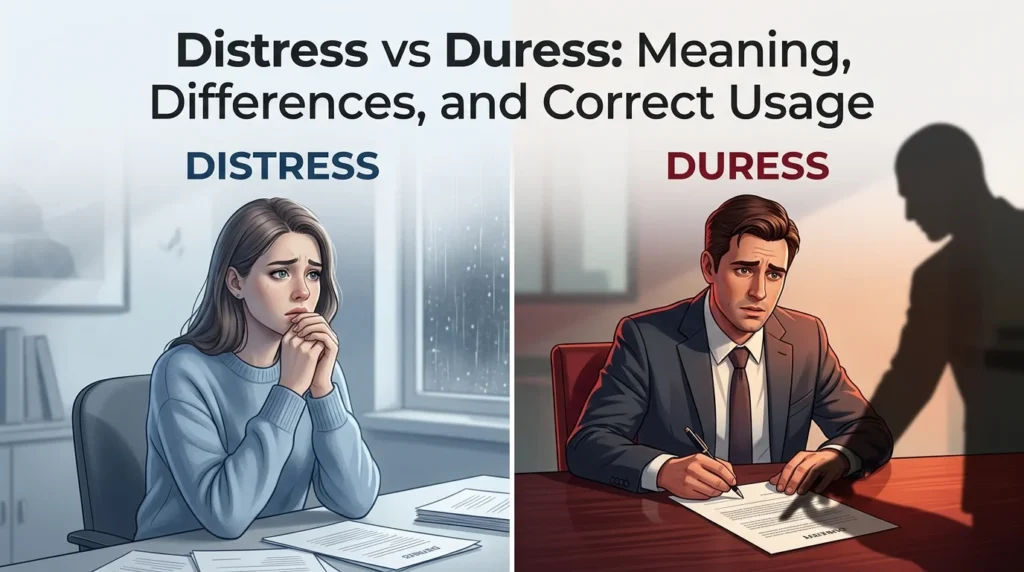

Distress and duress both describe difficult situations, but they are used differently. Distress means emotional suffering, pain, worry, or a state of being upset. Duress means being forced to do something through pressure, threats, or coercion. You can feel distress because of a problem, but you experience duress when someone or something forces you into an action.
What Is Distress vs Duress?
The words distress and duress are often confused because they sound similar and both relate to unpleasant experiences. However, they describe two different types of difficulty.
Distress refers mainly to emotional or physical suffering. It describes a person’s state of discomfort, sadness, anxiety, or pain caused by a difficult event.
Examples:
- Losing a job can cause emotional distress.
- A person may show signs of distress after an accident.
- Financial problems can create serious distress.
Duress, on the other hand, refers to pressure or force used to make someone do something against their will. It is commonly used in legal, professional, and formal situations.
Examples:
- Someone who signs a contract under threats may claim they acted under duress.
- A person forced to confess because of intimidation acted under duress.
The easiest difference to remember is:
Distress is about suffering. Duress is about being forced.
Why It Matters
Using distress and duress incorrectly can change the meaning of a sentence completely.
Imagine writing:
“The employee signed the agreement in distress.”
This means the employee was emotionally upset while signing it.
However:
“The employee signed the agreement under duress.”
This means the employee was pressured, threatened, or forced to sign it.
In everyday writing, confusing these words may only create unclear communication. In legal, workplace, or academic writing, the mistake can create a serious misunderstanding.
Correct word choice helps readers understand whether someone is experiencing pain or being controlled by pressure.
The Core Rule
Rule Box
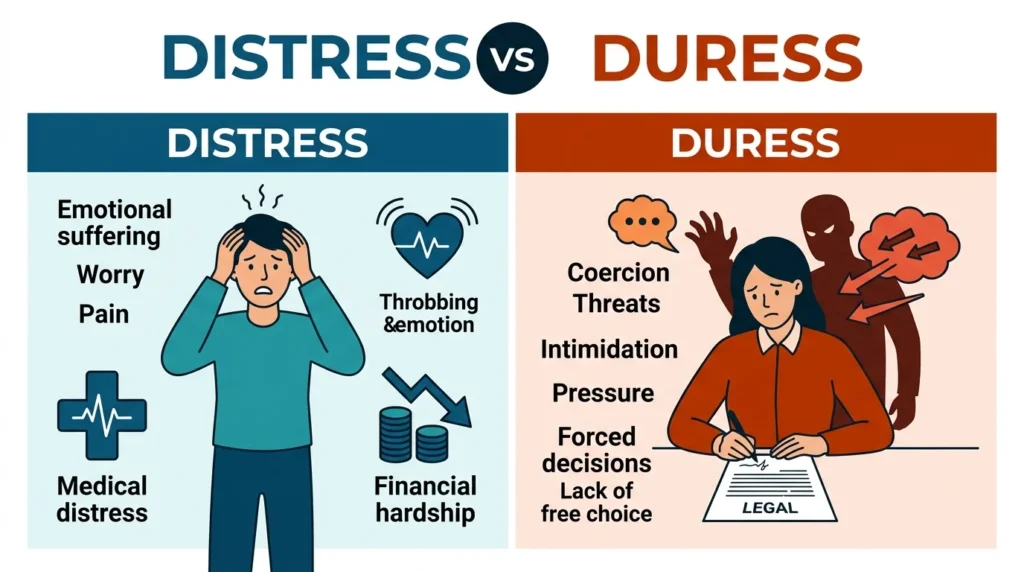
Use distress when describing suffering, worry, pain, fear, or emotional difficulty.
Use duress when describing force, threats, pressure, or coercion that makes someone act unwillingly.
Simple Formula
Distress = Feeling bad because of a difficult situation
Duress = Doing something because of outside pressure or force
Read More: Attornies vs Attorneys: Which Spelling Is Correct?
How to Use Distress
Normal Uses of Distress
The word distress is commonly used when talking about:
- Emotional suffering
- Anxiety or sadness
- Physical discomfort
- Financial hardship
- Difficult life situations
- Signs of fear or panic
Examples
- The news caused her great distress.
- The patient was in visible distress after the injury.
- The family experienced financial distress after losing their income.
- The child cried in distress after becoming separated from his parents.
Distress as a Verb
Distress can also be used as a verb meaning “to cause someone to feel upset or troubled.”
Examples:
- The accident distressed everyone involved.
- The report distressed the employees.
- The sudden change distressed the customers.
How to Use Duress
The word duress is less common in casual conversation. It usually appears in formal contexts, especially law, contracts, and discussions about unfair pressure.
Common Uses of Duress
- Signing something because of threats
- Acting because of intimidation
- Being forced into a decision
- Legal claims involving coercion
Examples:
- The defendant claimed he acted under duress.
- She signed the document under duress.
- The agreement may not be valid if it was made under duress.
Important Usage Note
We usually say:
✅ under duress
Not:
❌ in duress
The phrase under duress is the standard expression.
Correct Examples of Distress and Duress
| Situation | Correct Sentence | Why It Works |
|---|---|---|
| Emotional pain | She felt distress after hearing the bad news. | The sentence describes emotional suffering. |
| Medical emergency | The patient showed signs of distress. | Distress describes a state of difficulty or pain. |
| Workplace stress | The employee experienced distress because of the heavy workload. | The problem caused emotional strain. |
| Financial problems | Many families face financial distress during economic hardship. | Distress describes hardship. |
| Personal struggle | He was in deep distress after the accident. | The person is suffering emotionally. |
| Forced agreement | He signed the contract under duress. | Pressure or force caused the action. |
| Legal situation | The lawyer argued that the statement was made under duress. | The person was pressured. |
| Threat situation | The victim acted under duress because of threats. | Someone forced the action. |
| Business dispute | The company claimed the deal was accepted under duress. | The agreement involved coercion. |
| Workplace pressure | She resigned under duress after repeated threats. | The decision was not fully voluntary. |
Incorrect vs Correct Usage of Distress and Duress
| ❌ Incorrect | ✅ Correct | Why |
|---|---|---|
| The victim signed the paper in duress. | The victim signed the paper under duress. | The standard phrase is under duress because it describes pressure or force. |
| She was under distress when she accepted the offer. | She was under duress when she accepted the offer. | The person accepted because of pressure, not because she was emotionally upset. |
| The accident put him under duress. | The accident caused him distress. | An accident can cause suffering, but it does not usually force someone to act. |
| He felt duress after losing his job. | He felt distress after losing his job. | Losing a job creates emotional hardship, not coercion. |
| The company forced employees to work in distress. | The company forced employees to work under duress. | Force or threats create duress. |
| She experienced duress after receiving bad news. | She experienced distress after receiving bad news. | Bad news causes emotional pain, not forced action. |
| The contract was signed in distress. | The contract was signed under duress. | A contract issue involving pressure requires the word duress. |
| The patient was under duress after surgery. | The patient was in distress after surgery. | Medical pain or difficulty is described as distress. |
| The child acted under distress because of fear. | The child acted in distress because of fear. | Fear creates emotional suffering, not external force. |
| The employee suffered duress because of workload. | The employee suffered distress because of workload. | Workload may cause stress and suffering but does not necessarily involve coercion. |
| The witness gave evidence in distress. | The witness gave evidence under duress. | If someone is forced to give evidence, duress is the correct term. |
| Financial duress affected the family. | Financial distress affected the family. | Money problems create hardship, not usually coercion. |
The confusion between distress and duress happens for several reasons.
Similar Sound and Spelling
Both words:
- Start with d
- Contain similar sounds
- Describe difficult situations
- Come from related historical language roots connected with hardship
Because they look and sound alike, many writers assume they are interchangeable.
They are not.
The key difference is the source of the problem:
- If the problem creates suffering → distress
- If a person or force creates pressure → duress
Overgeneralizing the Meaning of “Pressure”
Many people use duress whenever they feel stressed or uncomfortable.
For example:
❌ “I was under duress because I had too much homework.”
This usually means:
“I was stressed because I had too much work.”
The better word is:
✅ “I was under distress because I had too much homework.”
However, if someone threatened you and forced you to complete the homework, then duress could apply.
Autocomplete and Spellcheck Problems
Spellcheck tools often recognize both words as correct because both are real English words.
A writing tool may not understand that:
- distress = suffering
- duress = forced action
Grammar software can detect spelling problems, but it may not always understand the intended meaning of a sentence.
Writers must check the context.
Translation Interference
Some languages use one general word for:
- suffering
- pressure
- hardship
- forced situations
When translating into English, learners may choose either word because both seem similar.
English separates these ideas more clearly:
Distress describes the emotional experience.
Duress describes the reason someone cannot act freely.
Mistake 1: Using Duress for Normal Stress
Wrong idea: Any stressful situation is duress.
Why it happens: People associate duress with difficulty.
Better approach: Ask:
“Was someone forced or threatened?”
If no, use distress.
Mistake 2: Saying “In Duress”
Incorrect:
❌ She was in duress.
Correct:
✅ She was under duress.
The fixed expression is under duress.
Mistake 3: Using Distress in Legal Situations
Incorrect:
❌ The contract was signed in distress.
Correct:
✅ The contract was signed under duress.
Legal situations involving force require duress.
Mistake 4: Assuming Similar Words Have Similar Uses
Words can look similar but have different meanings.
Distress and duress are examples of confused words: words that are close in form but different in meaning.
Mistake 5: Ignoring the Cause of the Situation
Ask:
What caused the problem?
- Accident, loss, fear, pain, hardship → distress
- Threat, force, intimidation → duress
Grammatically Correct but Less Natural
A sentence can be grammatically possible but still not sound natural in everyday English.
Distress
“The employee was experiencing distress because of the difficult workplace environment.”
This is grammatically correct, but in casual conversation many speakers may simply say:
“The employee was stressed because of the difficult workplace environment.”
Distress sounds more serious or formal. It is often used when the emotional impact is significant.
Duress
“The person made the decision under duress.”
This is grammatically correct and natural, especially in legal or serious situations.
However, using duress for everyday pressure sounds too formal.
For example:
“I was under duress because my friend wanted me to choose a restaurant.”
This sounds exaggerated unless there was real pressure or force.
Natural Everyday English
Distress
Natural examples:
- “She was in distress after the accident.”
- “The situation caused him a lot of distress.”
- “The animal appeared to be in distress.”
These are common and natural because they describe visible suffering.
Duress
Natural examples:
- “The confession was made under duress.”
- “The contract was signed under duress.”
- “He claimed he acted under duress.”
These are natural because they describe serious pressure or legal circumstances.
American vs British English
There is no major meaning difference between American and British English for distress and duress.
Both varieties use:
- distress for suffering, pain, or emotional difficulty
- duress for force, threats, or coercion
The phrase:
✅ under duress
is standard in both American and British English.
The difference is mainly about frequency. Duress is more common in formal and legal writing than everyday conversation in both varieties.
Formal vs Informal Usage
Formal Usage
Both words appear more often in formal writing.
Examples:
- Legal documents
- Medical reports
- Workplace policies
- Academic writing
Examples:
“The employee claimed that the agreement was signed under duress.”
“The patient showed signs of emotional distress.”
Informal Usage
In everyday conversation, people often replace:
distress with:
- stress
- worry
- sadness
- upset
duress with:
- pressure
- being forced
- being pushed
Example:
Formal:
“She experienced emotional distress.”
Informal:
“She was really upset.”
Distress vs Duress Comparison Table
| Feature | Distress | Duress |
|---|---|---|
| Main meaning | Suffering or emotional pain | Forced action caused by pressure |
| Focus | The person’s experience | The external force |
| Common phrase | In distress | Under duress |
| Usually involves | Sadness, fear, pain, hardship | Threats, coercion, intimidation |
| Common contexts | Health, emotions, personal problems | Law, contracts, serious disputes |
| Part of speech | Noun and verb | Mainly noun |
| Everyday use | More common | Less common |
| Example | She was in distress after the accident. | He signed the agreement under duress. |
Distress vs Duress vs Stress
| Word | Meaning | Example |
|---|---|---|
| Stress | General pressure or tension | I feel stressed before exams. |
| Distress | Severe emotional suffering | The accident caused emotional distress. |
| Duress | Pressure that removes free choice | He acted under duress. |
Memory Trick
Remember:
Distress = Deep Restlessness Inside
Think of the word:
D + distress = Difficulty inside you
It describes how someone feels.
Duress = “Due to pressure”
The word duress contains the idea of pressure forcing a person.
Quick reminder:
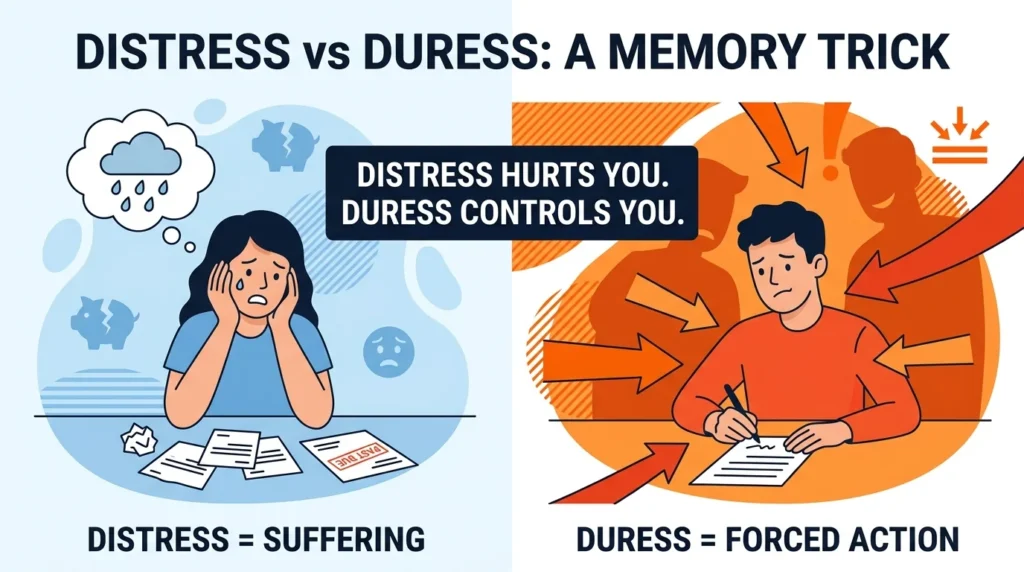
Distress hurts you.
Duress controls you.
Read More: Faring vs Fairing: What’s the Difference?
Real-Life Situations: Distress vs Duress in Context
Understanding these words becomes easier when you see how they work in real situations.
1. Job Interview Situation
Distress
Situation:
A candidate recently lost their previous job and feels anxious during an interview.
Correct usage:
“She was experiencing distress because of the uncertainty about her career.”
Why:
The person is suffering emotionally. Nobody is forcing her to do anything.
Duress
Situation:
An employee is threatened by a manager and forced to attend an interview or make a decision.
Correct usage:
“The employee claimed that he acted under duress because of workplace threats.”
Why:
The action happened because of pressure from another person.
2. Workplace Meeting Situation
Distress
“The announcement caused distress among employees because many were worried about job security.”
The employees feel worried or upset.
Duress
“The employee signed the resignation letter under duress after being threatened.”
The employee did not make a completely free decision.
3. Email Writing Situation
Distress Example
Subject: Employee Support Request
“I am writing because the recent changes have caused significant distress among team members.”
Here, distress describes emotional difficulty.
Duress Example
“The agreement should be reviewed because it appears to have been signed under duress.”
Here, duress describes possible force or unfair pressure.
4. Text Message Situation
Natural:
“My dog is in distress. I need to take him to the vet.”
This means the dog is suffering.
Unnatural:
“My friend made me choose a movie under duress.”
This sounds too serious unless the friend used threats or force.
5. Exam Situation
Distress
“The student felt distress after failing an important exam.”
The student feels emotional pain.
Duress
“The student answered the questions under duress because someone threatened them.”
The student was forced.
6. Legal Situation
Distress
“The witness showed emotional distress during the trial.”
The witness experienced emotional suffering.
Duress
“The lawyer argued that the confession was obtained under duress.”
The confession may have been forced.
Mini Quiz: Distress vs Duress
| Question | Answer | Explanation |
|---|---|---|
| 1. She was in ______ after hearing the tragic news. (distress/duress) | Distress | The person is experiencing emotional pain. |
| 2. The contract was signed ______. (in distress/under duress) | Under duress | The phrase describes forced agreement. |
| 3. Financial problems caused great ______ for the family. | Distress | Money problems create hardship and suffering. |
| 4. The suspect claimed the confession was made under ______. | Duress | The person claimed they were forced. |
| 5. The injured animal appeared to be in ______. | Distress | Animals can experience pain or suffering. |
| 6. Correct the sentence: “He accepted the offer in duress.” | “He accepted the offer under duress.” | The correct expression is under duress. |
| 7. Which word describes emotional suffering? | Distress | Distress focuses on pain or hardship. |
| 8. Which word describes threats or coercion? | Duress | Duress involves pressure that removes free choice. |
| 9. “The workload caused employee ______.” Which word fits? | Distress | Workload creates stress or suffering, not force. |
| 10. “The person acted because someone threatened them.” Which word fits? | Duress | Threats create duress. |
Expert Tips Textbooks Often Skip
1. Look at the Direction of the Problem
This is the fastest way to choose the correct word.
Ask:
Is the problem happening to someone?
Use:
→ Distress
Example:
“The accident caused distress.”
Is someone causing pressure on someone else?
Use:
→ Duress
Example:
“The person acted under duress.”
2. Distress Can Be Temporary or Long-Term
Distress can describe:
- A sudden emotional reaction
- Ongoing hardship
- Serious suffering
Examples:
- “She was in distress after the accident.”
- “The family experienced financial distress for years.”
3. Duress Usually Requires an External Source
Duress normally involves:
- Another person
- A threat
- Pressure
- Coercion
A difficult situation alone usually does not create duress.
4. Do Not Replace “Stress” With “Duress”
Many people use duress as a stronger version of stress.
However:
Stress:
“I have too much work.”
Distress:
“The workload is causing emotional suffering.”
Duress:
“My manager threatened me and forced me to work.”
5. Legal Meaning Is More Specific
In legal contexts, duress has a narrower meaning.
Not every uncomfortable situation is duress.
A person usually needs to show that pressure affected their ability to make a free choice.
Frequently Asked Questions About Distress vs Duress
What is the main difference between distress and duress?
Distress describes suffering, worry, or emotional pain. Duress describes being forced to act because of threats, pressure, or coercion.
Can distress and duress be used interchangeably?
No. They describe different situations. Distress focuses on someone’s feelings, while duress focuses on outside pressure.
Is it correct to say “under distress”?
Usually, no. The common expression is in distress.
Example:
✅ The patient was in distress.
Is “under duress” always correct?
Yes, under duress is the standard phrase when describing forced action.
Example:
✅ The document was signed under duress.
Can a person experience both distress and duress?
Yes.
Example:
“The victim experienced distress after being forced to act under duress.”
The person was emotionally suffering because of the forced situation.
Is distress a stronger word than stress?
Usually, yes. Distress often suggests a more serious level of emotional difficulty than ordinary stress.
Is duress only used in legal writing?
No. Although it is common in legal contexts, it can also describe serious situations involving force or pressure.
What is another word for distress?
Depending on context, alternatives include:
- suffering
- anguish
- worry
- hardship
- upset
What is another word for duress?
Depending on context, alternatives include:
- coercion
- force
- intimidation
- pressure
Why do people confuse distress and duress?
They sound similar and both relate to difficult experiences, but their meanings are different. One describes suffering, while the other describes forced action.
Which word should I use in everyday conversation?
Use distress for emotional difficulty. Use duress only when there is serious pressure, force, or coercion.
Quick Summary
Distress and duress are similar-looking words with different meanings. Distress refers to suffering, pain, worry, or emotional difficulty caused by a challenging situation. Duress refers to being forced to act because of threats, pressure, or coercion. Remember the simple difference: distress is something you experience, while duress is something imposed on you. Use “in distress” when describing suffering and “under duress” when describing forced actions. Choosing the correct word improves clarity, especially in professional, academic, and legal writing.