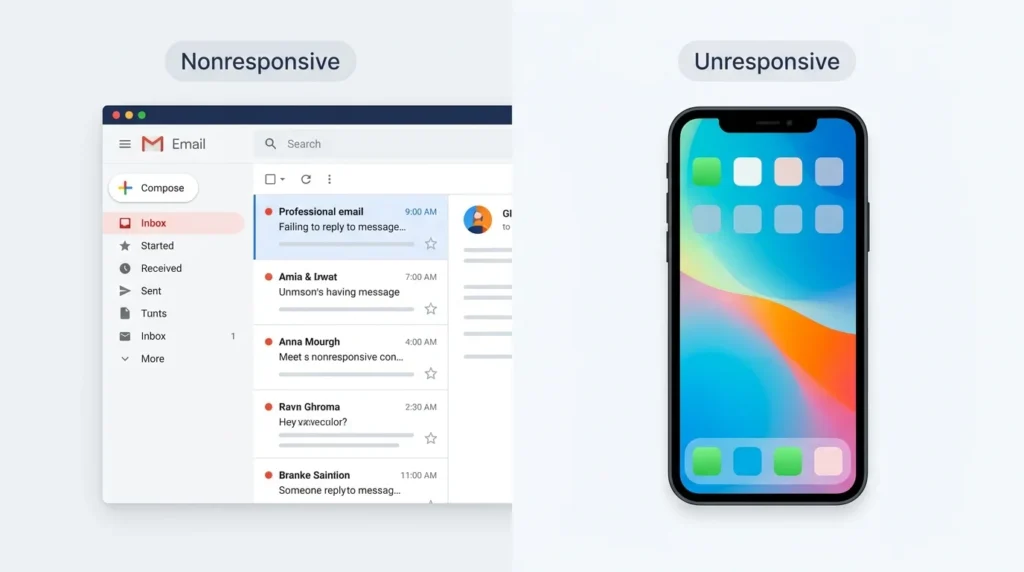

Nonresponsive and unresponsive are both correct adjectives meaning “not responsive,” but they are not always the best choice in the same situation. Use unresponsive as the natural general word for someone or something that does not react, especially a patient, person, device, or system. Use nonresponsive when emphasizing a missing or inadequate response, particularly in formal, legal, procedural, research, or business contexts.
What Are Nonresponsive and Unresponsive?
Both nonresponsive and unresponsive are adjectives. An adjective describes a person, thing, condition, or quality.
At their broadest level, both words mean not responsive. That is why sentences such as “the customer was nonresponsive” and “the customer was unresponsive” can sometimes communicate nearly the same idea.
The difference becomes clearer when you look at what kind of response is missing.
Unresponsive commonly describes a lack of reaction to a stimulus, request, influence, action, or input. Standard dictionary usage includes an unresponsive patient, an infection unresponsive to antibiotics, and an unresponsive organization.
Nonresponsive also means not giving a response, but it has an additional formal sense: something can be nonresponsive because it does not adequately address a question, request, requirement, or specification. This distinction matters especially in legal and procurement language.
In plain English:
- Unresponsive often focuses on lack of reaction.
- Nonresponsive often focuses on lack of an adequate or expected response.
- The meanings overlap, so context matters more than a rigid “one word is right, one is wrong” rule.
Why the Difference Matters
Choosing between nonresponsive and unresponsive can change how readers interpret a situation.
If you say, “The patient is unresponsive,” readers may understand that the person is not reacting to voice, touch, or other stimulation. Medical and first-aid sources use unresponsive in this sense.
If you say, “The bid was nonresponsive,” you are not saying that a document lost consciousness or refused to react. In procurement language, nonresponsive can mean that the bid failed to satisfy required conditions. U.S. federal regulations use the word in exactly this procedural sense.
The difference can therefore affect:
- medical clarity;
- workplace communication;
- legal and contract writing;
- technical documentation;
- research reports;
- customer-service notes;
- academic writing.
Good word choice tells readers what kind of response was expected and what failed to happen.
The Core Rule
Rule: When you simply mean “not reacting,” unresponsive is usually the safest general choice. Use nonresponsive when the context focuses on a missing, inadequate, or noncompliant response—especially in formal or specialized language.
Do not reduce the distinction to “nonresponsive = won’t respond” and “unresponsive = can’t respond.”
That shortcut sometimes works, but it is not a dependable grammar rule.
An employee who ignores an email can be called unresponsive. An infection can be unresponsive to antibiotics even though an infection cannot consciously choose whether to respond. Standard dictionary examples confirm this broader use of unresponsive.
How to Use Nonresponsive vs Unresponsive
Use this four-step decision process:
- Ask whether you are describing a physical, emotional, or technical reaction. If yes, unresponsive is usually natural.
- Ask whether a specific answer, submission, bid, or response failed to address requirements. If yes, nonresponsive is often more precise.
- Check for established terminology in your field. Medicine, law, procurement, research, and technology may have conventional wording.
- If both words are grammatically possible, choose the one that sounds clearest to your intended reader.
Use Unresponsive for a Person Who Does Not React
When a person does not respond to voice, touch, or other stimulation, unresponsive is the established and immediately understandable choice.
Example:
The paramedic found the patient unresponsive.
Medical sources use unresponsive for a person who does not respond to activity, touch, sound, or other stimulation.
A sudden unexplained loss of responsiveness can indicate a medical emergency, so this word carries serious meaning in such a context.
Use Unresponsive for Devices and Software
Unresponsive sounds natural when a screen, program, phone, browser, or device stops reacting to input.
Examples:
- The screen became unresponsive.
- My browser is unresponsive again.
- The touch controls remained unresponsive.
Here, the focus is on a missing reaction to input.
Nonresponsive can also appear in technical writing, particularly when the focus is on a system failing to answer requests. Cambridge, for example, recognizes non-responsive in the sense of something not working or reacting to instructions or changes.
Use Nonresponsive for Formal Answers and Requirements
Nonresponsive becomes especially useful when something technically exists as a response but fails to address what was asked.
Imagine this exchange:
Question: What time did the delivery arrive?
Answer: The weather was terrible that morning.
The speaker gave an answer, but the answer did not address the question. In a formal setting, it could be described as a nonresponsive answer.
This is different from receiving no answer at all.
Use Nonresponsive in Procurement and Contract Language
A nonresponsive bid is an established procurement expression.
Here, responsive does not simply mean “reacting.” It means satisfying the material requirements of the solicitation or bidding process. Federal regulations repeatedly use nonresponsive for bids that fail required conditions.
Example:
The agency rejected the bid as nonresponsive because a mandatory document was missing.
In this context, replacing nonresponsive with unresponsive would weaken the specialized meaning.
What About Treatment?
Be careful with claims that only nonresponsive can describe a failed treatment response.
Unresponsive to treatment is completely standard English. A major dictionary gives the example of an infection being “unresponsive to antibiotics.”
Depending on the discipline, you may also encounter nonresponsive to treatment, treatment-nonresponsive, or related specialist terminology.
For general writing, these are clear:
- The infection was unresponsive to antibiotics.
- The condition did not respond to treatment.
- The patient showed no response to the therapy.
The last two options are often safest when technical precision matters.
Correct Examples of Nonresponsive and Unresponsive
Here are original examples across everyday conversation, education, business, technology, medicine, and academic writing.
- Conversation: My phone became completely unresponsive, so I restarted it.
- Email: The supplier has been nonresponsive to three requests for updated pricing.
- School: The student seemed unusually unresponsive during the class discussion.
- Workplace: The dashboard became unresponsive shortly before the presentation.
- Business: We closed the lead after several weeks of nonresponsive communication.
- Medical: The patient remained unresponsive when the nurse called his name.
- Academic writing: Several participants were nonresponsive to the follow-up questionnaire.
- Legal: The attorney argued that the witness had given a nonresponsive answer.
- Procurement: The committee rejected the proposal as nonresponsive to a mandatory requirement.
- Technology: The application becomes unresponsive whenever the file is too large.
- Social media: I thought he was ignoring the group chat, but his phone had become unresponsive.
- Research: Subjects who were unresponsive to the initial intervention entered a second phase of the study.
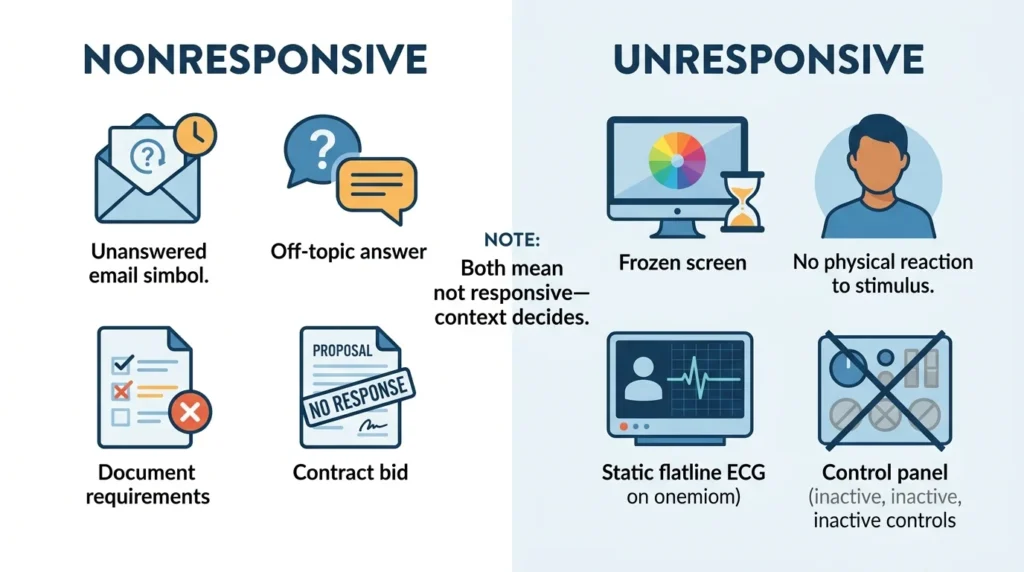
Notice that the words sometimes overlap. The goal is not to memorize artificial boundaries. The goal is to match the word to the type of response being discussed.
Read More: Scoup vs Scoop: Which Spelling Is Correct?
Incorrect vs Correct Usage
Because the two words overlap, several examples below are better described as poor or misleading word choices rather than absolute grammatical errors.
| ❌ Incorrect or Poor Fit | ✅ Correct or Clearer | Why |
|---|---|---|
| The unconscious patient was nonresponsive when paramedics arrived. | The unconscious patient was unresponsive when paramedics arrived. | Unresponsive is the established general term for a person showing no reaction to stimulation. |
| The agency rejected the bid as unresponsive to the specifications. | The agency rejected the bid as nonresponsive to the specifications. | Nonresponsive has a specialized procurement meaning involving failure to satisfy bidding requirements. |
| The treatment was unresponsive to the patient. | The patient was unresponsive to the treatment. | The direction of the relationship is reversed. The patient or condition responds to treatment. |
| My email has been unresponsive for three days. | The recipient has not responded to my email for three days. | An email itself is not normally the person expected to reply. |
| The witness was silent, so she gave a nonresponsive answer. | The witness did not answer the question. | A nonresponsive answer is generally an answer that fails to address the question; silence is simply no answer. |
| The frozen screen gave a nonresponsive emotional reaction. | The frozen screen was unresponsive to touch. | Devices react to input, not emotionally. |
| The proposal became unconscious and unresponsive. | The proposal was nonresponsive to the stated requirements. | Unconscious and medical-style unresponsive do not logically describe a document. |
| He was medically nonresponsive to my email. | He was unresponsive to my messages. | Medically creates the wrong meaning unless an actual health condition is being discussed. |
| Her infection refused to respond to antibiotics. | Her infection was unresponsive to antibiotics. | Refused suggests conscious choice. Unresponsive states the treatment outcome without personifying the infection. |
| The bidder submitted nothing, but its detailed answer was nonresponsive. | The bidder submitted no response. | If nothing was submitted, there is no answer to evaluate as responsive or nonresponsive. |
Why People Confuse Nonresponsive and Unresponsive
The confusion is understandable because the words have the same base: responsive.
Both also use a negative prefix.
- non- generally creates the idea of absence or negation;
- un- commonly reverses or negates the meaning of an adjective.
So both formations logically produce something close to “not responsive.”
Phonetic Similarity
The words sound almost identical after their first syllable:
- non-re-SPON-sive
- un-re-SPON-sive
When people hear rather than read the words, the distinction can be easy to miss.
Spelling Overlap
Only the opening prefix changes. Writers who remember the meaning but not the usual collocation may choose whichever form comes to mind first.
A collocation is a combination of words that commonly appear together, such as unresponsive patient or nonresponsive bid.
Overgeneralization
Learners often search for one universal rule:
nonresponsive = does not answer
unresponsive = cannot answer
The pattern is useful as a first clue, but English usage is more flexible.
For example, unresponsive can describe a bureaucracy that fails to react, an infection unaffected by antibiotics, or a person who does not reply. It does not always imply literal inability.
Autocomplete and Spellcheck Limits
A spelling checker may accept both words because both are legitimate English words.
That does not mean both are equally appropriate in every sentence.
Spellcheck can catch nonresponcive, but it may not know that nonresponsive bid is the established term your procurement document requires.
Translation Interference
Some languages use one equivalent for several kinds of “not responding.” An English learner may therefore expect one English adjective to cover every context.
English instead relies heavily on conventional combinations such as:
- unresponsive patient;
- unresponsive screen;
- unresponsive to treatment;
- nonresponsive answer;
- nonresponsive bid.
Learning the whole phrase is often more useful than memorizing the adjective alone.
Common Mistakes Checklist
- Treating the words as exact opposites: They overlap significantly. Context, not a single universal rule, determines the best choice.
- Assuming nonresponsive means intentional silence: It does not automatically mean someone deliberately ignored you.
- Assuming unresponsive always means physically incapable: It can also describe organizations, systems, emotions, diseases, and ordinary communication.
- Using medical wording casually: Calling someone unresponsive can sound serious if the context suggests consciousness or physical condition.
- Ignoring field-specific terminology: A procurement officer may need nonresponsive bid even where another adjective seems grammatically possible.
- Forgetting what is responding to what: Write “the condition was unresponsive to treatment,” not “the treatment was unresponsive to the condition.”
- Calling every unanswered message nonresponsive: Often, “hasn’t replied” or “didn’t respond” is simpler and more natural.
- Assuming spellcheck will choose correctly: Both words are valid, so automated tools may not flag a contextually poor choice.
- Forcing a difference where none exists: In some sentences, either word can work with only a small change in tone.
- Using technical language when plain English is clearer: “The customer hasn’t replied” may communicate more effectively than “the customer is nonresponsive.”
Read More: Naive vs Nieve: Which Spelling Is Correct?
Nonresponsive vs Unresponsive in Real English
Grammatically Correct English
Both words can modify people, systems, organizations, conditions, and other nouns when the intended meaning is “not responsive.” A sentence such as “The client was unresponsive” is grammatically correct even though some writers may choose nonresponsive in formal sales records. Grammar alone therefore cannot settle every case. Meaning, conventional usage, register, and the surrounding context all influence the better choice.
Grammatically Possible but Unnatural English
A sentence may obey grammar rules and still sound unnecessarily technical or strange. “My friend has been nonresponsive to my memes all morning” is understandable, but most speakers would simply say, “My friend hasn’t replied” or “She’s not responding.” Likewise, calling a frozen phone “nonresponsive” is possible, but “unresponsive” or “not responding” will usually sound more familiar in ordinary technology conversations.
Natural Everyday English
In everyday English, unresponsive works well when something simply does not react: “The screen is unresponsive,” “He seemed unresponsive,” or “The patient was unresponsive.” For ordinary messages, people often avoid both adjectives and use a verb instead: “She hasn’t responded yet.” Nonresponsive becomes especially useful when the context is formal, analytical, procedural, or concerned with whether a response actually addressed a requirement.
Formal vs Informal Usage
Formal Usage
Nonresponsive often fits naturally in formal writing where the quality or adequacy of a response is being evaluated.
Common examples include:
- a nonresponsive bid;
- a nonresponsive answer;
- a nonresponsive respondent;
- nonresponsive communication;
- a submission deemed nonresponsive.
Federal procurement rules provide clear examples of this specialized use.
Unresponsive is also fully appropriate in formal writing. Medicine, journalism, technology, and research regularly use it.
Informal Usage
In casual conversation, the verb respond is often more natural than either adjective.
Instead of:
“Josh is nonresponsive.”
you might say:
“Josh hasn’t replied.”
Instead of:
“My tablet appears to be in an unresponsive state.”
you would probably say:
“My tablet froze.”
Use the adjective when it adds useful meaning, not simply because it sounds more sophisticated.
Nonresponsive vs Unresponsive Comparison Table
| Feature | Nonresponsive | Unresponsive |
|---|---|---|
| Part of speech | Adjective | Adjective |
| Basic meaning | Not responsive | Not responsive |
| Main emphasis | Missing, inadequate, or expected response | Lack of reaction or response |
| Everyday conversation | Possible, but can sound formal | Very natural in many contexts |
| Medical consciousness | Possible but less idiomatic in general descriptions | Strong established use |
| Treatment response | Used in some specialist contexts | Fully standard: “unresponsive to treatment” |
| Technology | Possible | Very common for lack of reaction to input |
| Business communication | Useful for failure to reply | Also possible |
| Legal answers | Common: “nonresponsive answer” | Also occurs, but context controls terminology |
| Procurement | Established: “nonresponsive bid” | Not the conventional term |
| Emotional reaction | Less common | Natural |
| Implies deliberate refusal? | Not necessarily | Not necessarily |
| Implies inability? | Not necessarily | Not necessarily |
| Best general rule | Use when evaluating a response | Use when describing lack of reaction |
The key point is that neither prefix creates a guaranteed psychological meaning. You cannot determine intention or ability merely from non- versus un-.
Memory Trick
Remember this line:
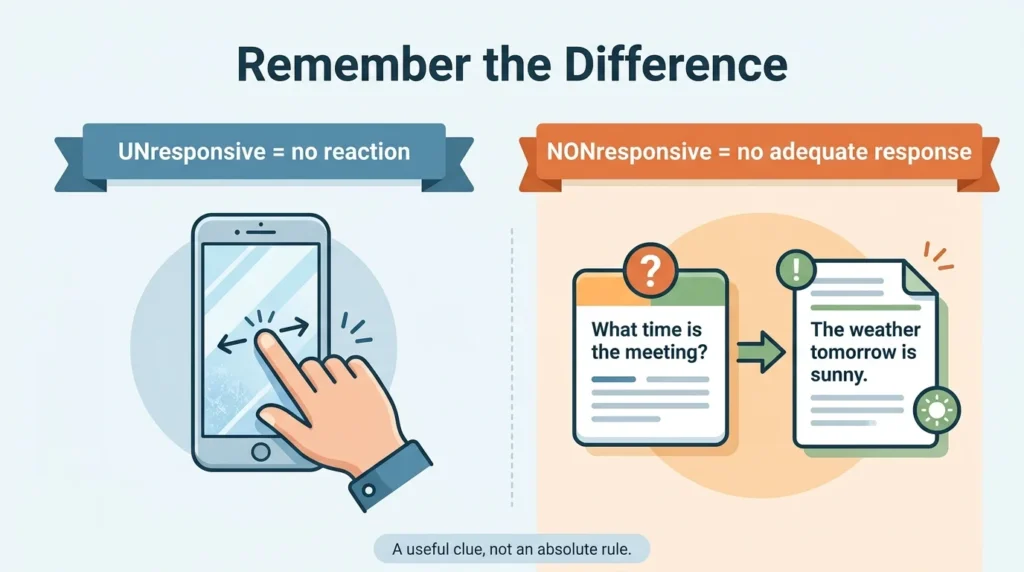
UNresponsive = no reaction; NONresponsive = no adequate response.
The mnemonic is not an absolute grammar law, but it points you toward the most useful distinction.
Picture two situations:
- An UNresponsive screen does nothing when you tap it.
- A NONresponsive answer says something but does not answer what you asked.
Then check the real context before making the final choice.
Read More: Transferred vs Transfered: Which Spelling Is Correct?
Real-Life Situations
Job Interview
The interviewer asks:
“Why did you leave your previous position?”
The candidate spends two minutes discussing the company’s parking lot but never addresses the reason for leaving.
You could describe that as a nonresponsive answer because a response was given, but it failed to answer the question.
Meeting
A manager presents three proposed changes. One employee sits silently and shows no visible reaction.
“He seemed unresponsive to the proposal.”
Here, the word describes a lack of observable reaction.
You have sent a supplier four requests for a shipping update and received nothing.
For a formal customer-management note:
“The supplier remains nonresponsive.”
For ordinary conversation:
“The supplier still hasn’t replied.”
Both communicate the situation, but the second sounds less bureaucratic.
Text Message
Your friend has not replied for twenty minutes.
Do not immediately say:
“My friend is unresponsive.”
In some contexts, unresponsive can suggest a physical or medical problem.
Simply say:
“My friend hasn’t replied yet.”
Exam
Suppose the question asks:
“What caused the company’s revenue to decline?”
A student writes only:
“The company was founded in 1998.”
The sentence may be factually correct, but it is nonresponsive to the question because it does not address the requested cause.
Expert Tips
Focus on the Noun After the Adjective
Certain combinations quickly reveal the natural choice:
- unresponsive patient
- unresponsive screen
- unresponsive controls
- nonresponsive answer
- nonresponsive bid
Learn these combinations as units.
Use a Verb When the Adjective Creates Ambiguity
Instead of debating whether a client is nonresponsive or unresponsive, write:
The client has not replied to our last three emails.
That sentence gives readers the exact fact and avoids suggesting a reason for the silence.
Do Not Diagnose Intent Through Word Choice
Neither adjective proves that someone could, could not, would, or would not respond.
If intent matters, state it separately:
- She chose not to answer.
- He was unable to answer.
- The customer did not receive the message.
- The server failed to process the request.
Respect Specialized Terminology
When writing inside a profession, established terminology can override a general-language preference.
For example, federal procurement regulations use nonresponsive for certain bids that fail required conditions.
If your workplace, academic discipline, court system, or style guide has a defined term, follow it consistently.
Be Careful With Medical Contexts
In ordinary medical and first-aid language, unresponsive can describe a person who does not respond to sound, touch, or other stimulation.
Do not casually replace it with “asleep.” A sleeping person and a medically unresponsive person are not necessarily in the same condition. Sudden unexplained unresponsiveness should be treated seriously.
Do Not Overcorrect Nonresponsive
Nonresponsive is a real word.
It is not a misspelling of unresponsive. Standard dictionaries recognize it, including its ordinary “not giving response” meaning and its specialized requirement-related sense.
Watch the Hyphen
You may encounter both nonresponsive and non-responsive. Major dictionaries do not all display the compound identically: one major American dictionary uses the closed form nonresponsive, while Cambridge lists non-responsive.
This is better treated as a dictionary or house-style issue than as a simple American-versus-British rule.
For consistency in this article, use nonresponsive.
Quick Summary
Nonresponsive and unresponsive are both correct adjectives, and both can broadly mean “not responsive.” Unresponsive is the safer general choice when a person, device, system, emotion, or condition shows no reaction. Nonresponsive is especially useful when an expected response is absent, inadequate, irrelevant, or fails formal requirements, as in a nonresponsive answer or nonresponsive bid. Do not rely on the oversimplified rule that nonresponsive always means “won’t respond” while unresponsive means “can’t respond.” Neither word automatically proves intention or ability. In medical emergencies, unresponsive is established wording for a person who does not react to stimulation. When either adjective sounds unnecessarily formal, plain wording such as “hasn’t replied” is often clearer.
FAQ
Is nonresponsive a real word?
Yes. Nonresponsive is a standard English adjective. It can mean not giving a response and can also describe something that fails to address or satisfy a request or requirement.
Is unresponsive a correct word?
Yes. Unresponsive is a standard adjective meaning not responsive. It can describe people, conditions, systems, organizations, emotions, and other things that fail to react or respond.
Which is correct: nonresponsive or unresponsive?
Both are correct. Choose according to context. Unresponsive is generally useful for lack of reaction, while nonresponsive is particularly valuable when evaluating whether a response, answer, submission, or communication adequately addressed something.
Should I say an unresponsive patient or a nonresponsive patient?
For a person who does not react to voice, touch, or other stimulation, unresponsive patient is established general medical and first-aid wording.
Specialized clinical literature may use other forms in particular contexts, so professional documentation should follow the terminology required by the relevant medical system.
Can I say “unresponsive to treatment”?
Yes. Unresponsive to treatment is standard English. Dictionary examples include an infection described as unresponsive to antibiotics.
You can also write “did not respond to treatment” when you want especially plain language.
What does a nonresponsive answer mean?
A nonresponsive answer is one that does not adequately address the question asked. The person may have spoken or written something, but the content does not actually answer the question.
This is why nonresponsive does not always mean “no response whatsoever.”
What does a nonresponsive bid mean?
In procurement, a bid may be called nonresponsive when it fails to comply with material bidding requirements. U.S. federal regulations use this terminology in several procurement provisions.
Can a computer be nonresponsive?
Yes. Nonresponsive can describe a computer or system that fails to respond to requests or instructions. However, unresponsive is also natural, especially when a device, application, or interface stops reacting to user input.
Is it nonresponsive or non-responsive?
Both forms can be encountered in edited English. Merriam-Webster lists nonresponsive, while Cambridge uses non-responsive as its headword.
Follow the spelling preferred by your dictionary, organization, or style guide and remain consistent.
Is irresponsive the same as unresponsive?
Readers may encounter irresponsive, but unresponsive and nonresponsive are much clearer choices for modern general writing. If your intended meaning is simply “not reacting,” unresponsive avoids unnecessary uncertainty.
Does nonresponsive mean someone is deliberately ignoring me?
No. Nonresponsive describes the absence or inadequacy of a response; it does not prove why the person did not respond.
They may be unwilling to reply, unable to reply, unaware of the message, unavailable, or experiencing a technical problem. State the cause separately if you know it.
Mini Quiz
| # | Question | Answer | Explanation |
|---|---|---|---|
| 1 | Fill in the blank: “The patient was completely ___ when emergency personnel arrived.” | unresponsive | The sentence describes a person showing no reaction, making unresponsive the established general choice. |
| 2 | Choose the better procurement term: “The agency rejected the ___ bid.” A) unresponsive B) nonresponsive | B) nonresponsive | Nonresponsive bid is established procurement terminology for a bid that fails required conditions. |
| 3 | Correct the sentence: “The treatment was unresponsive to the infection.” | The infection was unresponsive to the treatment. | The condition responds—or fails to respond—to treatment, not the other way around. |
| 4 | True or false: Nonresponsive is an incorrect version of unresponsive. | False | Both are legitimate English adjectives. |
| 5 | Fill in the blank: “The witness gave a ___ answer that never addressed the question.” | nonresponsive | The answer existed but failed to address what was asked. |
| 6 | Choose the most natural wording: “My touchscreen is ___.” A) unresponsive B) nonresponsive | A) unresponsive | Both may be understood, but unresponsive naturally describes a device that does not react to touch. |
| 7 | Which is clearer in an ordinary email? A) “Sam is nonresponsive.” B) “Sam hasn’t replied to my last two emails.” | B | The verb phrase states exactly what happened and avoids implying a cause. |
| 8 | True or false: Unresponsive always means physically incapable of responding. | False | The word also describes technology, organizations, emotions, conditions, and other forms of absent reaction. |
| 9 | Correct the wording: “The bid became unconscious and unresponsive.” | The bid was nonresponsive to the requirements. | Documents do not become unconscious; procurement uses nonresponsive for failure to meet requirements. |
| 10 | Fill in the blank: “The infection remained ___ to antibiotics.” | unresponsive | Unresponsive to can correctly describe a condition that does not react to treatment. |