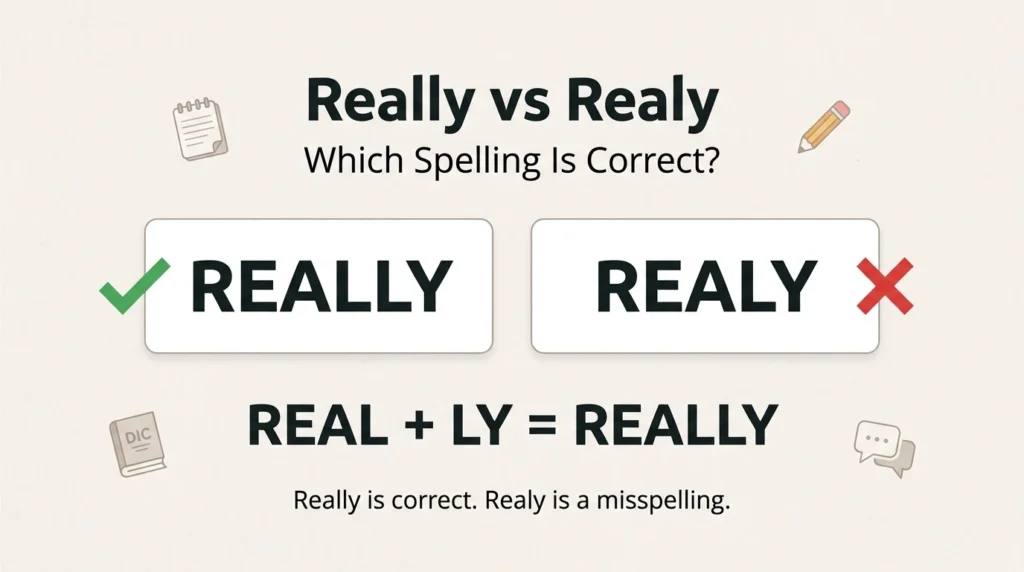

Really is the correct spelling. Realy is a spelling mistake and should not be used in standard English. The word really is usually an adverb meaning actually, truly, genuinely, or very. It contains two l’s because it can be understood as real + -ly = really. Standard dictionaries recognize really, not realy, as the English word.
What Is Really?
Really is most commonly an adverb, which means it adds information to a verb, adjective, another adverb, or sometimes an entire statement.
It can tell us that something is true:
I really saw him there.
Here, really means actually.
It can also increase the strength of an adjective or idea:
The test was really difficult.
Here, really means something close to very.
It can also emphasize a verb:
I really appreciate your help.
And in conversation, Really? can express surprise, interest, doubt, or a request for confirmation. These uses are all established in standard English.
Realy, by contrast, does not function as a standard alternative spelling with a separate meaning. When someone writes realy instead of really, one l has simply been left out.
Why It Matters
A missing letter may seem minor, but spelling affects how readers judge a piece of writing.
Writing realy in a casual text may cause little confusion because most people will understand what you intended. In a résumé, job application, school assignment, client email, article, report, or business proposal, however, the mistake can make the writing look less carefully edited.
The issue is especially noticeable because really is such a common word. Readers usually recognize its standard spelling immediately.
Correct spelling also helps English learners understand how words are formed. Once you recognize real + -ly, remembering the second l becomes much easier.
The Core Rule
Rule: Always write really with two l’s.
✅ really
❌ realyThink of the word as:
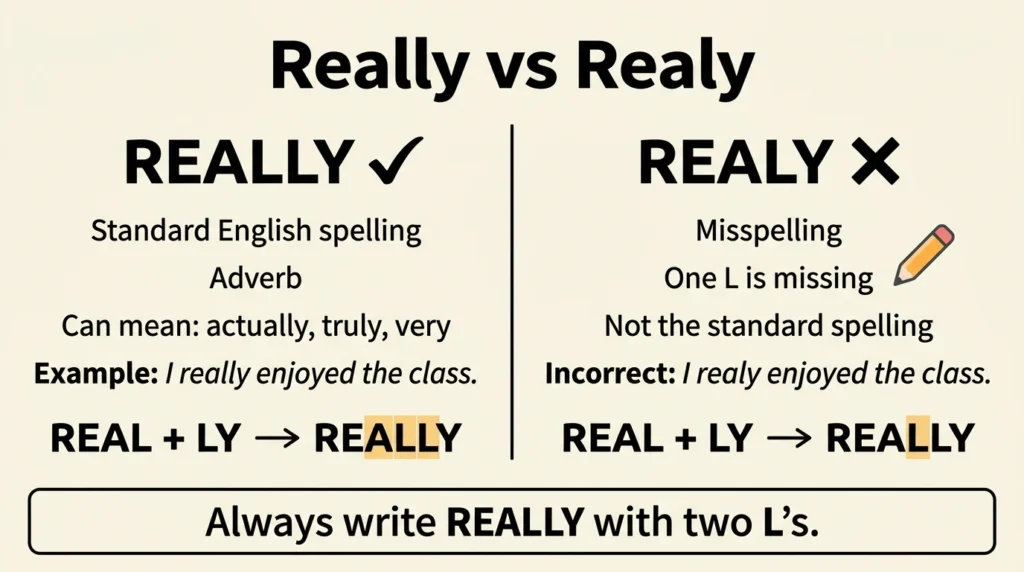
real + ly = really
The first l belongs to real. The second l begins the suffix -ly, an ending often used to form adverbs.
So you do not remove the l from real before adding -ly.
That gives:
real + ly → really
not:
real + y → realy
The normal word-plus-suffix principle is to keep the base word and add the suffix unless another spelling rule requires a change.
How to Use Really
1. Use Really to Mean “Actually”
Use really when you want to emphasize that something is true or actually happened.
- Did she really resign?
- I really heard the alarm.
- That is what really happened.
- He did not really understand the question.
In these sentences, really contrasts reality with doubt, appearance, misunderstanding, or expectation.
2. Use Really to Mean “Very” or “Very Much”
Really commonly acts as an intensifier. An intensifier makes another word stronger.
- The coffee is really hot.
- She is really talented.
- We were really tired.
- That was a really useful meeting.
In these examples, really strengthens the adjective that follows it.
This use is extremely common in everyday English.
3. Use Really to Emphasize a Verb
You can place really before many verbs to show strong feeling, intention, preference, or emphasis.
- I really appreciate your support.
- We really need more time.
- She really enjoys teaching.
- They really want to win.
Here, really strengthens the action or feeling expressed by the verb.
4. Use “Really?” as a Response
In conversation, Really? can stand alone.
For example:
“I got the job.”
“Really?”
Depending on tone, it may show surprise, excitement, doubt, or interest.
The spelling does not change simply because the word is being used alone.
5. Use “Not Really” for a Soft Negative
Not really is a common way to give a mild or less direct negative answer.
“Did you enjoy the film?”
“Not really.”
It often sounds softer than a direct no.
6. Use Really Before an Adjective, Not Realy
Correct:
The room was really quiet.
Incorrect:
The room was realy quiet.
The meaning may still be understandable, but realy is not the standard spelling.
Correct Examples of Really
Here are original examples across different types of everyday writing.
- Conversation: “I really thought you were coming tonight.”
- Text message: “That restaurant was really good!”
- School: “The experiment became really interesting after the temperature changed.”
- Workplace: “We really need to finish the report before Friday.”
- Email: “I really appreciate the detailed feedback you sent.”
- Meeting: “This proposal could really improve our response time.”
- Social media: “I really enjoyed visiting the new exhibition.”
- Academic writing: “The results do not really support the original assumption.”
- Customer service: “We are really sorry about the delay.”
- Interview: “I really value opportunities to learn new skills.”
- Family conversation: “Do you really want another slice?”
- Planning: “We should really check the schedule before booking anything.”
Each sentence uses the standard spelling really.
Really vs Realy: Incorrect and Correct Examples
| ❌ Incorrect | ✅ Correct | Why |
|---|---|---|
| I realy enjoyed the concert. | I really enjoyed the concert. | Really requires two l’s. |
| She is realy good at math. | She is really good at math. | The adverb modifying good is spelled really. |
| Are you realy leaving? | Are you really leaving? | Really means actually here. |
| We realy need your answer today. | We really need your answer today. | The first spelling omits an l. |
| That was realy surprising. | That was really surprising. | Really intensifies surprising. |
| I realy appreciate your help. | I really appreciate your help. | The standard adverb is really. |
| He didn’t realy explain the problem. | He didn’t really explain the problem. | Really modifies the verb explain. |
| The instructions were realy clear. | The instructions were really clear. | Use really, not the misspelling realy. |
| Do you realy believe that? | Do you really believe that? | Really adds emphasis to believe. |
| I’m not realy hungry. | I’m not really hungry. | Not really is the standard phrase. |
| The meeting was realy productive. | The meeting was really productive. | The correct intensifier is really. |
| She realy wants the position. | She really wants the position. | The word comes from real + -ly. |
Why People Spell Really as Realy
Several factors make this mistake understandable.
Pronunciation Does Not Clearly Reveal Both L’s
The word really is often pronounced smoothly and quickly. Depending on accent and speaking speed, listeners do not hear anything that obviously tells them to write two separate l letters.
Pronunciation therefore cannot always tell you the exact spelling. Standard pronunciation also varies somewhat between British and American accents without changing the written form.
The Word Real Creates Spelling Overlap
Learners recognize the adjective real and may assume that they only need to add a y:
real + y = realy
But that is the wrong analysis.
The ending is -ly, not simply -y:
real + ly = really
Seeing the word in these two parts is one of the easiest ways to avoid the error.
One L Can Disappear When Typing Quickly
Because the same letter appears twice in succession, one l can easily be skipped when typing:
really → realy
This can be a simple typing error rather than a misunderstanding of the word.
Learners May Overgeneralize Other -ly Spellings
Many common adverbs visually appear to have just one l near the end:
- slowly
- clearly
- badly
- safely
- quickly
A learner may notice the familiar -ly ending without recognizing that real already ends in l.
The result is really, with the final l of the base word next to the first letter of -ly.
Read More: Unaffected vs Uneffected: Which Is Correct?
Autocorrect Is Helpful but Not Perfect
A tool can be disabled, may not run in every app, or may behave differently when working with names, technical terms, informal messages, or multilingual text.
Spelling tools often catch realy, but writers should not depend on automatic correction alone.
Understanding the spelling yourself is more reliable.
Translation Can Affect Spelling Decisions
For English learners, translation interference may play a role when their first language does not form adverbs with an ending equivalent to English -ly.
Instead of seeing really as a base plus suffix, they may memorize it mainly by sound. Because the pronunciation does not strongly highlight two written l’s, realy can seem plausible.
The solution is to memorize the structure rather than only the sound:
real + ly = really
Common Mistakes Checklist
Before submitting important writing, check for these common problems:
- Writing realy with one l: Remember that real already ends in l, and -ly begins with another.
- Assuming realy is an informal spelling: It is not a standard casual variant. Use really in both formal and informal writing.
- Confusing real and really: Real is mainly an adjective; really is mainly an adverb.
- Relying only on pronunciation: Spoken English may not make every written letter obvious.
- Writing “real” when standard formal writing needs “really”: In phrases such as “really quickly,” really is the conventional adverb.
- Overusing really: Correct spelling does not mean the word is always the strongest stylistic choice.
- Using really when a more exact word would be clearer: “Really big” might sometimes become enormous, substantial, or extensive, depending on meaning.
- Ignoring repeated intensifiers: Several uses of really in one paragraph can make writing sound repetitive.
- Thinking the spelling changes by country: The standard spelling is really.
- Forgetting the second l when typing fast: Give repeated-letter words an extra check during proofreading.
Really in Real English
Grammatically Correct English
Really is grammatically correct when it means actually, strengthens an adjective or adverb, emphasizes a verb, or works as a conversational response. Sentences such as “I really agree,” “It was really difficult,” and “Did that really happen?” are ordinary standard English. The important spelling point is simple: these uses always take really, with two l’s.
Grammatically Possible but Sometimes Unnatural
A sentence can contain really without being wrong yet still sound repetitive or imprecise. For example, “The really big problem caused a really bad result” is understandable, but the repeated intensifier adds little information. A more natural or precise version might be “The major problem caused a serious result.” Good writing depends on meaning, not merely grammatical correctness.
Natural Everyday English
In everyday speech, really is extremely flexible. People naturally say “I really like it,” “That’s really nice,” “Really?”, “Not really,” and “Do you really think so?” The word often communicates emotion or emphasis that a more formal synonym would not express in exactly the same way. Trying to replace every occurrence with truly or actually can therefore make ordinary conversation sound unnatural.
Formal vs. Informal Usage
Really works in both formal and informal English, but the amount you use may change with the context.
Informal English
In conversation, texts, social posts, and friendly emails, really is natural and common:
- That was really funny.
- I really miss you.
- Are you really coming?
- I’m really excited.
There is usually no reason to avoid it.
Formal and Academic English
Really can also be grammatically correct in professional and academic writing:
The evidence does not really explain the difference.
However, formal writing often benefits from greater precision.
Instead of:
The increase was really large.
A more precise version might be:
The increase was substantial.
Instead of:
This is really important.
You might write:
This is particularly important.
The goal is not to ban really. It is to decide whether the word expresses the exact degree or meaning you need.
Really vs Realy Comparison Table
| Feature | Really | Realy |
|---|---|---|
| Standard English spelling | ✅ Yes | ❌ No |
| Number of l’s | Two | One |
| Main word class | Adverb | None as the intended standard word |
| Can mean “actually” | ✅ Yes | ❌ No |
| Can mean “very” | ✅ Yes | ❌ No |
| Can emphasize a verb | ✅ Yes | ❌ No |
| Can appear as “Really?” | ✅ Yes | ❌ No |
| Suitable for emails | ✅ Yes | ❌ No |
| Suitable for academic writing | ✅ When appropriate | ❌ No |
| Suitable for social media | ✅ Yes | ❌ Still a misspelling |
| Correct in American English | ✅ Yes | ❌ No |
| Correct in British English | ✅ Yes | ❌ No |
| Word structure | real + -ly | Missing an l |
Really, Real, and Other Similar Terms
Do not confuse really with words that have related meanings but different grammatical jobs.
| Word | Typical Function | Example |
|---|---|---|
| real | adjective | This is real gold. |
| really | adverb | This is really useful. |
| actually | adverb | I actually saw it happen. |
| truly | adverb | She is truly grateful. |
| very | adverb/intensifier | It is very cold. |
| genuine | adjective | Her concern was genuine. |
Really, actually, truly, and very can overlap in some contexts, but they are not interchangeable in every sentence.
For example:
I really like this.
sounds natural.
I actually like this.
can suggest that the fact is surprising or contrary to expectation.
I truly like this.
is possible but sounds more deliberate or emphatic.
Word choice changes tone as well as literal meaning.
Memory Trick
Use this simple mnemonic:
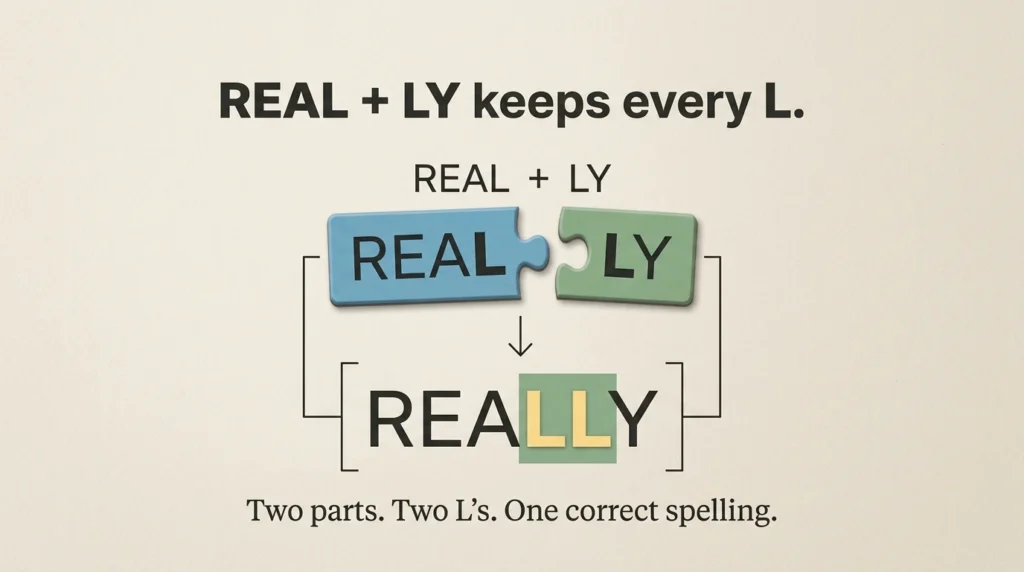
REAL + LY keeps every L.
Write the pieces separately:
REA L + L Y
Now bring them together:
REA L L Y
The two l’s come from two places:
- The first l finishes real.
- The second l starts -ly.
- Together they make really.
If you can remember real + ly, you do not need to memorize really as a random six-letter spelling.
Read More: Rug vs Rag: What Is the Difference?
Real-Life Situations
Interview
You want to express genuine interest in the role.
“I really enjoy working with customers.”
Not:
“I realy enjoy working with customers.”
The correct spelling matters because job-related writing and communication create an impression of your attention to detail.
Meeting
A manager emphasizes urgency:
“We really need to solve this before launch.”
Here, really strengthens need.
You thank a colleague:
“I really appreciate your help with the presentation.”
This is completely natural professional English.
Text Message
A friend sends unexpected news:
“I won the tickets.”
You reply:
“Really? That’s amazing!”
Here, Really? expresses surprise.
Exam
The sentence is:
“The weather was ___ cold yesterday.”
If the choices are really and realy, choose:
“The weather was really cold yesterday.”
Academic Assignment
Instead of repeatedly writing:
“The result was really important.”
you might choose:
“The result was significant.”
The spelling rule has not changed. You are simply choosing a more precise word for the context.
Expert Tips
Learn the Word in Parts
Do not memorize the letters as an unrelated sequence.
Memorize:
real + ly
Morphology—the study of meaningful word parts—can make spelling easier because you understand where the letters come from.
Proofread Double Letters Separately
Repeated letters are easy to miss when typing quickly.
When proofreading, look specifically for words such as:
- really
- necessary
- successful
- beginning
- occurrence
Do not assume that ordinary reading will catch every repeated-letter mistake.
Replace Really Only When Precision Improves
Avoid the simplistic advice that says you should never use really.
Compare:
I really appreciate your help.
Replacing really with a dramatic adjective would make little sense.
But compare:
The building is really big.
Depending on the context, enormous, vast, or high-capacity might communicate more useful information.
Use a replacement only when it improves meaning.
Watch for Clusters of Intensifiers
One really may be natural.
Five uses in one paragraph may become distracting.
For example:
It was really difficult because the instructions were really unclear and the deadline was really short.
A stronger revision is:
It was difficult because the instructions were unclear and the deadline was unusually short.
Remember That Spelling and Style Are Separate Questions
There are two different decisions:
Spelling question: Is really spelled correctly?
Yes.
Style question: Is really the best word in this particular sentence?
That depends on context.
This distinction helps writers avoid turning a straightforward spelling rule into an unnecessary grammar prohibition.
Quick Summary
Really is the only standard spelling when you mean actually, truly, genuinely, or very. Realy is a misspelling caused by leaving out one l. The easiest way to remember the spelling is to divide the word into real + -ly = really: the first l belongs to real, while the second begins -ly. Really can emphasize verbs, strengthen adjectives, describe what is actually true, appear alone as “Really?”, or form the phrase “not really.” It is natural in everyday English and can also appear in professional or academic writing. In formal contexts, however, a more precise word may sometimes communicate your meaning better. Always spell the word r-e-a-l-l-y.
Read More: Quantify vs Qualify: What’s the Difference?
FAQ
Is realy a real word?
Not when it is intended to mean really. In standard English, realy is a misspelling. Use really with two l’s.
How do you spell really correctly?
Spell it r-e-a-l-l-y. A useful way to remember it is real + ly = really.
Why does really have two l’s?
Because the base real ends in l, while the adverb-forming suffix -ly begins with l. When combined, they produce really.
Is it “I really like it” or “I realy like it”?
The correct sentence is:
I really like it.
Realy is missing an l.
Does really mean the same thing as very?
Sometimes. In “really cold,” really can mean approximately very. But in “Did he really leave?”, it means something closer to actually.
Can really mean actually?
Yes. For example, “What really happened?” asks what actually happened. Standard dictionaries include this use.
Is really an adjective or an adverb?
Really is primarily an adverb. Real is primarily an adjective. Compare “a real problem” with “a really serious problem.”
Is “really?” a complete response?
Yes. In conversation, Really? can stand alone to express surprise, interest, doubt, or a request for confirmation.
Is really too informal for professional writing?
No. Really can appear in professional English, especially in natural correspondence. However, more precise language may be preferable when degree or measurement matters.
Should I write real or really before an adjective?
Usually use really when you are intensifying another adjective in standard edited English: really good, really difficult, and really useful.
Mini Quiz
| # | Question | Answer | Explanation |
|---|---|---|---|
| 1 | Choose the correct spelling: realy / really | really | The standard spelling contains two l’s. |
| 2 | Fill in the blank: “I ___ enjoyed the class.” | really | Really emphasizes the verb enjoyed. |
| 3 | Correct the sentence: “She is realy tired.” | She is really tired. | Realy is missing the second l. |
| 4 | Which is correct? A) realy helpful B) really helpful | B) really helpful | The intensifier is spelled really. |
| 5 | Fill in the blank: “Did that ___ happen?” | really | Here, really means actually. |
| 6 | Correct the sentence: “I realy appreciate your support.” | I really appreciate your support. | Really is formed from real + -ly. |
| 7 | Which word means “genuine” in “a ___ diamond”: real or really? | real | Real is an adjective modifying diamond. |
| 8 | Which word fits? “That is a ___ difficult question.” | really | Really modifies the adjective difficult. |
| 9 | Correct or incorrect: “Not really.” | Correct | Not really is a standard, natural way to give a mild negative response. |
| 10 | Why are there two l’s in really? | real + -ly | One l ends real, and another begins -ly. |