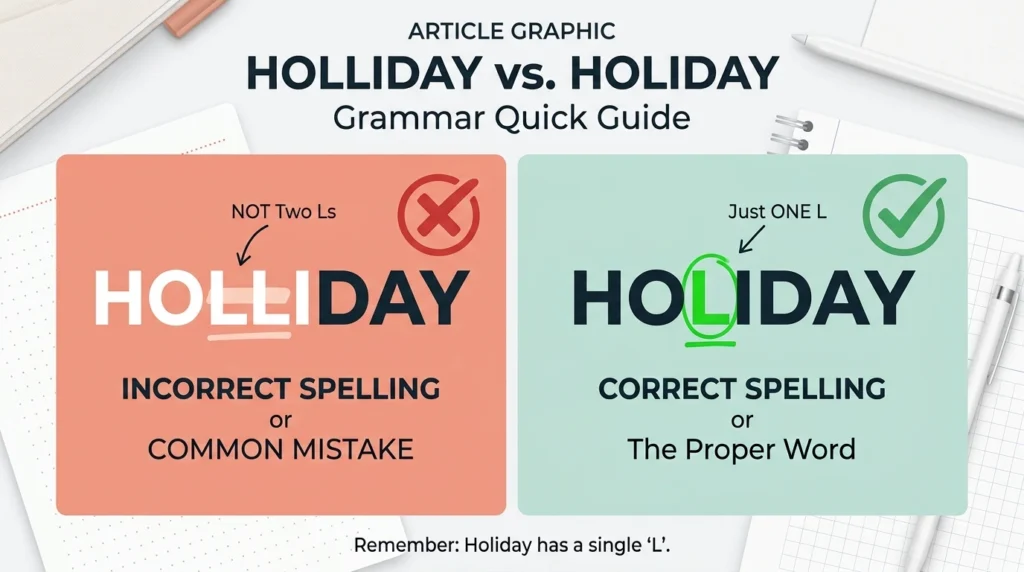

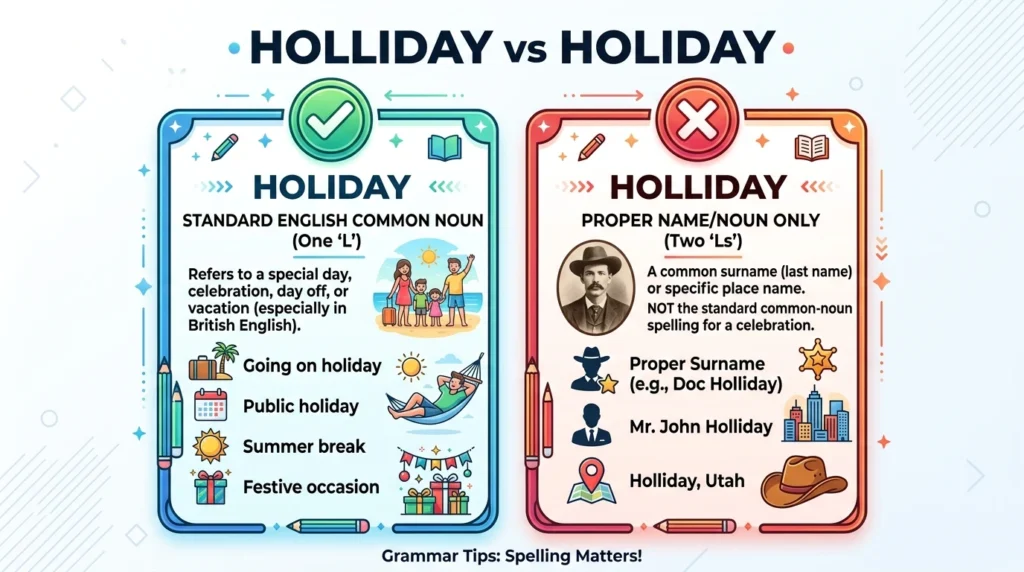
Holiday is the correct spelling when you mean a special day, a day off, or—in British English—a vacation or period away from work. Holliday is not an alternative spelling of the common English word. However, Holliday can be correct as a proper name, such as a person’s surname or the official name of a place.
What Is the Difference Between Holliday and Holiday?
The difference between holliday vs holiday is mainly a spelling issue.
Holiday is a standard English word. It can refer to a religious or national celebration, a day when people do not work or attend school, or—in British English—a period spent travelling or relaxing.
Holliday, with two l’s, is not the standard spelling of that common noun. If you write, “We are going on holliday,” the extra l is a spelling error.
There is one important exception: Holliday can be a proper noun. It is used as a surname, given name, and in certain place names. In those cases, changing the spelling would be incorrect because names must normally be written as their owners or official sources spell them.
So the distinction is simple:
- holiday = the normal English word
- Holliday = potentially correct as a name
- holliday = normally incorrect when you mean a holiday, vacation, celebration, or day off
Why Does the Correct Spelling Matter?
A single extra letter may look like a small error, but spelling affects how readers judge a piece of writing.
Writing holliday instead of holiday can stand out in:
- job applications
- business emails
- school assignments
- examinations
- reports
- website content
- advertisements
- social media captions
- invitations and announcements
The problem becomes more noticeable when the word appears in a title or greeting.
For example:
❌ Happy Hollidays!
✅ Happy Holidays!
A reader can usually understand the incorrect version, but understanding a word and spelling it correctly are different things.
The Core Rule
Rule: Use “holiday” with one l when referring to a day of celebration, a day off, or a vacation. Use “Holliday” with two l’s only when it is the correct spelling of a proper name.
The standard spelling contains seven letters:
H-O-L-I-D-A-Y
There is only one l.
Read More: What Is the Difference Between Prooving or Proving?
How to Use Holiday Correctly
Holiday as a Special Day
Use holiday for a day officially or traditionally connected with a celebration, commemoration, religious observance, or break from normal activities.
Examples:
- Monday is a public holiday.
- The office will close for the holiday.
- Christmas is an important holiday for many Christians.
- We have several holidays in December.
This is normal in both American and British English.
Holiday as Time Away From Work
In British English, holiday is commonly used for time spent away from work or home for rest and recreation.
For example:
- We’re going on holiday next month.
- She spent her holiday in Spain.
- I need to book my summer holiday.
American English normally uses vacation for this meaning:
- We’re going on vacation next month.
The spelling of holiday itself does not change between British and American English. The difference concerns how frequently the word is used for a vacation.
Holiday Before Another Noun
Holiday can also describe another noun:
- holiday weekend
- holiday season
- holiday destination
- holiday travel
- holiday plans
- holiday decorations
For example:
“The airport becomes busy during the holiday season.”
Holiday as a Verb
English dictionaries also record holiday as a verb, particularly in British usage.
For example:
“They holidayed in France.”
The form is grammatically correct, although many speakers may choose a more conversational expression such as went on holiday, travelled, or, especially in American English, went on vacation.
When Holliday Is Correct
Do not automatically change Holliday when it belongs to someone’s name.
For example:
- Mr. Holliday called this morning.
- The article was written by Dr. Holliday.
- Please send the form to Ms. Holliday.
Names are an important exception because Holliday genuinely exists as a proper name.
This also explains why a spellchecker may occasionally leave Holliday unchanged. Software may interpret a capitalized form as a person’s name rather than a misspelling.
Correct Examples of Holiday and Holliday
Here are original examples across everyday conversation, education, work, email, social media, travel, and formal writing.
- Conversation: “Are you working on the public holiday?”
- Email: “Our customer support office will be closed for the holiday.”
- School: “Students will return after the holiday break.”
- Workplace: “Please finish the report before the holiday weekend.”
- Social media: “Happy holidays from everyone on our team!”
- British travel English: “We’re going on holiday to Portugal in September.”
- American English: “I’m taking a vacation next week, but Monday is also a federal holiday.”
- Academic writing: “Responses submitted during public holidays were excluded from the sample.”
- Business writing: “Holiday opening hours will be published on our website.”
- Proper name: “Please check whether Mr. Holliday has approved the document.”
Notice that the last example does not use Holliday as another version of holiday. It is a surname.
Incorrect vs. Correct Examples
| ❌ Incorrect | ✅ Correct | Why |
|---|---|---|
| We are going on holliday next week. | We are going on holiday next week. | The common word meaning time away from work is spelled with one l. |
| Monday is a public holliday. | Monday is a public holiday. | Holliday is not the standard spelling for a public day off. |
| Happy Hollidays! | Happy Holidays! | The plural is formed from holiday: holiday → holidays. |
| The office closes during the holliday season. | The office closes during the holiday season. | The correct compound expression is holiday season. |
| Christmas is a religious holliday. | Christmas is a religious holiday. | A special or religious day uses the standard noun holiday. |
| We booked a holliday package. | We booked a holiday package. | Holiday is the standard spelling before another noun. |
| The school holliday begins Friday. | The school holiday begins Friday. | The extra l has no grammatical function. |
| Our holliday plans changed. | Our holiday plans changed. | The adjective-like noun modifier remains holiday. |
| She returned from her holliday yesterday. | She returned from her holiday yesterday. | British English uses holiday for a vacation, but the spelling still has one l. |
| Change Mr. Holliday to Mr. Holiday. | Keep Holliday if that is his surname. | A person’s name should not be “corrected” to match the common noun. |
Why Do People Write Holliday Instead of Holiday?
Several factors can lead to the holliday or holiday confusion.
Pronunciation Does Not Clearly Show the Number of L’s
When you hear holiday, the spoken word does not clearly tell you whether the spelling contains one l or two.
English spelling often contains information that cannot be recovered from sound alone. Someone who knows the pronunciation but has rarely seen the word written may therefore guess holliday.
The Two Spellings Look Very Similar
Compare them:
holiday
holliday
Only one letter separates them visually.
Because the incorrect form still looks familiar, writers may overlook it during fast proofreading.
People See Holliday as a Real Name
Holliday is genuinely used as a proper name. That can make the spelling look legitimate even when it is being used incorrectly as a common noun.
Seeing a valid proper noun does not make it an alternative spelling of the ordinary word.
Compare:
“Mr. Holliday is here.” ✅
“Tomorrow is a holliday.” ❌
Read More: Vinal vs Vinyl: Which Spelling Is Correct?
Writers Overgeneralize Double-L Patterns
English contains many words in which ll appears naturally, so a learner may insert a second l based on visual familiarity rather than a specific rule.
That strategy is unreliable because English spelling cannot always be predicted from nearby words or similar-looking patterns.
Autocorrect Is Helpful but Not Perfect
Spellcheckers work from dictionaries, language models, names, context, and software-specific rules.
A program may detect lowercase holliday as suspicious but accept capitalized Holliday because it can be a legitimate proper name.
That means proofreading still matters.
Translation Can Increase Uncertainty
For learners who first learned the concept in another language, the problem may be less about pronunciation and more about recalling an unfamiliar English spelling.
However, translation interference is not the main linguistic rule behind this particular mistake. The safest solution is simply to memorize the standard written form: holiday.
Common Mistakes Checklist
Before publishing or submitting your writing, check for these problems:
- Adding a second l: Write holiday, not holliday, when you mean a day off or celebration.
- Pluralizing the wrong spelling: The plural is holidays, not hollidays.
- Changing someone’s surname: Do not replace Holliday with Holiday if two l’s are part of the person’s actual name.
- Trusting spellcheck completely: A proper-name dictionary can prevent software from flagging Holliday.
- Confusing spelling with regional usage: British and American speakers may use holiday differently, but neither standard variety requires holliday for the common noun.
- Using pronunciation as the only guide: Hearing the word does not reliably reveal how many l’s it contains.
- Overcorrecting every instance: Search the surrounding sentence before replacing Holliday. It may be a person’s or place’s name.
Holliday vs Holiday in Real English
Grammatically Correct and Natural
In ordinary English, holiday is the natural spelling whenever you mean a celebration, recognized day off, or special day. British speakers also naturally use expressions such as go on holiday and be on holiday for recreational time away. These are standard constructions, not special grammar exceptions. The important point is that the spelling remains holiday with one l.
Grammatically Possible but Less Natural in Some Contexts
A sentence can be grammatically acceptable without being the expression most speakers would choose. For example, “We are holidaying in Florida” uses a recognized verb form, but many American speakers would more naturally say “We are vacationing in Florida” or “We’re on vacation.” British speakers have greater reason to use holiday for recreational travel.
Incorrect in Standard Common-Noun Use
“We enjoyed our holliday” is understandable, but holliday is not the standard common-noun spelling. The sentence does not become acceptable because the reader knows what was intended. By contrast, “I spoke to Ms. Holliday” can be completely correct because Holliday is functioning as a name. The key is therefore not simply counting l’s; it is identifying what the word represents in the sentence.
American vs. British English
There is a genuine American/British distinction here, but it concerns usage and meaning—not the spelling holiday vs holliday.
| Situation | American English | British English |
|---|---|---|
| Special national or religious day | holiday | holiday |
| Recognized day off | holiday | holiday |
| Recreational trip/time away | usually vacation | commonly holiday |
| “On holiday” for a trip | less typical | common |
| Correct spelling of common noun | holiday | holiday |
| Holliday as alternative spelling | No | No |
For example, a British speaker might say:
“We’re going on holiday to Italy.”
An American speaker would normally be more likely to say:
“We’re going on vacation to Italy.”
However, both may say:
“Monday is a holiday.”
This regional difference is well established in current dictionary usage guidance.
Read More: Enable vs Inable: Which Is Correct?
Holliday vs Holiday Comparison Table
| Feature | Holiday | Holliday |
|---|---|---|
| Standard common English word? | Yes | No, not for the ordinary meaning |
| Number of l’s | One | Two |
| Can mean a public or religious day? | Yes | No as a standard common noun |
| Can mean vacation? | Yes, especially in British English | No |
| Can be a surname or proper name? | Possible | Yes |
| Correct in American English? | Yes | Only when it is genuinely a name |
| Correct in British English? | Yes | Only when it is genuinely a name |
| Plural common noun | holidays | Not hollidays |
| Example | We enjoyed the holiday. | Mr. Holliday called. |
| Should spellcheck always replace it? | No replacement needed | Check context before changing |
The Easiest Memory Trick
The modern word holiday developed historically from a term meaning holy day. Its history goes back to Old English hāligdæg, formed from words corresponding to holy and day.
Use this mnemonic:
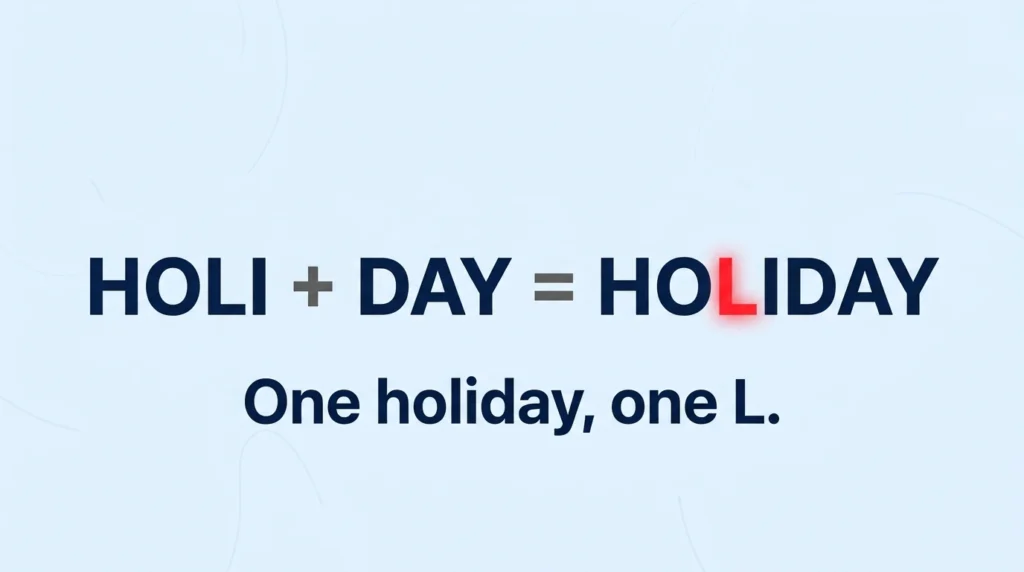
HOLI + DAY = HOLIDAY
There is only one L in the HOLI part.
Or remember:
One holiday, one L.
The rhyme is not an etymological rule, but it is an easy spelling reminder.
How to Check the Spelling in Five Seconds
When you are unsure, use this process:
- Ask whether you mean a celebration, day off, or vacation.
- If yes, write holiday.
- Check that there is only one l.
- If you see Holliday, determine whether it is a person’s, place’s, organization’s, or other proper name.
- Never alter a genuine proper name merely to match the common word.
This method prevents both common errors: accidentally writing holliday and accidentally “correcting” someone’s legitimate surname.
Real-Life Situations
In a Job Interview
You want to explain your availability:
“I’ll be available throughout the holiday period.”
Using the correct spelling keeps the sentence polished and professional.
In a Meeting
Your manager says:
“The deadline falls immediately after the public holiday.”
Here, holiday refers to an officially recognized day off.
In an Email
You write:
“Please note that our office will be closed for the holiday.”
Again, only one l is needed.
In a Text Message
A British speaker might write:
“We’re finally going on holiday tomorrow!”
A casual message does not change the spelling rule.
In an Exam
Suppose the sentence is:
“The school will reopen after the winter ______.”
The correct answer is:
holiday
Writing holliday would normally count as a spelling error.
When Writing Someone’s Name
Imagine a contact card shows:
Sarah Holliday
Do not change it to Sarah Holiday simply because your spelling knowledge tells you holiday has one l.
The spelling rule applies to the common word, not to every proper name that resembles it.
Expert Tips
Check the Word’s Function Before Editing It
A good proofreader does more than search for individual letter patterns.
Compare:
“We enjoyed the holliday.” → change it.
“I emailed Professor Holliday.” → probably leave it alone if that is the professor’s name.
Context determines whether you are correcting an error or damaging a proper noun.
Be Careful With Find and Replace
A global replacement from Holliday to Holiday can create mistakes in documents containing people’s names.
Search each occurrence in context rather than replacing everything automatically.
Remember the Plural
The correct plural is:
holiday → holidays
Not:
holliday → hollidays
Example:
“We celebrate several holidays each year.”
Capitalization Does Not Create a New Spelling
Capitalizing an incorrect common noun does not make it correct.
❌ The Holliday begins tomorrow.
✅ The holiday begins tomorrow.
However:
✅ Dr. Holliday arrives tomorrow.
The capital letter works in the last example because Holliday is a proper name.
Separate Spelling From Vocabulary Choice
A learner may ask whether to use holiday or vacation. That is a vocabulary and regional-usage question.
The holiday or holliday question is mainly a spelling question.
Keeping these issues separate makes the rule much easier to understand.
Frequently Asked Questions About Holliday vs Holiday
Is Holliday ever a correct spelling?
Yes. Holliday can be correct when it is a proper name, including a surname or given name. It should not normally be used as an alternative spelling of the common word holiday.
Is it holiday or holliday?
Use holiday when referring to a celebration, day off, public holiday, or—in British English—a vacation.
Example:
✅ We enjoyed our holiday.
❌ We enjoyed our holliday.
Does holiday have one l or two?
Holiday has one l.
Spell it:
H-O-L-I-D-A-Y
The form with two l’s is not the standard spelling of the common noun.
Why does Holliday sometimes appear online?
Because Holliday is a legitimate proper name. Search results can therefore contain the two-l spelling without proving that it is a valid alternative spelling of holiday.
Why doesn’t spellcheck always correct Holliday?
A spellchecker may interpret Holliday as a proper name. Software also differs in the dictionaries and language models it uses, so automated checking should not replace contextual proofreading.
Is the plural holidays or hollidays?
The correct plural is holidays.
Singular: holiday
Plural: holidays
Example:
“We have two public holidays next month.”
Is holiday spelled differently in British and American English?
No. The common noun is spelled holiday in both.
There is, however, a usage difference: British English commonly uses holiday for recreational time away, while American English generally uses vacation for that meaning.
Is holiday the same as vacation?
Sometimes.
In British English:
“We’re going on holiday.”
In American English, the equivalent idea is commonly:
“We’re going on vacation.”
However, American English still uses holiday for special or officially recognized days.
Does holiday come from holy day?
Yes. The word developed from Old English hāligdæg, referring to a holy or religiously significant day. Over time, its spelling and range of meanings developed into modern holiday.
Should holiday always be capitalized?
No.
Use lowercase for the ordinary noun:
“Monday is a public holiday.”
Capitalize the official names of particular holidays where normal capitalization rules require it:
“Christmas is a holiday.”
The word itself does not automatically require a capital letter.
Is “Happy Hollidays” correct?
Not in the standard greeting.
Write:
Happy Holidays!
A two-l version might appear deliberately in a brand, surname-based joke, or other proper-name context, but it is not the normal spelling.
What is the easiest way to remember holiday?
Break it into:
HOLI + DAY
Then remember:
One holiday, one L.
Mini Quiz: Holliday vs Holiday
| # | Question | Answer | Explanation |
|---|---|---|---|
| 1 | Multiple choice: Which is correct? A) holliday B) holiday | B) holiday | The common noun contains one l. |
| 2 | Fill in the blank: Monday is a public ______. | holiday | A recognized day off is a holiday. |
| 3 | Correct the sentence: We are going on holliday next week. | We are going on holiday next week. | Holliday is not the standard common-noun spelling. |
| 4 | Multiple choice: Which greeting is correct? A) Happy Hollidays! B) Happy Holidays! | B) Happy Holidays! | The plural of holiday is holidays. |
| 5 | Fill in the blank: Our ______ plans changed because of the weather. | holiday | Holiday can modify another noun, such as plans. |
| 6 | Correct or incorrect: “I spoke to Mr. Holliday.” | Potentially correct | If Holliday is the person’s surname, two l’s are correct. |
| 7 | Multiple choice: In British English, which can mean a vacation? A) holiday B) holliday | A) holiday | British English commonly uses holiday for recreational time away. |
| 8 | Correct the sentence: The office is closed for the holliday. | The office is closed for the holiday. | The standard common noun has one l. |
| 9 | Fill in the blank: We celebrate several public ______ every year. | holidays | The plural is holidays. |
| 10 | Multiple choice: Your document contains the name “Dr. Holliday.” What should you do? A) Automatically change it B) Check the person’s actual name | B) Check the person’s actual name | Proper names should not be changed simply because they resemble another word. |
Quick Summary
The correct spelling of the common English word is holiday, with one l. Use it for special days, public holidays, religious celebrations, and days off. In British English, holiday also commonly refers to a vacation, while American English usually prefers vacation for recreational time away. Holliday is not an alternative spelling of the common noun, but it can be completely correct when it is a person’s surname, given name, place name, or another proper name. Remember HOLI + DAY = HOLIDAY, and check context before allowing autocorrect or find-and-replace to change Holliday. The simplest rule is: one holiday, one l—unless you are spelling someone’s actual name.