


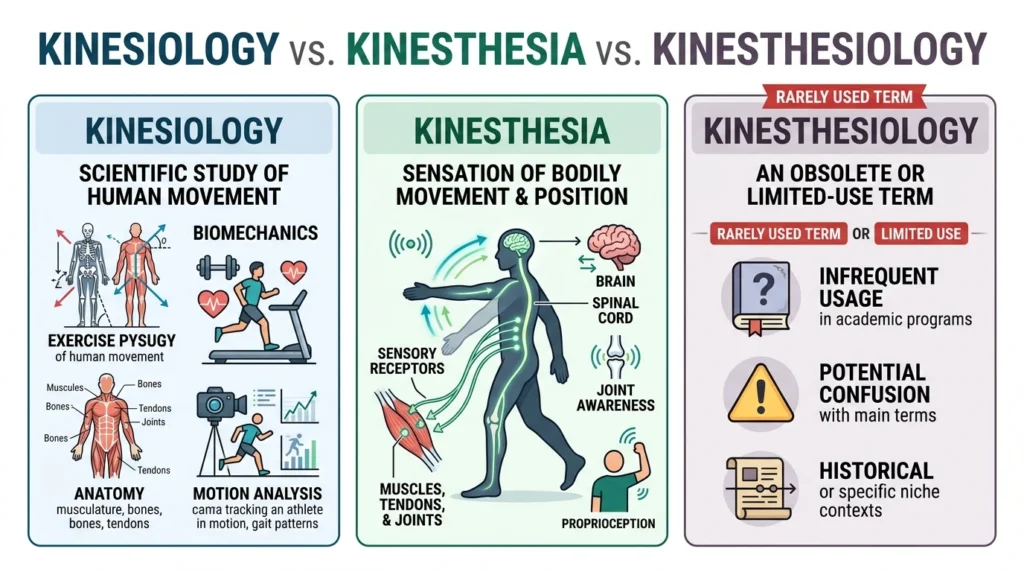
Kinesiology is the standard academic and scientific term for the study of human movement, physical activity, and related areas such as biomechanics, exercise physiology, motor behavior, and sport psychology. Kinesthesiology is a rare term that appears in some dictionaries and informal sources, but it is not the usual name for the established academic field. If you mean the sense of body movement, kinesthesia or proprioception is normally more accurate.
What Is Kinesiology?
Kinesiology is the scientific study of human movement and physical activity.
It examines how and why the body moves and how movement relates to health, performance, exercise, learning, and quality of life.
The field can draw on several disciplines, including:
- anatomy
- physiology
- biomechanics
- exercise physiology
- motor control
- motor learning
- sport and exercise psychology
- physical activity and health
Universities commonly use kinesiology in department names, degree programs, research programs, and professional descriptions. The American Kinesiology Association also identifies kinesiology as an academic discipline concerned with physical activity and its effects on health, society, and quality of life.
For example:
She is studying kinesiology because she wants to understand human movement and exercise.
That is normal, standard English.
What Is Kinesthesiology?
Kinesthesiology is a rare and inconsistently used term related to movement.
It does exist in some lexicographic sources. One recorded definition describes it as the medical and therapeutic study of the movement of muscles and joints. However, the word does not have the same established academic status or widespread professional use as kinesiology.
This is important because many online explanations make the distinction look much cleaner than real English usage supports.
You may see claims such as:
“Kinesiology studies movement, while kinesthesiology studies the perception of movement.”
That distinction sounds logical because kinesthesia refers to the sense of bodily movement. However, using kinesthesiology as the standard name for the scientific study of kinesthesia is not well established in mainstream academic terminology.
If you specifically mean the ability to sense movement or the position of your body, kinesthesia, kinesthetic sense, or sometimes proprioception will usually be clearer.
Why the Difference Matters
Using the wrong term can make otherwise accurate writing look unreliable.
This matters particularly in:
- university applications
- academic assignments
- research papers
- résumés and CVs
- professional biographies
- healthcare writing
- fitness and sports content
- course descriptions
Imagine writing:
I earned a Bachelor of Science in Kinesthesiology.
If the actual degree is called a Bachelor of Science in Kinesiology, changing its name can make the qualification appear inaccurate.
The same problem occurs when describing a university department. Schools routinely have departments or programs of kinesiology, exercise science, human performance, or related fields. Kinesthesiology is not the standard replacement for those names.
The Core Rule
Use kinesiology for the established academic study of human movement. Use kinesthesia when you mean the sense or perception of bodily movement. Treat kinesthesiology as a rare term rather than a normal synonym for either one.
That one rule solves most cases.
Read More: Emersion vs Immersion: Difference and Which One Is Correct?
Kinesthesiology vs Kinesiology Comparison Table
| Feature | Kinesiology | Kinesthesiology |
|---|---|---|
| Standard English term? | Yes | Rare |
| Established academic discipline? | Yes | Not commonly used as one |
| Common university degree name? | Yes | Rare to nonstandard |
| Main idea | Scientific study of human movement and physical activity | Rare term associated with movement or therapeutic study |
| Common in research? | Yes | Very uncommon |
| Common in professional writing? | Yes | Usually avoided unless specifically established by the source |
| Related to biomechanics? | Yes | Potentially, depending on intended meaning |
| Related to exercise science? | Yes | Not the standard term |
| Same as kinesthesia? | No | No |
| Safest term when unsure? | Kinesiology | Use only with a specific reason |
How to Use Kinesiology and Kinesthesiology Correctly
When choosing between the terms, follow this order:
- If you mean the scientific study of human movement, use kinesiology.
- If you mean a college major or university department, use kinesiology unless the institution officially uses another name.
- If you mean the sense of your body moving, use kinesthesia.
- If you mean the body’s awareness of its position or internal movement-related signals, proprioception may also be relevant.
- Use kinesthesiology only when a particular source, discipline, organization, or historical context specifically uses that word.
Use Kinesiology for Academic Study
Correct:
Jordan is majoring in kinesiology.
Correct:
The kinesiology department studies human movement and physical activity.
Correct:
Her research combines biomechanics and kinesiology.
Academic kinesiology is broad. It can include exercise science, motor behavior, biomechanics, sport psychology, physical education, and related areas.
Use Kinesthesia for the Sense of Movement
Kinesthesia refers to the sensation or awareness of bodily movement. It involves information associated with muscles, tendons, joints, movement, and tension.
For example:
Closing your eyes and still knowing that your arm is moving involves kinesthetic awareness.
Do not automatically replace kinesthesia with kinesthesiology.
They are not interchangeable forms of the same word.
What About Proprioception?
Proprioception overlaps with kinesthesia but is not simply another spelling of it.
The term refers broadly to internal sensory information that helps the body monitor itself, particularly information related to position and movement.
In everyday explanations, the distinction between proprioception and kinesthesia may be simplified. In technical writing, however, follow the terminology used by the relevant scientific field or source rather than creating a new distinction around kinesthesiology.
Correct Examples
Here are examples of kinesiology and related terms in natural contexts.
Conversation
1. “I’m thinking about studying kinesiology because I’m interested in exercise and human movement.”
University
2. “She changed her major from biology to kinesiology.”
Academic Writing
3. “The study examined human movement from a kinesiology perspective.”
Workplace
4. “His background in kinesiology helps him understand movement mechanics.”
5. “I am applying to the graduate kinesiology program next semester.”
Sports
6. “Kinesiology can help researchers analyze how athletes move during competition.”
Healthcare Education
7. “The course combines anatomy, physiology, biomechanics, and kinesiology.”
Research
8. “Her research focuses on motor control within the broader field of kinesiology.”
Social Media
9. “Three years of kinesiology classes completely changed how I think about exercise.”
Movement Perception
10. “Kinesthesia helps us perceive the movement of our limbs even when we are not watching them.”
Professional Biography
11. “Daniel holds a degree in kinesiology and works in exercise research.”
Classroom
12. “Today’s kinesiology lecture covered joint movement and muscle function.”
Incorrect vs Correct
The examples below assume you mean the established academic field or the sense of bodily movement.
| ❌ Incorrect | ✅ Correct | Why |
|---|---|---|
| I am majoring in kinesthesiology. | I am majoring in kinesiology. | Kinesiology is the standard name for the academic field and common degree programs. |
| She works in the kinesiology of body awareness. | She studies kinesthesia and body awareness. | When the focus is the sensation of movement, kinesthesia is clearer. |
| He earned a kinesiology sense after training. | He developed better kinesthetic awareness after training. | Kinesiology names a field of study, not a personal sensory ability. |
| The university has a kinesthesiology department. | The university has a kinesiology department. | Use the institution’s official title. Kinesiology is the standard academic label. |
| Kinesthesiology is another spelling of kinesiology. | Kinesthesiology is a rare related term, not simply the standard spelling of kinesiology. | Treating the words as spelling variants hides their different usage histories. |
| Kinesiology means your sense of where your limbs are. | Kinesthesia or proprioception describes awareness related to bodily movement and position. | Kinesiology is the study of movement, not the sensory experience itself. |
| My kinesthesia degree includes biomechanics. | My kinesiology degree includes biomechanics. | Kinesthesia is a sensory concept, not the usual degree name. |
| He is studying proprioception, so he is studying kinesthesiology. | He is studying proprioception and kinesthetic perception. | Kinesthesiology is not required as a label for research on proprioception. |
| She wants to become a kinesthesiologist after college. | She wants to work in kinesiology after college. | Kinesiologist is the established occupational term where that title is used. |
| The article discusses the kinesiology sense. | The article discusses the kinesthetic sense. | The adjective related to kinesthesia is kinesthetic. |
Why People Confuse Kinesthesiology and Kinesiology
Several things make this mistake unusually easy.
Phonetic Similarity
Both words begin with kine- and end with -ology.
When spoken quickly, the extra -sthesi- portion of kinesthesiology can be difficult to process. Someone who remembers the sound but not the spelling may blend kinesiology and kinesthesia together.
Spelling Overlap
Compare the three forms:
kinesiology
kinesthesia
kinesthesiology
The third looks as though it could logically mean “the study of kinesthesia.” That structure encourages people to assume it must be the official scientific term.
Language does not always develop according to the most predictable word-building pattern, however.
Confusion Between a Field and a Sense
This is probably the biggest source of confusion.
Kinesiology = a field concerned with human movement.
Kinesthesia = a sensory experience associated with bodily movement.
Because both involve movement, writers sometimes combine them into kinesthesiology.
Overgeneralization of “-ology”
The suffix -ology commonly means a field or branch of study.
That makes it tempting to reason:
kinesthesia + -ology = kinesthesiology
The resulting word is attested, but that does not make it the standard academic label for research into movement perception.
Autocomplete and Spellcheck Limits
Spellcheckers are useful for detecting impossible spellings. They are much less useful when two forms both occur somewhere in written English.
A word can be recognized by software and still be inappropriate for your context.
Read More: Grately vs Greatly: Difference, Meaning & Correct Usage
Translation Interference
People working across languages may encounter terms for movement science, physiotherapy, kinesthesia, or related specialties that do not map perfectly onto English terminology.
In that situation, translate the professional or academic concept, not merely the individual pieces of the original word.
Common Mistakes Checklist
Using Kinesthesiology as the Default Degree Name
Before writing the name of a qualification, check the university’s official wording.
If the diploma says Kinesiology, do not change it to Kinesthesiology.
Treating the Two Words as Equal Synonyms
They are not equally common alternatives.
Kinesiology is firmly established in academic and professional language. Kinesthesiology has much narrower and less consistent usage.
Assuming Kinesthesiology Must Mean the Study of Kinesthesia
The word’s structure makes that interpretation tempting, and some websites use it that way.
However, mainstream writing about the sensation of bodily movement normally uses terms such as kinesthesia, kinesthetic perception, or proprioception.
Confusing Kinesiology With Kinesthesia
Remember the difference between the field and the sense.
You can study kinesiology.
You can experience kinesthesia.
Calling Every Movement Professional a Kinesiologist
A kinesiology degree can lead toward many different careers, but professional titles, licensing rules, and qualification requirements vary by occupation and location.
A physical therapist, athletic trainer, exercise physiologist, and kinesiologist are not automatically the same profession.
Confusing Academic Kinesiology With Applied Kinesiology
Academic kinesiology is the scientific study of physical activity and human movement.
The term applied kinesiology is also used for a separate practice involving forms of manual muscle testing. The American Kinesiology Association specifically distinguishes the academic discipline from practices that use the kinesiology name in other ways.
Kinesthesiology vs Kinesiology in Real English
Grammatically and Terminologically Standard
“I study kinesiology at university.”
This is both grammatically correct and terminologically normal. A reader will understand that the speaker studies human movement or a related discipline. The same term naturally appears in phrases such as kinesiology department, kinesiology degree, kinesiology research, and kinesiology professor. These forms match widespread academic usage in English-speaking universities.
Possible but Unusual
“I study kinesthesiology.”
The sentence itself follows normal English grammar, and kinesthesiology is recorded in some lexical sources. The problem is usage, not sentence structure. Most readers in education, exercise science, sports science, and movement research will expect kinesiology. Unless the speaker’s program or source specifically uses kinesthesiology, the rarer term may create unnecessary uncertainty.
Natural Everyday English
In normal conversation, people usually say:
“I study kinesiology.”
If the subject is sensory awareness rather than a degree, they might say:
“I’m studying how people sense their own movement.”
A technical discussion could use kinesthesia, kinesthetic perception, or proprioception. Choosing the familiar established term is usually better than using a longer technical-looking word simply because it seems more scientific.
American vs British English
There is no important American-versus-British spelling difference for kinesiology. The standard form is kinesiology in both varieties.
There is, however, a genuine spelling difference in the related sensory term:
| American English | British English |
|---|---|
| kinesthesia | kinaesthesia |
| kinesthetic | kinaesthetic |
Major dictionaries recognize kinesthesia as the American spelling and kinaesthesia as the chiefly British form.
Do not change kinesiology to kinaesiology simply because you are writing in British English.
Formal vs Informal Usage
Formal Academic and Professional Writing
Use kinesiology when referring to the established field.
Examples:
Department of Kinesiology
Bachelor of Science in Kinesiology
kinesiology research
professor of kinesiology
When referring specifically to movement sensation, use the accepted technical term used by your field, such as kinesthesia, kinesthetic perception, or proprioception.
Informal Writing
You may encounter kinesthesiology in blogs, discussions, course descriptions, or casual speech.
Seeing the word does not prove that every occurrence is a simple spelling error. However, its rarity means it should not replace kinesiology automatically in polished academic or professional writing.
Read More:Encorporate vs Incorporate: Which Spelling Is Correct?
Kinesiology, Kinesthesia, and Proprioception Compared
| Term | Basic Meaning | Typical Context |
|---|---|---|
| Kinesiology | Scientific study of human movement and physical activity | University programs, research, sports science, exercise |
| Kinesthesia | Sensation or awareness of bodily movement | Neuroscience, psychology, motor control |
| Proprioception | Internal sensing related to body position and movement | Neuroscience, rehabilitation, motor control |
| Kinesthetic | Relating to the sense of movement | Kinesthetic feedback, kinesthetic awareness |
| Kinesiologist | Person trained in or working with kinesiology, where the title is used | Research, movement science, health and performance |
| Kinesthesiology | Rare term associated with movement study or therapeutic contexts | Limited and inconsistent usage |
Memory Trick
Think:
KINESIOLOGY = KINESIS + STUDY
The important part is kinesis, meaning movement.
So:
Kinesiology studies movement.
Then remember:
Kinesthesia = sensing movement.
A simple shortcut is:
Kinesiology studies it. Kinesthesia senses it.
You rarely need kinesthesiology to express either idea.
Real-Life Situations
Job Interview
Interviewer: What did you study in college?
Natural answer: “I studied kinesiology with a focus on exercise science.”
Using the official degree name sounds precise and professional.
University Application
Write:
“My interest in kinesiology developed through studying exercise physiology and biomechanics.”
Do not replace the program’s official name with kinesthesiology because it sounds more technical.
Workplace Meeting
“Our kinesiology team is analyzing the athlete’s movement patterns.”
Here, kinesiology clearly refers to the field.
Professional Email
“I am interested in learning more about your master’s program in kinesiology.”
Again, use the program’s actual name.
Text Message
“My kinesiology class was all biomechanics today.”
Perfectly natural in an informal conversation.
Research Paper
“The experiment investigated kinesthetic perception during controlled limb movement.”
Here the topic is the perception of movement, so a term based on kinesthesia is more precise.
Exam
Question:
What field studies human movement and physical activity?
Answer:
Kinesiology.

Expert Tips
Check Official Names Before Correcting Someone
If a person gives you the title of a degree, organization, course, or job, verify its official name before changing the terminology.
An unusual title can sometimes be intentional.
Do Not Trust Word Structure Alone
English contains many words that appear as though they should have predictable meanings but developed differently in actual usage.
A logically constructed term is not automatically a standard technical term.
Separate “Movement” From “Sensing Movement”
Ask yourself one question:
Am I talking about studying movement or sensing movement?
If you mean studying movement, think kinesiology.
If you mean sensing movement, think kinesthesia, kinesthetic perception, or proprioception depending on the exact context.
Use the Terminology of the Discipline
In scientific and academic writing, terminology is partly determined by established professional usage.
If researchers in your field consistently use motor control, proprioception, or kinesthetic perception, do not replace those established terms with kinesthesiology just because the alternative sounds technically plausible.
Preserve Degree and Department Names Exactly
Do not “correct”:
BS in Kinesiology
to:
BS in Kinesthesiology
unless the institution itself uses the second title.
Accuracy matters more than stylistic preference.
Remember That Kinesiology Is Broader Than Exercise Alone
Kinesiology is often associated with fitness, but the academic field can include biomechanics, motor behavior, psychology, physical education, health, and other dimensions of physical activity.
Read More: Encode vs Incode: Which Is Correct and When Should You Use Each?
FAQ
Is Kinesthesiology a Real Word?
Kinesthesiology is an attested but rare English word. Some lexical sources record it, including a definition connected with the medical or therapeutic study of muscle and joint movement. However, it is not nearly as established in academic and professional usage as kinesiology.
Is Kinesthesiology Just a Misspelling of Kinesiology?
Not always.
Because kinesthesiology has been recorded as a word, calling every occurrence a spelling mistake would be too strong.
However, when someone intends to name the established scientific field, university major, or academic department concerned with human movement, kinesiology is normally the correct term.
Which Is Correct: Kinesiology or Kinesthesiology?
For the scientific and academic study of human movement, kinesiology is the standard choice.
Use kinesthesiology only when you have a specific source or context that intentionally uses that rare term.
Is Kinesthesiology a College Major?
Kinesiology is the standard degree and program name used by many universities.
Programs may also be called exercise science, human movement, human performance, or related names. Always check the institution’s official program title rather than assuming kinesthesiology is interchangeable with kinesiology.
What Does a Kinesiologist Study?
A kinesiologist studies human movement and physical activity. Depending on the specialization, this may include anatomy, biomechanics, exercise physiology, motor learning, motor control, sport psychology, health, or physical performance.
Is Kinesiology the Same as Exercise Science?
Not necessarily.
The terms sometimes overlap in university programs, but kinesiology can be broader. Exercise science commonly focuses more specifically on exercise, physiological responses, physical performance, and training.
The exact relationship depends on how an institution organizes its programs.
Is Kinesiology the Same as Physical Therapy?
No.
Kinesiology is an academic field centered on human movement and physical activity. Physical therapy is a healthcare profession with specific professional education and licensing requirements.
A kinesiology degree can provide preparation for later professional study in physical therapy, but the two terms are not interchangeable.
What Is the Difference Between Kinesthesia and Kinesiology?
Kinesthesia is the sense or awareness associated with bodily movement.
Kinesiology is the scientific study of human movement and physical activity.
A simple distinction is:
Kinesthesia is something you experience. Kinesiology is something you study.
What Is the Difference Between Kinesthesia and Proprioception?
The concepts overlap.
Kinesthesia is particularly associated with sensing bodily movement, while proprioception broadly concerns internally generated information about the body’s position and movement.
Definitions and boundaries can vary somewhat across scientific contexts, so technical writers should follow the terminology used in their specific field.
Is Kinesiologist the Correct Professional Term?
Kinesiologist is an established word for someone associated professionally with kinesiology. However, what a kinesiologist is legally allowed to do can depend on the country, region, employer, qualifications, and professional regulations.
Do not assume the title means exactly the same thing everywhere.
How Do You Spell Kinesiology?
The standard spelling is:
K-I-N-E-S-I-O-L-O-G-Y
A useful way to divide it is:
kinesi + ology
Avoid common variations created by blending it with kinesthesia.
Is Applied Kinesiology the Same as Academic Kinesiology?
No.
Academic kinesiology is the scientific study of human movement and physical activity. Applied kinesiology is also used as the name of a separate practice involving particular forms of muscle testing.
The similarity of the names should not be taken to mean that the two are the same discipline.
Mini Quiz
| # | Question | Answer | Explanation |
|---|---|---|---|
| 1 | Fill in the blank: Maya is earning a degree in ________. | kinesiology | Kinesiology is the standard academic field and degree term. |
| 2 | Which word refers to the sense of bodily movement: kinesiology or kinesthesia? | kinesthesia | Kinesthesia refers to sensory awareness associated with movement. |
| 3 | Correct the sentence: “The university opened a new kinesthesiology department.” | The university opened a new kinesiology department. | Use kinesiology when referring to the standard academic discipline, assuming that is the department’s official name. |
| 4 | True or false: Kinesthesiology and kinesiology are simply American and British spellings of the same word. | False | Kinesiology is standard in both varieties. |
| 5 | Which is more natural: “I study kinesiology” or “I study kinesthesiology”? | I study kinesiology. | Kinesiology is the established academic term. |
| 6 | Fill in the blank: ________ helps describe awareness of bodily movement. | Kinesthesia | Kinesthesia concerns movement sensation rather than the general academic field. |
| 7 | Which term is broader in academic use: kinesiology or kinesthesia? | Kinesiology | Kinesiology covers the study of human movement and physical activity across multiple subfields. |
| 8 | Correct the sentence: “My kinesthesia major includes exercise physiology.” | My kinesiology major includes exercise physiology. | Kinesthesia is not the normal name of the degree. |
| 9 | Is every appearance of “kinesthesiology” necessarily a typo? | No. | The word is attested, but its usage is rare and much less standardized. |
| 10 | Which phrase is safest in a résumé: “degree in kinesiology” or “degree in kinesthesiology,” when the diploma says Kinesiology? | degree in kinesiology | Qualifications should be written using their official names. |
Quick Summary
Kinesiology is the standard scientific and academic term for the study of human movement and physical activity. It is widely used for university departments, degrees, research, and professional work involving areas such as biomechanics, exercise physiology, motor behavior, and sport psychology. Kinesthesiology is an attested but rare term whose meaning and usage are less consistent, so it should not automatically replace kinesiology. If you mean the body’s ability to sense its own movement, kinesthesia is usually the clearer term, while proprioception is also important in discussions of body position and movement. The easiest rule to remember is: kinesiology studies movement; kinesthesia senses movement.