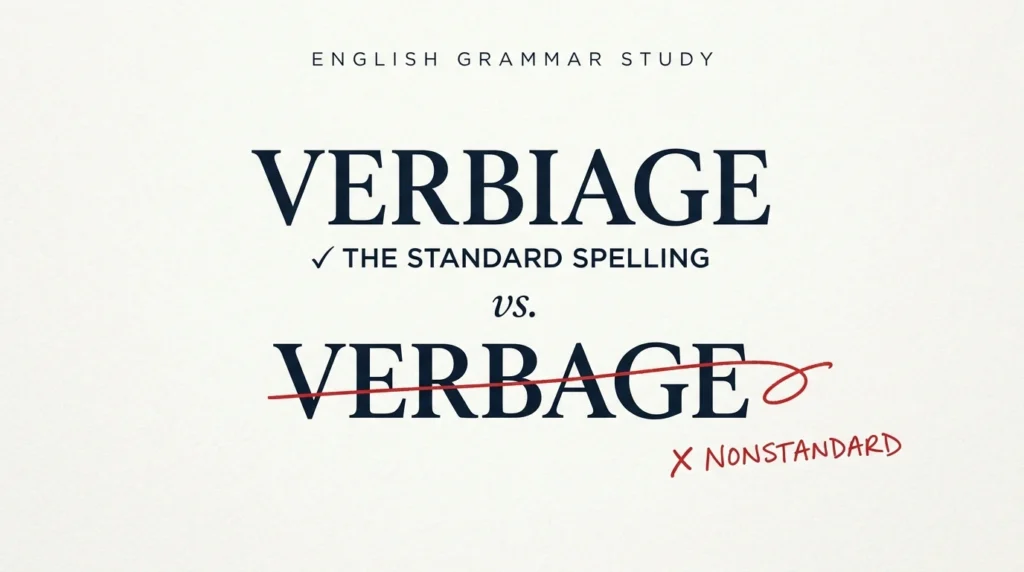

If you are choosing between verbiage and verbage, use verbiage. It is the standard spelling in modern English. Verbiage is a noun that can mean the wording used in a document or conversation, or an excessive amount of complicated or unnecessary language. Verbage is generally considered a nonstandard spelling when used with the same intended meaning. Whether you are writing an email, reviewing a contract, preparing an essay, or editing website content, verbiage is the safer choice.
What Is Verbiage vs Verbage?
The difference between verbiage and verbage is primarily a matter of spelling and standard usage, not two distinct meanings.
Verbiage is the established English word. It describes the words used to express an idea and often refers to language that is unnecessarily long, complicated, or difficult to understand.
Verbage is a nonstandard form commonly used when someone intends to write verbiage. Although readers may understand it, it is not the recommended spelling in edited English.
Consider these examples:
- Correct: The contract contains complicated legal verbiage.
- Incorrect in standard usage: The contract contains complicated legal verbage.
The first sentence uses the established spelling. The second contains a spelling error in standard edited English.
Why It Matters
Choosing the correct spelling helps your writing look accurate and professional. This matters when the words you use represent your expertise, attention to detail, or understanding of a subject.
For example, imagine sending a client an email that says, “We need to update the contract verbage.” Your client will probably understand your meaning, but the nonstandard spelling may distract from the message.
The same issue can arise in:
- Business proposals and client emails.
- Academic assignments and research papers.
- Contracts, policies, and formal documents.
- Website content and marketing campaigns.
- Reports, presentations, and professional correspondence.
There is another important point: spelling verbiage correctly does not automatically make your writing clear. The word itself can refer to unnecessarily complicated language. Good writing requires both accurate spelling and effective communication.
The Core Rule
The rule to remember
- Verbiage = the standard spelling.
- Verbage = a nonstandard spelling when intended to mean verbiage.
- Wording = often the simpler alternative in everyday communication.
Example: “Please simplify the verbiage in this policy.”
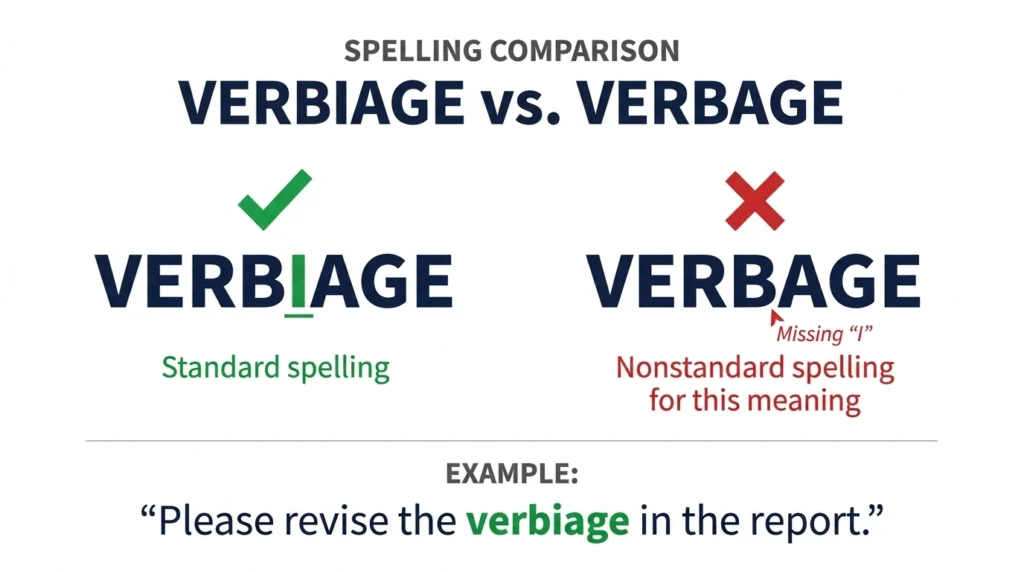
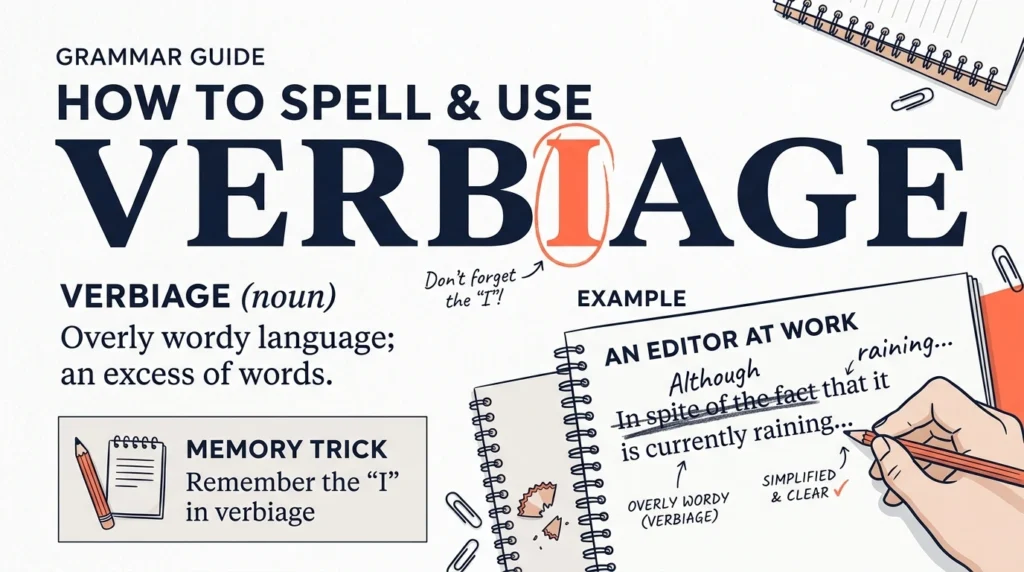
Remember the i after the b in verbiage. Do not omit it when writing the standard word.
How to Use Verbiage Correctly
Verbiage is a noun, meaning it names something rather than describing an action. Its meaning depends on the context.
When Verbiage Means Wording
In professional communication, verbiage can refer neutrally to the words used in a document, statement, or message.
Examples:
- The lawyer reviewed the verbiage in the agreement.
- We need to change the verbiage on the registration page.
- The manager approved the revised verbiage in the announcement.
In these sentences, the word refers to the language used. It does not necessarily mean the wording is excessive or bad.
However, wording is often more direct and natural when you simply mean how something is expressed.
Read More: Speach vs Speech: Which Spelling Is Correct?
When Verbiage Means Excessive Language
Verbiage can also have a negative meaning. It may suggest that someone has used too many words or made a simple idea unnecessarily complicated.
Examples:
- The report contains excessive verbiage.
- The speaker lost the audience with unnecessary verbiage.
- The editor removed the verbiage that obscured the main point.
Here, the word criticizes the writing or speech for being too wordy.
When You Should Avoid Verbiage
Avoid using verbiage simply to make ordinary writing sound more sophisticated. If wording, language, or text expresses your meaning more clearly, choose the simpler term.
For instance:
- Less direct: Please review the verbiage of this short message.
- More direct: Please review the wording of this short message.
Both sentences are understandable, but the second is usually more natural for a routine request.
Correct Examples of Verbiage in Sentences
These original examples show how to use verbiage in different situations.
- Conversation: “The idea is good, but the verbiage makes it difficult to follow.”
- Business email: “Could you review the verbiage in the proposal before I send it?”
- School assignment: “My teacher advised me to remove unnecessary verbiage from my essay.”
- Workplace meeting: “The team agreed that the verbiage in the new policy needed simplifying.”
- Social media: “The announcement would be stronger with less verbiage.”
- Academic writing: “The researcher examined the verbiage used in the public statement.”
- Legal document: “The attorney suggested revising the verbiage of the disputed clause.”
- Marketing: “The updated verbiage makes the product’s benefits easier to understand.”
- Website editing: “We changed the verbiage on the checkout page to reduce confusion.”
- Customer service: “Please make the verbiage in the refund policy easier for customers to understand.”
- Job interview: “I try to avoid unnecessary verbiage when explaining complex ideas.”
- Presentation: “The slides contain too much verbiage and not enough useful information.”
Notice that some examples use verbiage neutrally, while others criticize excessive wording. Context determines which meaning is intended.
Incorrect vs Correct: Verbiage or Verbage?
The following table highlights common errors and shows how to correct them.
| ❌ Incorrect | ✅ Correct | Why |
|---|---|---|
| Please fix the verbage. | Please fix the verbiage. | The standard spelling includes an i after b. |
| The contract verbage is confusing. | The contract verbiage is confusing. | Use the established spelling in formal documents. |
| Remove the extra verbage. | Remove the extra verbiage. | Verbage is nonstandard in this intended sense. |
| I dislike the verbage in this email. | I dislike the verbiage in this email. | The correct form is verbiage. |
| The policy has too much verbage. | The policy has too much verbiage. | The standard spelling contains the middle i. |
| We revised the website verbage. | We revised the website verbiage. | Use verbiage when referring to wording. |
| The report’s verbage needs work. | The report’s verbiage needs work. | The nonstandard form should be replaced. |
| Please simplify this verbage. | Please simplify this verbiage. | The corrected form is standard English. |
| The speech was full of verbage. | The speech was full of verbiage. | Verbiage can describe excessive language. |
| Check the verbage before publishing. | Check the verbiage before publishing. | Use the established spelling in edited content. |
| The lawyer changed the verbage. | The lawyer changed the verbiage. | Verbiage can refer to the wording of a legal document. |
| This verbage sounds too formal. | This wording sounds too formal. | Wording is a clear, natural alternative here. |
The last example is different from the others: verbiage is correctly spelled, but wording may be the better choice for natural, straightforward communication.
Why People Make This Mistake
The confusion between verbiage and verbage is understandable. The words look similar, and the correct spelling may not be obvious from pronunciation alone.
1. The Missing Letter Is Easy to Overlook
The difference is only one letter. When reading quickly, people may fail to notice the i in verbiage.
How to avoid it: Check the spelling whenever you use the word in important writing.
2. The Word Begins With “Verb”
English speakers recognize verb and verbal, so verbage may look like a logical spelling. However, familiar word patterns do not always reveal the correct spelling of another word.
How to avoid it: Learn verbiage as a complete word rather than constructing its spelling from verb.
3. Pronunciation Can Be Misleading
When spoken quickly, the middle part of verbiage may not sound distinct enough to remind a listener that an i belongs in the spelling.
How to avoid it: Use the written form as your guide instead of relying entirely on what you hear.
4. Spellcheck Does Not Replace Proofreading
Spellcheckers can miss errors, especially when a nonstandard form appears in a particular dictionary or context. Autocorrect may also fail to catch every mistake.
How to avoid it: Search your document for verbage and review each occurrence.
5. Translation Can Affect Spelling
English learners may mentally translate a word from another language or spell it according to a familiar pronunciation pattern. This can encourage plausible but nonstandard spellings.
How to avoid it: Keep a personal list of confusing English words and learn their standard spellings with example sentences.
Common Mistakes Checklist
Use this checklist whenever you are writing or editing the word.
- Leaving out the i: Writing verbage instead of verbiage. Check the middle of the word.
- Assuming both forms are equally standard: Similar appearance does not mean equal acceptance. Use verbiage in edited writing.
- Assuming verbiage always means bad writing: It can refer neutrally to wording, although it often suggests excessive language.
- Using verbiage when wording is clearer: Choose wording for ordinary requests about how something is phrased.
- Confusing verbiage with verbosity: Verbiage refers to wording or language, while verbosity specifically emphasizes excessive use of words.
- Using more words than necessary: Correct spelling does not guarantee clear writing. Remove unnecessary words while preserving important meaning.
- Trusting autocorrect completely: Proofread important documents manually.
Verbiage in Real English
Grammatically Correct
Verbiage is a standard noun, so sentences such as “The verbiage in this agreement is unclear” are grammatically correct. It can function as the subject or object of a sentence, and it can be modified by words such as legal, technical, excessive, or unnecessary. The spelling verbage, when intended as the same word, is not the standard choice in edited English.
Grammatically Possible but Unnatural
A sentence such as “Please send me the verbiage for the little birthday text” is grammatically possible. However, it may sound unnecessarily formal for an ordinary conversation. The sentence “Please send me the wording for the birthday text” is more straightforward. The issue is not grammar or spelling; it is whether the chosen word fits the situation and audience.
Natural, Everyday English
In everyday English, people often use wording instead of verbiage when discussing a sentence, message, or short document. For example, “I don’t like the wording of this email” sounds direct and conversational. Verbiage is especially useful when discussing formal documents, technical language, or excessive wording. Choose it when it communicates the intended meaning clearly, not simply because it sounds more sophisticated.
American vs British English
There is no standard American-versus-British spelling distinction between verbiage and verbage. The established spelling is verbiage in both varieties of English.
There is, however, a difference worth knowing about usage. The neutral sense of verbiage, meaning the wording of a document or message, is particularly common in American English. In other contexts, the word often suggests excessive or unnecessarily complicated language.
Examples:
- American business context: “Please update the verbiage in the customer agreement.”
- British business context: “Please revise the wording of the customer agreement.”
Both sentences are understandable. The second uses a simpler alternative; it does not represent a mandatory British spelling rule.
Formal vs Informal Usage
The choice depends on your audience, the document, and the meaning you want to convey.
| Situation | Recommended usage | Example |
|---|---|---|
| Academic writing | Verbiage, when appropriate | The article contains unnecessary verbiage. |
| Legal documents | Verbiage or wording | The lawyer revised the wording of the clause. |
| Business communication | Verbiage or wording | Please approve the revised verbiage. |
| Everyday conversation | Usually wording | I don’t like the wording of that message. |
| Editing and proofreading | Verbiage for excessive language | The editor removed redundant verbiage. |
| Informal digital writing | Standard spelling remains preferable | The verbiage needs simplifying. |
You do not need to avoid verbiage in formal writing. You simply need to use it accurately. In many cases, wording is easier to understand and sounds less formal.
Comparison Table: Verbiage, Verbage, Wording, and Verbosity
These four terms are related to language, but they do not serve exactly the same purpose.
| Feature | Verbiage | Verbage | Wording | Verbosity |
|---|---|---|---|---|
| Standard status | Standard English | Nonstandard for the intended meaning | Standard English | Standard English |
| Part of speech | Noun | Nonstandard form | Noun | Noun |
| Main meaning | Wording or excessive language | Usually intended as verbiage | The way something is phrased | Excessive use of words |
| Can be neutral? | Yes | Not recommended | Yes | Usually critical |
| Common context | Documents, language, writing | Usually a spelling error | Everyday and professional communication | Criticism of wordiness |
| Example | The verbiage is unclear. | Avoid this spelling. | The wording is unclear. | The speech suffers from verbosity. |
Verbiage vs Wording
Verbiage can sound more formal and may suggest a large amount of language. Wording is a more direct term for the specific words used to express something.
- Verbiage: “The legal verbiage is difficult to understand.”
- Wording: “The wording of the legal clause is difficult to understand.”
Both are correct, but the second is often more accessible to a general audience.
Verbiage vs Verbosity
These words overlap, but they are not interchangeable in every sentence.
Verbiage refers to the language or wording itself and can be neutral. Verbosity describes the quality of using too many words.
- “The verbiage in the policy is unclear.” This focuses on the language used.
- “The report’s verbosity frustrated the readers.” This focuses on excessive length.
Verbiage vs Vocabulary
Vocabulary refers to the words a person knows or uses, or the collection of words associated with a subject.
- “Her technical vocabulary is impressive.”
- “The technical verbiage in the manual is difficult to understand.”
The first sentence concerns knowledge and choice of words. The second concerns the wording in a particular text.
Memory Trick
Here is a simple way to remember the standard spelling:
Remember the i in verbiage.
Write it as:
V E R B I A G E
Not:
V E R B A G E
When proofreading, pause after writing verb- and check that the i is present before the ending -age.
A second memory aid is to associate verbiage with language. Both relate to the words people use to express ideas. This is a spelling reminder, not a claim about the words having the same origin.
Real-Life Situations
Situation 1: A Job Interview
An interviewer asks how you make complicated information easier to understand.
A strong answer might be:
“I remove unnecessary verbiage and explain the main idea in simple language.”
This uses verbiage to mean excessive wording.
Situation 2: A Client Email
You need a colleague to review a proposal before it reaches a customer.
Write:
“Please review the verbiage in the proposal and let me know whether any changes are needed.”
This is an appropriate professional use of the word.
Situation 3: A School Examination
A student writes verbage in an English assignment.
The standard correction is verbiage. The issue is spelling, not a difference in meaning between two standard words.
Situation 4: A Team Meeting
Your manager says the new instructions are too complicated.
You could respond:
“I agree. We can remove unnecessary verbiage without losing any essential details.”
This demonstrates an understanding of both the word and its negative sense.
Situation 5: A Text Message
A friend asks you to review a short message.
You might say:
“The wording sounds a little harsh. Let’s make it friendlier.”
Here, wording is more natural than verbiage because the conversation is informal and the message is short.
Read More: Honor vs Honour: The Spelling Difference Explained.
Expert Tips for Better Usage
1. Choose Precision Over Sophistication
Do not choose verbiage just because it sounds professional. Choose it when it communicates the meaning you intend. In ordinary writing, wording may be clearer.
2. Understand the Context Before Interpreting the Word
If a colleague says, “I like the verbiage in this policy,” they may simply mean they like how it is written. If they say, “This report contains too much verbiage,” they are criticizing its excessive wording.
3. Do Not Confuse Length With Poor Quality
Long writing is not automatically bad writing. Contracts, scientific explanations, and technical manuals sometimes need detail. The problem arises when words make an idea harder to understand without adding useful information.
4. Avoid Redundancy
Redundancy means repeating information unnecessarily. Phrases such as “unnecessary verbiage” can be appropriate, but “excessive verbiage” may be repetitive in a sentence that already makes the excess clear.
For example:
- Wordy: The report contains an excessive amount of unnecessary verbiage.
- Clearer: The report is unnecessarily wordy.
5. Use a Find-and-Replace Check Carefully
Before publishing an article or sending an important document, search for verbage. If you intended the standard word, correct it to verbiage. Review the sentence afterward to make sure wording or another simpler alternative would not be better.
6. Separate Spelling From Style
A correctly spelled word can still be a poor stylistic choice. Conversely, a sentence can be understandable even when it contains a spelling mistake. Good editing checks spelling, grammar, meaning, tone, and clarity separately.
Quick Summary
Verbiage is the standard English spelling, while verbage is generally considered nonstandard when used to mean the same thing. Verbiage is a noun that can refer to the wording of a document or message, or to an excessive amount of complicated or unnecessary language. Its meaning depends on context: it can be neutral when describing wording and negative when criticizing wordiness. The same spelling applies in American and British English. Although verbiage is appropriate in professional, academic, and formal writing, wording is often simpler and more natural in everyday communication. Remember the i after the b, and focus on choosing language that communicates your meaning clearly.
Frequently Asked Questions
Is verbiage or verbage correct?
Verbiage is the standard spelling. Verbage is generally considered nonstandard when intended to mean the same thing. Use verbiage in professional, academic, and edited writing.
Is verbage ever accepted in English?
The form verbage appears in informal writing and speech, but it is not the recommended standard spelling for this meaning. Readers may understand it, yet verbiage is the safer choice when accuracy matters.
What does verbiage mean in simple words?
Verbiage means the words used to express something. It can also mean too many words or unnecessarily complicated language. For example, “The report contains too much verbiage” means the report is too wordy.
Is verbiage always a negative word?
No. It can be neutral when referring to the wording of a document, policy, or message. It can be negative when describing language that is unnecessarily long, complicated, or difficult to understand.
What is the difference between verbiage and verbosity?
Verbiage refers to wording or language and can be neutral or negative. Verbosity specifically describes the excessive use of words. For example, a document can contain complicated verbiage, while a speaker can be criticized for verbosity.
Is wording a better alternative to verbiage?
Often, yes. Wording is usually clearer when discussing how a sentence, email, or message is phrased. Verbiage can sound more formal and may suggest excessive language, depending on the context.
How do you pronounce verbiage?
Verbiage is commonly pronounced VER-bee-ij, with the stress on the first syllable. Pronunciation can vary slightly among speakers. Remember that the standard spelling contains an i after the b.
Can I use verbiage in a business email?
Yes. You can write, “Please review the verbiage in the proposal.” The word is suitable for professional communication, although “Please review the wording in the proposal” may sound more direct.
Is verbiage a noun or a verb?
Verbiage is a noun. It names the wording or language being discussed. You can write, “The verbiage needs revision,” but you cannot use verbiage as a standard verb meaning to revise or simplify language.
Is verbiage the same in American and British English?
The standard spelling is the same in both varieties. The neutral meaning of verbiage, referring to wording, is particularly common in American English. In either variety, wording remains a useful alternative.
How can I remember the spelling of verbiage?
Remember the i after the b: V-E-R-B-I-A-G-E. When proofreading, look for verbage and correct it if you intended the standard word verbiage.
Mini Quiz: Verbiage vs Verbage
Test your understanding with these 10 questions. Each answer includes an explanation.
| No. | Question | Answer | Explanation |
|---|---|---|---|
| 1 | Choose the standard spelling: (A) Verbage (B) Verbiage | B — Verbiage | The established standard spelling contains an i after the b. |
| 2 | The lawyer revised the contract ___. (A) verbage (B) verbiage | B — verbiage | Verbiage can refer to the wording used in a contract. |
| 3 | True or false: Verbiage always means unnecessary words. | False | It can also refer neutrally to wording or language. |
| 4 | Correct this sentence: “The report contains too much verbage.” | The report contains too much verbiage. | The standard spelling is verbiage. |
| 5 | Which word is usually simpler for an everyday email: verbiage or wording? | Wording | It communicates the idea directly without sounding overly formal. |
| 6 | Fill in the blank: The editor removed unnecessary ___ from the article. | Verbiage | Here, the word refers to excessive or unnecessary language. |
| 7 | True or false: American and British English use different standard spellings of verbiage. | False | The spelling is the same in both varieties. |
| 8 | Which word specifically describes excessive use of words: verbiage or verbosity? | Verbosity | Verbosity focuses on the excessive use of words. |
| 9 | Correct this sentence: “Please simplify the verbage on our website.” | Please simplify the verbiage on our website. | Replace the nonstandard spelling with the standard form. |
| 10 | Choose the more natural everyday sentence: (A) I dislike the verbiage of this text. (B) I dislike the wording of this text. | B — The wording of this text. | Wording is generally more direct when discussing a short, everyday message. |
Score guide
- 9–10 correct: Excellent. You understand the spelling and usage.
- 7–8 correct: Good work. Review the differences between verbiage, wording, and verbosity.
- 5–6 correct: Revisit the core rule and comparison table.
- 0–4 correct: Start with the memory trick and practise the examples again.