
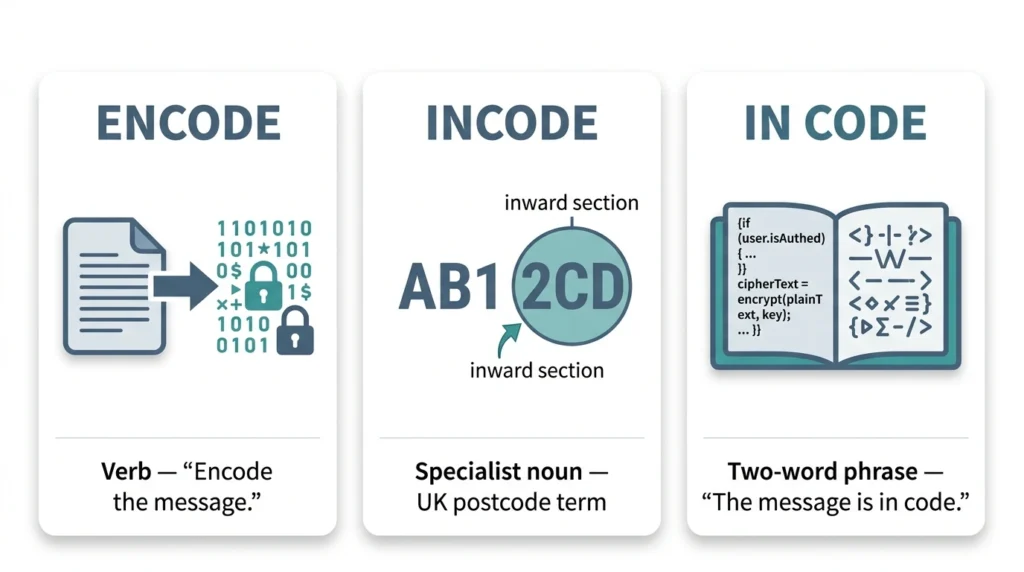

Encode is the correct English verb when you mean to convert, represent, or express information in a particular coded form. Incode is not an alternative spelling of encode. However, incode does have a legitimate specialist meaning in UK postal terminology: it is the final three characters of a postcode, also called the inward code.
For most everyday, academic, workplace, and computing sentences, the rule is simple:
- ✅ encode the data
- ✅ encode the message
- ✅ encode the video
- ❌ incode the data
- ❌ incode the message
- ❌ incode the video
What Is Encode vs Incode?
Encode is a verb. It means to represent information in another form or system, often so that the information can be stored, transmitted, processed, or interpreted. Dictionaries also recognize specialized uses in areas such as language and communication.
Examples include:
- encoding text in UTF-8
- encoding a video for streaming
- encoding information into a signal
- encoding meaning through language
- genes encoding biological information
Incode, by contrast, is not the standard verb for this action.
Writing:
The application will incode the data.
is incorrect in normal English.
You should write:
The application will encode the data.
There is one important exception. In British postcode terminology, incode is a noun meaning the inward part of a postcode. For example, in NW6 4DP, the incode is 4DP. Official UK mapping documentation identifies an incode as the final three characters containing the postcode sector and postcode unit.
That means the real distinction is more precise than simply saying “incode is not a word.”
Why the Difference Matters
Using incode when you mean encode can make otherwise professional writing look careless.
The mistake is especially noticeable in:
- software documentation
- technical reports
- university assignments
- job applications
- business emails
- programming tutorials
- cybersecurity discussions
- data-processing instructions
Imagine writing in a developer guide:
The function incodes the user input before transmission.
A technical reader is likely to notice the spelling immediately. The expected verb is encodes.
Accuracy becomes even more important when similar terms such as encode, encrypt, decode, code, and in code appear in the same document. Each can describe something different.
Read More: Encorporate vs Incorporate: Which Spelling Is Correct?
The Core Rule
Rule: Use encode as the verb. Use incode only when it has a specific established noun or proper-name meaning, such as the inward portion of a UK postcode.
An easy decision process is:
- Ask whether you mean convert or represent information in another form.
- If yes, use encode.
- Ask whether you specifically mean the last three characters of a UK postcode.
- If yes, incode can be correct as a noun.
- If you mean something is written using programming or symbolic language, you may actually need the two-word phrase in code.
How to Use Encode Correctly
Encode as a Verb
Encode normally describes an action performed on information, data, signals, messages, media, or other forms of content.
A simple grammatical pattern is:
subject + encode + object
For example:
The software encodes the file.
Here, software is performing the action and file is the object receiving that action.
Other common forms include:
- encode — base form
- encodes — third-person singular
- encoded — past tense and past participle
- encoding — present participle or gerund
- encoder — a person, device, or software component that performs encoding
Encode Something in a Format
Use encode in when naming the format, system, or representation used.
The document is encoded in UTF-8.
The characters were encoded in Unicode.
This construction is especially natural in computing.
Encode Something as Something
Use encode as when describing the resulting representation.
The application encodes the image as Base64 data.
The value is encoded as a sequence of bytes.
Encode Something Into Another Form
Encode into can emphasize transformation.
The device encodes the signal into digital information.
This construction is grammatical, although in or as may sometimes sound more precise when you are naming a particular encoding or representation.
When Is Incode Correct?
Incode has a genuine but narrow use in UK postal terminology.
A UK postcode contains an outward portion and an inward portion. The latter is also called the incode. It consists of the final three characters after the space and represents the postcode sector and unit.
For example:
NW6 4DP
- Outcode: NW6
- Incode: 4DP
Therefore, this sentence is correct:
The incode in NW6 4DP is 4DP.
But this is not evidence that incode can replace the verb encode.
These sentences remain incorrect:
The program will incode the file.
Please incode this video.
The server incoded the response.
The correct verb in all three cases is encode.
Incode can also appear as a proper name, including company, product, project, or software names. Proper names follow the spelling chosen by their owners and do not establish incode as an alternative form of the English verb encode. For example, Incode is currently used as the name of an identity-verification technology company.
Correct Examples of Encode
Conversation
1. Can you encode this video before you send it to me?
2. My phone automatically encodes the recording before uploading it.
3. Please encode the exported file using the required character format.
4. We encoded the attachment successfully, so it should now open correctly.
School
5. The students learned how computers encode letters as numerical values.
6. The assignment explains how a message can be encoded and later decoded.
Workplace
7. Our application encodes incoming data before sending it to the next service.
8. The engineering team changed how the system encodes special characters.
Social Media
9. The platform encodes uploaded videos into formats suitable for streaming.
Academic Writing
10. Human language can encode complex relationships between ideas.
11. Researchers examined how information is encoded during memory formation.
Computing
12. The browser correctly decoded the text because it had been encoded in UTF-8.
Incorrect vs Correct Usage
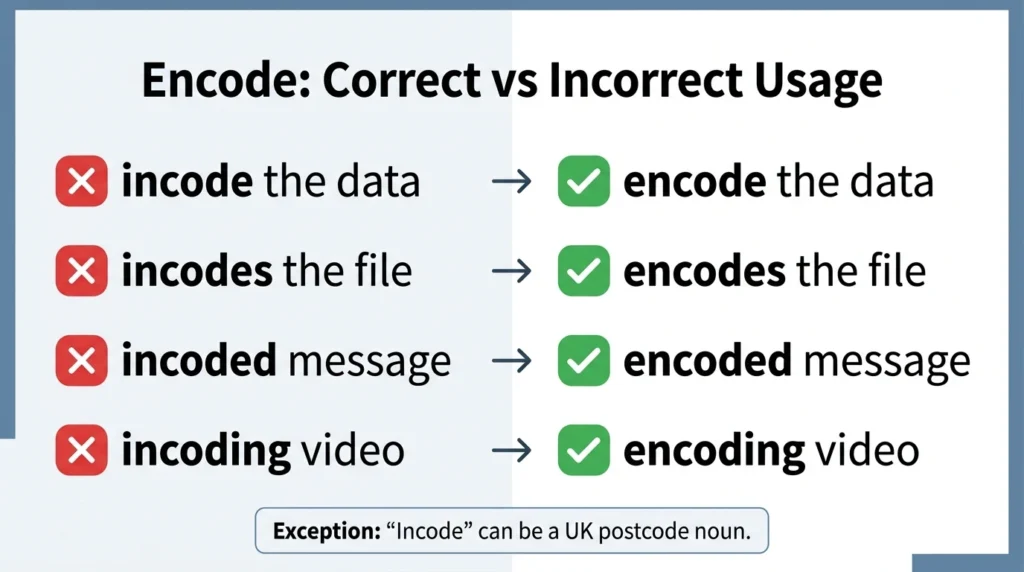
| ❌ Incorrect | ✅ Correct | Why |
|---|---|---|
| Please incode the file before uploading it. | Please encode the file before uploading it. | Encode is the standard verb for converting or representing data in another form. |
| The program incodes every image automatically. | The program encodes every image automatically. | The third-person form of encode is encodes, not incodes. |
| We incoded the video yesterday. | We encoded the video yesterday. | The past tense is encoded. |
| The server is incoding the response. | The server is encoding the response. | The present participle is encoding. |
| The message was incoded before transmission. | The message was encoded before transmission. | Standard English uses the passive form was encoded. |
| This tool can incode text as Base64. | This tool can encode text as Base64. | The action of producing an encoded representation requires encode. |
| The browser incodes characters in UTF-8. | The browser encodes characters in UTF-8. | Character encoding uses the verb encode. |
| We need to incode the signal digitally. | We need to encode the signal digitally. | Converting a signal to a coded representation is encoding. |
| The gene incodes a particular protein. | The gene encodes a particular protein. | Encode is the established verb in this biological sense. |
| The application incoded the user input. | The application encoded the user input. | Incoded is not the standard past-tense form of encode. |
| The incode of NW6 4DP is 4DP. | The incode of NW6 4DP is 4DP. | This one is already correct because incode is being used as the UK postcode noun. |
| The instructions are incode. | The instructions are in code. | If you mean “written using code,” in code is a two-word prepositional phrase. |
Why People Confuse Encode and Incode
They Sound Almost Identical
The first syllable of encode is commonly pronounced with a vowel similar to the sound in in. Cambridge lists pronunciations beginning with /ɪn-/ in both British and American English. As a result, hearing the word does not clearly reveal whether its written form begins with en- or in-.
Someone who has heard encode many times but has rarely seen it written may naturally guess incode.
English Contains Many Words Beginning With In-
Words such as include, insert, input, inside, and inspect make in- feel familiar.
A learner may therefore reason:
in + code = incode
But English word formation does not always follow the spelling that seems most intuitive.
The verb uses en-.
The Prefix En- Can Sound Like In-
The prefix en- is used in English to form verbs involving putting something into a condition or causing something to become something. Examples include encase, encircle, enable, and enlarge.
Encode follows this established spelling pattern.
A useful conceptual reading is:
en- + code → put into or represent in code
“In Code” Is Already a Valid Phrase
Another source of confusion is the correct phrase in code.
Compare:
The developer encoded the message.
and
The message was written in code.
Because in code already sounds so similar to encode, writers sometimes merge the two words and produce incode.
Read More: Realist vs Realest: What Is the Difference?
Autocomplete Does Not Always Fix It
A spelling checker may fail to flag incode in every situation.
Why? Because incode can occur as a specialist noun, proper name, project identifier, company name, variable, username, or technical label.
A spellchecker therefore cannot determine your intended meaning with perfect accuracy.
Translation Can Encourage the Wrong Prefix
Learners sometimes translate a phrase literally from another language and assume that “put something in code” should produce incode.
English instead established encode as the normal verb.
Learning the complete word rather than translating its parts is more reliable.
Common Mistakes Checklist
Using Incode as a Verb
Mistake: “The program incodes files.”
Why it happens: The writer associates in with putting something inside a format.
Avoid it: Remember that the standard verb begins with en-: encode.
Writing Incoded
Mistake: “The message was incoded.”
Why it happens: Once someone assumes incode is the base verb, incoded seems like a logical past tense.
Avoid it: Build every inflected form from encode: encoded, encoding, encodes.
Writing Incoding
Mistake: “Video incoding takes several minutes.”
Why it happens: It follows the same incorrect pattern.
Avoid it: The normal noun or gerund is encoding.
Confusing Encode With In Code
Mistake: “The instructions are incode.”
Why it happens: The speaker hears no obvious boundary between in and code.
Avoid it: If you mean “written using code,” write in code as two words.
Treating Encode and Encrypt as Synonyms
Encoding and encryption can both transform data, but their purposes differ.
Encoding normally changes the representation of information so it can be processed, transmitted, stored, or interpreted properly. Encryption is specifically designed to protect information from unauthorized access and generally relies on cryptographic mechanisms such as keys.
For example, Base64 encoding is not a security measure simply because the resulting text looks unreadable.
Assuming Every Appearance of Incode Is a Typo
This is the opposite mistake.
If you are discussing UK postcode structure, incode can be completely correct. It can also be a proper name.
Always check the context before changing it.
Encode vs Incode in Real English
Grammatically Correct English
In standard sentences describing data conversion, representation, media processing, communication, genetics, or information systems, encode is the established verb. Natural forms include encode, encodes, encoded, and encoding. You can say, “The software encodes the data,” “The message was encoded,” or “We are encoding the video.” These constructions are both grammatically correct and normal in professional English.
Grammatically Possible but Unnatural English
A sentence can follow English grammar while still sounding unnecessarily awkward. For example, “The system encoded the information into a coded encoding” is structurally possible but repetitive. Likewise, “Please perform the encoding of the document” may be valid but heavier than “Please encode the document.” Strong writing usually chooses the shortest form that preserves the exact technical meaning.
Natural Everyday English
Outside highly technical situations, speakers often choose simpler verbs when the technical process does not matter. Someone might say “convert the video,” “save it in another format,” or “turn the message into code.” However, when the transformation itself matters, encode sounds completely natural: “The app is encoding the video now.” Native usage does not require replacing encode merely because the conversation is informal.
American vs British English
There is no ordinary American-versus-British spelling difference for the verb. Both varieties use encode, encoded, and encoding. Cambridge records the same spelling while showing the expected pronunciation differences between UK and US English.
The regional distinction appears elsewhere.
In British postal terminology, incode or inward code can refer to the second portion of a UK postcode. For instance, the incode of NW6 4DP is 4DP.
American ZIP Codes do not use incode as an equivalent structural term.
So:
Computing in the US: encode
Computing in the UK: encode
General English: encode
UK postcode terminology: incode can be correct as a noun
Read More: Grately vs Greatly: Difference, Meaning & Correct Usage
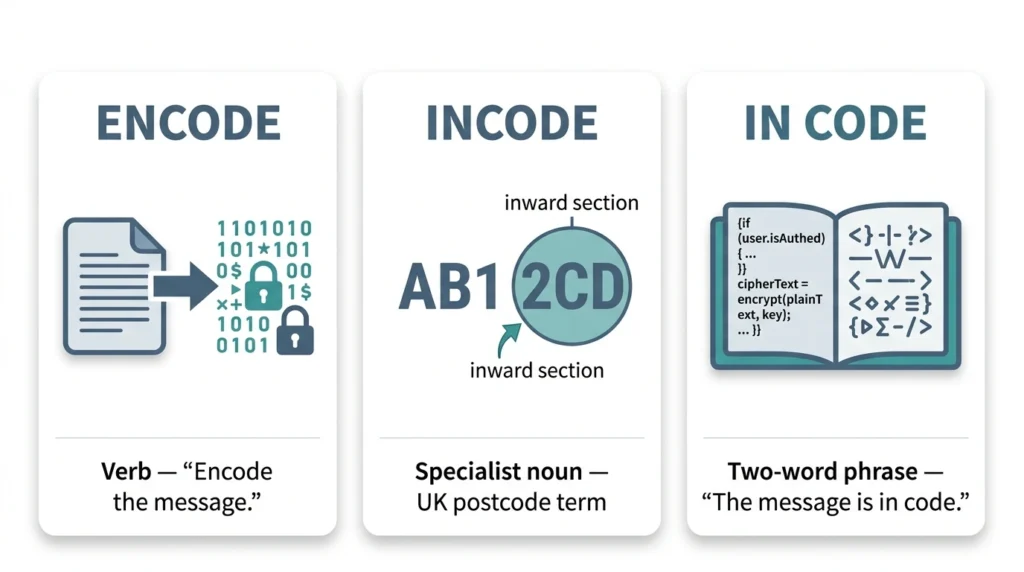
Encode vs Incode vs In Code
| Feature | Encode | Incode | In Code |
|---|---|---|---|
| Form | One word | One word | Two words |
| Main part of speech | Verb | Specialist noun | Prepositional phrase |
| Standard computing verb? | Yes | No | No |
| Means convert/represent information? | Yes | Not normally | No |
| Valid in UK postcode terminology? | No special postal meaning | Yes | No |
| Can describe how something is written? | As an action | Usually no | Yes |
| Example | Encode the message. | The incode is 4DP. | The message is in code. |
| Past form | Encoded | Not a standard equivalent verb form | Not applicable |
| -ing form | Encoding | Not a standard equivalent verb form | Not applicable |
Encode vs Encrypt
These words are related to information processing, but they should not automatically replace each other.
Encoding changes how information is represented.
Encryption protects information so unauthorized people cannot understand it without the required cryptographic information.
For example:
The application encodes text as Base64.
That does not mean the text is secure. Anyone who understands Base64 can reverse the representation.
By contrast:
The application encrypts sensitive information before transmission.
Here, security is the purpose.
A useful rule for technical writing is:
Compatibility or representation → encode
Confidentiality or cryptographic protection → encrypt
This distinction is especially important when writing about passwords, authentication, APIs, storage, or cybersecurity.
Encode vs Code
Code has several meanings and can function as either a noun or a verb.
A developer may code an application, meaning write software.
A communication system may encode information, meaning represent it according to a particular scheme.
Compare:
Maria coded the feature yesterday.
This means Maria wrote computer code.
The application encoded the text in UTF-8.
This describes how information was represented.
The meanings can overlap in some contexts, but encode is more precise when representation or transformation is the central idea.
The Easiest Memory Trick
Remember:
ENter a new form = ENcode
Both ENter and ENcode begin with EN.
When information ENters a coded or represented form, you ENcode it.
So think:
ENter → ENcode
Not:
IN → incode
The only time incode should make you stop and reconsider this trick is when you are dealing with a genuine specialized noun, especially UK postcode terminology.
Real-Life Situations
Job Interview
Interviewer: How does your application handle uploaded video?
Natural answer: “It encodes each uploaded file into a format suitable for streaming.”
Using incodes here would create an unnecessary spelling error during a technical explanation.
Team Meeting
Manager: Why are some characters appearing incorrectly?
Developer: “The old system encoded the text using the wrong character set.”
Here, encoded precisely describes the representation problem.
Professional Email
Please make sure the exported text is encoded in UTF-8 before sending the final file.
This is concise, professional, and technically clear.
Text Message
The video is still encoding. I’ll send it when it finishes.
No complicated technical language is necessary. Encoding sounds natural in ordinary conversation when the process is relevant.
Exam
Question: What does it mean to encode information?
Strong answer: To encode information means to represent or convert it according to a particular code, system, or format.
Expert Tips
Learn the Whole Word
Do not try to reconstruct encode every time from in + code.
Store the spelling encode as one vocabulary item.
Remember Its Word Family
Learning related forms together reduces spelling mistakes:
encode → encodes → encoded → encoding → encoder
If one form begins with en-, the rest do too.
Check Whether You Actually Mean In Code
If your sentence describes the state or form of something rather than an action, you may need two words.
Action: We encoded the instructions.
Form: The instructions are written in code.
Do Not Use Encoding as a Security Claim
Saying data is “encoded” does not automatically mean it is protected.
If security is the real subject, identify whether the system uses encryption, hashing, tokenization, or another mechanism rather than using encode as a vague substitute.
Be Precise With Password Terminology
In professional technical writing, avoid statements such as:
“We securely encode passwords.”
If the system actually hashes passwords, say hash. If a specific encryption system is used, say encrypt.
Precise terminology matters more than making the process sound technical.
Preserve Incode When It Is a Defined Proper Name
Do not automatically run a global find-and-replace from incode to encode.
First check whether the term refers to:
- a UK postcode component
- a company
- a product
- a project
- a software identifier
- an acronym or defined technical label
Context determines whether correction is appropriate.
Read More: Conex or Connex: What Is the Difference?
FAQ
Is Incode a Real Word?
Yes, but only in limited contexts. It is a recognized specialist noun in UK postcode terminology, where it means the inward portion of a postcode. It can also occur as a proper name. It is not the standard alternative spelling of the verb encode.
Is Incode Correct in Programming?
Not when you mean the normal action of converting or representing data.
Write:
encode data
not:
incode data
A programmer could still use Incode as a class name, project name, company name, or custom identifier, but that does not make it the standard English verb.
Is Incoding Correct?
Normally, no.
The standard form is encoding.
Write:
The video is encoding.
not:
The video is incoding.
A highly specialized proper name or defined domain-specific term could behave differently, so context should always be checked.
Is Incoded Correct?
Not as the normal past tense meaning “converted into a coded form.”
The standard past tense and past participle are encoded.
Correct: The file was encoded successfully.
Incorrect: The file was incoded successfully.
Should I Write Encode or In Code?
They perform different grammatical jobs.
Encode is a verb:
Encode the message.
In code is a phrase describing the form of something:
The message was written in code.
Do not merge the second expression into incode unless you are using the established specialist noun or a proper name.
Does Encode Mean Encrypt?
Not necessarily.
Encoding concerns representation. Encryption concerns protection and confidentiality.
Something can be encoded without being encrypted. Therefore, you should not describe ordinary encoding as a security measure merely because the output is difficult for a person to read.
Does Encode Mean Compress?
Not automatically.
Encoding and compression can occur during the same media-processing workflow, but the concepts are not identical. Encoding describes representing information according to a particular scheme, while compression specifically aims to reduce the amount of data required.
Use the technically accurate term for the process you are describing.
Is “Encoded in UTF-8” Correct?
Yes.
The text is encoded in UTF-8 is a natural and standard construction because UTF-8 identifies the character encoding used to represent the text.
You may also encounter constructions using as or into, depending on what result or transformation the writer wants to emphasize.
Why Is Encode Spelled With En Instead of In?
The en- prefix is used in English to form many verbs involving putting something into a state or causing it to become something, as in encase, encircle, and enable. The pronunciation can resemble in-, which helps explain the spelling confusion.
What Does Incode Mean in a UK Postcode?
The incode, also called the inward code, is the final three characters of a UK postcode.
For NW6 4DP, the incode is 4DP.
It contains the postcode sector and postcode unit and is separated from the outcode by a space.
Mini Quiz
| # | Question | Answer | Explanation |
|---|---|---|---|
| 1 | Fill in the blank: “The application will ___ the video before upload.” | encode | Encode is the standard verb for converting or representing the video in another format. |
| 2 | Which is correct? A) incoding B) encoding | B) encoding | The -ing form of encode is encoding. |
| 3 | Correct the sentence: “The program incodes every message.” | The program encodes every message. | The third-person singular form is encodes. |
| 4 | Which sentence is correct? A) The instructions are incode. B) The instructions are in code. | B | In code is the two-word phrase meaning written or expressed using code. |
| 5 | Fill in the blank: “The text was ___ in UTF-8.” | encoded | Encoded is the correct past participle. |
| 6 | True or false: Encoding always protects information from unauthorized access. | False | Encoding changes representation; it does not automatically provide confidentiality. |
| 7 | Which term best describes the final three characters of a UK postcode: encode or incode? | incode | In UK postcode terminology, incode is the inward portion of the postcode. |
| 8 | Correct the sentence: “We incoded the file yesterday.” | We encoded the file yesterday. | The past tense of encode is encoded. |
| 9 | Which is better for a security statement if cryptographic confidentiality is intended: “encode the data” or “encrypt the data”? | encrypt the data | Encryption specifically describes protecting information cryptographically. |
| 10 | Fill in the blank: “ENter a new form = ___.” | ENcode | The mnemonic connects the correct en- spelling with the idea of entering another representation. |
Quick Summary
Encode is the correct verb when you mean to convert or represent information in a particular code, format, signal, or system. Its standard forms are encode, encodes, encoded, and encoding. Do not use incode, incodes, incoded, or incoding as substitutes in ordinary computing or general English. However, incode is not always an error: in UK postcode terminology, it is a specialist noun for the final three characters of a postcode, also known as the inward code. Also remember that in code is a separate two-word phrase. Finally, do not confuse encoding with encryption: encoding changes representation, while encryption is designed to protect information from unauthorized access.