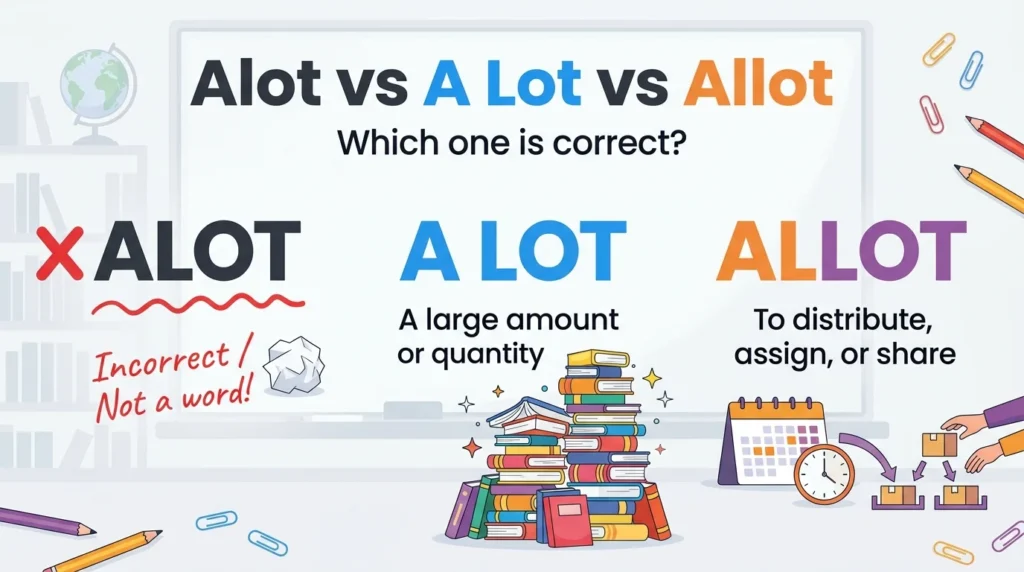

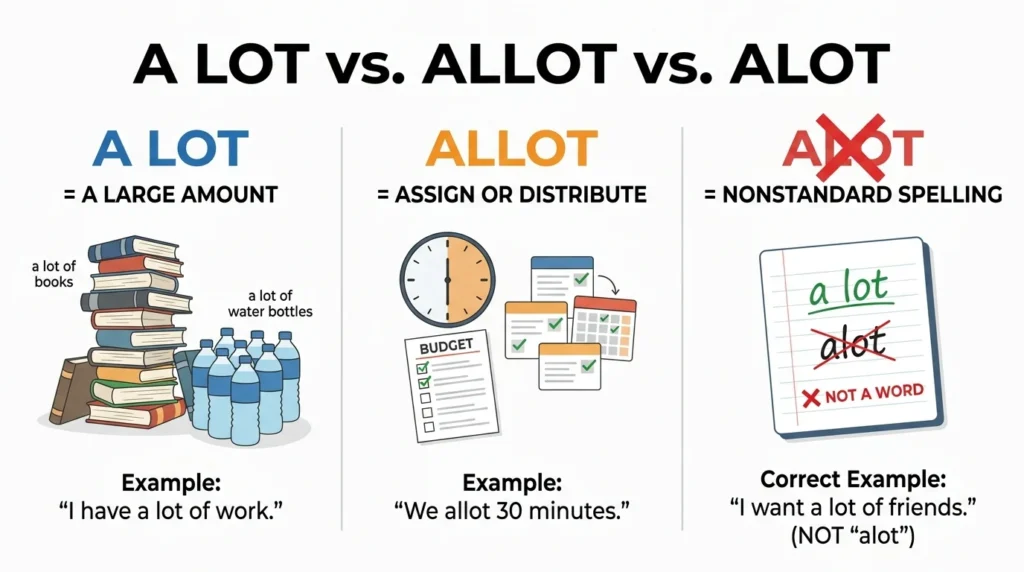
A lot is the correct two-word phrase meaning a large amount, a large number, or very much. Allot is a verb meaning to assign, distribute, or set aside something for a particular purpose. Alot is a nonstandard spelling that should be avoided in ordinary English writing. For example, “I have a lot of work to do” is correct, while “The manager will allot two hours to the project” is also correct.
What Is the Difference Between Alot, A Lot, and Allot?
The difference between alot, a lot, and allot comes down to spelling and meaning. Two forms are correct in standard English, but they serve different purposes.
- A lot: Means a large amount, many things, or very much.
- Allot: Means to assign or distribute something for a specific purpose.
- Alot: A common spelling mistake for a lot.
Consider these three examples:
- Correct: I have a lot of emails to answer.
- Correct: We will allot 30 minutes to each interview.
- Incorrect: I have alot of emails to answer.
The key is to identify what you want to express. If you are describing quantity or degree, use a lot. If you are talking about assigning a share of something, use allot.
Why Does the Difference Matter?
Spelling mistakes can make an otherwise clear message look careless. Confusing a lot with allot can also change the meaning of a sentence or make it grammatically incorrect.
Imagine sending your manager this message:
“I will alot two hours for the presentation.”
The intended meaning is clear, but the spelling is incorrect. A better version is:
“I will allot two hours for the presentation.”
Now consider this sentence:
“I learned allot from my teacher.”
If you mean that you learned a great deal, write:
“I learned a lot from my teacher.”
Understanding this distinction helps you write clearer emails, complete school assignments accurately, prepare professional documents, and communicate confidently in English.
Read More: Appendices vs Appendixes: Which Is Correct?
The Core Rule: When to Use Each Form
Remember these three rules:
- Write a lot as two separate words when referring to quantity, amount, degree, or frequency.
- Write allot as one word when you mean to assign, distribute, or set aside something.
- Avoid alot in standard English writing because it is a nonstandard spelling of a lot.
A quick substitution test makes the choice easier:
- If you can replace the expression with many, much, very much, or frequently, you probably need a lot.
- If you can replace the word with assign, allocate, or distribute, you probably need allot.
For example, “She reads a lot” means she reads frequently or extensively. “She will allot an hour to reading” means she will set aside an hour for that activity.
How to Use A Lot Correctly
A lot has several common uses. It can describe quantity, degree, or frequency, depending on the sentence.
A Lot Meaning a Large Amount or Number
Use a lot of before a noun when referring to a large quantity or number.
Examples:
- We have a lot of work to finish today.
- The library contains a lot of useful books.
- She drinks a lot of water during the summer.
- A lot of students joined the competition.
- There is a lot of traffic near the stadium.
Use a lot of with both plural countable nouns and singular uncountable nouns.
Countable nouns are things you can count individually, such as books, students, and chairs. Uncountable nouns refer to things usually treated as a whole, such as water, information, and advice.
A Lot Meaning Very Much
You can also use a lot after a verb to express degree or intensity.
Examples:
- I appreciate your help a lot.
- This course helped me a lot.
- She enjoys travelling a lot.
- We miss our old friends a lot.
- Your feedback means a lot to me.
In these sentences, a lot does not describe a specific number of objects. It emphasizes how strongly someone feels or how much something affects them.
A Lot Meaning Frequently
Use a lot to describe an action that happens frequently or repeatedly.
Examples:
- He travels a lot for work.
- My younger brother plays football a lot.
- She practises her English a lot.
- We talk about business a lot.
- The neighbours complain about the noise a lot.
The exact meaning depends on context. “She reads a lot” generally means she reads frequently or extensively, not that she distributes reading materials.
Using A Lot Without a Noun
You do not always need to write a lot of. Sometimes, a lot stands alone.
Correct examples:
- I learned a lot.
- Thank you a lot for your support.
- Prices have increased a lot.
- We enjoyed the trip a lot.
- He has improved a lot.
Notice the difference:
- Correct: I learned a lot.
- Correct: I learned a lot of useful information.
- Incorrect: I learned a lot of.
The last example is incomplete if no noun or suitable continuation follows. You can omit of when the expression stands alone, but you generally need of before a noun in this construction.
How to Use Allot Correctly
Allot is a verb. It describes the act of assigning or distributing a portion of something, such as time, money, space, work, or resources.
Allot Time
Use allot when deciding how much time to give to an activity.
Examples:
- The teacher will allot 20 minutes to the exercise.
- Please allot an hour for the client meeting.
- I allot 30 minutes each morning to reading.
- The organiser allotted ten minutes to every speaker.
- We should allot enough time for questions.
The central idea is that someone assigns or sets aside a specific amount of time.
Allot Money or Resources
You can also use allot when distributing money, equipment, staff, or other resources.
Examples:
- The company will allot more funds to research.
- The school allotted new computers to the science department.
- The council will allot space for a public garden.
- Each department was allotted a separate budget.
- The organisation allotted emergency supplies to affected families.
In these examples, allot describes an allocation rather than a large quantity.
Allot Tasks or Responsibilities
Use allot when assigning duties, responsibilities, or portions of a shared workload.
Examples:
- The supervisor will allot tasks to each team member.
- The teacher allotted different topics to the students.
- The project manager allotted responsibilities according to experience.
- Each volunteer was allotted a specific area to manage.
- The committee allotted duties before the event began.
Allot, Allots, Allotted, and Allotting
Allot changes its form according to tense and grammatical use.
| Form | Usage | Example |
|---|---|---|
| Allot | Base form | We allot time for training. |
| Allots | Present tense with he, she, or it | The manager allots tasks fairly. |
| Allotted | Past tense or past participle | She allotted funds to the project. |
| Allotting | Form used with -ing | We are allotting more space to storage. |
Spelling tip: The past-tense form is allotted, with a double t. The -ing form is allotting, also with a double t. This doubling follows a common English spelling pattern for certain short verbs ending in a consonant.
Correct Examples of A Lot and Allot
Here are 12 original examples from everyday, academic, and professional situations.
| Situation | Correct sentence | Why it is correct |
|---|---|---|
| Conversation | I learned a lot from that discussion. | Describes the amount learned. |
| Thank you for taking a lot of time to explain the process. | Describes a large amount of time. | |
| School | A lot of students submitted their assignments early. | Describes a large number of students. |
| Workplace | We have a lot of deadlines this month. | Describes a large number of deadlines. |
| Social media | I have learned a lot from this community. | Describes the extent of learning. |
| Academic writing | A lot of evidence supports this interpretation. | Describes a substantial quantity of evidence. |
| Interview | I have gained a lot of experience in customer service. | Describes extensive experience. |
| Meeting | We should allot 15 minutes to the budget discussion. | Assigns a specific amount of time. |
| Project planning | The team allotted extra funds to testing. | Describes the allocation of money. |
| Education | Each group was allotted a different research topic. | Describes the assignment of topics. |
| Event management | The organisers allotted seats to registered guests. | Describes the distribution of seats. |
| Personal planning | I allot part of my income to savings each month. | Describes setting aside money for a purpose. |
Incorrect vs. Correct: 12 Common Mistakes
The following table shows how to correct the most common errors involving these forms.
| ❌ Incorrect | ✅ Correct | Why |
|---|---|---|
| I have alot of work today. | I have a lot of work today. | A lot must be written as two words. |
| She travels alot for business. | She travels a lot for business. | The phrase describes frequency. |
| We learned alot in class. | We learned a lot in class. | The phrase describes the amount learned. |
| There are alot of options. | There are a lot of options. | A lot of introduces a plural countable noun. |
| I miss you allot. | I miss you a lot. | The intended meaning is degree, not allocation. |
| He knows alot about history. | He knows a lot about history. | The phrase describes the extent of his knowledge. |
| The manager will a lot the tasks. | The manager will allot the tasks. | Allot is the verb meaning to assign. |
| We will alot more time for training. | We will allot more time for training. | The sentence describes assigning time. |
| The school will a lot funds to science. | The school will allot funds to science. | The verb describes the allocation of funds. |
| Each student was alot ten minutes. | Each student was allotted ten minutes. | The passive construction needs the past participle allotted. |
| The committee is alotting new duties. | The committee is allotting new duties. | The correct -ing form is allotting. |
| I will allot of effort to this task. | I will put a lot of effort into this task. | Allot needs an object that is assigned or allocated; the intended meaning here is the amount of effort. |
Why People Make This Mistake
There are several reasons writers confuse alot, a lot, and allot.
They Sound Alike
A lot and allot are pronounced alike in many varieties of English. When people learn a word mainly by hearing it, they may not remember which spelling represents which meaning.
The solution is to connect each form with its function: quantity means a lot, while assignment means allot.
A Lot Looks Like It Should Be One Word
English contains many familiar compound words, so it may seem natural to combine a lot into alot. However, frequent use does not make a spelling standard.
Compare these familiar phrases:
- a little
- a bit
- a lot
- a great deal
Their words remain separate in standard writing.
Spellcheck Does Not Replace Understanding
Spellcheck tools may identify alot as an error, but automated corrections do not always explain the difference between a lot and allot. A correctly spelled word can still be wrong for the intended meaning.
For instance, “I allot my friends” may contain a correctly spelled verb, but it does not communicate the intended idea if you mean that you spend time with your friends.
Read More: Sence vs Sense: Which Spelling Is Correct?
Translation Can Cause Confusion
Learners sometimes transfer spelling patterns from another language into English. If a similar expression is written as one word in their first language, they may assume that English works the same way.
The best approach is to learn the English phrase as a complete unit: a lot, not alot.
Autocomplete Can Hide Errors
Typing suggestions can encourage you to accept a word without checking the sentence. This is especially risky when two forms are pronounced alike but have different meanings.
Read the complete sentence after using autocomplete. Ask yourself whether you are describing an amount or assigning something.
Common Mistakes Checklist
Use this checklist when proofreading your writing.
- Writing alot as one word: It is a nonstandard spelling for the intended phrase. Replace it with a lot.
- Using allot to mean “many”: Allot is a verb meaning to assign or distribute. Use a lot to describe quantity.
- Forgetting of before a noun: Write “a lot of books,” not “a lot books.”
- Adding of when it is unnecessary: Write “I learned a lot,” not “I learned a lot of,” when the expression ends there.
- Confusing allot with a lot in a sentence: Test whether the meaning is “assign” or “a large amount.”
- Misspelling allotted: The past-tense form doubles the final t.
- Using a lot in every formal sentence: The phrase is correct, but a more precise expression may suit formal academic or professional writing better.
- Trusting spellcheck without reviewing meaning: Confirm that the chosen word fits the sentence, not just that it is spelled correctly.
A Lot vs. Allot vs. Alot in Real English
Grammatically Correct
A lot and allot are both standard English forms, but they perform different grammatical jobs. “We have a lot of applications” describes quantity. “We will allot each applicant five minutes” describes assigning time. The spelling alot is not standard for either meaning. In edited schoolwork, business writing, and published content, keep a lot as two words and use allot only when the meaning involves assignment or distribution.
Grammatically Possible but Unnatural
A sentence may be grammatically understandable yet sound awkward or vague in context. For example, “The company allotted a lot of money” is grammatically correct, but it may be less informative than “The company allocated $50,000 to staff training.” Likewise, repeating a lot several times in a formal report can make the writing imprecise. These are style issues, not spelling errors; the best revision depends on the meaning and audience.
Natural, Everyday English
A lot is very common in everyday conversation and ordinary writing: “I like this place a lot,” “We have a lot of time,” and “She works a lot.” Allot is natural when discussing planned allocations, such as time, funds, or responsibilities, although assign, set aside, and allocate may be more conversational in some contexts. Alot should be avoided in standard prose, even in informal messages.
American vs. British English
There is no standard American-versus-British spelling difference for this comparison.
Both American and British English use:
- A lot for quantity, degree, or frequency.
- Allot for assigning or distributing something.
- Alot as a nonstandard spelling when intended to mean a lot.
The same distinction applies whether you are writing a US business email, a British school assignment, or international English content.
Formal vs. Informal Usage
The difference between a lot and allot is not a difference in formality. It is a difference in meaning.
A lot is common and natural in conversation, emails, and everyday writing. It is also grammatically correct in formal writing, although it may sometimes be too vague for academic or technical work.
In formal writing, consider more precise alternatives when appropriate:
| Instead of | Possible alternative | Example |
|---|---|---|
| A lot of people | Many people | Many participants completed the survey. |
| A lot of money | A substantial sum | The project required a substantial sum. |
| A lot of evidence | Considerable evidence | Considerable evidence supports the conclusion. |
| A lot of times | Frequently | The issue occurs frequently. |
| Allot money | Allocate funds | The board allocated funds to research. |
Do not replace allot with a lot simply to make a sentence sound more conversational. Choose the expression that preserves your intended meaning.
Comparison Table: A Lot vs. Allot vs. Alot
| Feature | A lot | Allot | Alot |
|---|---|---|---|
| Standard spelling | Yes | Yes | No, for the intended meaning |
| Number of words | Two | One | One |
| Main function | Quantity, degree, frequency | Assigning or distributing | Common misspelling |
| Grammatical role | Phrase used adverbially or as a quantity expression | Verb | Nonstandard spelling |
| Example | We have a lot of work. | We will allot more time. | We have alot of work. |
| Formal writing | Correct; precision may vary | Correct when meaning fits | Avoid |
| Past-tense form | No verb tense | Allotted | Not applicable |
| Useful substitute | Many, much, frequently | Assign, allocate, distribute | A lot |
Memory Trick: Separate the Amount, Assign the Share
Use this simple memory trick:
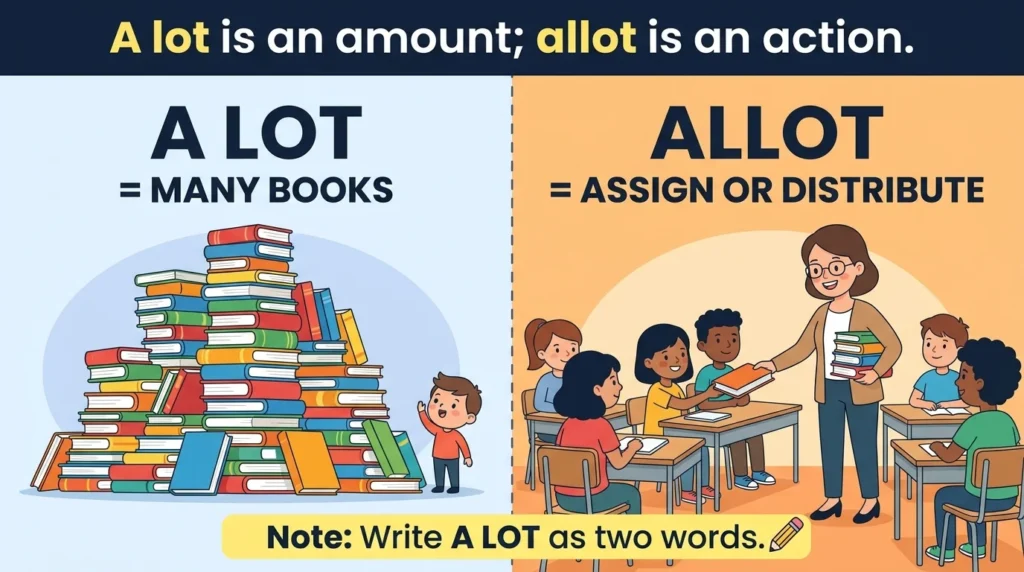
A lot is an amount. Allot is an action.
- A lot: Imagine a large pile of books. You have a lot of books.
- Allot: Imagine a teacher distributing those books among students. The teacher allots the books.
- Alot: Remember that the standard phrase for the pile needs a space: a lot.
You can also remember the phrase “a little” as a clue. You would not normally write alittle in standard English, so do not combine a lot into alot.
Real-Life Situations: Which Form Should You Choose?
In a Job Interview
Incorrect: “I learned alot in my previous job.”
Correct: “I learned a lot in my previous job.”
The sentence describes the extent of your learning, not the distribution of anything.
In a Business Meeting
Incorrect: “We should a lot more time to customer research.”
Correct: “We should allot more time to customer research.”
The meeting is about assigning additional time to a task.
In an Email
Incorrect: “Thank you for helping me allot.”
Correct: “Thank you for helping me a lot.”
For a more natural professional message, write “Thank you for your help” or “Your support has helped me greatly.”
In a Text Message
Incorrect: “I miss you alot.”
Correct: “I miss you a lot.”
The intended meaning is emotional intensity, so a lot is the correct phrase.
In an Exam
Incorrect: “The school allotted of money to the library.”
Correct: “The school allotted money to the library.”
Here, allotted already means that money was assigned. No of is required between the verb and its direct object.
Read More: Summarize vs Summarise: Which Spelling Is Correct?
In a Research Report
Less precise: “A lot of participants reported the same problem.”
More precise, if the data supports it: “Most participants reported the same problem.”
The second sentence communicates a clearer proportion, but use most only when the findings justify it.
Expert Tips for Choosing the Right Form
- Identify the meaning before checking the spelling. Decide whether the sentence refers to quantity or allocation.
- Remember that a lot is two words. This is true whether it means “many,” “very much,” or “frequently.”
- Look for an object after allot. You might allot time, funds, space, duties, or resources.
- Use the past-tense spelling carefully. Write allotted and allotting, not aloted or aloting.
- Choose precise alternatives when needed. Words such as many, considerable, frequently, and allocate may communicate more exact meanings.
- Proofread for meaning as well as spelling. Allot is a real word, so a spellchecker may not flag it when you accidentally use it instead of a lot.
- Do not confuse frequency with quantity. “She visits a lot” describes how often she visits; “She allots an hour” describes the time she assigns.
- Keep the sentence natural. A lot is perfectly acceptable in everyday English. Do not force a formal synonym when it makes the sentence less clear.
Quick Summary
A lot, allot, and alot look similar, but only two are standard English forms for the meanings discussed here. Write a lot as two words when you mean a large amount, many things, very much, or frequently. Use allot when you mean to assign or distribute something, such as time, money, space, or responsibilities. The spelling alot is a common mistake and should be avoided in standard writing. Remember the simple rule: a lot is an amount; allot is an action. If you are writing formally, consider whether a more precise alternative, such as many, considerable, or allocate, would communicate your meaning more clearly.
Read More: Cancellation vs Cancelation: Which Spelling Is Correct?
Frequently Asked Questions
Is “alot” ever correct in English?
Not as the standard spelling of the phrase meaning “a large amount” or “very much.” In ordinary writing, use a lot. A name, brand, or deliberately stylised expression may use a nonstandard spelling for a special purpose, but that does not make alot the correct spelling of the common phrase.
Is “a lot” one word or two words?
A lot is two words: the article a and the noun lot. Keep the space whether the phrase refers to a large quantity, degree, or frequency.
Is “allot” the same as “a lot”?
No. Allot means to assign or distribute something for a purpose. A lot refers to quantity, degree, or frequency. For example, “We have a lot of work” describes the amount of work, while “We will allot two hours to the work” describes assigning time.
Can I write “I like it allot”?
No, not if you mean that you like it very much. Write “I like it a lot.” Use allot only when the sentence refers to assigning or distributing something.
Is “a lot of” grammatically correct before uncountable nouns?
Yes. You can write “a lot of water,” “a lot of advice,” or “a lot of information.” These nouns are generally treated as uncountable in these meanings, but the phrase a lot of works with them.
Can “a lot” appear at the end of a sentence?
Yes. For example, “I enjoyed the performance a lot” and “She travels a lot” are both correct. In these sentences, the phrase describes degree or frequency.
What is the past tense of “allot”?
The past tense is allotted. For example: “The committee allotted extra funds to the project.” The past participle is also allotted, as in “Extra funds were allotted to the project.”
Is “allotting” spelled with one or two t’s?
It is spelled allotting, with two t’s at the end. The same doubling occurs in allotted. Both forms follow the spelling pattern used for this verb.
Is “a lot” too informal for academic writing?
Not automatically. It is standard English, but it can be vague in academic contexts. Depending on the evidence and intended meaning, many, a substantial amount, considerable, or a precise number may be better choices.
Does British English use “alot” differently from American English?
No standard spelling distinction exists here. Both varieties use a lot and allot with the meanings explained above, and alot is not the standard spelling for the common phrase.
What is the easiest way to remember “a lot” versus “allot”?
Remember: a lot describes an amount; allot means to assign. If you can replace the expression with “many” or “very much,” choose a lot. If you can replace it with “assign” or “allocate,” choose allot.
Can I use “allot” and “a lot” in the same sentence?
Yes. For example: “We need to allot a lot of time to the final review.” The first expression means to assign time; the second describes how much time is needed.
Mini Quiz: Alot vs. A Lot vs. Allot
Choose the correct form in each question. Answers and explanations are included so you can check your understanding.
| No. | Question | Answer | Explanation |
|---|---|---|---|
| 1 | I have ___ of assignments to finish. (a) alot (b) a lot (c) allot | (b) a lot | The phrase describes a large number of assignments. |
| 2 | The manager will ___ 20 minutes to each presentation. (a) alot (b) a lot (c) allot | (c) allot | The manager is assigning a specific amount of time. |
| 3 | Correct the sentence: “She travels alot for work.” | She travels a lot for work. | A lot is always written as two words in standard English. |
| 4 | We learned ___ from the workshop. (a) allot (b) a lot (c) alot | (b) a lot | The phrase describes the extent of learning. |
| 5 | The committee ___ additional funds last month. (a) allotted (b) a lot (c) alot | (a) allotted | Allotted is the past tense of allot. |
| 6 | True or false: “Alot” is the standard spelling in informal English. | False | Informal writing does not make alot the standard spelling. |
| 7 | Fill in the blank: Please ___ enough space for the new equipment. | allot | The sentence refers to assigning space. |
| 8 | Correct the sentence: “I miss my family allot.” | I miss my family a lot. | The sentence expresses degree, not allocation. |
| 9 | Which sentence is correct? (a) We have alot of time. (b) We have a lot of time. (c) We have allot of time. | (b) We have a lot of time. | A lot of time correctly describes a large amount of time. |
| 10 | Fill in the blank: The school is ___ extra desks to each classroom. | allotting | Allotting is the correct -ing form of allot. |