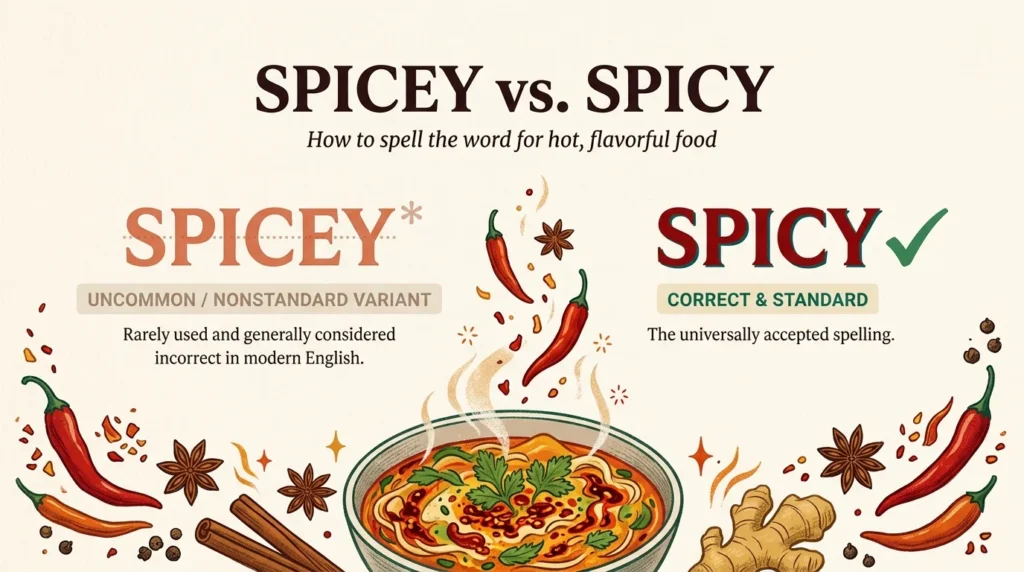

Spicy is the standard spelling. Spicey is an uncommon variant spelling and is usually not the form you want in modern writing. The word spicy can describe food with strong flavors from spices, and it can also have figurative meanings such as exciting, provocative, or lively depending on context. The easiest form to remember is spice → spicy, not spice → spicey.
What Is the Difference Between Spicey and Spicy?
The main difference is spelling and standard usage.
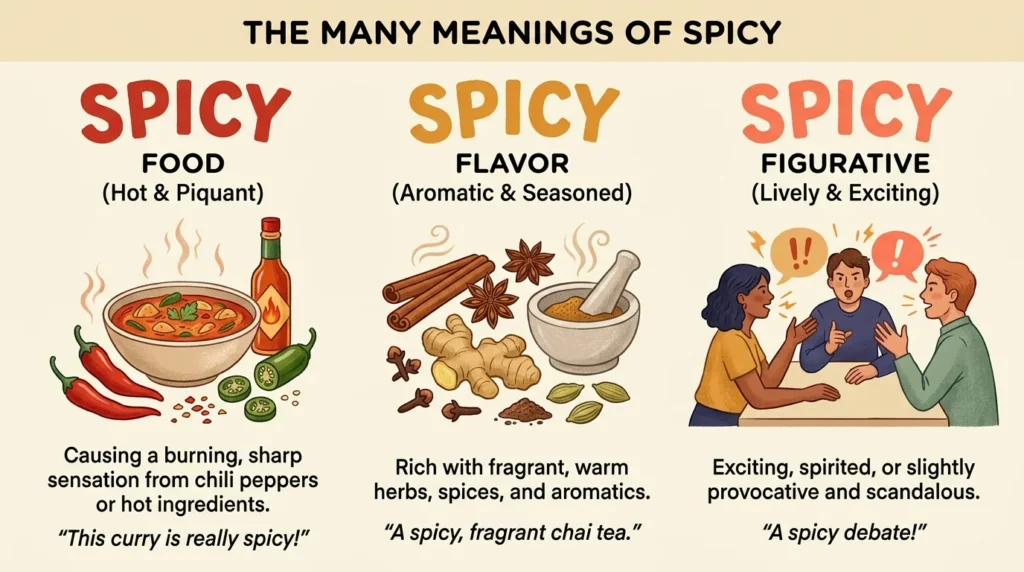
Spicy is the established modern adjective formed from spice. It commonly describes food or flavor that has a strong taste from spices. It can also describe something figuratively as exciting, provocative, or lively.
Spicey has appeared as an uncommon spelling variant, including in historical usage. However, it is not the ordinary spelling used in modern standard English. If you are writing a sentence today and need the adjective, spicy is the safe and natural choice.
For example:
- The curry is spicy.
- She ordered a spicy noodle dish.
- This sauce has a spicy flavor.
- That was a spicy comment.
The distinction is therefore not really about two different modern meanings. It is primarily about choosing the standard spelling.
Why It Matters
A one-letter spelling difference can look minor, but spelling choices affect how polished your writing appears.
Using spicy is especially important when you are writing:
- A restaurant menu
- A recipe
- A food product description
- A school assignment
- A business email
- A blog post
- An academic paper
- A social media caption
- A restaurant review
- Marketing copy
If you write spicey in one of these situations, most readers will understand what you mean. The problem is that the spelling can look like an error because spicy is the normal modern form.
For casual texting, a reader may simply understand the intended meaning. In formal or public writing, however, standard spelling is the better choice.
The Core Rule
Use SPICY when you mean “having a strong or hot flavor from spices.”
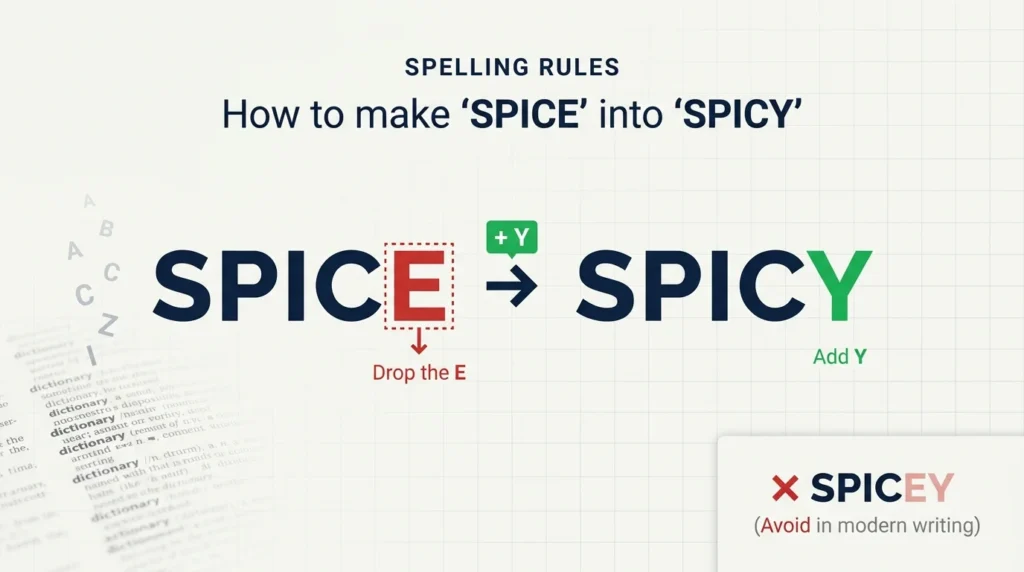
spice → spicy
Not:
spice → spicey
The important point is that the final e in spice is not retained in the standard spelling spicy.
Dictionary definitions support spicy as the established adjective for food and flavor.
How to Use Spicy
Use Spicy for Food
This is the most common use.
- The chicken is spicy.
- I cannot eat very spicy food.
- She made a spicy tomato sauce.
- These noodles are extremely spicy.
- Would you like a mild or spicy curry?
The word does not necessarily mean “extremely hot.” Something can be mildly spicy, moderately spicy, or very spicy.
Use Spicy for Flavor
Spicy can describe a particular flavor or quality.
- The soup has a spicy flavor.
- The sauce has a warm, spicy aroma.
- I like the combination of sweet and spicy flavors.
- The restaurant is known for its spicy dishes.
Use Spicy in Figurative Language
The word can move beyond food.
Depending on context, spicy can mean exciting, provocative, controversial, or lively. Modern dictionaries recognize several figurative uses.
For example:
- The interview included some spicy questions.
- She posted a spicy opinion online.
- The debate became spicy.
- The novel contains some spicy scenes.
These uses are strongly dependent on context and register. In particular, figurative uses can be informal.
Correct Examples
Here are examples from different types of real-world writing.
| Situation | Correct Example |
|---|---|
| Conversation | “Is this curry spicy?” |
| Restaurant | “I would like the spicy chicken, please.” |
| Recipe | “Add the chili and cook until the sauce becomes spicy.” |
| “The new menu includes several spicy dishes.” | |
| School | “The writer uses spicy imagery to create a lively tone.” |
| Workplace | “The discussion became a little spicy after the announcement.” |
| Social media | “This is probably my spiciest opinion yet.” |
| Food review | “The noodles were spicy but still flavorful.” |
| Academic writing | “The dish is characterized by a spicy and aromatic flavor.” |
| Product description | “Our spicy sauce combines chili, garlic, and herbs.” |
| Text message | “I ordered the spicy one by mistake!” |
| Interview | “That was a spicy question.” |
Incorrect vs. Correct
| ❌ Incorrect / Nonstandard Choice | ✅ Correct Standard Choice | Why |
|---|---|---|
| This curry is spicey. | This curry is spicy. | Spicy is the standard modern adjective. |
| I love spicey noodles. | I love spicy noodles. | The adjective is spelled spicy. |
| The sauce is too spicey. | The sauce is too spicy. | The final e is not retained. |
| We ordered a spicey chicken dish. | We ordered a spicy chicken dish. | Spicy is the normal form in modern writing. |
| Add more spicey sauce. | Add more spicy sauce. | The standard adjective is spicy. |
| The restaurant serves spicey food. | The restaurant serves spicy food. | Use spicy in food descriptions. |
| This salsa has a spicey kick. | This salsa has a spicy kick. | Spicy is the established spelling. |
| I don’t like spicey meals. | I don’t like spicy meals. | The extra e is not used in the standard form. |
| Is Indian food always spicey? | Is Indian food always spicy? | Spicy is the standard adjective. |
| The soup smells spicey. | The soup smells spicy. | The adjective remains spicy regardless of sentence position. |
| She made a spicey sauce. | She made a spicy sauce. | The correct spelling is spicy. |
| That was a spicey comment. | That was a spicy comment. | Figurative uses also use spicy. |
Why People Make This Mistake
The Base Word Looks Like It Should Keep the E
The noun is spice.
So it is easy to think:
spice + y = spicey
That looks logical at first glance. But established English spelling does not always work by simply attaching letters to the complete visible form of a base word.
The standard adjective is:
spice → spicy
This is best learned as the established spelling rather than as a universal rule that applies perfectly to every English word ending in e.
The Pronunciation Does Not Help Much
Spicy and spicey would naturally look very similar when pronounced.
The final sound does not give you a strong clue about which spelling to choose. That makes this a spelling-memory problem rather than a pronunciation problem.
Visual Similarity Creates Doubt
The two forms differ by only one letter:
spicy
spicey
Because spice is already a familiar word, the eye can accept spicey as visually logical.
People Add the Suffix Too Literally
Learners often apply a simple pattern:
Base word + y = adjective
That pattern can be useful, but English spelling has many established forms that require changes to the base spelling.
With this particular word, remember the complete form spicy rather than trying to construct it every time.
Autocomplete and Spellcheck Are Not Perfect
Digital writing tools can help identify spelling mistakes, but they should not replace knowledge of standard spelling.
A word can appear online many times and still not be the form you should use in careful writing. Search results, usernames, brand names, comments, and informal posts can all contain unusual spellings.
Common Mistakes Checklist
Mistake 1: Keeping the E
❌ spicey
✅ spicy
Why it happens: Writers see the base noun spice and add y without changing the spelling.
How to avoid it: Memorize the pair:
spice → spicy
Mistake 2: Thinking the Two Forms Have Different Meanings
Some writers assume spicey and spicy might describe different kinds of food.
They do not function as two standard modern words with separate meanings. Where spicey occurs as a variant, it corresponds to spicy.
Mistake 3: Calling Spicy Only “Hot”
Spicy can describe food with strong flavors from spices, not merely food that produces extreme heat. Dictionary definitions include strong or pungent flavor and related senses.
Mistake 4: Confusing Spicy With Spiced
These words are related but are not identical.
Spiced means that something has been seasoned or flavored with spices.
Spicy describes a quality or flavor associated with spices, often including a strong or hot taste.
For example:
- The chicken was spiced with cumin and coriander.
- The chicken was spicy.
A dish can be heavily spiced without being especially hot.
Mistake 5: Assuming Spicy Always Means Hot
Context matters.
A spicy dish can refer to strong seasoning or flavor, while in everyday food conversations it often suggests noticeable heat.
If you specifically mean heat, words such as hot, fiery, or very spicy may communicate the intended intensity more clearly.
Spicy in Real English
Natural and Everyday
Spicy is completely natural in everyday English when describing food, flavor, or a person’s reaction to food.
“This curry is too spicy for me.”
This is an ordinary, natural sentence. You would hear and read spicy food, spicy sauce, spicy chicken, and spicy noodles regularly. Dictionary examples and common collocations also show spicy food, spicy sauce, and related expressions as established usage.
Grammatically Possible but Context-Dependent
Spicy can also be used figuratively, but the intended meaning depends heavily on context.
“That was a spicy question.”
This does not describe food. It can suggest that the question was provocative, bold, controversial, or otherwise likely to create a reaction. Such uses are more conversational and context-sensitive than the basic food meaning. Dictionaries recognize figurative senses involving excitement, controversy, or suggestiveness.
Standard but Not Always the Most Precise Word
Sometimes spicy is grammatically correct but not the most precise description.
Compare:
- spicy — strong or hot flavor associated with spices
- hot — emphasizes heat
- fiery — often suggests very strong heat
- pungent — emphasizes a strong or sharp smell or taste
- aromatic — emphasizes fragrance
For example, if a dish contains many spices but has no chili heat, spiced or aromatic may describe it more precisely than spicy.
American vs. British English
There is no spelling difference between American and British English for this word.
Both use:
spicy ✅
Neither standard variety changes the spelling to spicey.
There can be small pronunciation differences between British and American English, but the written form remains spicy. Current dictionary entries give pronunciations for both varieties while retaining the same spelling.
So you do not need to memorize:
- American: spicy
- British: spicey
That distinction would be incorrect.
The useful rule is simply:
American English: spicy
British English: spicy
Formal vs. Informal Usage
Formal Writing
Use spicy when the word is appropriate.
For example:
The restaurant specializes in spicy regional cuisine.
The sauce has a strong and spicy flavor.
The spelling does not become more formal or less formal.
Informal Writing
The same spelling applies:
That was a spicy take.
Things got spicy during the debate.
The figurative meanings can be more informal than the literal food meaning, but the spelling remains spicy.
Important Distinction
Do not assume that a word becomes acceptable in standard spelling merely because it appears in informal communication.
People may write spicey in texts, comments, usernames, advertisements, or other online spaces. That does not make it the preferred standard spelling.
Comparison Table
| Feature | Spicy | Spicey |
|---|---|---|
| Standard modern spelling | ✅ Yes | Usually no |
| Common adjective for food | ✅ Yes | No |
| Meaning related to spice | Yes | Same intended meaning when used as a variant |
| Common in recipes | Yes | No |
| Common in professional writing | Yes | No |
| Common in academic writing | Yes | No |
| Figurative use | Yes | Not the normal form |
| American English | Yes | Not standard |
| British English | Yes | Not standard |
| Dictionary-recorded variant | Main form | Uncommon variant in some sources |
| Recommended for ordinary writing | Yes | No |
The important nuance is that calling spicey simply “not a word” can be too absolute. Historical and dictionary evidence records spicey as an uncommon variant spelling of spicy. That does not make it the normal spelling to choose in modern standard writing.
Read More: Muscle vs Mussel: Meaning, Difference & Examples.
Memory Trick
Use this:
SPICE loses the E when it becomes SPICY.
Think:
SPICE → SPICY
You can also connect it with:
ICE → ICY
The visual pattern is easy to remember:
- ice → icy
- spice → spicy
Do not treat this as a perfect rule for every English word ending in e. English spelling contains many exceptions. Use it as a memory aid for this particular word.
Real-Life Situations
At a Restaurant
You want to ask about the heat level.
“Is the chicken very spicy?”
Not:
“Is the chicken very spicey?”
In a Text Message
A friend asks how dinner was.
“Great, but the curry was really spicy!”
In an Email
You are describing a new menu.
“We have added three new spicy dishes to the menu.”
In a School Assignment
You are describing a food tradition.
“The region is known for its rich and spicy cuisine.”
In a Product Description
You are writing copy for a sauce.
“A bold spicy sauce made with chili, garlic, and herbs.”
On Social Media
You are sharing an opinion.
“Here comes my spicy take on restaurant pricing.”
Here, spicy is figurative rather than literal.
Expert Tips
Tip 1: Learn the Whole Word
Do not rely entirely on constructing the adjective from spice.
Instead, store this spelling visually:
SPICY
That reduces hesitation.
Tip 2: Watch the Ending
The standard spelling ends in:
-icy
not:
-icey
When you see spicey, stop and check it.
Tip 3: Separate Spelling From Meaning
The question is not:
“Does spicey mean something different?”
The more useful question is:
“Which spelling should I use in standard modern writing?”
The answer is spicy.
Tip 4: Know That Variant Spellings Exist
This is especially useful for advanced learners.
Finding spicey in an old book or online does not automatically mean that the person who wrote it had invented a new word. Historical and dictionary records show that spicey has existed as a variant spelling.
But recognition and recommendation are different things.
You can recognize spicey without choosing it.
Tip 5: Be Precise About Food
If you want to describe the exact quality of a dish, choose the word that matches the sensation.
- spicy — strong or hot flavor associated with spices
- spiced — seasoned with spices
- hot — high level of heat
- pungent — sharp or strong smell/taste
- aromatic — strongly fragrant
- fiery — extremely intense or hot
This gives your writing more precision than using spicy for every strong flavor.
FAQ
Is spicey a correct spelling?
Spicey is an uncommon variant spelling recorded in some dictionary and historical sources, but spicy is the normal standard spelling for modern English writing.
Which is correct: spicey or spicy?
Use spicy. It is the established modern form used for the adjective describing food, flavor, and several figurative meanings.
Why is it spelled spicy instead of spicey?
The standard spelling is formed as spice → spicy, with the final e removed before the y. It is better to remember this established spelling than to assume that every word ending in e follows exactly the same pattern.
Is spicey a misspelling?
In ordinary modern writing, spicey is best treated as a nonstandard or uncommon variant rather than the form to use. Some dictionaries record it as a variant, so saying it has never existed as a spelling would be inaccurate.
Is spicy used in both American and British English?
Yes. Spicy is used in both American and British English. The spelling does not change between the two varieties
Does spicy mean hot?
Often, especially when describing food, spicy suggests heat or a strong flavor. However, it can also describe food that has a strong or pungent flavor from spices, so it does not always mean extremely hot.
What is the difference between spicy and spiced?
Spiced describes something that has been seasoned with spices. Spicy describes a quality of the resulting food or flavor, often suggesting strong or hot taste.
Can spicy describe something that is not food?
Yes. Spicy can have figurative meanings. It may describe something exciting, provocative, controversial, lively, or suggestive depending on context.
Is “spicy” an adjective?
Yes. Spicy is an adjective. It modifies nouns such as food, sauce, curry, question, or comment.
What is the comparative form of spicy?
The comparative form is spicier, and the superlative is spiciest.
For example:
- This sauce is spicier than the first one.
- That was the spiciest curry I have ever eaten.
How do you remember the spelling of spicy?
Remember:
SPICE → SPICY
The final e disappears.
Is “spicy” only used for food?
No. Although food is its most familiar use, dictionaries also recognize figurative meanings involving excitement, controversy, suggestiveness, or lively behavior.
Mini Quiz
| # | Question | Answer | Explanation |
|---|---|---|---|
| 1 | Choose the correct spelling: “The curry is very ___.” A) spicey B) spicy | B) spicy | Spicy is the standard spelling. |
| 2 | Fill in the blank: “I ordered a ___ chicken sandwich.” | spicy | The adjective describing the sandwich is spicy. |
| 3 | Correct the sentence: “This sauce is too spicey.” | This sauce is too spicy. | The standard spelling is spicy. |
| 4 | Which is standard? A) spicey food B) spicy food | B) spicy food | Spicy food is the standard expression. |
| 5 | Fill in the blank: “That was a ___ question.” | spicy | Here spicy is being used figuratively to mean provocative or challenging. |
| 6 | Correct the sentence: “She made a spicey tomato sauce.” | She made a spicy tomato sauce. | Remove the final e from spice when forming spicy. |
| 7 | Is spicy an adjective or noun? | Adjective | It describes a noun, such as spicy food. |
| 8 | Which sentence is correct? A) The noodles are spicey. B) The noodles are spicy. | B) The noodles are spicy. | Spicy is the normal modern spelling. |
| 9 | Complete the pattern: spice → ___ | spicy | The standard adjective is spicy. |
| 10 | True or false: Spicey has never appeared as a spelling in English. | False | Spicey is recorded as an uncommon variant, although spicy is the standard form to use today. |
Quick Summary
Spicy is the standard modern spelling when you describe food, flavor, or something figuratively as lively, provocative, or exciting. Spicey may appear as an uncommon variant spelling, but it is not the normal choice for modern standard writing. The easiest form to remember is spice → spicy: the final e is removed before the y. There is no American-versus-British spelling difference; both varieties use spicy. Also remember that spicy and spiced are not identical: spiced describes something seasoned with spices, while spicy describes a quality or flavor. When in doubt, choose spicy.