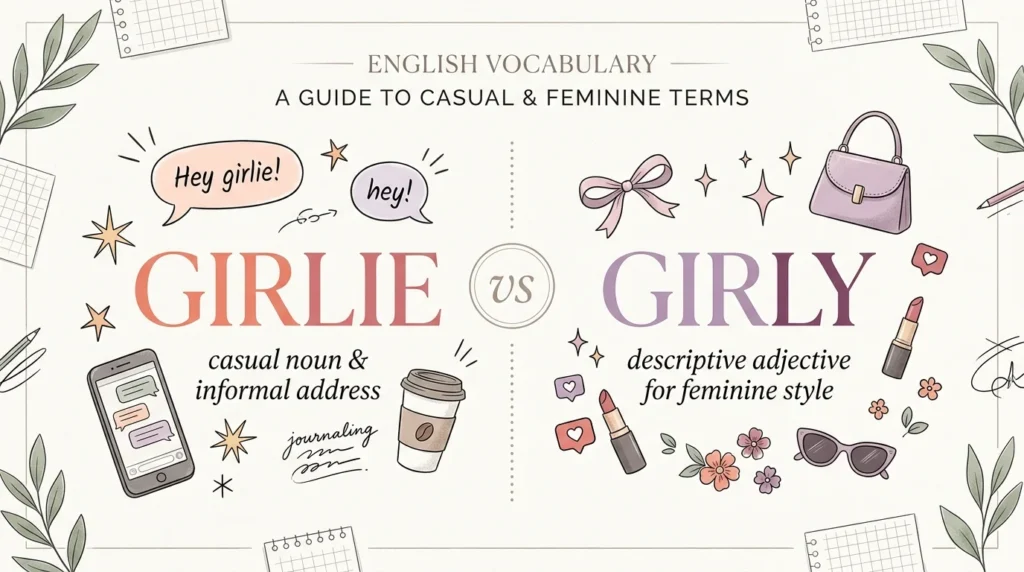

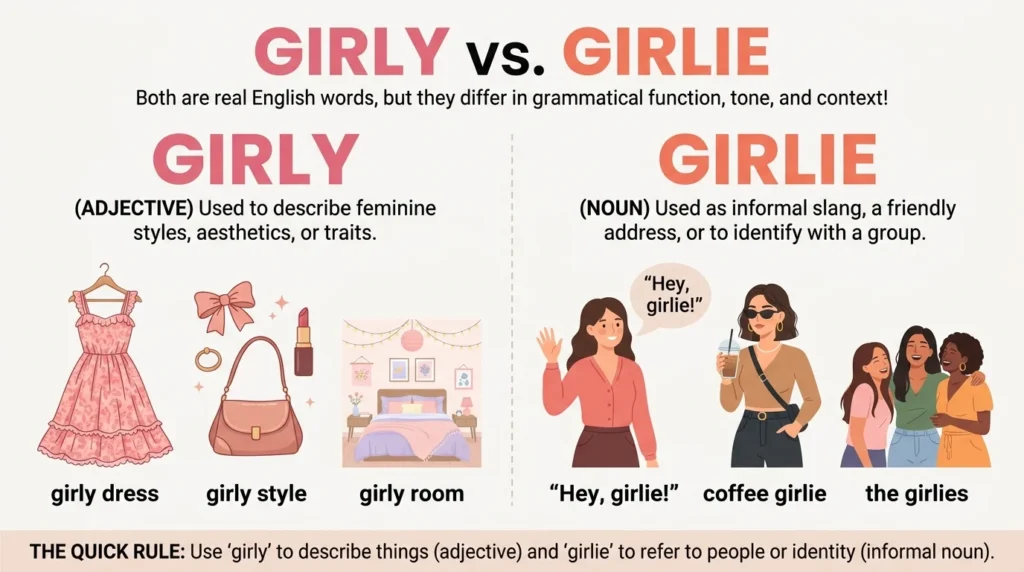
Girly and girlie are both real English words. Use girly when describing something associated with girls or traditionally feminine qualities, such as “a girly dress” or “a girly style.” Girlie can describe similar things, but it is also used informally as a noun or friendly form of address, as in “Hey, girlie!” or “the girlies.” Neither spelling is simply wrong. Context determines which one sounds appropriate.
What Is the Difference Between Girlie and Girly?
The main difference is not simply spelling. It is usage and grammatical function.
Girly is commonly an adjective. It describes something that is considered typical of girls or associated with femininity:
- a girly dress
- a girly room
- a girly hairstyle
- a girly aesthetic
- a girly voice
Girlie can also be an adjective with essentially the same broad meaning:
- a girlie dress
- a girlie weekend
- a girlie style
- a girlie magazine
However, girlie has additional uses. It can function as an informal noun or as a form of address:
- “Hey, girlie!”
- “Thanks, girlie.”
- “The girlies are meeting tonight.”
Dictionaries recognize this overlap. Cambridge lists girly as an adjective and also records girlie as an alternative form. Oxford similarly lists girlie as an informal variant of girly when it is used as an adjective.
So the simple idea that “girly is correct and girlie is wrong” is inaccurate.
The more useful rule is this:
Use “girly” when you want the straightforward adjective. Use “girlie” when the informal, playful, conversational, or noun-like use is part of what you mean.
Why Does the Difference Matter?
The spelling can change how your sentence sounds.
Compare:
- “She has a girly style.”
- “Hey, girlie, are you coming?”
The first sentence describes a style. The second directly addresses a person.
This becomes particularly important in writing because girlie can carry more personality than girly. In casual online language, expressions such as “gym girlie,” “coffee girlie,” or “the girlies” can identify a person with a particular interest or group identity.
At the same time, the word can have older or less positive associations in some contexts. Major dictionaries record girlie in expressions such as “girlie magazines,” and some dictionary definitions mark noun uses referring to women or girls as offensive or disapproving.
That means writers should consider audience and context, not just spelling.
The Core Rule
Use “girly” as your straightforward adjective when describing something associated with girls or traditionally feminine qualities. Use “girlie” when the context calls for its informal, playful, noun-like, or stylistic use.
For example:
- She bought a girly dress. ✓
- She bought a girlie dress. ✓
- Hey, girlie! ✓
- The girlies are going shopping. ✓
- Hey, girly! — possible in informal speech, but not necessarily the same tone or usage as “girlie.”
The two forms overlap, so this is a usage guideline rather than an absolute grammatical law.
How to Use Girly
Use “girly” to describe a style
When girly modifies a noun, it usually describes something considered traditionally feminine or associated with girls.
Examples include:
- girly clothes
- girly shoes
- girly makeup
- girly colors
- girly decorations
- girly handwriting
- girly hairstyles
- girly fashion
- girly bedroom
- girly aesthetic
For example:
She chose a simple but girly design for the bedroom.
Here, girly is an adjective describing the design.
Use “girly” to describe a quality or appearance
It can also describe a person, behavior, voice, style, or preference.
She has a very girly sense of style.
The meaning depends on context. Calling something girly can be affectionate or descriptive, but it can also sound dismissive if the speaker is treating traditionally feminine interests as inferior. Cambridge specifically notes that this usage can be disapproving in some contexts.
Use “girly” when you want the clearer general-purpose adjective
If you are writing an ordinary sentence and simply need an adjective meaning “associated with girls or traditionally feminine,” girly is often the most straightforward choice.
For example:
The brand has a soft, girly visual style.
There is no need to use girlie unless its particular tone or context is intended.
How to Use Girlie
Use “girlie” as an informal form of address
One of the clearest modern uses is addressing someone casually:
Hey, girlie! How are you?
Thanks, girlie!
This is informal and conversational. It may sound friendly between people who are comfortable with one another, but it would usually be unsuitable for a formal business email to someone you do not know.
Use “girlie” as an informal identity label
Modern informal English also uses girlie in expressions such as:
She is a total coffee girlie.
I’m a morning-walk girlie now.
Every skincare girlie knows this problem.
Here, girlie is not merely describing something as feminine. It identifies a person through a particular interest, habit, or identity.
This use is especially visible in contemporary online language.
Use “girlie” as a noun
Girlie can also refer informally to a girl or woman:
The girlies are meeting after work.
This noun use is recognized in dictionaries, although the tone and acceptability depend heavily on context. Cambridge marks the noun as informal, while Oxford gives a stronger warning about potentially offensive use when referring to a girl or young woman.
Use “girlie” as an adjective when the context naturally calls for it
Girlie is not restricted to noun use.
It can also describe something:
They planned a girlie weekend.
She wore a girlie dress with lots of ruffles.
Oxford explicitly lists girlie as an informal adjective and gives examples involving clothing.
So it would be inaccurate to say:
“Girlie can only be a noun.”
It can be an adjective as well.
Read More: Muscle vs Mussel: Meaning, Difference & Examples.
Correct Examples
Here are examples showing how the two forms work in different situations.
| Situation | Correct Example |
|---|---|
| Conversation | “I never used to like pink, but this dress is pretty girly.” |
| Text message | “Hey girlie, are you free tonight?” |
| Email to a close friend | “Thanks, girlie! That really helped.” |
| Workplace design discussion | “The current packaging looks too girly for the target market.” |
| Fashion | “She prefers a girly style with floral details.” |
| Social media | “I’m officially a coffee girlie.” |
| Casual group reference | “The girlies are going out after dinner.” |
| School writing | “The character is described as having a girly appearance.” |
| Academic discussion | “The advertisement uses traditionally girly colors and imagery.” |
| Personal conversation | “She has never considered herself particularly girly.” |
| Branding | “The new design feels less girly and more minimalist.” |
| Informal invitation | “It’s going to be a girlie weekend.” |
Notice that girly and girlie can sometimes both be grammatically possible. The question is then not “Which spelling is legal?” but “Which form best fits the intended meaning and tone?”
Incorrect vs. Correct
| ❌ Incorrect or Poor Choice | ✅ Better Choice | Why |
|---|---|---|
| “Hey girly, how are you?” when intending the modern friendly address | “Hey girlie, how are you?” | Girlie is a natural informal form of address in this context. |
| “The room is very girlie” when formal neutral wording is wanted | “The room is very girly” | Girly is the straightforward adjective for this meaning. |
| “The girlies design is beautiful.” | “The girly design is beautiful.” | Here the writer needs an adjective describing the design. |
| “I am a girly now.” | “I am a girlie now.” | The noun-like identity expression normally uses girlie. |
| “The girlie are meeting later.” | “The girlies are meeting later.” | A plural noun needs the plural form girlies. |
| “She bought a girly dress” is wrong because girlie is the only adjective. | “She bought a girly dress.” | Girly is a fully established adjective. |
| “Hey girlie” in a formal letter to a client | Use the person’s name or a professional greeting. | Girlie is informal and may be inappropriate professionally. |
| “She is girly” always means she is childish. | “She is girly” means she is perceived as having traditionally feminine qualities. | The word does not automatically mean childish. |
| “Girlie is just a misspelling of girly.” | “Girlie is also an established English form.” | Dictionaries recognize girlie as a word. |
| “Girly and girlie always have exactly the same meaning.” | “They overlap, but their usage and tone can differ.” | Context affects how each form functions. |
The most important correction is the ninth one: girlie is not simply a spelling error. Cambridge and Oxford both recognize the relationship between girly and girlie.
Why People Make This Mistake
They sound almost identical
In ordinary speech, girly and girlie are pronounced alike or extremely similarly. Cambridge gives the same pronunciation for the two forms when girly is listed with girlie as an alternative.
When two words sound the same, spelling becomes the main source of confusion.
Their meanings overlap
Both words can describe things associated with girls or traditionally feminine qualities.
That means a learner can encounter:
a girly dress
and:
a girlie dress
without seeing an obvious difference in meaning.
Social media has expanded “girlie”
Modern informal English frequently uses girlie in identity expressions:
- book girlie
- coffee girlie
- gym girlie
- skincare girlie
- travel girlie
- Pilates girlie
These expressions can make learners think that girlie has replaced girly. It has not. The two forms continue to have overlapping but distinct uses.
Spellcheck does not explain tone
A spellchecker may accept both words because both exist.
That does not mean they are interchangeable in every sentence.
Spellcheck can tell you whether a word is recognized. It cannot always tell you whether your choice sounds natural, appropriate, formal, affectionate, humorous, dated, or potentially offensive.
Translation can cause confusion
Learners may try to translate a word such as “feminine,” “girlish,” or a similar expression directly into English and assume there is one fixed spelling.
English does not work that neatly here because girly and girlie have overlapping dictionary meanings but different usage patterns.
Common Mistakes Checklist
Mistake 1: Treating “girlie” as wrong
Why it happens: Some grammar websites oversimplify the distinction and call girlie slang or incorrect.
How to avoid it: Remember that dictionaries recognize girlie as an English word.
Mistake 2: Treating “girly” as only a noun
Why it happens: Informal expressions such as “Hey, girly” sometimes appear online.
How to avoid it: In standard dictionary descriptions, girly is commonly an adjective, although it also has an informal noun use.
Mistake 3: Assuming “girlie” is only for social media
Why it happens: The modern noun and identity-label uses are highly visible online.
How to avoid it: Remember that girlie has older adjective uses too, including established expressions such as “girlie magazine” and “girlie dress.”
Mistake 4: Ignoring tone
Why it happens: Writers focus on spelling instead of the relationship between speaker and audience.
How to avoid it: Before using girlie to address someone, ask whether the relationship is informal enough for that tone.
Mistake 5: Assuming “girly” is always positive
Why it happens: People often use girly as a compliment.
How to avoid it: Consider context. Dictionary examples show that girly can sometimes carry a disapproving meaning.
Mistake 6: Using “girlies” for everyone
Why it happens: Social media has made group expressions such as “the girlies” popular.
How to avoid it: Treat it as an informal expression. It may sound friendly in one group and patronizing or inappropriate in another.
Girlie vs. Girly in Real English
When “girly” is grammatically correct and natural
Girly is natural when it functions as an adjective describing something associated with girls or traditionally feminine qualities. Phrases such as “girly clothes,” “girly style,” “girly colors,” and “girly bedroom” fit this pattern well. The word is informal, but it is an established English adjective. Its exact tone depends on the context and on whether the speaker treats the feminine quality positively, neutrally, or negatively.
When “girlie” is grammatically correct and natural
Girlie is natural when its informal character is part of the intended voice. “Hey, girlie!” is a clear example because the word is being used as an informal form of address. Modern expressions such as “coffee girlie” or “gym girlie” also make sense because the word is being used as an informal identity label. This is casual language rather than formal professional vocabulary.
When “girlie” is grammatically possible but less natural
You can sometimes replace girly with girlie before a noun without creating a grammatical error:
a girlie dress
a girlie room
But the choice can change the tone. Girlie may sound more playful, informal, conversational, or stylistically marked than the straightforward girly.
That does not make it incorrect. It simply means that the writer should consider what voice the sentence needs.
When either form can work
Some sentences allow both:
She has a very girly style.
She has a very girlie style.
Both can describe a feminine style. The first is the more straightforward adjective choice. The second adds a more informal or stylistic flavor.
The difference is therefore not always a strict grammar rule. Real English contains overlap.
American vs. British English
There is no simple American-versus-British spelling rule that says one country uses “girly” and the other uses “girlie.”
Both forms occur in English.
Cambridge lists girly with girlie as an alternative and gives examples such as “girlie chat” and “girlie weekend” in British usage.
Oxford also recognizes girlie as an informal form alongside girly.
The more useful distinction is therefore context and register, not nationality.
Formal vs. Informal Usage
Formal writing
In academic, professional, legal, or official writing, consider whether either word is actually necessary.
For example, instead of:
The advertisement uses girly colors.
a formal report might say:
The advertisement uses colors traditionally associated with femininity.
That wording is more precise when the exact cultural association matters.
Everyday writing
Girly is perfectly normal in informal everyday English:
That’s such a girly outfit.
Casual online communication
Girlie is particularly common in informal online language:
Thanks, girlie!
I’m a skincare girlie.
The girlies understand.
These expressions depend heavily on social context and tone.
Professional communication
Avoid using girlie as a form of address with a client, manager, professor, interviewer, or unfamiliar professional contact unless you already know that such a casual style is appropriate.
The issue is not spelling. The issue is register.
Read More: Imbed vs Embed: Which Spelling Is Correct?
Comparison Table
| Feature | Girly | Girlie |
|---|---|---|
| Correct English word? | Yes | Yes |
| Common adjective | Yes | Yes |
| Describes feminine qualities | Yes | Yes |
| Informal use | Yes | Yes |
| Informal noun use | Yes | Yes |
| Informal form of address | Possible | Especially common |
| Modern identity-label use | Less characteristic | Very common in some online expressions |
| Formal tone | Usually informal | Usually informal |
| Can appear in “girlie magazine” | Yes, as an alternative form | Yes |
| Can mean a girl or woman | Informally | Informally |
| Best default adjective | Often | Context-dependent |
The table shows why a simple “girly = correct, girlie = wrong” rule does not accurately describe English usage.
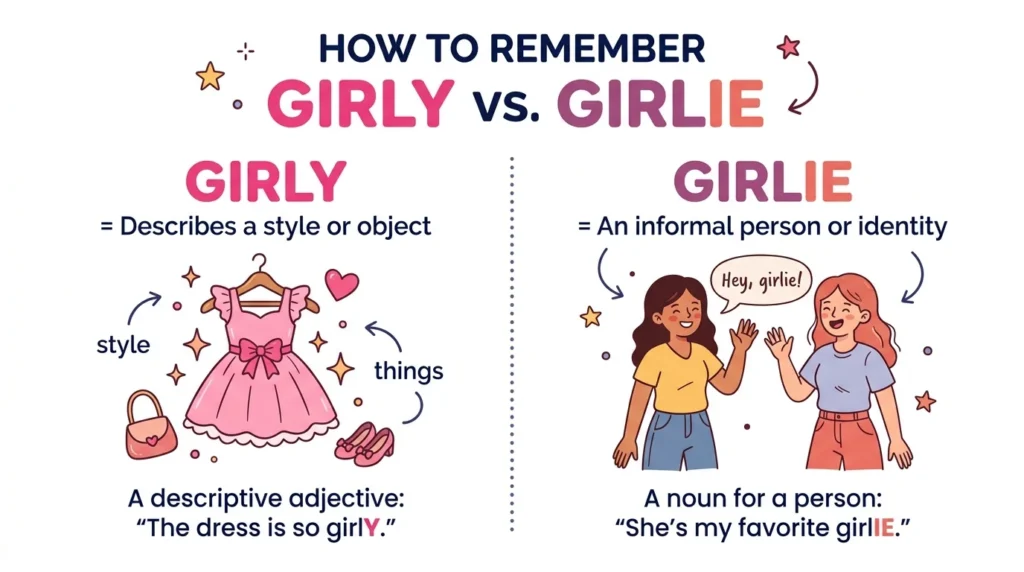
Memory Trick
Think of the -ie ending in girlie as adding a little extra personality.
Girly → describes
Girlie → can describe, address, or label someone informally
So:
Girly dress → describing a dress
Hey, girlie! → addressing a person
Coffee girlie → identifying a person by an interest
This is not a complete grammar rule, but it is a useful memory aid.
Real-Life Situations
In an interview
If you are discussing fashion:
“The collection has a very girly aesthetic.”
This is a straightforward descriptive use.
In a business meeting
If you are evaluating packaging:
“The current design may look too girly for the intended audience.”
Here, girly describes the visual impression.
In a personal text
To a close friend:
“Hey girlie, are you coming tonight?”
The informal form of address fits the situation.
In an email to a professor
Avoid:
“Hi girlie!”
Use a normal professional greeting instead.
The issue is not that girlie is grammatically impossible. The problem is that the register is inappropriate.
In a social media caption
“A little self-care because this girlie needed it.”
Here, girlie functions as part of a playful informal voice.
In an academic paper
Instead of casually describing something as “girly,” you may need a more precise term such as:
traditionally feminine
associated with femininity
marketed toward girls
The best choice depends on what exactly you are trying to describe.
Expert Tips
1. Do not ask only “Which spelling is correct?”
Ask:
What am I trying to do with the word?
Are you describing something? Addressing someone? Referring to a group? Creating a playful social-media voice?
That question often solves the problem immediately.
2. Do not confuse “informal” with “incorrect”
A word can be informal and still be completely legitimate English.
Dictionaries explicitly recognize informal uses of both girly and girlie.
3. Think about the audience
“Hey girlie!” might be perfectly natural between friends and completely inappropriate in a formal business letter.
4. Be careful with gender stereotypes
Both words can describe things that a culture traditionally associates with girls or women. That does not mean those qualities are inherently feminine.
When precision matters, describe the actual feature:
- pink and floral
- playful
- feminine
- targeted at young women
- traditionally associated with girls
This is often clearer than relying on girly.
5. Watch for historical meanings
Girlie appears in older expressions such as “girlie magazine,” where it can refer to sexualized images of women. Major dictionaries still record this sense.
So the surrounding words matter.
6. Do not let social media rewrite the dictionary
Online language changes quickly.
The popularity of “gym girlie” does not mean that girly has become incorrect. Likewise, the existence of girly does not make every use of girlie a spelling error.
FAQ
Is “girlie” a correct word?
Yes. Girlie is a real English word. It can function as an adjective and, in informal usage, as a noun or form of address. Dictionaries recognize it as an established form related to girly.
Is “girly” a correct word?
Yes. Girly is an established English adjective meaning associated with girls or traditionally feminine qualities. It can also have an informal noun use.
Is “girlie” just a misspelling of “girly”?
No. Both forms are recognized in dictionaries. Girlie has its own established uses and is not simply a typographical error.
Which is better: “girlie dress” or “girly dress”?
Both can be correct. “Girly dress” is the straightforward adjective choice. “Girlie dress” is also established but can sound more informal or stylistically marked.
Can I say “Hey, girlie”?
Yes. It is an informal form of address. It is appropriate mainly in casual relationships where that friendly tone is expected.
Can I say “Hey, girly”?
It is possible in informal speech, but it does not necessarily have exactly the same tone as “Hey, girlie.” Context and speaker relationship matter.
Is “girlie” formal English?
Girlie is generally associated with informal usage. Oxford and Cambridge both mark relevant uses as informal.
Is “girly” formal English?
Girly is also generally informal. In formal writing, a more precise expression such as “feminine,” “traditionally associated with girls,” or “marketed toward girls” may be more appropriate, depending on the meaning.
What does “girlies” mean?
Girlies is the plural of girlie when it is used as a noun. In casual modern language, it can refer to a group of girls or women. The expression is informal and its tone depends on context.
Is “girlie” common on social media?
Yes. Modern informal online English uses girlie in expressions such as “coffee girlie,” “gym girlie,” and “the girlies.” These uses are conversational and identity-focused rather than formal.
Does “girly” mean childish?
Not automatically. Girly can describe something traditionally associated with girls or femininity. In some contexts it can suggest youthfulness or childishness, but that is not its only meaning. Cambridge and Oxford distinguish several contextual senses.
Can “girly” and “girlie” be used interchangeably?
Sometimes. Both can function as adjectives with the broad meaning of feminine or associated with girls. But girlie has additional informal noun and address uses, so the words are not interchangeable in every sentence.
Mini Quiz
| # | Question | Answer | Explanation |
|---|---|---|---|
| 1 | Which is the straightforward adjective? A) girly B) girlie | A) girly | Girly is a common adjective for something associated with girls or femininity. |
| 2 | Complete: “Hey ___, are you coming?” A) girly B) girlie | B) girlie | Girlie works naturally as an informal form of address. |
| 3 | Is “girlie” a real English word? | Yes | Dictionaries recognize girlie as an adjective and/or noun depending on the dictionary and sense. |
| 4 | Correct the sentence: “I am a girly who loves coffee.” | “I am a coffee girlie.” | The intended modern informal identity-label use is better expressed with girlie. |
| 5 | Which sounds more straightforward in “She has a ___ style”? A) girly B) girlie | A) girly | Girly is the uncomplicated adjective choice. |
| 6 | True or false: “Girlie” is always incorrect in formal English. | False | The word itself is legitimate, although its informal senses may be unsuitable for formal contexts. |
| 7 | Complete: “The ___ are meeting after work.” | girlies | Girlies is the plural noun form of girlie. |
| 8 | Correct the sentence for a professional email: “Hey girlie, can you send the report?” | “Hi [Name], could you send the report?” | The problem is inappropriate register, not spelling. |
| 9 | Can “girly” and “girlie” both describe a dress? | Yes | Both can function as adjectives, although girly is the more straightforward choice. |
| 10 | Which statement is accurate? A) Girlie is always wrong. B) Girly is always the only correct spelling. C) Both are real words with overlapping but different uses. | C | Dictionaries recognize both forms, and context determines the most appropriate choice. |
Quick Summary
Girlie and girly are both correct English words. Girly is commonly used as an adjective to describe something associated with girls or traditionally feminine qualities, such as a girly dress, style, or room. Girlie can also work as an adjective, but it has additional informal uses as a noun, form of address, or identity label, especially in casual online language. Neither spelling should automatically be treated as a mistake. When you simply need the straightforward adjective, girly is usually the clearest choice. When you are addressing someone informally or using a playful identity expression such as “coffee girlie,” girlie may be more natural. Always consider grammar, tone, audience, and context.