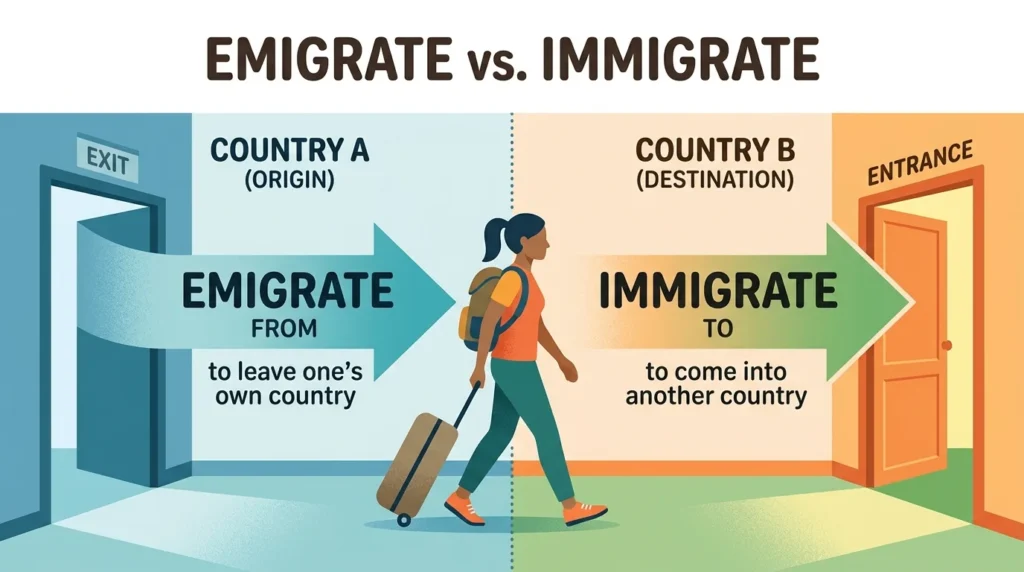

Use emigrate when you mean leaving a country to live somewhere else, and use immigrate when you mean moving into another country to live there. For example, “She emigrated from Pakistan” focuses on the country she left, while “She immigrated to Canada” focuses on the country she entered. The two words can describe the same move from opposite points of view.
What Is the Difference Between Emigrate and Immigrate?
Emigrate and immigrate both describe moving from one country to another, but they focus on opposite ends of that journey.
- Emigrate = leave a country to live elsewhere.
- Immigrate = enter another country to live there.
Think of one person moving from Pakistan to Canada.
From Pakistan’s point of view, the person emigrated from Pakistan.
From Canada’s point of view, the person immigrated to Canada.
So the two words are not competing descriptions of two different kinds of moves. They can describe the same move from different perspectives.
The easiest way to remember the distinction is:
Emigrate = exit
Immigrate = into
This difference is about direction and perspective, not about whether the move itself is legal, voluntary, temporary, or permanent in every possible context. In ordinary dictionary usage, both words are associated with moving to another country to live there, with emigrate emphasizing departure and immigrate emphasizing arrival.
Read More: Imbed vs Embed: Which Spelling Is Correct?
Why It Matters
Choosing the wrong word can make a sentence confusing, especially when writing about migration, international education, employment, family relocation, history, or immigration policy.
Compare these:
- “My grandparents emigrated from Italy.”
- “My grandparents immigrated to Australia.”
Both can describe the same family history.
But these sentences focus on different places:
- from Italy → the departure point → emigrated
- to Australia → the destination → immigrated
The distinction becomes particularly useful in professional and academic writing because the two verbs are not simply interchangeable synonyms.
If you write:
“They emigrated to Canada.”
Many readers will understand what you mean because the overall context is clear. However, “They immigrated to Canada” is the more direct choice when the sentence is specifically focusing on entering Canada.
Likewise, if your focus is on leaving Poland, “They emigrated from Poland” makes that relationship immediately clear.
The Core Rule
Use emigrate for leaving a country. Use immigrate for entering a new country.
A useful preposition pattern is:
emigrate + from
immigrate + to
For example:
- He emigrated from Ireland.
- She immigrated to Canada.
When both the origin and destination are mentioned, one sentence can contain both perspectives:
He emigrated from Ireland and immigrated to Canada.
This is not repetitive. The first verb describes leaving Ireland; the second describes entering Canada.
Grammar references specifically identify “emigrate from” and “immigrate to/into” as the standard pairings.
How to Use Emigrate
Use emigrate when the sentence emphasizes the country or place a person is leaving.
Emigrate from a country
This is the clearest and most common construction when the origin matters.
- She emigrated from Brazil in 2018.
- His parents emigrated from India.
- Thousands of people emigrated from the region.
- My grandfather emigrated from Poland after the war.
The important question is:
“Where did the person leave?”
If that is the focus, emigrate is usually the appropriate verb.
Emigrate to a new country
You may also encounter emigrate to when the destination is mentioned.
For example:
She emigrated from Germany to Canada.
Here, emigrated still emphasizes the act of leaving Germany, while “to Canada” supplies the destination.
However, if the sentence is mainly about moving into Canada, immigrated to Canada is more precise.
This is an important distinction because learners sometimes turn the “from/to” rule into an absolute grammar rule. The practical rule is better understood as a meaning-and-focus rule:
- emigrate → departure is the main focus
- immigrate → arrival is the main focus
How to Use Immigrate
Use immigrate when the sentence emphasizes entering and settling in another country.
Immigrate to a country
This is the standard construction.
- She immigrated to Canada in 2020.
- His family immigrated to Australia.
- They immigrated to the United States after the war.
- My grandparents immigrated to Britain in the 1950s.
The key question is:
“Where did the person move into?”
If the answer is the focus, use immigrate.
Immigrate from a country
A sentence can also mention the country of origin with from:
She immigrated to Canada from India.
Here, to Canada identifies the destination and from India identifies the origin.
The important point is that the preposition alone does not always determine the verb. The meaning of the verb and the main direction being described matter.
Correct Examples
Here are examples showing how the two verbs work in different settings.
| Situation | Correct Example |
|---|---|
| Conversation | My uncle emigrated from Pakistan when he was young. |
| Family history | Her grandparents immigrated to Canada in the 1960s. |
| My parents emigrated from Italy before I was born. | |
| Workplace | Several employees immigrated to the country for new career opportunities. |
| School essay | Many families emigrated from Europe during the nineteenth century. |
| Academic writing | The study examines people who immigrated to the region during the postwar period. |
| Social media | My family emigrated from India three generations ago. |
| News writing | Thousands of residents emigrated from the country during the crisis. |
| Personal statement | My parents immigrated to Australia before I started school. |
| Historical writing | The community was established by families who had emigrated from Ireland. |
| Biography | He emigrated from Russia and eventually settled in the United States. |
| Immigration context | Her family immigrated to Germany in search of new opportunities. |
Incorrect vs. Correct
The following examples focus on the most common word-choice problems.
| ❌ Incorrect | ✅ Correct | Why |
|---|---|---|
| We will emigrate to Canada. | We will immigrate to Canada. | The sentence focuses on entering Canada. |
| They immigrated from Poland. | They emigrated from Poland. | The sentence focuses on leaving Poland. |
| My family emigrated to Australia. | My family immigrated to Australia. | If Australia is the destination being emphasized, immigrate is the clearer choice. |
| She immigrated from Ireland. | She emigrated from Ireland. | The focus is on leaving Ireland. |
| He emigrated to the United States from Mexico. | He emigrated from Mexico to the United States. | The revised version clearly presents emigration as departure from Mexico. |
| They immigrated from France to Canada. | They immigrated to Canada from France. | The destination should be clear when immigrate is the main verb. |
| My grandfather immigrated from Italy. | My grandfather emigrated from Italy. | If the intended meaning is that he left Italy, emigrate expresses that viewpoint. |
| She plans to emigrate to New Zealand permanently. | She plans to immigrate to New Zealand permanently. | The sentence emphasizes entering the destination country. |
| Many citizens immigrated from the country last year. | Many citizens emigrated from the country last year. | The sentence describes people leaving the country. |
| They emigrated to Canada and left their homeland. | They immigrated to Canada after leaving their homeland. | The second version keeps the arrival focus clear. |
The first and fourth examples illustrate the basic distinction that grammar references commonly teach: emigrate from and immigrate to.
Why People Make This Mistake
The words look almost identical
Both words contain -migrate, and their spellings differ by only a few letters.
That makes it easy to remember that they are related without remembering which one describes leaving and which describes arriving.
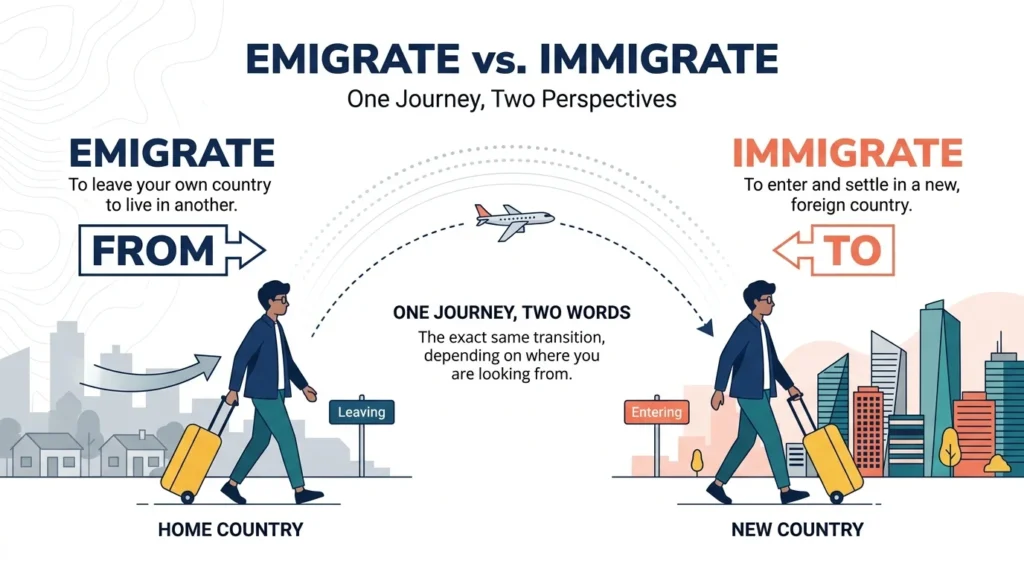
They describe the same journey
This is probably the biggest source of confusion.
Imagine a person moving from Spain to France.
There is only one physical journey.
But you can describe it in two ways:
She emigrated from Spain.
or:
She immigrated to France.
Because both sentences can be true, learners sometimes conclude that the verbs are interchangeable. They are not. They simply describe different perspectives on the same movement.
Read More: Licence vs License: British and American English.
The pronunciation is similar
The words sound similar enough that learners may recognize the general meaning but forget which beginning belongs to which direction.
Spelling does not provide enough help
The prefixes are useful clues, but they are not always obvious to learners.
A practical memory aid is:
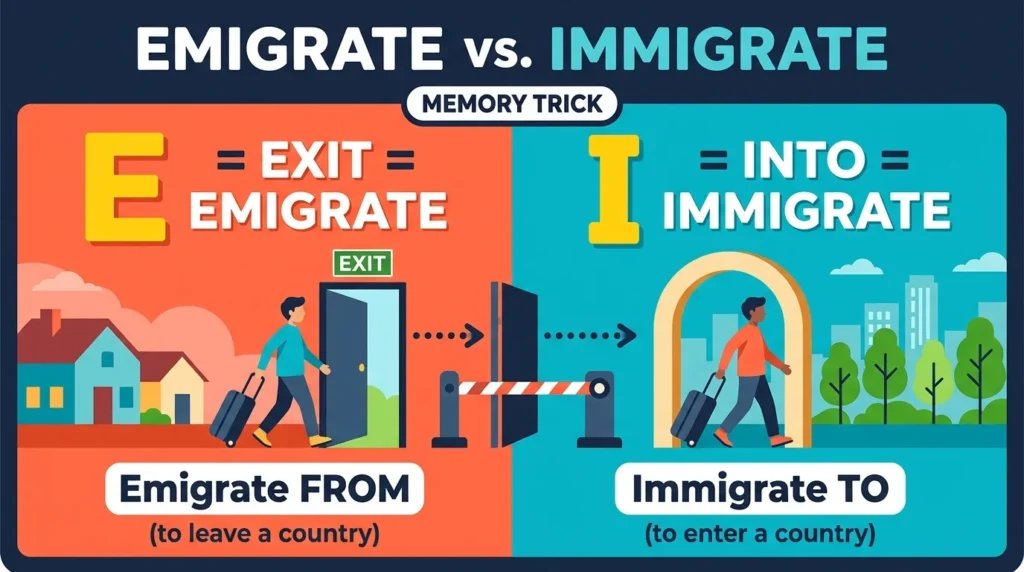
E = Exit → Emigrate
I = Into → Immigrate
This is a memory device, not a complete explanation of the words’ history.
Translation interference
In some languages, one general word may cover both ideas. A learner may therefore translate a sentence using one word for “move abroad” and assume English works the same way.
English makes the viewpoint distinction more clearly with these two verbs.
Spellcheck cannot always save you
A spelling checker can recognize that emigrate and immigrate are correctly spelled words.
If you use the wrong one in a grammatically acceptable sentence, ordinary spellcheck may not identify the intended meaning.
For example:
We plan to emigrate from Brazil.
and:
We plan to immigrate to Canada.
Both contain correctly spelled words. The important question is whether the chosen verb matches the intended direction.
Common Mistakes Checklist
1. Using “emigrate” when the destination is the focus
Mistake:
They emigrated to Canada.
Better:
They immigrated to Canada.
Why:
The sentence is primarily about entering Canada.
2. Using “immigrate” when the departure is the focus
Mistake:
She immigrated from India.
Better:
She emigrated from India.
Why:
The sentence emphasizes leaving India.
3. Treating the words as spelling variants
They are not two spellings of the same word.
They have different meanings.
4. Forgetting the perspective
Ask:
Am I looking at the country being left or the country being entered?
That question often solves the problem immediately.
5. Assuming “from” and “to” are absolute grammar tests
The common patterns are useful:
- emigrate from
- immigrate to
But sentences can mention both origin and destination. For example:
She immigrated to Canada from Pakistan.
So do not treat the preposition as the only rule. First identify the intended perspective.
Emigrate vs. Immigrate in Real English
Grammatically correct: “They emigrated from Mexico.”
This is a straightforward, natural construction. The sentence focuses on the country the people left. Emigrate from is a well-established combination and is especially clear when the origin country is important. It works naturally in conversation, biographies, historical writing, news reporting, and academic contexts.
Grammatically correct: “They immigrated to Canada.”
This is also a straightforward, natural construction. The sentence focuses on Canada as the destination. Immigrate to is the standard way to describe moving into another country to live there. It is common in discussions of migration, family history, education, employment, and immigration.
Grammatically possible but less precise for the intended focus: “They emigrated to Canada.”
This construction can occur because emigrate can describe the broader act of leaving one country to live elsewhere, and the destination can be supplied. However, if the writer’s main point is that the people entered Canada, immigrated to Canada makes the intended perspective clearer. The issue is therefore one of precision and focus rather than simply declaring the construction impossible.
Grammatically possible but potentially unclear: “They immigrated from Mexico.”
A sentence like this can appear when the origin is being supplied, but it can make the intended perspective less immediately clear because immigrate normally directs the reader toward the destination. If the point is specifically that the people left Mexico, emigrated from Mexico is clearer. If both are important, write “They immigrated to Canada from Mexico.”
Natural everyday alternative: “They moved to Canada.”
In ordinary conversation, people often use move to instead of either emigrate or immigrate. “We moved to Canada in 2020” is simple and natural when the immigration terminology itself is not important.
That does not make emigrate or immigrate incorrect or unnatural. The choice depends on what you want the sentence to communicate.
American vs. British English
There is no major American-versus-British difference in the basic distinction between these two verbs.
American and British English both use:
- emigrate for leaving a country
- immigrate for entering another country
Pronunciation can vary between British and American English, but the basic meaning and word-choice distinction remain the same. Dictionary entries for both varieties maintain the same core contrast.
Formal vs. Informal Usage
Both emigrate and immigrate are standard words and can be used in formal writing.
They are particularly useful in:
- academic writing
- historical writing
- government and immigration contexts
- journalism
- biographies
- research
- professional communication
In casual conversation, however, move to is often simpler:
“My family moved to Canada.”
Instead of:
“My family immigrated to Canada.”
The second sentence is perfectly natural when the immigration aspect matters. The first is simply more general and conversational.
Comparison Table
| Feature | Emigrate | Immigrate |
|---|---|---|
| Basic meaning | Leave a country to live elsewhere | Enter another country to live there |
| Main focus | Departure | Arrival |
| Typical preposition | from | to |
| Example | She emigrated from India. | She immigrated to Canada. |
| Perspective | Country being left | Country being entered |
| Related noun | Emigrant | Immigrant |
| Process noun | Emigration | Immigration |
| Same journey possible? | Yes | Yes |
| Common everyday alternative | Move away / move abroad | Move to another country |
| Memory clue | E = Exit | I = Into |
Emigrant vs. Immigrant
The same distinction applies to the nouns.
An emigrant is a person viewed from the perspective of the country they leave.
An immigrant is a person viewed from the perspective of the country they enter.
For example:
Maria emigrated from Brazil.
Maria can therefore be described as an emigrant from Brazil.
At the same time:
Maria immigrated to Canada.
Maria can also be described as an immigrant to Canada.
One person can therefore be both an emigrant and an immigrant, depending on the perspective.
Emigration vs. Immigration
The nouns follow the same pattern.
Emigration focuses on leaving:
Emigration from the region increased during the decade.
Immigration focuses on entering:
Immigration to the country increased during the decade.
This is why you will often see both words used in the same discussion:
The country experienced high emigration, while its neighboring countries received high levels of immigration.
The movement may involve the same people, but the statistical or descriptive perspective is different.
What About Migrate?
Migrate is the broader word.
It means to move from one place to another and does not necessarily emphasize either the country of departure or the destination in the same way.
For example:
Thousands of people migrated to the cities.
You can also use migrate for animals:
The birds migrate south every winter.
This makes migrate different from the more specific country-focused meanings of emigrate and immigrate.
A useful three-word distinction is:
- Migrate = move
- Emigrate = leave
- Immigrate = enter
Memory Trick
Use the first letter as your quick reminder:
E = Exit → Emigrate
I = Into → Immigrate
Picture a doorway.
If the person is exiting the country, think E:
Emigrate from Pakistan.
If the person is moving into a new country, think I:
Immigrate to Canada.
Another useful shortcut is:
FROM → EMIGRATE
TO → IMMIGRATE
This is not a substitute for understanding the meanings, but it is a fast way to check your choice while writing.
Real-Life Situations
Interview
“My parents emigrated from Bangladesh when I was five.”
The speaker is talking about the country their parents left.
Job application
“I immigrated to the United States with my family in 2015.”
The applicant is focusing on entering the United States.
Family conversation
“My grandparents moved to Australia after the war.”
Here, the simple everyday verb moved works perfectly because the technical migration perspective is not important.
Academic writing
“The study examines families that immigrated to the region during the twentieth century.”
The destination is the focus.
Historical writing
“Large numbers of families emigrated from Ireland during the nineteenth century.”
The departure country is the focus.
“My family emigrated from Italy before I was born.”
The sentence explains the family’s departure.
Social media
“My grandparents immigrated to Canada nearly 60 years ago.”
The destination is central to the statement.
Expert Tips
Tip 1: Look for the country that matters most
If the sentence is about leaving, choose emigrate.
If it is about arriving, choose immigrate.
Tip 2: Do not confuse the person with the perspective
The same individual can be an emigrant and an immigrant.
It depends on which country you are talking about.
Tip 3: “Move” is often the simplest choice
If you do not need to emphasize immigration or emigration, move may be more natural:
We moved to Germany last year.
There is no need to force a technical migration word into an ordinary sentence.
Tip 4: Use the preposition as a quick check
When you see:
___ from India
Ask whether the sentence means leaving India.
If yes, emigrate is usually the right choice.
When you see:
___ to Canada
Ask whether the sentence means entering Canada.
If yes, immigrate is usually the right choice.
Tip 5: Remember that one journey can have two descriptions
Do not try to decide which word is universally “correct” for a person.
Both may be correct:
He emigrated from China.
He immigrated to Canada.
The correct word depends on the viewpoint.
Quick Summary
Emigrate means to leave a country to live elsewhere, while immigrate means to enter another country to live there. The easiest distinction is emigrate = exit and immigrate = into. A person moving from India to Canada can emigrate from India and immigrate to Canada. The words therefore describe the same international move from different perspectives. Emigrate commonly works with from, while immigrate commonly works with to. The two words are used in both American and British English with essentially the same distinction. In everyday conversation, move to is often a simpler alternative when the immigration perspective is not important. When writing precisely, focus on whether your sentence emphasizes the country being left or the country being entered.
FAQ
Frequently Asked Questions
Is it emigrate or immigrate to another country?
Use immigrate when the sentence focuses on moving into the new country.
She immigrated to Canada.
Use emigrate when the sentence focuses on leaving the original country.
She emigrated from India.
Can one person emigrate and immigrate?
Yes. The same person can do both.
Someone who moves from Mexico to Canada can emigrate from Mexico and immigrate to Canada. The two verbs describe different perspectives on the same move.
Is “emigrate to” correct?
It can occur, particularly when the destination is supplied as part of a larger description, but immigrate to is generally clearer when the destination is the main focus.
For example:
She emigrated from Germany to Canada.
She immigrated to Canada from Germany.
The first emphasizes departure; the second emphasizes arrival.
Is “immigrate from” correct?
It can appear when the origin is included, especially alongside a destination:
They immigrated to Australia from India.
If the sentence only focuses on leaving India, however, emigrated from India is the clearer choice.
What is the easiest way to remember emigrate and immigrate?
Remember:
E = Exit → Emigrate
I = Into → Immigrate
You can also remember:
emigrate from
immigrate to
What is the difference between emigrate and migrate?
Emigrate specifically focuses on leaving a country to live elsewhere. Migrate is broader and simply describes movement from one place to another. Migrate can also be used for animals and for movement that is not necessarily international.
What is the difference between an emigrant and an immigrant?
An emigrant is a person considered from the perspective of the country they left.
An immigrant is a person considered from the perspective of the country they entered.
The same person can therefore be both.
Is immigrate more common than emigrate?
In many modern contexts involving government, population, and settlement, immigration and immigrant are encountered very frequently. However, frequency does not make immigrate a replacement for emigrate. Each word has its own perspective and meaning.
Are emigrate and immigrate formal words?
Yes. Both are standard words suitable for formal and academic writing. In casual conversation, people often use simpler wording such as move to another country.
Do American and British English use these words differently?
The basic distinction is the same in both varieties:
- emigrate = leave
- immigrate = enter
The main differences you may hear are pronunciation differences, not a different basic rule.
Which word should I use in an academic essay?
Use the word that matches your intended perspective. Use emigrate when discussing departure from a country and immigrate when discussing arrival in a country. If the distinction is not important, move or migrate may sometimes be more appropriate.
Mini Quiz
| # | Question | Answer | Explanation |
|---|---|---|---|
| 1 | She plans to ___ to Canada next year. A) emigrate B) immigrate | B) immigrate | Canada is the destination, so immigrate to is the natural choice. |
| 2 | His family ___ from Ireland in 1952. A) emigrated B) immigrated | A) emigrated | The sentence focuses on leaving Ireland. |
| 3 | Fill in the blank: They immigrated ___ Australia. | to | Immigrate to is the standard destination pattern. |
| 4 | Fill in the blank: She emigrated ___ Spain. | from | Emigrate from identifies the country being left. |
| 5 | Correct the sentence: “My grandparents immigrated from Italy to Canada.” | My grandparents immigrated to Canada from Italy. | The revised sentence makes the destination the focus of immigrate. |
| 6 | Which word focuses on leaving a country? A) immigrate B) emigrate | B) emigrate | Emigrate focuses on departure. |
| 7 | Which sentence is clearer if Canada is the destination? A) They emigrated to Canada. B) They immigrated to Canada. | B) They immigrated to Canada. | Immigrate to directly expresses arrival in the destination country. |
| 8 | Correct the sentence: “Thousands immigrated from the country during the crisis.” | Thousands emigrated from the country during the crisis. | The sentence focuses on people leaving the country. |
| 9 | A person moved from India to Canada. Complete both: “She ___ from India and ___ to Canada.” | emigrated; immigrated | Emigrate describes leaving India; immigrate describes entering Canada. |
| 10 | Which sentence is correct? A) We moved to France last year. B) We immigrated to France last year. | Both are correct. | Moved is general and conversational; immigrated specifically emphasizes entering France to live there. |