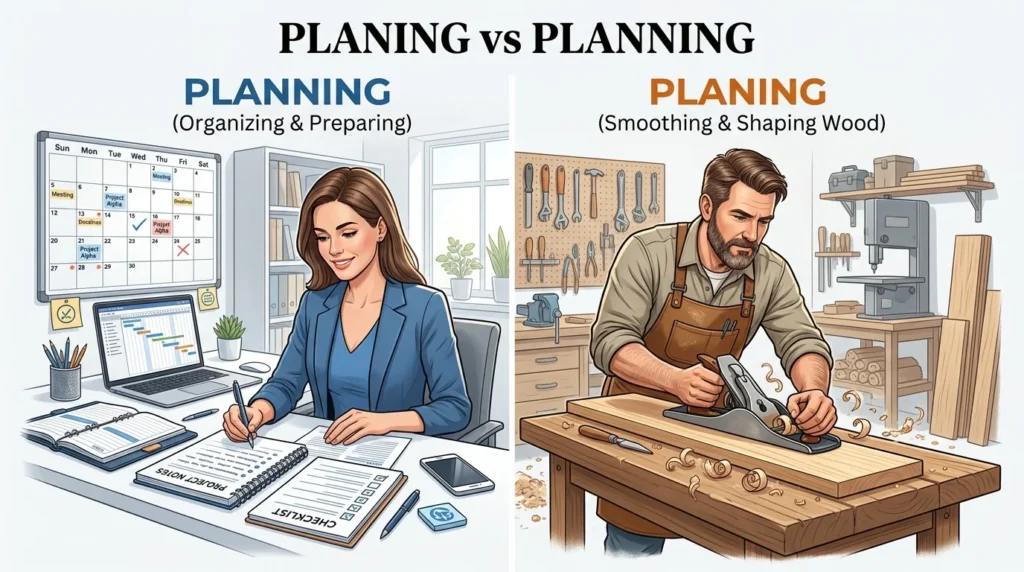

If you mean making arrangements, preparing for something, or deciding what to do, the correct word is planning.
Planing is also a real English word, but it has a different meaning. It usually refers to smoothing or shaping a surface with a plane, especially in woodworking. It can also describe certain kinds of gliding movement, such as a boat planing over water.
So:
- planning = organizing or preparing
- planing = smoothing/shaping with a plane, or gliding in certain contexts
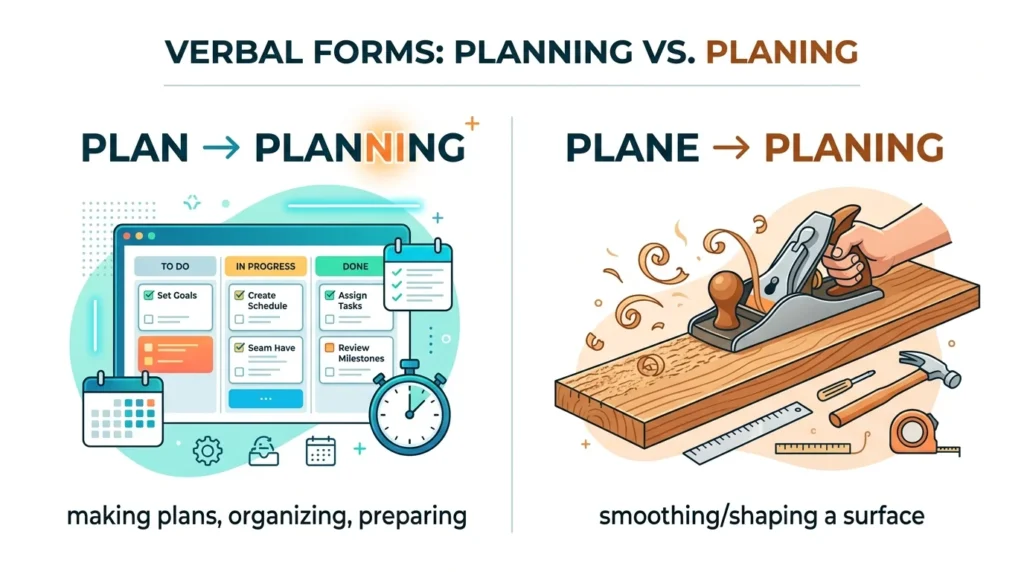
The extra n changes the word because these forms come from two different base verbs: plan → planning and plane → planing.
What Is the Difference Between Planing and Planning?
The difference is mainly a difference in meaning and base word.
Planning comes from the verb plan. It means thinking about what you will do, organizing steps, preparing for an event, or deciding how to achieve a goal.
We are planning a family trip.
Planing comes from the verb plane. In woodworking, to plane something means to remove thin layers from a surface with a plane so that the surface becomes smoother, flatter, or more even.
The carpenter is planing the wooden door.
There is also another meaning of plane related to movement. A boat can plane when it moves rapidly across water with much of its hull lifted above the surface. The -ing form is planing.
The key is therefore not simply to look at the number of n’s. Look at the meaning first.
| Word | Base verb | Main meaning | Example |
|---|---|---|---|
| planning | plan | Preparing or organizing | We are planning the event. |
| planing | plane | Smoothing or shaping a surface | He is planing the board. |
| planing | plane | Moving/gliding over a surface | The boat was planing across the water. |
For ordinary conversations about trips, projects, meetings, careers, schedules, or future activities, planning is the form you normally need.
Why Does It Matter?
A one-letter difference can completely change the meaning of a sentence.
Consider:
We are planing our wedding.
The spelling planing is not inherently fake or misspelled. It is a legitimate English word. But in this sentence, the intended meaning is almost certainly that the people are organizing a wedding.
The correct sentence is:
We are planning our wedding.
Now consider:
The carpenter is planing the cabinet door.
Here, planing is exactly right because the carpenter is using a plane to remove material from the door.
This distinction matters because a reader may recognize both words. A spellchecker may also recognize both words. The problem is therefore sometimes not spelling validity, but word choice.
Getting the wrong form into an email, report, assignment, proposal, or professional document can make the writer appear careless even though the mistaken word itself is a legitimate English word.
Read More: Licence vs License: British and American English.
The Core Rule
Use planning when you mean making or organizing plans. Use planing when you mean the action of planing something with a plane, or a relevant sense of gliding over a surface.
The easiest comparison is:
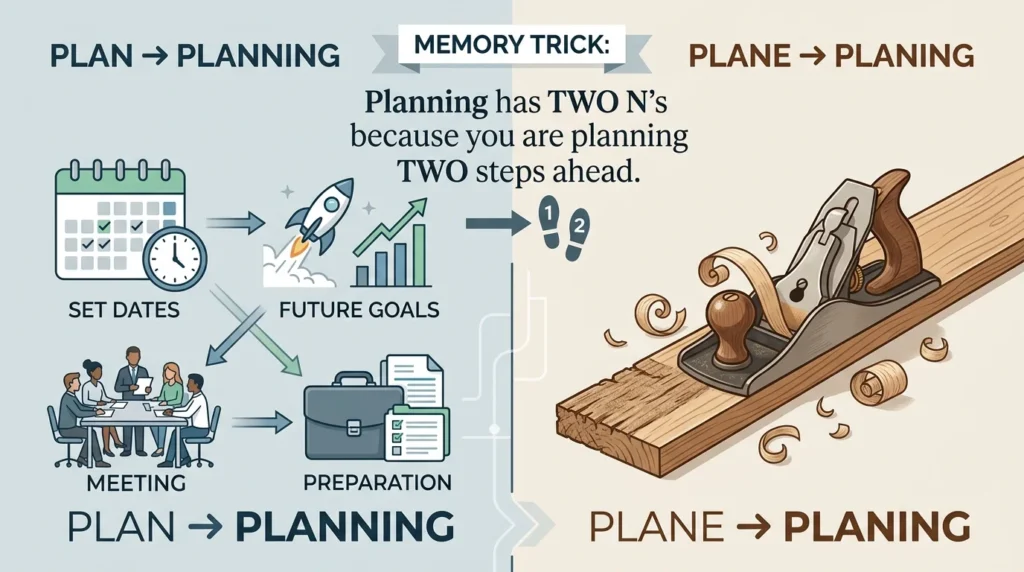
plan → planning
plane → planing
Do not treat planing as an alternative spelling of planning. They are forms of different verbs.
The spelling pattern behind planning
The verb plan is a one-syllable verb ending in a consonant after a short vowel sound.
When -ing is added, the final consonant is doubled:
- plan → planning
- run → running
- sit → sitting
- stop → stopping
So:
plan + ing → planning
By contrast, plane ends in a silent e. When -ing is added, the final e is normally removed:
plane + ing → planing
This gives us:
plan → planning
plane → planing
The two spellings are therefore not competing versions of the same word.
How to Use Planning
Use planning when you are talking about preparing for something or organizing what needs to happen.
Planning a future activity
We are planning a trip to Lahore next month.
You are deciding what will happen and preparing for it.
Planning an event
The committee is planning the annual conference.
The committee is organizing the event.
Planning at work
Our team is planning a new marketing campaign.
The team is deciding how the campaign will be carried out.
Planning your time
I am planning my schedule for next week.
You are organizing future activities.
Planning a project
They spent three weeks planning the construction project.
They prepared the steps before beginning the work.
Planning a career
She is planning her career carefully.
She is thinking ahead and making decisions about her future.
Planning in academic writing
Careful planning can improve the structure of a research project.
Here, planning is a noun referring to the process of preparing or organizing.
Planning in everyday conversation
Are you planning anything for the weekend?
This is the ordinary form used when asking about future arrangements.
How to Use Planing
Use planing when the verb is plane, not plan.
In its most familiar technical use, planing means removing material from a surface with a plane.
Woodworking
The carpenter is planing the oak board.
The carpenter is using a plane to smooth or flatten the wood.
Furniture making
After planing the edges, she sanded the table.
The edges were physically shaped or smoothed.
Fitting a door
The carpenter is planing the bottom of the door.
Material is being removed so that the door fits properly.
Surface preparation
The craftsman finished planing the wooden panel.
The word refers to the physical process rather than future organization.
Boats and movement
Planing can also be used when a boat moves rapidly across water in a way that lifts much of its hull above the surface.
The speedboat was planing across the lake.
This is another legitimate use of planing, but it is unrelated to making plans.
Correct Examples
Here are examples showing how the two words work in different situations.
| Situation | Correct sentence |
|---|---|
| Conversation | I am planning a short trip this weekend. |
| We are planning the meeting for Thursday. | |
| Workplace | The team is planning its next campaign. |
| School | I am planning my study schedule for the exam. |
| Academic writing | Careful planning is essential before collecting the data. |
| Social media | We are planning something special for Friday. |
| Business | The company is planning to open another branch. |
| Travel | They are planning their holiday months in advance. |
| Carpentry | The carpenter is planing the wooden board. |
| Boat movement | The boat was planing smoothly across the water. |
| Furniture making | He spent the morning planing the tabletop. |
| Home repair | She is planing the door because it does not close properly. |
Notice that the surrounding words usually make the intended meaning obvious.
Words such as meeting, holiday, campaign, exam, business, event, schedule, career, and project strongly suggest planning.
Words such as board, wood, door, timber, carpenter, plane, and tabletop strongly suggest the woodworking meaning of planing.
Incorrect vs. Correct
The following mistakes are common because planing is a real word. The issue is not always that the writer has created a nonexistent spelling; the issue is that the word does not fit the intended meaning.
| ❌ Incorrect | ✅ Correct | Why |
|---|---|---|
| We are planing a vacation. | We are planning a vacation. | A vacation is being organized, not physically smoothed. |
| She is planing her wedding. | She is planning her wedding. | The verb is plan, so its -ing form is planning. |
| They are planing the meeting. | They are planning the meeting. | A meeting is organized; it is not being shaped with a plane. |
| I am planing my schedule. | I am planning my schedule. | The meaning is organizing future activities. |
| He is planing a new business strategy. | He is planning a new business strategy. | A strategy is being developed, not physically smoothed. |
| We spent weeks planing the project. | We spent weeks planning the project. | The intended meaning is preparation and organization. |
| She is planing for her exam. | She is planning for her exam. | The intended verb is plan. |
| The carpenter is planning the board. | The carpenter is planing the board. | Here the carpenter is smoothing the board with a plane. |
| He is planning the door to make it fit. | He is planing the door to make it fit. | The physical surface is being reduced or smoothed. |
| The speedboat was planning across the lake. | The speedboat was planing across the lake. | The relevant verb is plane, describing the boat’s movement. |
The important lesson is that context determines which legitimate word belongs in the sentence.
Why People Make This Mistake
The words look almost identical
planing and planning differ by only one letter.
That makes them visually easy to confuse, especially when writing quickly.
The base words are easy to overlook
A writer may think:
plan + ing = planing
That looks logical if the writer is simply attaching the ending.
But English spelling sometimes requires a consonant to be doubled.
The correct form is:
plan + ing = planning
English spelling rules are not always obvious
The doubling pattern appears in many common verbs:
- run → running
- sit → sitting
- stop → stopping
- shop → shopping
- plan → planning
A learner who has not internalized this pattern may leave the final consonant unchanged.
“Planing” is a real word
This is an especially tricky part of the problem.
If you type planing, a spellchecker may not necessarily mark it as a spelling error because planing is a legitimate English word.
For example:
The carpenter is planing the board.
That sentence is correctly spelled.
But:
We are planing the conference.
is wrong if the intended meaning is organizing the conference.
The software can recognize the word. It cannot always determine whether the meaning fits the context.
Pronunciation can contribute to confusion
In ordinary speech, the difference may not be easy for every learner to notice. The spelling distinction becomes much clearer when you connect each form to its base verb:
plan → planning
plane → planing
Translation interference
Learners who translate directly from another language may choose a spelling based on the sound or on the way the concept is normally represented in their first language.
The safest approach is to connect the English form to its English base verb rather than relying only on pronunciation or translation.
Common Mistakes Checklist
1. Writing planing when you mean organizing
What happens:
You write planing a trip instead of planning a trip.
Why:
You attach -ing to plan without doubling the final consonant.
How to avoid it:
Remember:
plan → planning
2. Assuming planing is simply a misspelling
What happens:
You believe planing is never correct.
Why:
Most everyday contexts use planning, so the other form can look wrong.
How to avoid it:
Remember that planing is a real word connected to plane.
3. Trusting spellcheck too much
What happens:
Your software accepts planing, so you assume the sentence is correct.
Why:
The software may recognize planing as a valid English word.
How to avoid it:
Check the meaning, not just the spelling.
4. Confusing plan with plane
What happens:
You treat plan and plane as if they were the same word.
Why:
They look closely related.
How to avoid it:
Keep the base verbs separate:
- plan = decide or organize
- plane = smooth or shape with a plane; also glide/skim in certain uses
5. Using planning for woodworking
What happens:
You write planning the wood when you mean removing material from the wood.
Why:
You remember that planning is common but forget the specific technical meaning.
How to avoid it:
If a plane is being used on a surface, planing may be the correct form.
Planing vs Planning in Real English
Planning
Planning is the natural everyday choice when talking about future activities, arrangements, preparation, decisions, goals, or organization. Phrases such as planning a trip, planning a meeting, planning a project, and planning for the future are standard and natural. In these contexts, replacing planning with planing is not a stylistic variation. It changes the word and creates the wrong meaning.
Planing
Planing is natural when the context involves the verb plane. In woodworking, for example, a person can naturally talk about planing a board, planing a door, or planing a piece of timber. The word can also occur in descriptions of boats that are planing across water. Outside such contexts, using planing when you mean organizing something is not natural English.
Grammatically possible vs. naturally appropriate
Both planning and planing are grammatically valid forms, but they are not interchangeable. A sentence can contain a correctly spelled word and still be wrong because that word does not express the intended meaning.
For example:
We are planning the conference.
is natural.
We are planing the conference.
is grammatically shaped like an English sentence, but the meaning is inappropriate unless the writer somehow intends the unusual idea of physically planing something called a conference.
That distinction is important: correct spelling is not enough; the word must also fit the meaning and context.
American vs. British English
There is no American-versus-British spelling difference that turns planning into planing.
This is not a case like:
- color / colour
- center / centre
- organize / organise
In both American and British English, when the verb plan takes -ing, the standard form is:
planning
And when the verb plane takes -ing, the form is:
planing
The distinction is based on the base verb and meaning, not on regional spelling preference.
Formal vs. Informal Usage
Both planning and planing are standard words, so the issue is not one of formal versus informal English.
Planning can appear in every register:
- casual conversation
- text messages
- business emails
- reports
- academic writing
- government documents
- professional communication
Planing is also standard when its meaning is appropriate, but it is naturally more common in specialized contexts such as woodworking, carpentry, manufacturing, or descriptions of boat movement.
You should not choose between the two based on formality. Choose based on meaning.
Comparison Table
| Feature | Planning | Planing |
|---|---|---|
| Base verb | plan | plane |
| Basic meaning | Making arrangements or preparing | Smoothing/shaping with a plane |
| Another meaning | — | Gliding/skim-moving over a surface in certain contexts |
| Spelling | Double n | Single n |
| Word formation | plan + ing | plane + ing, with final e removed |
| Common context | Work, school, travel, business, life | Woodworking, carpentry, boat movement |
| Example | We are planning a trip. | He is planing the board. |
| Common in everyday English | Very common | Less common |
| Alternative spelling of the other word? | No | No |
Planning vs. Planing: A Simple Test
When you are unsure, ask yourself:
What am I doing?
If you are:
- organizing
- preparing
- scheduling
- deciding
- arranging
- thinking ahead
use planning.
If you are:
- smoothing wood
- flattening a surface with a plane
- shaping material with a plane
- describing a boat moving in a planing state
use planing.
This test works because it focuses on meaning, which is more reliable than simply looking at the spelling.
Memory Trick
Use this:
Plan two steps ahead → planning has two N’s.
The word planning is about thinking ahead and making arrangements.
For the other word:
Plane a surface → planing has one N.
You can also remember the base verbs:
PLAN → PLANNING
PLANE → PLANING
If you remember those two pairs, the spelling becomes much easier.
Real-Life Situations
In an interview
“I am planning to develop my professional skills over the next year.”
The speaker is discussing future intentions, so planning is correct.
In a business meeting
“We are planning the launch for early November.”
The team is organizing a future event.
In an email
“We are currently planning next quarter’s activities.”
The word refers to preparation and organization.
In a text message
“Are you planning to come tonight?”
The speaker is asking about someone’s intention or arrangement.
In an exam
“The students are planning their research projects.”
The students are organizing their work.
In a carpentry workshop
“The carpenter is planing the board.”
The carpenter is physically smoothing the board with a plane.
During a home repair
“The door is too tight, so I am planing its edge.”
Material is being removed from the door.
On a lake
“The speedboat was planing across the water.”
Here, planing describes the boat’s movement.
Expert Tips
Think about the base verb first
Instead of asking:
“Does this word have one N or two?”
ask:
“What is my base verb?”
If the base verb is plan, write planning.
If the base verb is plane, write planing.
Do not let a spellchecker make the decision
A spellchecker can tell you whether a word exists in its dictionary. It may not tell you whether you have selected the correct word for your sentence.
Compare:
We are planing our vacation.
We are planning our vacation.
The first contains a real English word, but the second expresses the intended meaning.
Look at the object
The noun following the verb can often reveal the answer.
Planning commonly goes with:
- trip
- meeting
- event
- project
- campaign
- schedule
- career
- strategy
- future
- vacation
Planing can go with:
- board
- wood
- door
- timber
- surface
- tabletop
Context is not a perfect mechanical test, but it is a powerful clue.
Remember that the extra letter has a reason
The second n in planning is not decorative.
It reflects the spelling pattern used when certain short verbs ending in a consonant take -ing.
That is why:
plan → planning
rather than:
plan → planing
The existence of the separate word planing makes this particular spelling trap even easier to miss.
Read More: Abley vs Ably: Which Spelling Is Correct?
FAQ
Is planning the correct spelling?
Yes, when you mean making plans, preparing, organizing, or deciding what to do. Planning is the -ing form of the verb plan.
Is planing a real word?
Yes. Planing is the -ing form of plane. It can refer to smoothing or shaping a surface with a plane, especially in woodworking. It can also describe certain kinds of movement over a surface.
Is “I am planing a trip” correct?
No, if you mean that you are organizing the trip. The correct sentence is:
I am planning a trip.
Is “the carpenter is planing the wood” correct?
Yes. If the carpenter is using a plane to smooth or shape the wood, planing is correct.
Why does planning have two n’s?
Because planning is formed from the one-syllable verb plan by adding -ing, with the final consonant doubled. The result is planning.
Why doesn’t planing have two n’s?
Because planing comes from plane, not plan. The final silent e is removed before -ing is added:
plane → planing
Can planing and planning be used interchangeably?
No. They come from different base verbs and have different meanings. Planning relates to making arrangements or preparing. Planing relates to plane, including smoothing a surface or certain forms of gliding movement.
Is “planning” a noun or a verb?
It can be both. It is the present participle of plan and can also function as a gerund or noun.
For example:
They are planning the event.
Here it is part of the verb phrase.
Careful planning takes time.
Here it functions as a noun.
Is “planing” only used for wood?
No. Woodworking is a major use, but plane/planing has other meanings. For example, planing can describe a boat moving rapidly across water with much of its hull lifted above the surface.
Does British English use “planing” instead of “planning”?
No. British English does not use planing as an alternative spelling of planning. The two forms represent different words and meanings.
What is the easiest way to remember planning vs planing?
Remember the base verbs:
plan → planning
plane → planing
Or use the simple memory trick:
Plan two steps ahead → planning has two N’s.
Mini Quiz
| # | Question | Answer | Explanation |
|---|---|---|---|
| 1 | We are ___ a holiday for December. A) planing B) planning | B) planning | The sentence refers to organizing a future holiday. |
| 2 | The carpenter is ___ the wooden board. A) planning B) planing | B) planing | The carpenter is smoothing the board with a plane. |
| 3 | Correct the sentence: “She is planing her wedding.” | She is planning her wedding. | A wedding is being organized, so the base verb is plan. |
| 4 | Which word means organizing something in advance? A) planing B) planning | B) planning | Planning means preparing or organizing. |
| 5 | Complete: “I am ___ my study schedule.” | planning | A study schedule is being organized. |
| 6 | Complete: “The carpenter spent the morning ___ the door.” | planing | The door is being physically shaped or smoothed. |
| 7 | Which base verb produces “planning”? A) plane B) plan | B) plan | plan + ing becomes planning. |
| 8 | Which sentence is correct? A) We are planing a meeting. B) We are planning a meeting. | B) We are planning a meeting. | A meeting is organized, not planed with a woodworking tool. |
| 9 | Correct the sentence: “The boat was planning across the lake.” | The boat was planing across the lake. | The intended verb describes the boat’s movement over the water. |
| 10 | Fill in the blank: “Good ___ can prevent problems later.” A) planing B) planning | B) planning | The sentence refers to preparation and organization. |
Quick Summary
Planning and planing are both real English words, but they come from different verbs and have different meanings. Planning is the -ing form of plan and means preparing, organizing, arranging, or deciding what to do. It is the form you need when talking about trips, meetings, projects, schedules, careers, events, or future actions. Planing is the -ing form of plane. It commonly refers to smoothing or shaping a surface with a plane, especially in woodworking. It can also describe certain types of boat movement. The easiest way to remember the difference is plan → planning and plane → planing. If you are organizing something, use planning. If you are using a plane or describing a relevant planing movement, use planing.