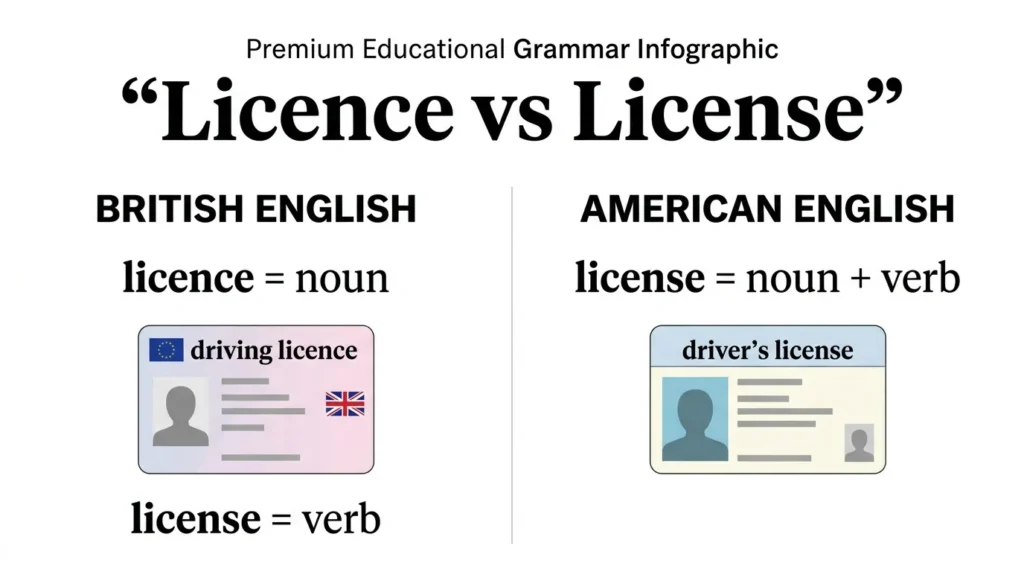

If you are writing American English, use license for both the noun and the verb. If you are writing British English, use licence as the noun and license as the verb. For example, British English has a driving licence but the council will license the company. The two forms have the same pronunciation and closely related meanings; the main difference is regional spelling and, in British English, grammatical function.
What Is the Difference Between Licence and License?
Licence and license refer to official permission, authorization, or a document that gives someone permission to do, have, or use something.
The difference is mainly about English variety and grammatical role.
In British English, the traditional distinction is:
- licence = noun
- license = verb
In American English, license is used for both the noun and the verb.
Compare these sentences:
British English: She renewed her driving licence.
British English: The authority will license the new operator.
American English: She renewed her driver’s license.
American English: The authority will license the new operator.
So neither spelling is simply “the correct one” in every situation. Your choice depends on which variety of English you are writing and, for British English, whether the word is functioning as a noun or a verb.
Why It Matters
This difference may look small, but spelling matters when you are writing official, academic, professional, or public-facing English.
You may encounter the words in:
- Driving documents
- Government forms
- Business applications
- Professional qualifications
- Legal documents
- Software agreements
- Academic writing
- Emails and reports
- Product documentation
- Websites and marketing material
For example, a British English document might say:
Please provide a copy of your driving licence.
An American English document would normally use:
Please provide a copy of your driver’s license.
The problem becomes more noticeable when one document mixes regional conventions. If the rest of your writing follows British spelling, suddenly writing driver’s license may look inconsistent. Likewise, using licence throughout an American English document can conflict with the spelling expected by American readers.
The key is not to memorize two unrelated words. Learn the system behind them.
The Core Rule
British English: licence = noun; license = verb.
American English: license = noun and verb.
A noun names a person, place, thing, or idea. A verb describes an action or state.
British English
Noun: licence
She applied for a driving licence.
Here, licence names the document.
Verb: license
The government will license the company.
Here, license describes the action of officially giving permission.
American English
Noun: license
She applied for a driver’s license.
Verb: license
The government will license the company.
American English uses license for both grammatical roles.
How to Use Licence
In British English, use licence when the word is a noun.
A licence can mean an official document that gives someone permission to do, own, or use something. It can also refer more generally to official permission or freedom to do something.
Driving
She finally passed her test and received her driving licence.
Business
The restaurant applied for a new operating licence.
Professional work
The doctor must hold a valid medical licence.
Software
The company purchased a software licence.
Broadcasting
The station renewed its broadcasting licence.
The same noun spelling applies regardless of the type of permission.
How to Use License
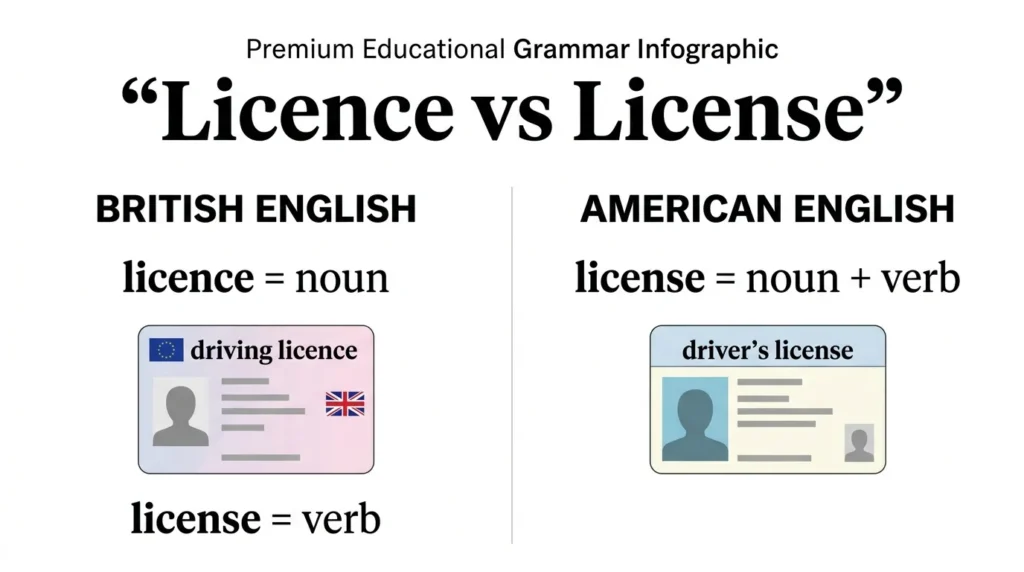
License is the standard spelling in American English for both the noun and the verb.
It is also the standard verb spelling in British English. Cambridge and Oxford both identify license as the verb, while Oxford notes that licence can also occur as a less frequent British variant of the verb.
As a noun in American English
I renewed my driver’s license yesterday.
The company needs a business license.
As a verb
The government will license the company.
The agency licensed the new facility.
The software is licensed for commercial use.
The related forms are normally written with s as well:
- license
- licenses
- licensed
- licensing
For most modern British writing, license is the straightforward choice for the verb.
Correct Examples
Here are examples showing how the choice works in real writing.
| Situation | British English | American English |
|---|---|---|
| Driving document | She renewed her driving licence. | She renewed her driver’s license. |
| Business permission | We applied for a business licence. | We applied for a business license. |
| Government action | The council will license the operator. | The city will license the operator. |
| Professional permission | He needs a medical licence. | He needs a medical license. |
| Software | The company purchased a software licence. | The company purchased a software license. |
| Verb, past tense | The authority licensed the business. | The authority licensed the business. |
| Verb, present | The agency licenses new providers. | The agency licenses new providers. |
| Academic writing | The study discusses licensing regulations. | The study discusses licensing regulations. |
| Please send a copy of your licence. | Please send a copy of your license. | |
| Workplace | Her professional licence expires in June. | Her professional license expires in June. |
The important pattern is simple: the verb is license in both systems, while the main noun difference is licence in British English versus license in American English.
Incorrect vs. Correct
The following examples assume the stated English variety.
| ❌ Incorrect | ✅ Correct | Why |
|---|---|---|
| She renewed her driving license. (British) | She renewed her driving licence. | In British English, the noun is normally licence. |
| He applied for a business license. (British) | He applied for a business licence. | The word is a noun referring to official permission. |
| The council will licence the operator. (standard British usage) | The council will license the operator. | License is the normal British verb spelling. |
| The company has licence to use the software. (British) | The company has a software licence. | The noun is licence in British English. |
| She has a driver’s licence. (American) | She has a driver’s license. | American English uses license for the noun. |
| The state will licence the business. (American) | The state will license the business. | License is the American verb. |
| We need to renew our business license. (British) | We need to renew our business licence. | British English uses licence as the noun. |
| The regulator licenced the company. | The regulator licensed the company. | The standard modern verb spelling is licensed. |
| The agency issues professional licenses. (British) | The agency issues professional licences. | The plural noun follows licence in British English. |
| The US company applied for a licence. (American) | The US company applied for a license. | American English uses license as the noun. |
The regional label is important. A form that is wrong for one variety may be completely normal in another.
Why People Make This Mistake
The confusion is easy to understand because the two spellings are extremely similar.
They sound the same
In ordinary pronunciation, licence and license are pronounced the same. Cambridge gives the same pronunciation for the British noun licence and the American noun license.
That means you cannot reliably hear the spelling difference.
Read More: Abley vs Ably: Which Spelling Is Correct?
The letters are almost identical
Only the middle consonant changes:
licence → C
license → S
When a writer hears the word and writes it from memory, there is little sound-based information to help.
Different English varieties use different systems
A learner may read British websites, American software documentation, Australian material, and international business emails. The spelling can change according to the source.
Spellcheckers can hide the problem
A spellchecker configured for American English may prefer license. A British English writing environment may expect licence for the noun.
Spellcheck therefore cannot replace knowing which variety you are using.
Translation can add another layer of confusion
Learners whose first language uses one word for both “permission” and “license” may not expect English to distinguish the spelling according to regional conventions.
The safest approach is to identify your target variety before proofreading.
Common Mistakes Checklist
1. Assuming licence is always correct
It is not.
Licence is the standard British noun spelling, but American English normally uses license.
2. Assuming license is always correct
That is also incomplete.
If you are writing British English and the word is a noun, licence is normally expected.
3. Thinking the meanings are different
Usually, the underlying meaning is the same. The difference is primarily regional spelling and, in British English, grammatical function.
4. Forgetting the verb
British English writers sometimes remember licence as the British spelling and then incorrectly use it everywhere.
Remember:
British noun: licence
British verb: license
5. Mixing varieties in one document
A document that otherwise follows British spelling should not casually switch to American spellings without a reason.
6. Writing “licenced” as the default British verb
The modern standard form is generally licensed, with licensing for the -ing form. Oxford lists license as the verb and gives licensed and licensing as its forms.
Licence and License in Real English
British English noun: licence
In everyday British English, licence is the normal noun when referring to official permission or a document that provides it. Expressions such as driving licence, business licence, and licence holder fit naturally into ordinary British usage. The spelling does not signal a different kind of permission; it signals the British noun convention.
British English verb: license
When British English uses the word as a verb, license is the standard spelling you should normally choose. For example, the authority will license the business means the authority will officially give the business permission. Oxford also records licence as a less frequent British variant of the verb, but license is the safer standard form for general writing.
American English: license
American English removes the noun-versus-verb spelling distinction. License works as both a noun and a verb: driver’s license, business license, the state licenses businesses, and the company was licensed. If your intended audience is American, using license consistently is the straightforward choice.
American vs. British English
This is a genuine regional difference, so it is worth learning directly.
| Grammatical role | British English | American English |
|---|---|---|
| Noun | licence | license |
| Verb | license | license |
| Plural noun | licences | licenses |
| Past tense | licensed | licensed |
| Present participle | licensing | licensing |
The easiest way to see the difference is with two sentences:
British:
She has a driving licence.
The government will license the company.
American:
She has a driver’s license.
The government will license the company.
Cambridge and Oxford both distinguish the British noun licence from the American noun license, while identifying license as the principal verb form.
Formal vs. Informal Usage
There is no major formal-versus-informal spelling distinction here.
The choice between licence and license is primarily about regional English, not about whether the sentence is formal or casual.
For example, a formal British legal document may use:
The applicant must hold a valid licence.
An informal British message may say:
Have you got your licence yet?
The register changes, but the noun spelling does not.
Likewise, American English uses license in both formal and informal contexts.
Comparison Table
| Feature | Licence | License |
|---|---|---|
| British noun | ✅ Yes | ❌ Normally no |
| British verb | Less common variant | ✅ Standard |
| American noun | ❌ Normally no | ✅ Yes |
| American verb | ❌ No | ✅ Yes |
| Meaning | Official permission/document | Official permission/document |
| Pronunciation | Same | Same |
| British plural | licences | — |
| American plural | — | licenses |
| British past tense | — | licensed |
| American past tense | — | licensed |
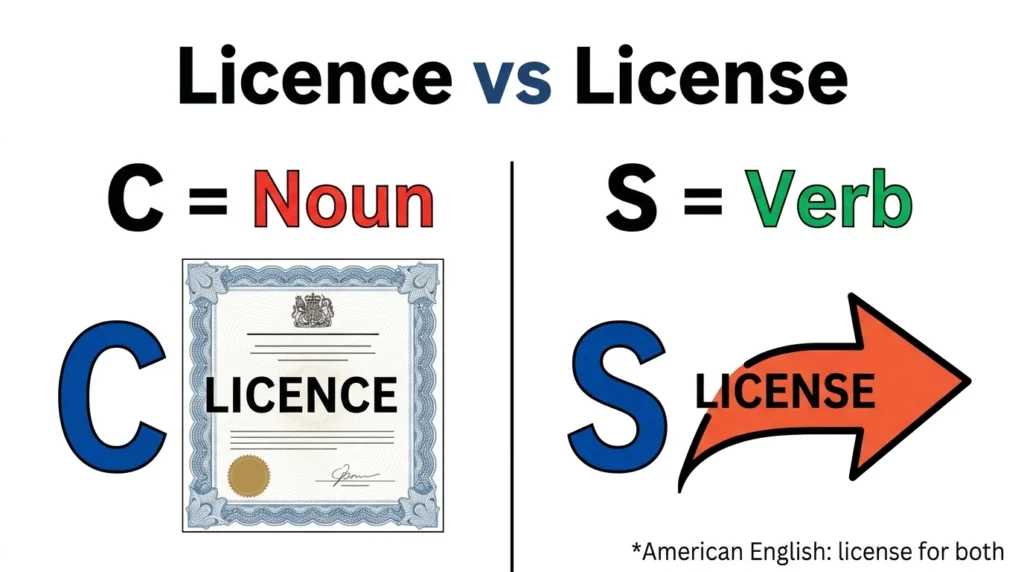
| Best memory clue | C = British noun | S = verb / American form |
Memory Trick
For British English, remember:
C = Certificate → licence
S = Service/action → license
A licence is the thing you receive or hold.
A license is the action of officially giving permission.
For American English, make it even easier:
US English = license for everything.
You can also connect the British pattern with advice/advise:
- advice = noun
- advise = verb
- licence = noun
- license = verb
The comparison is useful as a memory aid, although the words are not interchangeable.
Real-Life Situations
Driving test
British English:
I passed my test and received my driving licence.
American English:
I passed my test and received my driver’s license.
Business meeting
British English:
We cannot begin trading until we obtain the required business licence.
American English:
We cannot begin trading until we obtain the required business license.
Government regulation
Both varieties:
The authority will license new operators next year.
British English:
Please send us a copy of your current professional licence.
American English:
Please send us a copy of your current professional license.
Software
British English:
The company purchased a software licence for 50 users.
American English:
The company purchased a software license for 50 users.
Academic writing
British English:
The researcher examined the legal requirements for obtaining a professional licence.
American English:
The researcher examined the legal requirements for obtaining a professional license.
Expert Tips
- Decide on your English variety first.
Do not decide between the spellings sentence by sentence. - Check the grammatical role in British English.
If it is a noun, use licence. If it is a verb, use license. - For American English, stop worrying about the noun/verb distinction.
Use license. - Remember the derived forms.
The standard forms are licensed and licensing, not licenced and licencing as your default choices. - Look at the surrounding spelling system.
If your document uses colour, centre, and organise, you are probably following British conventions. If it uses color, center, and organize, American conventions are likely. - Do not change quotations or official names unnecessarily.
If an organization’s official name contains a particular spelling, preserve its official form. - Do not treat regional spelling as a difference in meaning.
In most ordinary uses, licence and license refer to the same underlying concept.
FAQ
Is “licence” or “license” correct?
Both can be correct. Licence is the standard British noun spelling, while license is the standard American spelling for both noun and verb. In British English, license is used as the verb.
Is “licence” British or American?
Licence is primarily the British spelling of the noun. American English normally uses license for the noun.
Is “license” British English?
Yes. British English uses license as a verb. For example: The authority will license the company. British English normally uses licence when the word is a noun.
Is “license” American English?
Yes. American English uses license for both the noun and the verb. For example: I have a driver’s license and the state will license the business.
Do licence and license have different meanings?
Usually, no. They refer to official permission, authorization, or a document providing permission. The main distinction is regional spelling and, in British English, grammatical role.
Is “driver’s licence” British or American?
Driver’s licence is the British form. American English uses driver’s license. Cambridge specifically gives driving licence as the British form and driver’s license as the American form.
Is “licensed” correct in British English?
Yes. Licensed is the standard spelling of the past participle formed from license. For example: The company is fully licensed. Oxford lists licensed as the past form and past participle of license.
Is “licenced” correct?
You may encounter licenced, particularly in some British usage, but licensed is the standard form recommended by major learner dictionaries for the verb license. For general writing, licensed is the safer choice.
Are licence and license pronounced differently?
No. The two spellings are normally pronounced the same. The spelling difference is therefore not something you can reliably hear in ordinary speech.
How do I remember licence vs. license?
If you are using British English, remember C = noun and S = verb: licence is the document; license is the action. If you are using American English, simply use license for both.
What is the plural of licence?
In British English, the plural is licences. In American English, the plural of license is licenses.
Mini Quiz
| # | Question | Answer | Explanation |
|---|---|---|---|
| 1 | British: She renewed her driving ___ yesterday. A) license B) licence | B) licence | Licence is the standard British noun spelling. |
| 2 | American: He lost his driver’s ___. A) licence B) license | B) license | American English uses license as the noun. |
| 3 | British: The council will ___ the new operator. A) licence B) license | B) license | License is the standard British verb spelling. |
| 4 | American: The state will ___ the company. A) licence B) license | B) license | American English uses license as the verb. |
| 5 | Choose the correct British sentence. A) She has a business license. B) She has a business licence. | B | Licence is the British noun form. |
| 6 | Choose the correct American sentence. A) The company obtained a software licence. B) The company obtained a software license. | B | American English uses license as the noun. |
| 7 | Correct this British sentence: “The agency will licence the provider.” | The agency will license the provider. | The word is being used as a verb. |
| 8 | Correct this American sentence: “She renewed her professional licence.” | She renewed her professional license. | American English uses license for the noun. |
| 9 | Fill in the blank: “The business has been ___ by the regulator.” | licensed | The past participle is licensed in standard usage. |
| 10 | Which statement is correct? A) American English uses licence for nouns. B) British English uses licence for nouns. C) British English always uses licence. | B | British English uses licence as the noun but license as the normal verb. |
Quick Summary
Licence and license have the same basic meaning, but their spelling depends on English variety. In British English, licence is normally the noun, while license is the verb: a driving licence but the authority will license the company. In American English, license is used for both the noun and the verb: a driver’s license and the state will license the company. The two forms are normally pronounced the same. The easiest memory trick for British English is C = noun, S = verb. When writing for an American audience, simply use license. For professional or academic writing, the most important rule is consistency: choose the appropriate English variety and keep the spelling system consistent throughout the document.