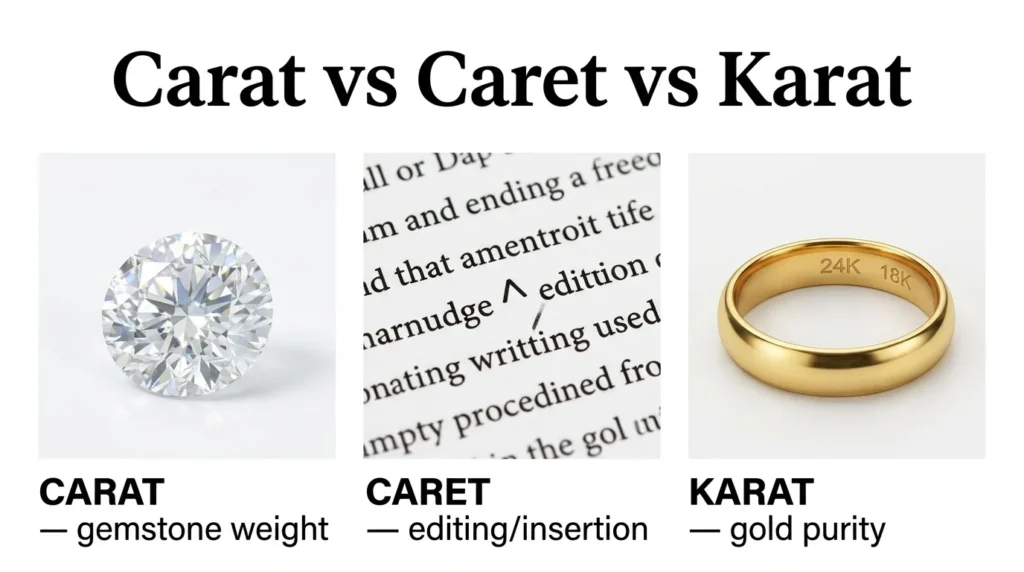

If you are talking about the weight of a gemstone, use carat. If you mean the proofreading mark ^ or a text insertion point, use caret. If you are describing gold purity, karat is the usual spelling in American English. The words sound alike, but their meanings are completely different. One important regional detail is that carat is also used for gold purity in British English.
What Is the Difference Between Carat, Caret, and Karat?
These three words are pronounced alike in many varieties of English, but they belong to different areas of language.
- Carat — a unit of weight for gemstones.
- Caret — a proofreading mark or, in computing, an indicator of a text insertion position.
- Karat — a measure of gold fineness, especially in American English.
The easiest distinction is:
Carat = gemstone weight. Caret = editing or text insertion. Karat = gold purity.
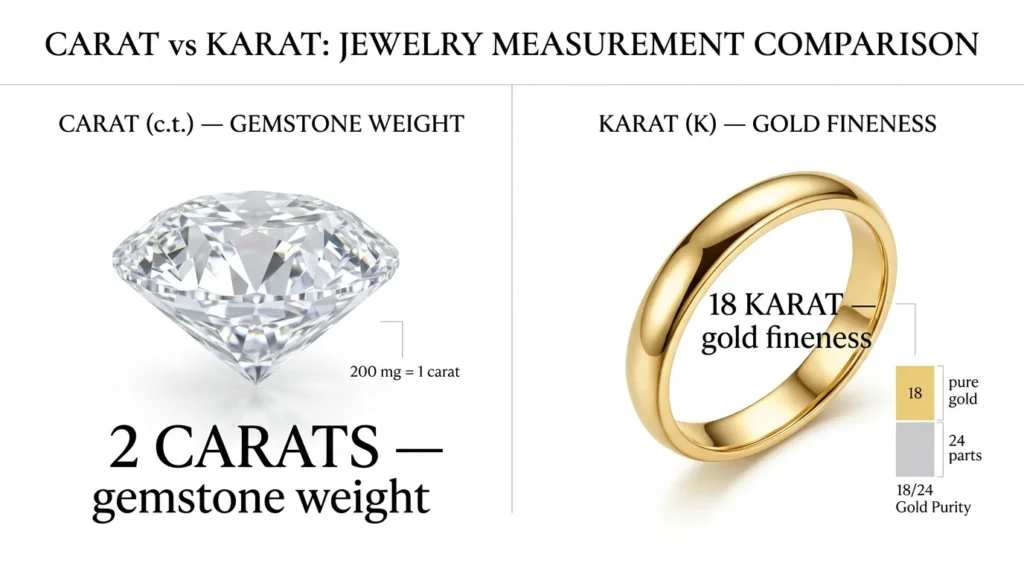
One carat equals 200 milligrams, or 0.2 grams, so a 5-carat gemstone has a mass of 1 gram. Gold karat, however, is not a weight measurement. It expresses the proportion of gold in an alloy on a 24-part scale.
Why the Difference Matters
These words are easy to confuse because they sound the same. In writing, however, the wrong spelling can change the meaning completely.
Compare:
- a 2-carat diamond → the diamond’s weight
- 18-karat gold → the gold’s fineness
- a proofreading caret → a mark showing where something should be inserted
This distinction matters in jewelry descriptions, product listings, school assignments, editing instructions, technical writing, and professional communication.
A jewelry seller who writes “18-caret gold” has used an editing term where a gold term belongs. A student who writes “a 3-karat diamond” has confused gold fineness with gemstone weight.
The Core Rule
Use carat for gemstone weight, caret for an editing or text-insertion mark, and karat for gold purity in American English.
There is one important regional qualification: British English commonly uses carat for both gemstone weight and gold purity, while American English normally distinguishes carat for gemstones from karat for gold.
How to Use Carat
Carat is a unit of mass used for gemstones such as diamonds, rubies, sapphires, and emeralds.
One carat equals 200 milligrams.
Use carat when the number describes how much a gemstone weighs:
- a 1-carat diamond
- a 2.5-carat sapphire
- a 3-carat emerald
- a 0.75-carat ruby
Carat weight does not directly tell you a gemstone’s physical dimensions, apparent size, quality, or value. Two stones with the same carat weight can look different because of their shape, cut, proportions, and other characteristics.
Examples of Carat
- The jeweler showed us a 2-carat diamond.
- She inherited a 1.5-carat sapphire.
- The ring features a three-carat emerald.
- The laboratory report lists the diamond’s weight as 0.82 carat.
- He was looking for a one-carat stone for the engagement ring.
- The necklace contains a large four-carat gemstone.
- The buyer compared two diamonds with identical carat weights.
- The advertisement describes the center stone as a 1.2-carat diamond.
- Her assignment explained how carat weight differs from diamond quality.
- The jeweler confirmed that the ruby weighed 2.1 carats.
How to Use Caret
A caret is traditionally a proofreading mark used to show where something needs to be inserted into written text.
The mark looks like this:
^
For example, suppose a sentence reads:
She went ^ the store yesterday.
The proofreader could place to at the caret, producing:
She went to the store yesterday.
The caret therefore tells the editor or writer where something belongs.
The word also has technical uses in computing. Depending on context, caret can refer to the position indicator showing where typed text will appear. This should not automatically be confused with the character ^ itself; the terms can refer to related but distinct things in different technical contexts.
Examples of Caret
- The editor placed a caret where the missing word should go.
- Insert the comma at the caret.
- The proofreader marked the omission with a caret.
- Add the missing article at the caret.
- The manuscript contained several caret marks.
- The editor used a caret to show where the sentence needed an additional phrase.
- In the text field, the caret shows where the next character will appear.
- The teacher explained how a caret is used during proofreading.
- I placed a caret before the final word and added the missing preposition.
- The editing instructions asked students to use a caret for insertions.
How to Use Karat
Karat is used to describe the fineness or gold content of an alloy, especially in American English.
The traditional scale divides gold content into 24 parts. Therefore:
- 24-karat gold = 24 parts gold out of 24 on the traditional scale
- 18-karat gold = 18 parts gold out of 24, or 75%
- 14-karat gold = 14 parts gold out of 24, or about 58.3%
- 10-karat gold = 10 parts gold out of 24, or about 41.7%
So karat is about gold composition, not gemstone weight.
Examples of Karat
- She bought an 18-karat gold necklace.
- The ring is made from 14-karat gold.
- The jeweler specializes in 22-karat gold jewelry.
- He prefers 18-karat gold for everyday pieces.
- The bracelet is marked 14K, indicating 14-karat gold.
- The customer asked whether the chain was 18-karat gold.
- The museum displayed a piece made from 24-karat gold.
- The designer selected 18-karat gold for the new collection.
- The report explains the difference between 14-karat and 18-karat gold.
- The hallmark indicated that the item was made with 18-karat gold.
Incorrect vs. Correct
| ❌ Incorrect | ✅ Correct | Why |
|---|---|---|
| She bought a 2-karat diamond. | She bought a 2-carat diamond. | Carat describes gemstone weight. |
| The ring is made of 18-caret gold. | The ring is made of 18-karat gold. | Caret refers to editing; karat describes gold fineness in American English. |
| The editor inserted a carat at the missing word. | The editor inserted a caret at the missing word. | A caret is the proofreading insertion mark. |
| This is a 5-caret ruby. | This is a 5-carat ruby. | A ruby’s weight is measured in carats. |
| She wears a 24-carat gold ring. | She wears a 24-karat gold ring. | In American English, karat is the normal spelling for gold purity. |
| Put a karat before the missing word. | Put a caret before the missing word. | The context is proofreading, not gold. |
| The diamond weighs 18 karats. | The diamond weighs 18 carats. | Karat normally refers to gold purity in American English. |
| The necklace contains 14 caret gold. | The necklace contains 14-karat gold. | Gold fineness takes karat in American English. |
| The proofreader marked the omission with a karat. | The proofreader marked the omission with a caret. | A caret marks an insertion in text. |
| The jeweler measured the ruby in carets. | The jeweler measured the ruby in carats. | Gemstone weight is measured in carats. |
Why People Make This Mistake
The main reason is simple: carat, caret, and karat sound extremely similar and are often pronounced the same.
Several factors make the confusion worse.
Phonetic similarity
When you hear someone say the word, pronunciation usually does not tell you which spelling they mean. You need the context.
If someone says:
“It is eighteen ___ gold.”
you need to recognize that the context is gold purity and choose karat in American English.
Spelling overlap
All three words begin with car-/kar- and contain similar letters. A writer may remember the sound but not the spelling associated with the meaning.
Overgeneralization
A learner may discover that carat is associated with jewelry and then use it for every jewelry-related measurement.
But jewelry has different measurements and descriptions. A diamond’s weight and gold’s fineness are not the same thing.
Autocomplete and spellcheck
Spellcheck can identify a word as correctly spelled without knowing whether it is the right word for the context.
For example, both carat and caret are legitimate English words. A spellchecker may therefore accept the wrong one if you type it in the wrong sentence.
Translation interference
Learners whose first language uses one spelling or transliterated form for these concepts may naturally transfer that spelling into English. This is particularly likely when the distinction between gemstone weight and gold purity is not made clearly in the learner’s first language.
Read More: Abley vs Ably: Which Spelling Is Correct?
Common Mistakes Checklist
Before publishing or sending your sentence, check these points:
- Talking about a diamond, ruby, or other gemstone’s weight? Use carat.
- Talking about gold purity? Use karat in American English.
- Talking about a proofreading insertion mark? Use caret.
- Talking about a text insertion position? Caret may be the appropriate technical term.
- Writing for British readers? Remember that carat is commonly used for gold purity as well.
- Describing diamond quality? Do not treat carat as a synonym for quality.
- Writing a jewelry listing? Check every occurrence because carat and karat may appear in the same sentence.
- Using a spellchecker? Check meaning, not just spelling.
Carat, Caret, and Karat in Real English
Grammatically correct and natural: “a 2-carat diamond”
“A 2-carat diamond” is a normal, natural phrase in English. The number identifies the gemstone’s weight. You will commonly see this construction in jewelry descriptions, conversations about diamonds, and professional gem-related writing. The hyphen is appropriate because 2-carat functions as a compound modifier before the noun diamond.
Grammatically correct and natural: “18-karat gold”
“18-karat gold” is the standard American English expression for gold with an 18/24 fineness. It is common in jewelry descriptions, retail communication, and everyday speech. You may also see 18K gold, particularly in jewelry specifications and product descriptions. In British English, 18-carat gold is also a standard form.
Grammatically correct and natural: “insert a caret”
“Insert a caret” is natural when discussing proofreading or editing. The phrase tells someone to use the insertion mark to show where missing material belongs. In computing, caret can also refer to a text-position indicator, but the exact terminology can depend on the software or technical context.
Possible but potentially confusing: “carat gold”
“Carat gold” is not universally wrong. British English commonly uses carat for gold purity, while American English normally uses karat. Some dictionaries also recognize carat as a variant relating to gold fineness. Therefore, context and English variety matter. If you are writing specifically for an American audience, 18-karat gold is the clearer standard choice.
American vs. British English
There is a genuine regional difference here.
| Meaning | American English | British English |
|---|---|---|
| Gemstone weight | carat | carat |
| Gold purity | karat | carat commonly used |
| Proofreading mark | caret | caret |
So these sentences can both be correct:
- American English: She bought an 18-karat gold bracelet.
- British English: She bought an 18-carat gold bracelet.
The distinction between carat and karat for gold is therefore not simply a matter of one spelling being universally correct and the other being universally wrong. The expected spelling depends partly on regional usage.
Formal vs. Informal Usage
There is no major formal-versus-informal distinction between these three words.
The important issue is meaning and regional convention, not formality.
For example:
- Formal: The stone has a weight of 2.4 carats.
- Everyday: That’s a two-and-a-half-carat diamond.
- Formal: The ring is manufactured using 18-karat gold.
- Everyday: It’s an 18K gold ring.
- Editing: Place a caret at the point of insertion.
Both formal and informal writing can use these words correctly.
Comparison Table
| Feature | Carat | Caret | Karat |
|---|---|---|---|
| Main meaning | Gemstone weight | Insertion/proofreading mark or text-position indicator | Gold fineness |
| Typical symbol | ct | ^ in proofreading contexts | K or kt in jewelry contexts |
| Main field | Jewelry/gemology | Editing/computing | Jewelry/gold |
| Example | 2-carat diamond | Insert a caret | 18-karat gold |
| Related question | How much does the gemstone weigh? | Where should text be inserted? | How much gold does the alloy contain? |
| American English | Standard | Standard | Standard for gold |
| British English | Standard | Standard | Carat commonly used instead |
Carat vs. Karat: The Most Important Difference
The most common confusion is between carat and karat because both appear in jewelry contexts.
But they measure different things.
Carat measures gemstone weight. Karat describes gold fineness.
Consider this sentence:
She bought a 2-carat diamond set in 18-karat gold.
Both words are correct because the sentence contains two different measurements.
- 2-carat → the weight of the diamond
- 18-karat → the fineness of the gold
This is one of the easiest ways to understand the distinction.
Read More: Skillset vs Skill Set: Which One Is Correct?
Does Carat Mean Diamond Size?
Not exactly.
A carat is a unit of mass, not a direct measurement of a diamond’s visible dimensions.
Two diamonds can have the same carat weight but appear different in size from above. Their shape, cut, depth, and proportions affect how the weight is distributed.
Therefore:
Carat weight tells you how much the gemstone weighs, not exactly how large it looks.
This distinction is especially important when reading jewelry descriptions. A larger carat number does not by itself tell you everything about a diamond’s appearance or quality.
Does Karat Mean Gold Quality?
Karat describes gold fineness, not every aspect of jewelry quality.
For example, 18-karat gold contains a greater proportion of gold than 14-karat gold. The remaining material consists of other metals used in the alloy.
That can affect characteristics such as hardness, color, and durability.
So it is more accurate to say:
A higher karat number means a higher proportion of gold, not automatically a better piece of jewelry.
The best choice can depend on the design, intended use, durability, color, and other factors.
Can Carat and Karat Ever Mean the Same Thing?
There is an important dictionary and regional nuance.
Historically, carat and karat are related forms, and carat can be used for gold fineness in some varieties of English. In particular, British English commonly uses carat for gold purity. American English developed the more familiar distinction of carat for gemstones and karat for gold.
So avoid an overly simple rule such as:
“Carat is always wrong for gold.”
That statement would be inaccurate.
A better rule is:
For American English, use carat for gemstone weight and karat for gold purity. For British English, carat is commonly used for both.
Real-Life Situations
At a jewelry store
A customer asks:
“How heavy is the diamond?”
The salesperson can answer:
“It is a 1.25-carat diamond.”
If the customer asks about the gold setting:
“The setting is 18-karat gold.”
In an email
A jewelry company might write:
“The pendant features a 0.8-carat diamond set in 18-karat gold.”
Both terms are needed because they describe different properties.
During proofreading
An editor notices:
“The company launched product in March.”
The editor can place a caret between “launched” and “product” and insert the.
In a text editor
A user clicks inside a sentence and sees the blinking position where the next character will appear. That position may be described as the text caret.
In an exam
If the question asks for the spelling used for gold purity in American English, the answer is karat.
If it asks for the spelling used for gemstone weight, the answer is carat.
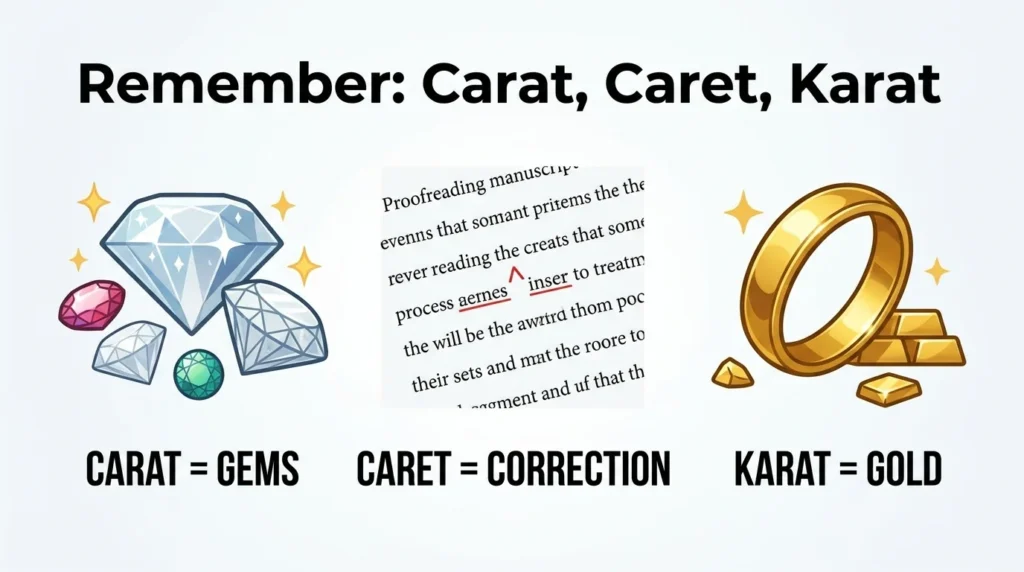
Memory Trick
Use this three-word formula:
Carat = crystals and gemstones
Caret = correction
Karat = K for gold
Or remember the shortest version:
Gems → carat. Editing → caret. Gold → karat.
If you are unsure, first identify the thing being described. Do not start with the spelling. Start with the meaning.
Expert Tips
- Look at the noun after the word. “___ diamond” strongly points to carat; “___ gold” in American English points to karat.
- Do not rely on pronunciation. These words can sound identical.
- Do not rely entirely on spellcheck. A correctly spelled word can still be the wrong word.
- Remember that carat is a weight measurement. It does not directly measure visible gemstone size.
- Remember that karat describes gold fineness. It is not another word for gemstone weight.
- Remember the British English exception. British writers commonly use carat for gold purity.
- Treat caret as a completely different category. It belongs primarily to editing and computing, not jewelry.
- Check the audience before editing “carat gold.” The appropriate form depends on English variety.
FAQ
Is a carat a unit of weight?
Yes. A carat is a unit of mass used for gemstones. One carat equals 200 milligrams, or 0.2 grams.
What does a caret symbol look like?
The traditional proofreading caret looks like ^, although the exact appearance can vary slightly depending on handwriting or typography.
Is caret only used in proofreading?
No. Caret also has technical uses in computing. It can refer to an indicator showing the current text insertion position, while the character ^ has several technical uses of its own.
Is 18-carat gold wrong?
Not necessarily. 18-carat gold is normal British English. In American English, 18-karat gold is the usual form.
Is 24-karat gold completely pure?
The traditional 24-karat designation represents the highest point on the 24-part gold scale. In real-world commercial descriptions, purity may also be expressed using fineness numbers such as 999, so “24K” should not automatically be treated as a claim of chemically absolute purity.
Is carat a measurement of diamond size?
No. Carat measures the diamond’s mass. Its visible dimensions depend on factors such as shape, cut, depth, and proportions.
Can I use carat for gold in American English?
It can be encountered as a variant or in other regional usage, but karat is the standard American spelling for gold fineness.
Why do carat and karat sound the same?
They are historically related forms and developed with overlapping meanings. Modern English uses the spellings to distinguish common applications, especially gemstone weight versus gold fineness.
What is the easiest way to remember the three words?
Use:
Carat = gems
Caret = corrections
Karat = gold
Is “2-carat diamond” hyphenated?
Yes. When 2-carat comes directly before diamond as a compound modifier, the hyphenated form 2-carat diamond is standard.
Which word should I use for gold: carat or karat?
For American English, use karat. For British English, carat is commonly used for gold purity as well.
Mini Quiz
| # | Question | Answer | Explanation |
|---|---|---|---|
| 1 | She bought a 2-___ diamond. A) carat B) caret C) karat | A) carat | Carat measures gemstone weight. |
| 2 | The ring is made of 18-___ gold. A) caret B) karat C) carat | B) karat | Karat is the standard American English term for gold fineness. |
| 3 | The proofreader placed a ___ before the missing word. A) carat B) caret C) karat | B) caret | A caret marks an insertion point in proofreading. |
| 4 | Correct the sentence: “She owns a 3-karat ruby.” | She owns a 3-carat ruby. | A ruby’s weight is expressed in carats. |
| 5 | Which word describes gold purity in American English? | Karat | Karat describes gold fineness. |
| 6 | Which word describes a proofreading insertion mark? | Caret | The caret is traditionally used to show where something should be inserted. |
| 7 | Complete the sentence: “The necklace contains a ___ diamond and an 18-___ gold setting.” | carat; karat | The first describes the diamond’s weight; the second describes gold fineness. |
| 8 | Correct this sentence: “The editor marked the omission with a karat.” | The editor marked the omission with a caret. | The editing mark is a caret. |
| 9 | True or false: A carat directly measures the visible size of a diamond. | False | Carat measures mass, not the diamond’s visible dimensions. |
| 10 | Which sentence is correct for American English? A) 18-caret gold B) 18-carat gold C) 18-karat gold | C) 18-karat gold | Karat is the usual American English spelling for gold fineness. |
Quick Summary
Carat, caret, and karat sound alike but have different meanings. Carat is a unit of weight used for gemstones, and one carat equals 200 milligrams. Caret refers to the proofreading mark used to show where something should be inserted and also has technical uses in computing. Karat describes gold fineness and is the usual American English spelling for gold purity. British English commonly uses carat for gold as well. The fastest memory trick is simple: carat = gems, caret = corrections, and karat = gold. When you see these words in a sentence, focus on the meaning and context rather than pronunciation.