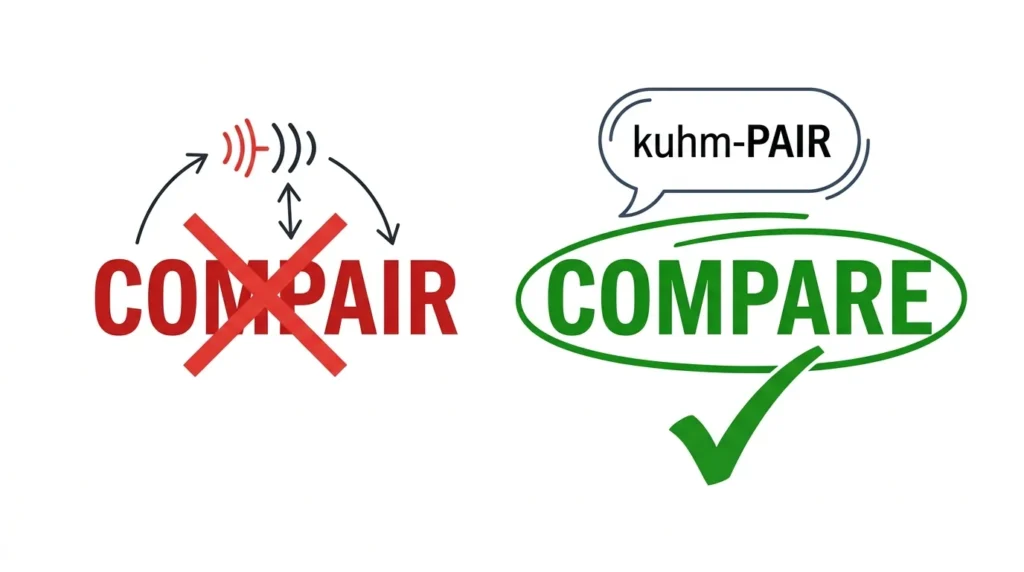

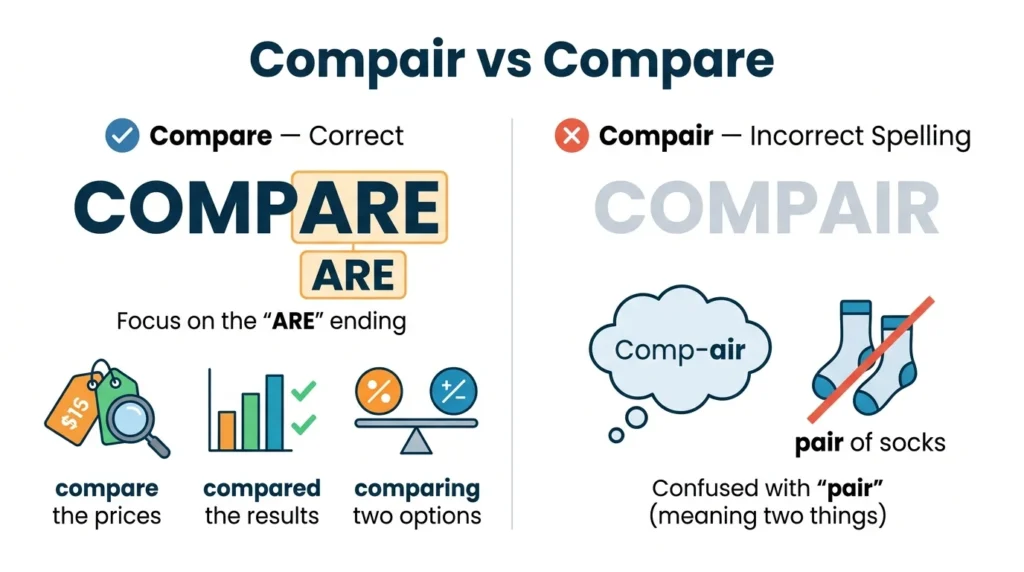
Quick Answer: Compare is the correct spelling. Compair is a misspelling when you mean the verb compare, which means to examine two or more people, things, ideas, or situations to identify similarities, differences, or relative qualities. The confusion usually comes from pronunciation: compare sounds roughly like “kuhm-PAIR,” but its correct spelling ends in -are, not -air.
What Is Compare?
Compare is a verb used when you examine two or more things in relation to each other.
You might compare:
- two products
- two prices
- two people
- two ideas
- two reports
- two cities
- two methods
- two pieces of writing
The purpose of comparing can be to find similarities, differences, strengths, weaknesses, or relative qualities.
For example:
We need to compare the two proposals before making a decision.
Here, the writer is looking at both proposals and considering how they relate to each other.
Compare can also mean to describe or consider one thing as similar to another:
The writer compared the city to a living organism.
It can also appear in expressions such as compare favorably, compare notes, and beyond compare. Dictionaries also recognize compare as a noun in expressions such as “beauty beyond compare.”
Why It Matters
A spelling mistake such as compair usually does not prevent a reader from understanding your meaning. However, standard spelling matters when your writing needs to look accurate and polished.
The difference becomes important in:
- school and university assignments
- academic writing
- business emails
- reports and proposals
- professional websites
- résumés and applications
- presentations
- published articles
Consider these two sentences:
We will compair the results before Friday.
We will compare the results before Friday.
The first sentence contains a spelling error. The second uses the standard English form.
A small spelling mistake may be easy to understand, but repeated errors can distract readers from the message itself. Proofreading is specifically concerned with catching surface-level problems such as spelling, grammar, punctuation, and formatting.
The Core Rule
Use compare, not compair, when you mean “to examine two or more things and identify their similarities or differences.”
The spelling is:
C-O-M-P-A-R-E
Not:
C-O-M-P-A-I-R
The easiest way to remember the correct ending is to connect compare with its word family:
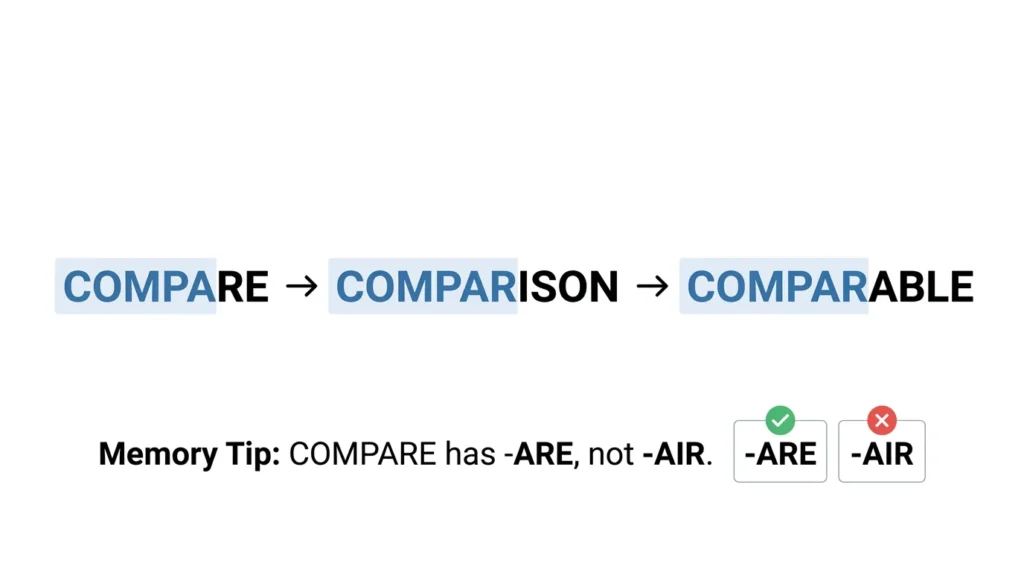
compare → compared → comparing → comparison → comparable → comparative
The common spelling pattern is compar-.
How to Use Compare
Compare as a verb
The most common use is as a verb followed by the things being examined.
Compare the two prices.
The students compared their answers.
We compared several hotels before booking one.
The verb can also be followed by with or to, depending on the meaning and construction.
Compare with
Compare with is commonly used when two things are examined side by side to identify similarities or differences.
Compare this year’s sales figures with last year’s figures.
The teacher asked us to compare the two poems with each other.
We compared the new design with the original version.
This construction is especially natural when the focus is an analytical comparison.
Compare to
Compare to is also standard English.
It is often used when one thing is described as similar to another, particularly when the comparison creates an analogy or image.
The poet compared the moon to a silver coin.
She compared his voice to warm honey.
But the distinction is not an absolute grammatical rule. Modern English uses compare to and compare with more flexibly than the traditional rule suggests. Major dictionaries give examples of both constructions, including cases where either can be used.
Compare favorably
The expression compare favorably with means that something performs well when considered alongside another thing.
The new model compares favorably with more expensive alternatives.
Compare notes
Compare notes means to share information or experiences with another person and see what each person knows.
After the meeting, the two managers compared notes.
Beyond compare
Beyond compare means so exceptional that it cannot reasonably be matched or equaled.
Her dedication to the project was beyond compare.
This is a more literary or formal expression than the ordinary verb compare.
Correct Examples
Here are original examples showing how compare works in different situations.
- Conversation:
“Let’s compare the two restaurants before we choose one.” - Email:
“Could you compare the attached quotations and tell me which services differ?” - School:
“The teacher asked us to compare the two characters in the novel.” - Workplace:
“We should compare this month’s sales with the same month last year.” - Academic writing:
“The study compares two approaches to language learning.” - Social media:
“It is difficult to compare these two phones without considering their different price ranges.” - Shopping:
“I compared the specifications of four laptops before buying one.” - Interview:
“How would you compare your current role with your previous position?” - Business report:
“The report compares customer retention rates across five regions.” - Everyday writing:
“She compared the two photographs and noticed several small differences.” - Creative writing:
“The author compares the changing seasons to different stages of life.” - Professional presentation:
“This chart compares quarterly revenue across the three departments.”
Incorrect vs. Correct
| ❌ Incorrect | ✅ Correct | Why |
|---|---|---|
| We need to compair the prices. | We need to compare the prices. | Compair is a misspelling of compare. |
| Please compair these two reports. | Please compare these two reports. | The standard verb is compare. |
| I compaired the results. | I compared the results. | The past tense is formed from compare → compared. |
| She is compairing the products. | She is comparing the products. | Before -ing, the final e is dropped. |
| Let’s compair our answers. | Let’s compare our answers. | Compare is the correct base form. |
| The article will compair both methods. | The article will compare both methods. | Academic and professional writing use compare. |
| Can you compair these offers? | Can you compare these offers? | The spelling follows compar-, not compair-. |
| We compaired three suppliers. | We compared three suppliers. | Compair does not become correct by adding -ed. |
| The study is compairing two groups. | The study is comparing two groups. | The correct present participle is comparing. |
| I want to compair these options. | I want to compare these options. | The intended English verb is compare. |
Why People Make This Mistake
Phonetic similarity
The biggest reason is pronunciation.
In American English, compare is pronounced approximately /kəmˈper/. In British English, the pronunciation is approximately /kəmˈpeə/. The final stressed sound can resemble the familiar word pair, which makes compair look logical when someone is writing from sound alone.
That creates a tempting mental connection:
compare → “com-pair” → compair
But pronunciation and spelling are not the same system. English frequently contains words whose sounds do not provide a perfect guide to their written forms.
Spelling overlap with “pair”
The word pair is a real English word, and its spelling is familiar.
Because comparing often involves putting two things together, a learner may unconsciously connect the meaning of comparison with the spelling of pair.
That creates a believable-looking but incorrect form:
com + pair = compair
English does not build the word that way.
Overgeneralization
Learners sometimes assume that if a sound is represented by -air in one familiar word, it should be represented by -air in every similar-sounding word.
That is not how English spelling works.
The same or similar sound can have different spellings in different words.
Autocomplete and spellcheck
Digital tools can help identify spelling errors, but they are not a substitute for knowing the correct word.
If someone repeatedly sees compair in informal posts, comments, or user-generated content, the form may begin to look familiar. Familiarity, however, does not make a spelling standard.
Translation interference
Learners who think in another language may also spell an English word according to how its pronunciation appears to them. This is especially common when English spelling conventions differ from the spelling system of the learner’s first language.
Read More: Unorganized vs Disorganized: What’s the Difference?
Common Mistakes Checklist
1. Writing from pronunciation
Mistake: Writing compair because compare sounds like “com-pair.”
Why it happens: The pronunciation strongly resembles the word pair.
How to avoid it: Memorize the written form compare rather than trying to reconstruct the spelling from sound.
2. Writing “compaired”
Mistake: Adding -ed to the incorrect form.
Incorrect: compaired
Correct: compared
How to avoid it: Remember the base spelling first: compare.
3. Writing “compairing”
Mistake: Keeping the ai spelling and adding -ing.
Incorrect: compairing
Correct: comparing
How to avoid it: Start with compare, remove the final e, and add -ing.
4. Confusing spelling with meaning
Some writers assume that because pair means two things considered together, compair should logically mean “put things together for comparison.”
English vocabulary does not always work through such obvious visual combinations.
5. Trusting repetition
Seeing an incorrect spelling many times online can make it appear legitimate.
A word can be common in user-generated text without being standard English.
Compare in Real English
Grammatically correct and natural
We need to compare the two proposals.
This is ordinary, natural English. The verb clearly tells the reader that the two proposals will be examined in relation to each other.
Grammatically possible but less precise
We need to compare.
This sentence can be grammatical when the objects of comparison are already obvious from context. However, when the reader does not know what is being compared, the sentence may feel incomplete or unclear.
A stronger version is:
We need to compare the two proposals.
This gives the reader the missing information.
Natural everyday English
I compared the prices before I bought it.
This sounds natural in everyday conversation because the context is straightforward.
Natural professional English
We compared the three proposals against the project requirements.
This works well in workplace communication because it identifies both the items being compared and the basis for the comparison.
Natural academic English
The researchers compared the results from the two groups.
This is a normal academic construction. Compare is useful when a writer needs to examine similarities, differences, or relative results between defined subjects.
Correct but potentially incomplete comparison
This product is cheaper.
The sentence may be perfectly grammatical, but the reader may ask, “Cheaper than what?”
In contexts where the comparison matters, make the second element clear:
This product is cheaper than the previous model.
Clear comparisons help readers understand exactly what is being measured. Comparisons are also stronger when the elements being compared are clear and logically matched.
Read More: Loosing vs Losing: Meaning, Difference & Correct Use.
American vs. British English
There is no spelling difference between American and British English for this word.
Both use:
compare
Both also use:
compared
comparing
comparison
comparable
comparative
The pronunciation differs somewhat between British and American English, but that does not create different spellings. Cambridge gives approximately /kəmˈpeə(r)/ for British English and /kəmˈper/ for American English.
So whether you are writing for an American, British, or international audience, use compare.
Formal vs. Informal Usage
The spelling rule does not change with formality.
Use compare in:
- formal reports
- academic papers
- business emails
- job applications
- presentations
- text messages
- social media posts
- everyday conversation
Informal writing may contain intentional misspellings, playful spellings, or typing mistakes. However, compair is not the standard informal spelling of compare.
If you want standard English, use compare.
Compare vs. Compair: Comparison Table
| Feature | Compare | Compair |
|---|---|---|
| Standard English spelling | Yes | No |
| Meaning “examine similarities/differences” | Yes | No |
| Standard verb | Yes | No |
| Correct past tense | Compared | Not applicable |
| Correct -ing form | Comparing | Not applicable |
| Used in academic writing | Yes | No |
| Used in professional writing | Yes | No |
| Used in everyday English | Yes | No |
| Main source of confusion | Pronunciation | Spelling error based on pronunciation |
| Correct form to remember | compare | avoid |
Compare, Contrast, and Evaluate
These words are related, but they are not identical.
Compare means to examine things in relation to each other, including similarities and differences.
Compare the two designs.
Contrast places greater emphasis on differences.
Contrast the two designs.
Evaluate means to judge something by considering its quality, value, effectiveness, or importance.
Evaluate the two designs based on cost and usability.
You can compare two things without deciding which one is better.
You can also compare them as part of an evaluation.
This distinction matters in academic writing because an instruction to compare does not automatically mean “choose the winner.” It means examine the subjects in relation to each other.
Compare To vs. Compare With
Both compare to and compare with are standard constructions.
A traditional guideline sometimes associates compare to with pointing out a likeness or analogy and compare with with examining two things for similarities and differences.
For example:
The poet compared the woman’s voice to a violin.
Here, the writer creates a comparison based on likeness.
And:
The researcher compared the two results with earlier findings.
Here, the purpose is analytical.
However, this distinction is not absolute in modern English. Cambridge provides examples of both compared to and compared with, while GrammarBook lists compare as a verb that can take either to or with.
So do not make the mistake of thinking:
compare to = always correct
or:
compare with = always correct
The surrounding sentence and intended meaning matter.
Word Forms of Compare
Learning the whole word family makes the spelling much easier to remember.
| Word Form | Example |
|---|---|
| compare | We compare the two products. |
| compares | She compares prices carefully. |
| compared | We compared the results. |
| comparing | They are comparing the options. |
| comparison | The comparison was useful. |
| comparable | The two products are comparable. |
| comparative | The report provides a comparative analysis. |
Notice the repeated compar- pattern.
This is one reason the word family is a better memory aid than trying to remember the pronunciation alone.
A Simple Memory Trick
Remember:
Compare has “ARE,” not “AIR.”
Think of the spelling as:
comp + ARE
Not:
comp + AIR
An even stronger memory chain is:
compare → comparison → comparable
If you know comparison is spelled with compar-, it becomes easier to remember that the verb is compare.
You can also ask yourself:
“Would I spell the noun comparison as compairison?”
No.
That visual check can quickly bring you back to the correct spelling:
compare
Real-Life Situations
Job interview
Incorrect:
“I compaired my previous position with this one.”
Correct:
“I compared my previous position with this one.”
The correct spelling matters because the answer is part of a professional interaction.
Business meeting
Incorrect:
“Let’s compair the two proposals.”
Correct:
“Let’s compare the two proposals.”
The meaning is the same, but only the second uses standard spelling.
Incorrect:
“Please compair the attached quotations.”
Correct:
“Please compare the attached quotations.”
The corrected version is appropriate for professional communication.
Text message
Incorrect:
“Did you compair the prices?”
Correct:
“Did you compare the prices?”
Even in informal messages, compare remains the standard spelling.
Exam
Question: Compare the two characters.
A student should understand that the task requires examining the characters in relation to each other. This may include similarities, differences, or both, depending on the wording of the question.
Academic writing
“This study compares the effectiveness of the two methods.”
Here, compares is the third-person singular form of compare.
Expert Tips
Learn spelling through word families
Instead of memorizing one isolated word, connect:
compare → comparison → comparable → comparative
This gives you several visual reminders of the same spelling pattern.
Do not spell from sound
The pronunciation can make compair seem reasonable, but sound is not a reliable spelling guide here.
Watch the past tense
The correct form is:
compare → compared
Not:
compair → compaired
Watch the -ing form
The correct form is:
compare → comparing
The final e disappears before -ing.
Remember that compare is not the same as contrast
If your focus is primarily on differences, contrast may be the more precise verb. If you are examining similarities and differences together, compare is appropriate.
Make comparisons complete when clarity matters
Instead of:
This option is better.
Consider:
This option is better than the previous one.
A reader should be able to identify what is being compared whenever the context does not already make it obvious. Clear comparison structures help prevent incomplete or misleading comparisons.
FAQ
Is “compair” a correct spelling?
No. When you mean the standard English verb meaning “to examine two or more things in relation to each other,” the correct spelling is compare.
Why is “compair” wrong?
Compair is a spelling error caused largely by the pronunciation of compare. The final sound can resemble the word pair, making the spelling seem logical even though standard English uses -are.
Is “compare” a verb?
Yes. Compare is primarily a verb. It can mean to examine people or things for similarities and differences, or to describe one thing as similar to another. It can also appear as a noun in expressions such as beyond compare.
How do you spell the past tense of compare?
The past tense is compared.
Correct:
We compared the two reports.
Incorrect:
We compaired the two reports.
How do you spell the -ing form of compare?
The correct form is comparing.
The final e in compare is removed before adding -ing.
Is “compairing” correct?
No. The correct spelling is comparing.
Is “compare to” correct English?
Yes. Compare to is a standard English construction. It is often used when one thing is likened to another, but modern English also uses it more broadly.
Is “compare with” correct English?
Yes. Compare with is also standard. It is commonly used when things are examined side by side for similarities or differences. However, the distinction between compare to and compare with is not completely rigid.
Is “compare” spelled differently in British and American English?
No. The spelling is compare in both varieties. The pronunciation differs somewhat, but the written form remains the same.
What is the easiest way to remember compare?
Remember:
compare = -are
You can also connect it with comparison and comparable, which share the compar- spelling.
Is compare the same as contrast?
Not exactly. Compare involves examining things in relation to each other and can include both similarities and differences. Contrast places particular emphasis on differences.
Can “compair” ever appear in writing?
A spelling resembling CompAir could occur as part of a proper name, brand, username, or other deliberately chosen name. That does not make compair an alternative standard spelling of the English verb compare.
Mini Quiz
| # | Question | Answer | Explanation |
|---|---|---|---|
| 1 | Choose the correct spelling: “We need to ___ the two plans.” A) compair B) compare | B) compare | Compare is the standard English verb. |
| 2 | Fill in the blank: “She ___ the prices before buying the laptop.” | compared | The past tense of compare is compared. |
| 3 | Correct the sentence: “I want to compair these options.” | I want to compare these options. | Compair is a misspelling. |
| 4 | Choose the correct form: “They are ___ the results.” A) compairing B) comparing | B) comparing | The final e is removed before -ing. |
| 5 | True or false: Compair is the British spelling of compare. | False | British English also uses compare. |
| 6 | Choose the correct sentence. A) We compaired the reports. B) We compared the reports. | B | Compared is the correct past tense. |
| 7 | Fill in the blank: “The researcher ___ the two methods.” | compared | The sentence needs the past-tense form compared. |
| 8 | Correct the sentence: “Can you compair these prices?” | Can you compare these prices? | The correct base form is compare. |
| 9 | Which word focuses more strongly on differences? A) compare B) contrast | B) contrast | Contrast emphasizes differences, while compare can cover similarities and differences. |
| 10 | Choose the correct word: “The poet ___ the moon to a silver coin.” A) compaired B) compared | B) compared | Compared is the correct past form, and compare to can express an analogy. |
Quick Summary
Compare is the correct spelling, while compair is a misspelling when the intended meaning is to examine two or more things in relation to each other. The confusion mainly comes from pronunciation because compare sounds roughly like “com-pair.” However, its spelling uses -are, not -air. Use compare, compares, compared, and comparing according to the sentence. Both compare to and compare with are standard constructions, although their typical uses can differ by context. American and British English use the same spelling. The easiest memory aid is compare → comparison → comparable, all built around compar-. When in doubt, choose compare.