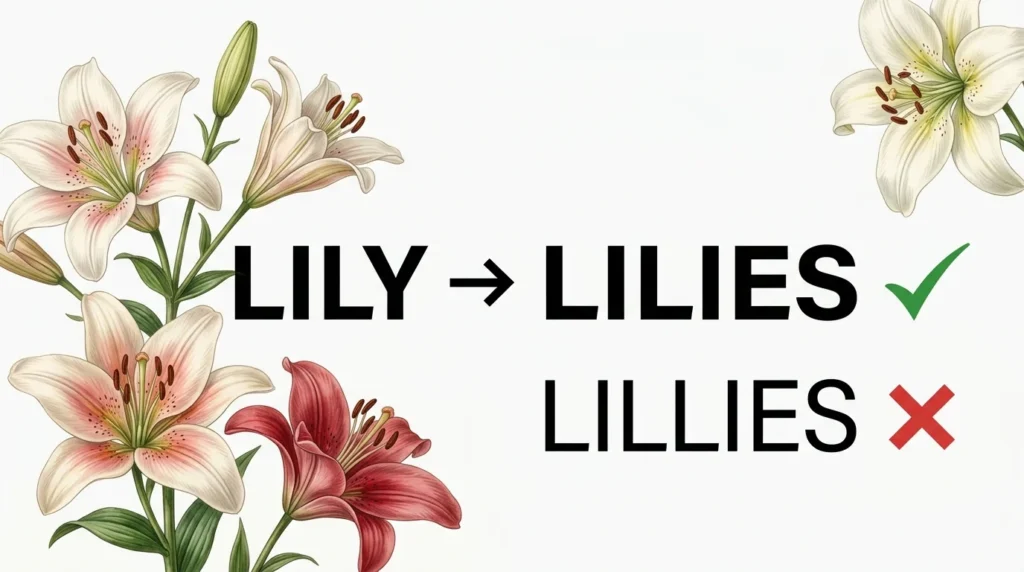

Quick Answer: Lilies is the correct spelling. It is the plural form of lily, meaning more than one lily flower or plant. Lillies is a misspelling and should not be used in standard English. The spelling changes from lily to lilies because nouns ending in a consonant + y normally change the y to i and add -es to form the plural.
What Is the Difference Between Lilies and Lillies?
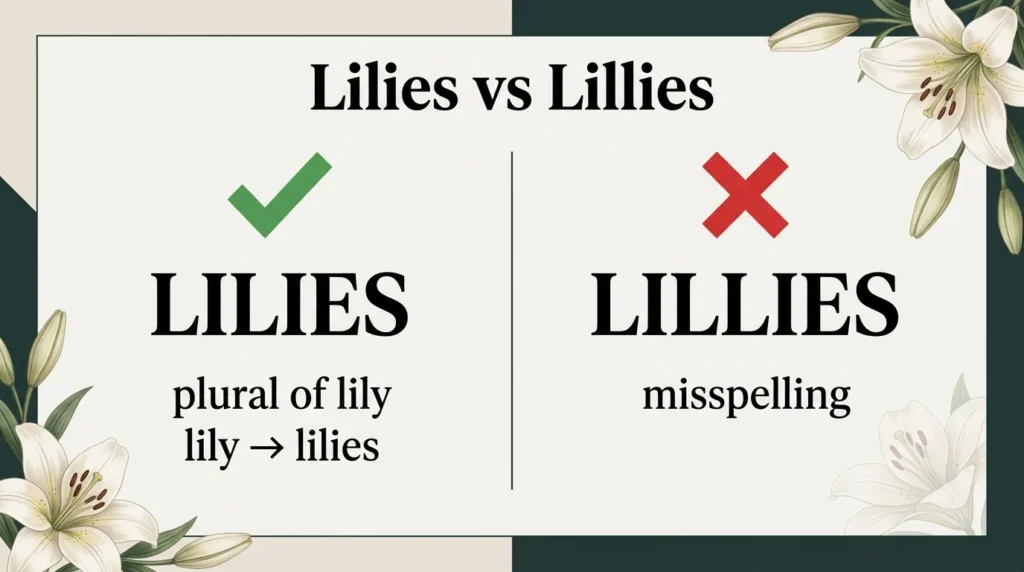
The difference is simple: lilies is correct, while lillies is incorrect when you mean the plural of lily.
Lily is the singular noun. It refers to a flowering plant or its flower. When you mean more than one, the standard plural is lilies.
- One lily
- Two lilies
- Several lilies
- A garden full of lilies
The form lillies adds an extra l that does not belong in the standard spelling.
Major English dictionaries list lilies as the plural form of lily.
Why It Matters
A spelling mistake such as lillies usually does not make the meaning impossible to understand. Most readers will know what the writer means.
However, spelling still matters in many situations.
For example, imagine these phrases:
- Fresh lilies available
- Order white lilies online
- A bouquet of lilies
- The garden is filled with lilies
If lillies appears on a business sign, product description, wedding invitation, school assignment, or professional document, it can make the writing look less carefully edited.
This is especially noticeable when the word is displayed prominently. A misspelling in a large shop sign can be much more visible than the same mistake in a quick text message.
The solution is easy once you remember the singular form:
lily → lilies
The Core Rule
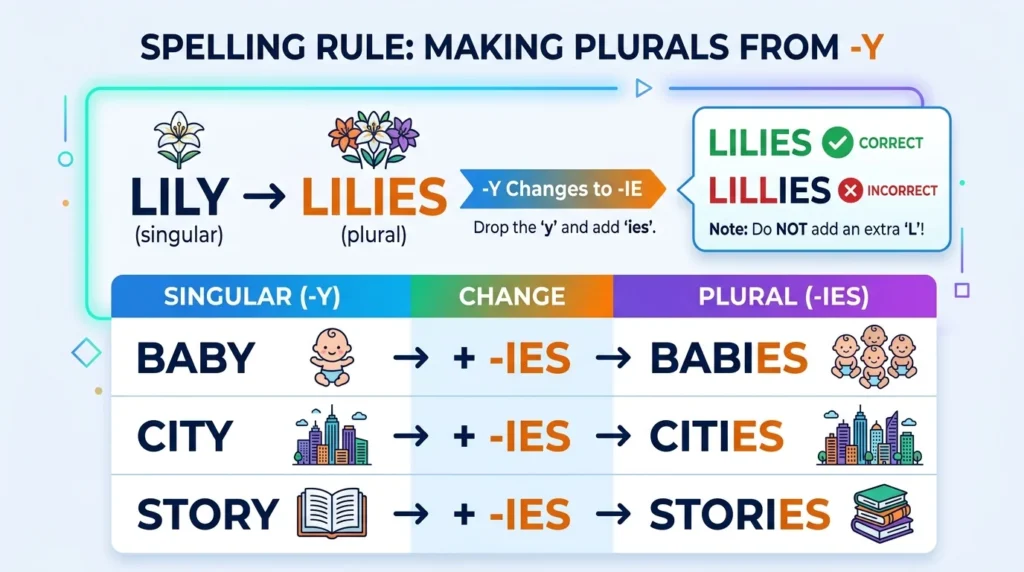
When a noun ends in a consonant + y, the usual plural spelling changes y to i and adds -es.
The pattern
consonant + y → ies
Examples:
- lily → lilies
- baby → babies
- city → cities
- family → families
- story → stories
- country → countries
So:
lily → lilies
Not:
lily → lillies
The plural ending does not require you to double the l.
Rule Box
Remember: If a singular noun ends in a consonant followed by y, change the y to i and add -es.
This is why lilies has one l after the initial i rather than the double ll found in the incorrect form lillies.
How to Use Lilies Correctly
Use lily when you are talking about one flower or plant.
Use lilies when you are talking about two or more.
Singular
The lily is blooming in the garden.
There is one lily.
Plural
The lilies are blooming in the garden.
There is more than one lily.
The important point is that the plural does not simply add s to the original spelling.
It changes:
lily + s
into:
lilies
This same spelling pattern appears in many English nouns ending in consonant + y.
A simple three-step method
- Start with the singular word: lily.
- Remove the final y.
- Add ies: lilies.
You do not add another l.
Correct Examples
Here are examples showing how lilies works in different types of everyday writing.
Conversation
“I bought some lilies for the dining room.”
The speaker is referring to more than one flower.
Text Message
“The lilies you sent are beautiful!”
The plural form is lilies.
“We have arranged the lilies in separate vases.”
The word is used naturally in a normal professional email.
Workplace
“The event tables will be decorated with white lilies.”
Again, lilies is the plural of lily.
School Assignment
“The garden contained roses, lilies, and several other flowering plants.”
The plural form is appropriate in academic writing.
Academic Writing
“Several species of lilies were observed during the survey.”
Here, lilies refers to multiple plants or types within the intended context.
Social Media
“Fresh lilies from the garden this morning.”
The spelling remains lilies even in an informal caption.
Shopping
“These lilies are available in several colors.”
The plural noun correctly describes multiple flowers.
Gardening
“Plant the lilies in a location with suitable growing conditions.”
The writer is discussing multiple plants.
Floral Arrangement
“The bouquet contains pink lilies and white roses.”
The spelling is lilies, not lillies.
Read More: Unorganized vs Disorganized: What’s the Difference?
Incorrect vs. Correct
| ❌ Incorrect | ✅ Correct | Why |
|---|---|---|
| The garden is full of lillies. | The garden is full of lilies. | Lilies is the standard plural of lily. |
| She bought three lillies. | She bought three lilies. | The final y changes to ies. |
| I love white lillies. | I love white lilies. | The plural does not contain an extra l. |
| These lillies smell wonderful. | These lilies smell wonderful. | Lillies is a misspelling. |
| The florist arranged the lillies. | The florist arranged the lilies. | The correct plural is lilies. |
| We planted yellow lillies. | We planted yellow lilies. | Lily becomes lilies. |
| The bouquet contains six lillies. | The bouquet contains six lilies. | More than one lily = lilies. |
| She photographed the lillies. | She photographed the lilies. | The extra l is incorrect. |
| The shop sells fresh lillies. | The shop sells fresh lilies. | The standard plural spelling is lilies. |
| Several lillies bloomed overnight. | Several lilies bloomed overnight. | The plural follows the consonant + y pattern. |
Why People Make This Mistake
The mistake is understandable because lillies looks visually plausible.
Several things can encourage the error.
Phonetic similarity
When you hear lilies, you cannot see whether it contains one l or two.
Spoken English does not provide a reliable spelling clue here. You have to know the written form.
Spelling overlap
The singular lily already contains two appearances of the letter l:
l i l y
When people try to form the plural mentally, the visual pattern can make lillies feel natural even though it is incorrect.
Overgeneralisation
English has many spelling rules involving doubled consonants. Learners may remember that some words double letters when suffixes are added and apply that idea where it does not belong.
But lily does not become lillies.
Familiar-looking names
The spelling Lilly can also appear as a personal name. That can make lillies look more familiar than it should when someone is thinking about the flower.
A person’s name, however, does not change the standard spelling of the flower.
Autocomplete and spellcheck
Digital tools can help detect spelling mistakes, but they should not replace knowledge of the word.
Different applications use different dictionaries, and names or unusual entries can sometimes behave differently from ordinary vocabulary.
The safest approach is to remember the correct form:
lily → lilies
Translation interference
Learners may also transfer plural spelling patterns from another language into English. If the learner’s first language forms plurals differently, English spelling may feel less predictable.
Learning common English word patterns helps reduce this problem.
Common Mistakes Checklist
Mistake 1: Writing “lillies”
Problem: An extra l has been inserted.
Correct form: lilies
How to avoid it: Start from the singular lily and apply the plural pattern.
Mistake 2: Writing “lilys”
Problem: The writer simply adds s to lily.
Correct form: lilies
How to avoid it: Remember that a consonant + y usually changes to -ies in the plural.
Mistake 3: Thinking “lilly” is the standard flower spelling
Problem: The spelling resembles names such as Lilly.
Correct flower spelling: lily
Plural: lilies
Mistake 4: Assuming all nouns simply add “s”
Many nouns do form plurals by adding s, but English has several plural spelling patterns.
For example:
- book → books
- flower → flowers
- lily → lilies
The final letter of the singular noun matters.
Mistake 5: Relying only on pronunciation
Lilies and the incorrect spelling lillies may not sound different enough to expose the spelling mistake.
If you are unsure, think about the written pattern rather than the sound.
Lilies in Real English
Grammatically correct and natural
Lilies is the normal and natural plural form when referring to more than one lily.
The lilies are blooming in the garden.
This is straightforward everyday English. There is no need to replace lilies with another form simply to sound more formal or more natural.
Read More: Loosing vs Losing: Meaning, Difference & Correct Use.
Grammatically possible but unnatural
There is no standard alternative plural such as lillies that becomes acceptable in informal speech or casual writing.
A writer might encounter lillies online, but repeated appearance does not make it a standard plural spelling. It remains a spelling error when it is intended to mean multiple lilies.
Natural everyday English
Native and proficient English speakers normally use lily for one and lilies for more than one.
For example:
I bought a lily.
and:
I bought some lilies.
The change is part of ordinary English spelling rather than a special formal-writing rule.
American vs. British English
There is no meaningful American-versus-British spelling difference between lilies and lillies for the flower.
Both varieties use lily as the singular and lilies as the plural.
Cambridge lists lily with the plural lilies, while other major English dictionaries likewise give lilies as the plural form.
So you do not need to choose between lilies and lillies based on whether your audience uses American or British English.
Use:
lilies
Formal vs. Informal Usage
The correct spelling lilies works in both formal and informal English.
Formal
The study examined the growth of several varieties of lilies.
Informal
These lilies are gorgeous!
The spelling does not change according to the level of formality.
What changes is usually the surrounding vocabulary and sentence style, not the spelling of lilies itself.
Comparison Table
| Feature | Lilies | Lillies |
|---|---|---|
| Standard English spelling | ✅ Yes | ❌ No |
| Singular form | lily | — |
| Meaning | More than one lily | Intended as the plural of lily |
| Dictionary plural | ✅ Yes | ❌ No |
| Formal writing | ✅ Appropriate | ❌ Avoid |
| Informal writing | ✅ Appropriate | ❌ Avoid |
| Academic writing | ✅ Appropriate | ❌ Avoid |
| American English | ✅ Yes | ❌ No |
| British English | ✅ Yes | ❌ No |
| Correct plural pattern | lily → lilies | Does not follow the standard pattern |
Memory Trick
Use this simple rule:
“One lily has a Y; many lilies trade the Y for IES.”
Think:
LILY → LILIES
Not:
LILY → LILLIES
Another useful way to remember it is to connect lily with other words ending in consonant + y:
- baby → babies
- city → cities
- story → stories
- lily → lilies
If baby does not become babbies, then lily does not become lillies.
Real-Life Situations
At a flower shop
A customer asks:
“Do you have white lilies?”
The plural lilies is correct because the customer is asking about more than one flower.
In a wedding invitation
“The venue will be decorated with roses and lilies.”
Again, lilies is the correct plural.
In a workplace email
“Please confirm how many lilies are needed for the reception tables.”
The professional setting does not change the spelling.
In a text message
“I love the lilies you planted!”
Even informal writing uses lilies.
In an exam
Question:
What is the plural of “lily”?
Answer:
Lilies
Writing lillies would be a spelling error.
Expert Tips
Learn the singular before the plural
If you know that the singular is lily, the plural becomes much easier to remember.
Do not memorize lillies vs. lilies as two unrelated words.
Memorize the transformation:
lily → lilies
Watch the final two letters
The key part is:
-ly → -lies
Not:
-ly → -llies
Do not invent an extra consonant
The plural ending changes the final y. It does not require another l.
Compare related words
When you see:
- city → cities
- party → parties
- story → stories
- lily → lilies
the pattern becomes easier to recognize.
Check the singular form
When unsure about a plural spelling, mentally return to the singular.
Ask:
“What is the singular word?”
If the answer is lily, the standard plural is lilies.
FAQ
Is “lilies” or “lillies” correct?
Lilies is correct. Lillies is a misspelling when referring to the plural of lily.
What is the plural of lily?
The plural of lily is lilies.
one lily → two lilies
Why is it spelled “lilies” instead of “lillies”?
The noun lily ends in a consonant followed by y. Its standard plural changes the y to i and adds -es, producing lilies.
Is “lillies” ever correct?
Not as the standard plural spelling of the flower lily. If you mean more than one lily, use lilies.
Is “lilys” correct?
No. The standard plural is lilies, not lilys.
Is “lily” singular or plural?
Lily is singular.
one lily
The plural is:
two lilies
Is “lillies” a British spelling?
No. Lillies is not an alternative British spelling of lilies. British English uses lilies.
Is “lillies” an American spelling?
No. American English also uses lilies.
Does the spelling change in formal writing?
No. Lilies is correct in formal, academic, professional, and informal writing.
Can “Lilly” be a correct spelling?
Yes, Lilly can be a legitimate personal name. That does not make lillies the correct plural of the flower lily. When writing a person’s name, use the spelling that person actually uses.
How do you remember the spelling of lilies?
Remember:
lily → lilies
The y changes to ie, and you do not add another l.
What is an easy example of the rule?
Compare:
city → cities
with:
lily → lilies
Both follow the same consonant + y plural pattern.
Quick Summary
Lilies is the correct plural spelling of lily. Lillies is a misspelling and should be avoided in standard English. The reason is the usual plural pattern for nouns ending in a consonant + y: change the y to i and add -es. Therefore, lily becomes lilies, just as city becomes cities and story becomes stories. The spelling is the same in American and British English and does not change between formal and informal writing. If you are unsure, return to the singular word: one lily, two lilies. The simplest memory rule is: “One lily has a Y; many lilies trade the Y for IES.”
Mini Quiz
| # | Question | Answer | Explanation |
|---|---|---|---|
| 1 | Which is correct: lilies or lillies? | Lilies | Lilies is the standard plural of lily. |
| 2 | Fill in the blank: “The garden contains several ___.” | lilies | More than one lily requires the plural lilies. |
| 3 | Choose the correct sentence: A) She planted three lillies. B) She planted three lilies. | B | Lilies is the correct spelling. |
| 4 | What is the singular of lilies? | lily | Lily is the singular noun. |
| 5 | Fill in the blank: “The florist arranged the white ___.” | lilies | The sentence refers to multiple flowers. |
| 6 | Correct this sentence: “I bought two lillies.” | I bought two lilies. | Replace the misspelling lillies with lilies. |
| 7 | Which spelling follows the same pattern as lily → lilies? A) city → cities B) book → bookies C) flower → flowries | A | City → cities also changes consonant + y to -ies. |
| 8 | True or false: Lillies is an acceptable British spelling. | False | British English uses lilies. |
| 9 | Fill in the blank: “The bouquet included roses and ___.” | lilies | Lilies is the plural needed after “roses and.” |
| 10 | Correct the sentence: “The yellow lilly produced several lillies.” | The yellow lily produced several lilies. | Both the singular and plural forms need correction: lily → lilies. |