
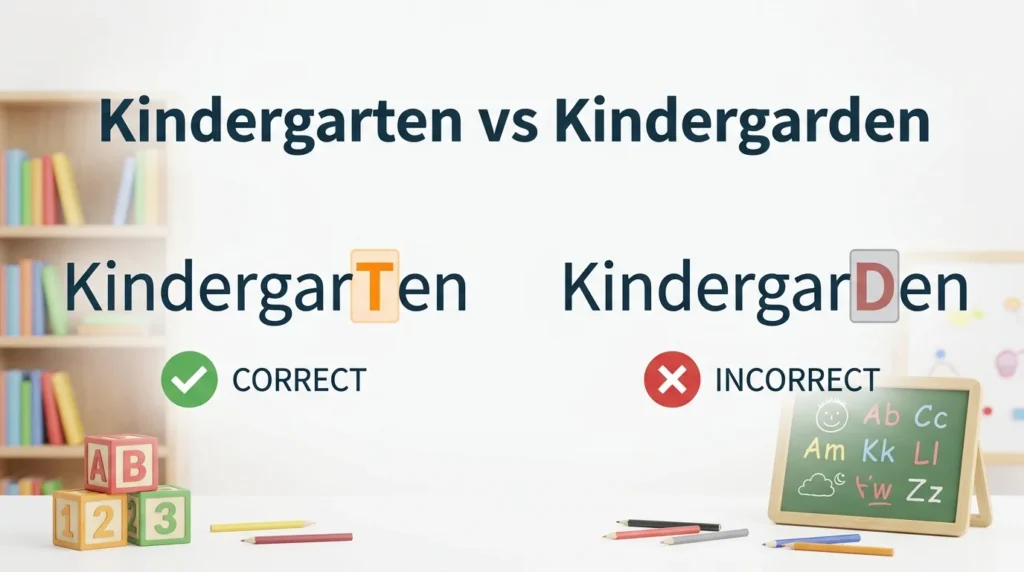

Kindergarten is the correct spelling. Kindergarden is incorrect in standard English. The word kindergarten refers to an educational class or school for young children. Its spelling comes from German, which helps explain the unusual -garten ending. Although kindergarden may appear in searches, messages, or informal writing, use kindergarten in schoolwork, emails, applications, professional writing, and published content.
What Is Kindergarten?
Kindergarten is a noun used for an early stage of education for young children.
The exact meaning depends somewhat on the variety of English and education system.
In American English, kindergarten commonly refers to the first year of formal schooling for children around five years old. In British English, the word can refer to a nursery school for young children.
For example:
My daughter starts kindergarten in September.
The word can also describe the class, program, or educational setting itself:
- a kindergarten teacher
- a kindergarten classroom
- kindergarten students
- kindergarten education
- kindergarten registration
The important spelling point is simple:
kindergarten → correct
kindergarden → incorrect
The two forms may look almost identical, but the middle of the word is different.
Why Does Kindergarten Matter?
Spelling kindergarten correctly matters because this is a word used in many formal and everyday situations.
You may need it when:
- filling out a school application
- writing an email to a teacher
- discussing your child’s education
- preparing a school report
- writing an academic paper
- creating educational content
- applying for a teaching position
- writing a professional biography
- posting about early education on social media
A misspelling does not necessarily make the meaning impossible to understand. A reader will usually know what kindergarden is intended to mean.
However, in formal writing, the standard spelling is kindergarten.
Read More: Receive vs Recieve: Correct Spelling and Examples.
The Core Rule
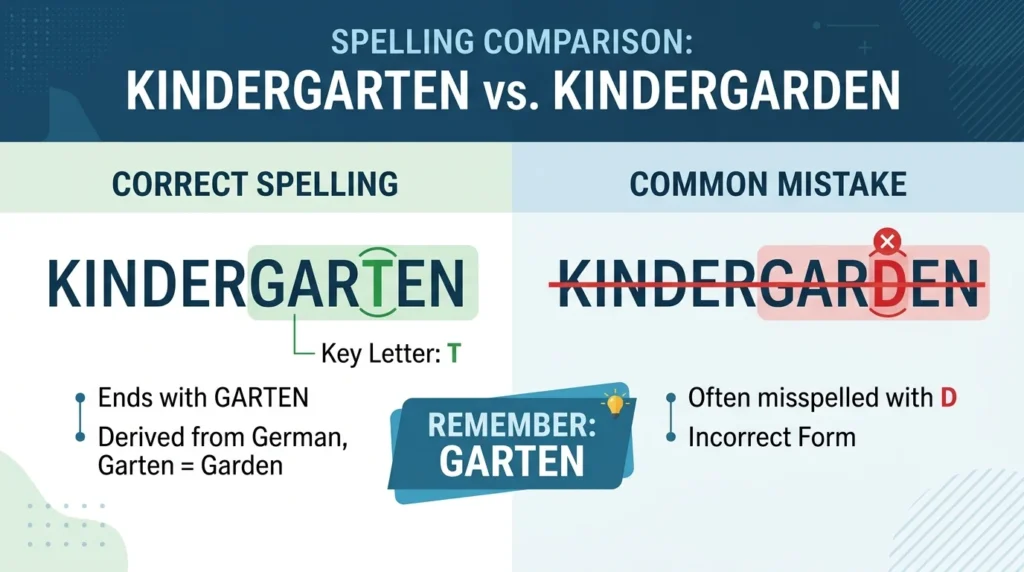
Use kindergarten with T: -GARTEN, not -GARDEN.
Remember:
Correct: kindergarten
Incorrect: kindergarden
The final part is garten, not garden.
This is not a choice between two accepted English spellings. There is no standard British-versus-American spelling difference that makes kindergarden correct.
How to Use Kindergarten
The word kindergarten is normally used as a noun.
Talking About the School Year
In American English:
My son starts kindergarten next year.
She has been in kindergarten since August.
Kindergarten is an important first step in formal education.
Talking About a Class
The kindergarten class went outside for a nature activity.
There are twenty children in the kindergarten class.
Talking About a Teacher
My sister is a kindergarten teacher.
The kindergarten teacher sent a note to the parents.
Talking About a Place
We visited the kindergarten yesterday.
The new kindergarten has three classrooms.
Talking About Education
The school offers a full-day kindergarten program.
Children learn basic academic and social skills in kindergarten.
The spelling stays the same in all these uses.
Correct Examples
Here are examples showing how kindergarten appears naturally in different types of writing.
| Situation | Correct Example |
|---|---|
| Conversation | My daughter starts kindergarten next month. |
| I would like to ask about kindergarten registration. | |
| School | The kindergarten students practiced writing their names. |
| Workplace | She has five years of experience teaching kindergarten. |
| Social media | My little one had an exciting first day of kindergarten! |
| Academic writing | The study examined language development among kindergarten children. |
| Application | The child is eligible to enter kindergarten this year. |
| Parent communication | The kindergarten teacher asked parents to label the children’s books. |
| News writing | The district announced changes to its kindergarten enrollment process. |
| Everyday writing | We bought a new backpack for kindergarten. |
| Professional writing | The program provides training for future kindergarten teachers. |
| School website | Kindergarten enrollment opens in March. |
Notice that none of these examples needs kindergarden.
Incorrect vs. Correct
| ❌ Incorrect | ✅ Correct | Why |
|---|---|---|
| My son starts kindergarden next year. | My son starts kindergarten next year. | The standard spelling ends in -garten. |
| She teaches kindergarden. | She teaches kindergarten. | Kindergarden is a misspelling. |
| The kindergarden class went outside. | The kindergarten class went outside. | The word keeps the t in -garten. |
| We visited the kindergarden yesterday. | We visited the kindergarten yesterday. | The educational term is spelled kindergarten. |
| He is in kindergarden this year. | He is in kindergarten this year. | Kindergarden is not the standard form. |
| Kindergarten starts next week. | Kindergarten starts next week. | The standard spelling is kindergarten. |
| She applied for a kindergarden position. | She applied for a kindergarten position. | The compound adjective uses the correct noun spelling. |
| The school offers kindergarden programs. | The school offers kindergarten programs. | Kindergarten remains unchanged when used before another noun. |
| Our kindergarden teacher called. | Our kindergarten teacher called. | The correct form contains -garten. |
| The child entered kindergarden at age five. | The child entered kindergarten at age five. | The spelling is not changed because of pronunciation. |
The main lesson is consistent throughout the table: do not replace the “t” in -garten with the “d” from garden.
Why People Make This Mistake
The mistake is understandable because kindergarden looks logical to an English speaker.
The English word garden is familiar. When people hear kindergarten, they may mentally divide the word as:
kinder + garden
That makes the spelling kindergarden feel natural.
But that is not how the borrowed word is spelled.
Phonetic Similarity
One major reason for the error is pronunciation.
When people hear a word rather than see it written, they may remember the sound without remembering the exact letters.
The ending can therefore be mentally connected with garden, producing:
kindergarden
instead of:
kindergarten
Familiar English Spelling
English speakers already know the word garden.
They may unconsciously substitute that familiar spelling for the less familiar garten.
This is a common type of spelling mistake: a less familiar sequence is replaced by a familiar one.
Translation Interference
The word has German roots. The German word Garten means “garden,” and Kinder means “children.” English borrowed the compound Kindergarten, retaining the spelling of the German elements.
So someone who understands the meaning as “children’s garden” may actually become more likely to think the English spelling should contain garden.
Typing Habits
The mistake can also happen while typing quickly.
A person may know the word perfectly well but automatically type the more familiar sequence:
garden
instead of:
garten
This is especially easy to miss when the surrounding sentence makes the intended meaning obvious.
Spellcheck Is Not a Complete Solution
Spellcheck can help, but it should not replace knowledge of common spelling patterns.
A tool may flag an unusual spelling, but depending on the software, language settings, dictionary, or context, not every error will be handled in exactly the same way.
The safest solution is to remember the correct form:
kindergarten
Common Mistakes Checklist
Mistake 1: Writing “kindergarden”
This is the most common confusion.
Avoid it: Remember that the ending is -garten.
Mistake 2: Thinking “garden” because of the meaning
The word is associated with the idea of a “children’s garden,” but that does not change the spelling.
Avoid it: Meaning and spelling do not always follow the same pattern in borrowed words.
Mistake 3: Assuming two spellings are acceptable
Seeing kindergarden online does not make it a standard alternative.
Avoid it: Use kindergarten in standard English writing.
Mistake 4: Memorizing only the pronunciation
The sound can lead you toward the wrong letters.
Avoid it: Learn the written form as a complete word: K-I-N-D-E-R-G-A-R-T-E-N.
Mistake 5: Treating it as an American/British spelling difference
The difference between kindergarten and kindergarden is not an AmE/BrE spelling distinction.
Avoid it: Both varieties use kindergarten.
Read More: Rumor vs Rumour: Which Spelling Is Correct?
Kindergarten in Real English
Grammatically correct and natural
Kindergarten is the normal standard form when referring to the educational setting.
My daughter starts kindergarten in September.
This is ordinary, natural English. The word is widely used in educational and everyday contexts. Cambridge gives kindergarten as the standard noun and records different educational meanings in American and British English.
Grammatically possible but unnatural
There is generally no reason to replace kindergarten with kindergarden in standard English.
A reader may understand kindergarden immediately because it resembles kindergarten, but recognition does not make it a natural or standard spelling.
For formal communication, do not treat the misspelling as an acceptable alternative.
Natural everyday English
In American English, phrases such as these are completely ordinary:
She’s in kindergarten.
He starts kindergarten next fall.
My child has a kindergarten teacher.
In British English, the word exists but may describe a different type of early-years educational setting. British speakers may also use terms such as nursery school depending on the context.
The spelling remains kindergarten.
American vs. British English
There is a genuine difference here, but it concerns meaning and educational terminology, not the spelling of kindergarten.
| Feature | American English | British English |
|---|---|---|
| Spelling | kindergarten | kindergarten |
| Common meaning | Often the first year of school for children around age five | Can refer to a nursery school for younger children |
| Alternative terms | preschool may refer to earlier education | nursery school is commonly used |
| “Kindergarden” | Incorrect | Incorrect |
| Main spelling rule | Use -garten | Use -garten |
Cambridge specifically distinguishes the US meaning as the first year of school and the UK meaning as a nursery school.
So:
American English: kindergarten
British English: kindergarten
Not:
American: kindergarten
British: kindergarden
That would be incorrect.
Formal vs. Informal Usage
The spelling kindergarten is suitable for both formal and informal writing.
Formal
The district has announced its kindergarten enrollment schedule.
The research examined children’s experiences during their first year of kindergarten.
Informal
My little boy starts kindergarten tomorrow!
She’s so excited about kindergarten.
The register may change the surrounding language, but it does not change the spelling.
You should not use kindergarden as a casual alternative. It remains a misspelling.
Read More: Authorization vs Authorisation: Which Is Correct?
Kindergarten vs. Kindergarden: Comparison Table
| Feature | Kindergarten | Kindergarden |
|---|---|---|
| Standard English spelling | ✅ Yes | ❌ No |
| Refers to early education | ✅ Yes | Intended to, but misspelled |
| Used in formal writing | ✅ Yes | ❌ Avoid |
| Used in everyday English | ✅ Yes | ❌ Avoid |
| American English | ✅ Yes | ❌ No |
| British English | ✅ Yes | ❌ No |
| Correct ending | -garten | -garden |
| Standard dictionary form | ✅ Yes | ❌ Not the standard form |
| Recommended spelling | Kindergarten | Do not use |
Memory Trick
The easiest memory trick is:
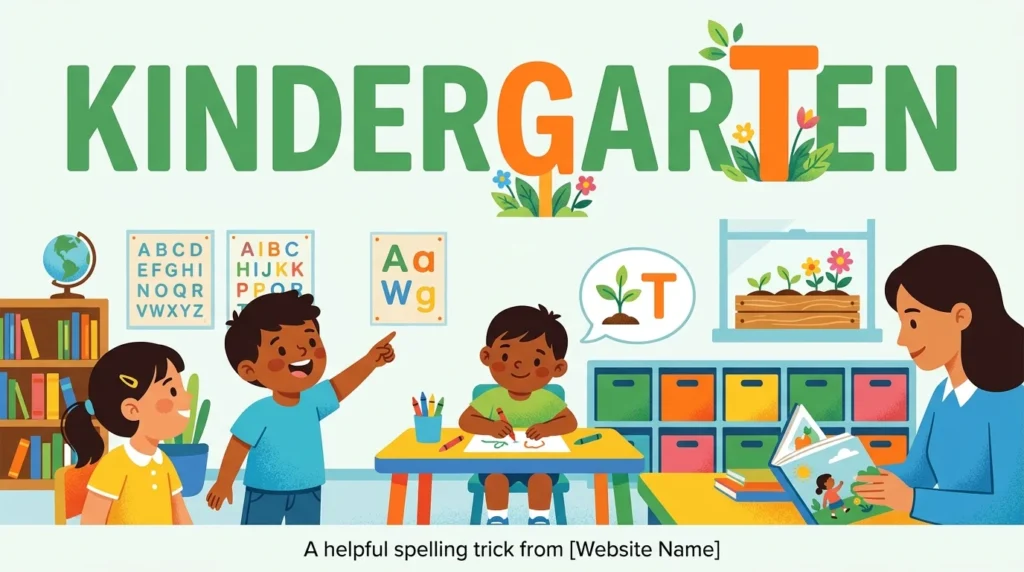
Kindergarten has a T before the final E.
Think:
kinder + garten
not:
kinder + garden
Another simple trick is to say:
Kids go to kinderGARTEN, not kinderGARDEN.
The visual difference is only one letter, so train yourself to look specifically at the T/D:
GARTEN ✅
GARDEN ❌
If you remember T = kindergarten, you can avoid the mistake quickly.
Real-Life Situations
School registration
You are filling out a school form and see a field asking about your child’s education.
Write:
Kindergarten
Not:
Kindergarden
Email to a teacher
You want to ask when classes begin.
Could you please confirm the kindergarten start date?
Job application
You are applying for an early-childhood teaching position.
I have three years of experience as a kindergarten teacher.
Social media
You post about your child’s first school day.
Today was her first day of kindergarten!
Academic writing
You are discussing early education in a paper.
The study followed children from kindergarten through elementary school.
In every situation, the spelling stays kindergarten.
Expert Tips
1. Learn the unusual part, not the whole word
Most people already know how to spell kinder and garden. The dangerous part is the ending.
Focus on:
-garten
Read More: Heros vs Heroes: Which Spelling Is Correct?
2. Do not let meaning control spelling
The word is associated with “children’s garden,” but English spelling does not require you to turn Garten into garden.
3. Check the T
When proofreading, look specifically at the middle:
kindergarten
If you see:
kindergarden
stop and correct it.
4. Memorize it visually
Write this three times:
kindergarten
kindergarten
kindergarten
Visual memory can be useful for a spelling question like this.
5. Keep the distinction simple
You do not need a complicated grammar rule.
Just remember:
Kindergarten = correct
Kindergarden = misspelling
Quick Summary
Kindergarten is the correct spelling, while kindergarden is a misspelling. The word refers to an early educational setting, although its exact meaning differs somewhat between American and British English. In American English, it commonly means the first year of school for children around age five; in British English, it can refer to a nursery school. The spelling is the same in both varieties: kindergarten. The easiest way to remember it is to focus on -garten, not -garden. If you are writing an email, school document, academic paper, professional message, or social media post, always use kindergarten.
FAQ
Is kindergarten or kindergarden correct?
Kindergarten is correct. Kindergarden is a misspelling.
Is kindergarden a real word?
Kindergarden is not the standard spelling of the educational term in English. If you mean the school or class for young children, write kindergarten.
Why is kindergarten spelled with a T?
The word was borrowed from German Kindergarten. The German element Garten means “garden,” which explains why English retains the t in the spelling.
Why do people write kindergarden?
The mistake is easy to make because garden is a familiar English word and the pronunciation of kindergarten can lead people toward that spelling.
Is kindergarten American or British English?
It is used in both American and British English, but the meaning can differ. In American English, it commonly refers to the first year of school for children around five. In British English, it can refer to a nursery school.
Is kindergarten one word or two?
Kindergarten is one word.
Not:
kinder garden
And not:
kinder-garten
Should kindergarten be capitalized?
Usually, kindergarten is lowercase because it is a common noun.
My daughter starts kindergarten next week.
It should be capitalized when it begins a sentence or appears as part of a proper name or official title.
What is the plural of kindergarten?
The plural is kindergartens.
Example:
Several kindergartens participated in the program.
What do you call a teacher who teaches kindergarten?
A common term is kindergarten teacher.
Example:
She works as a kindergarten teacher.
How do you spell kindergarten?
Spell it:
K-I-N-D-E-R-G-A-R-T-E-N
The important part to remember is:
GARTEN
not:
GARDEN
Quiz
| # | Question | Answer | Explanation |
|---|---|---|---|
| 1 | Which spelling is correct: kindergarten or kindergarden? | Kindergarten | The standard spelling ends in -garten. |
| 2 | My daughter starts ___ next year. | kindergarten | Kindergarten is the correct noun. |
| 3 | Choose the correct form: “She is a kindergarten teacher” or “She is a kindergarden teacher.” | She is a kindergarten teacher. | Kindergarden is a misspelling. |
| 4 | Fill in the blank: “The ___ class went outside.” | kindergarten | The educational term is spelled with t. |
| 5 | Is “kindergarden” an alternative British spelling? | No | The spelling does not change to kindergarden in British English. |
| 6 | Correct this sentence: “He entered kindergarden at age five.” | He entered kindergarten at age five. | Replace kindergarden with kindergarten. |
| 7 | Which ending is correct: -garten or -garden? | -garten | Kindergarten retains the spelling associated with its German origin. |
| 8 | Fill in the blank: “The school offers a full-day ___ program.” | kindergarten | The standard compound form is kindergarten program. |
| 9 | Correct the sentence: “My sister teaches kindergarden.” | My sister teaches kindergarten. | The standard spelling is kindergarten. |
| 10 | Complete the memory trick: “Kinder___, not kinder___.” | garten, garden | Remember kinderGARTEN, not kinderGARDEN. |