
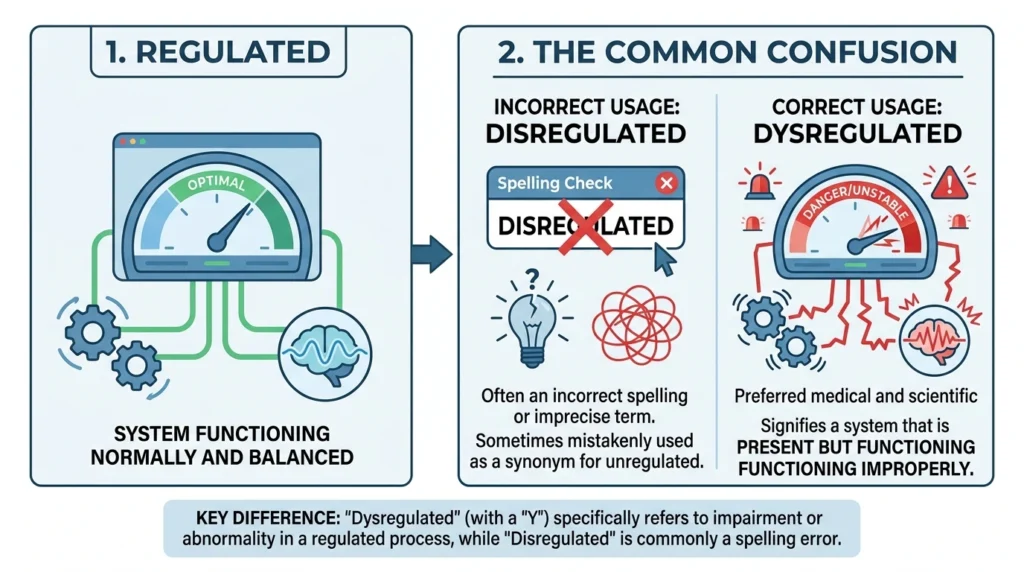

Dysregulated describes something that has difficulty maintaining normal control, balance, or regulation.
The word comes from:
Dysregulated is the correct and widely accepted word. It means that a system, process, emotion, or behavior is not properly controlled or balanced. Disregulated is usually considered an incorrect spelling created from confusion between prefixes. The correct term appears frequently in psychology, healthcare, biology, and everyday discussions about emotional control.
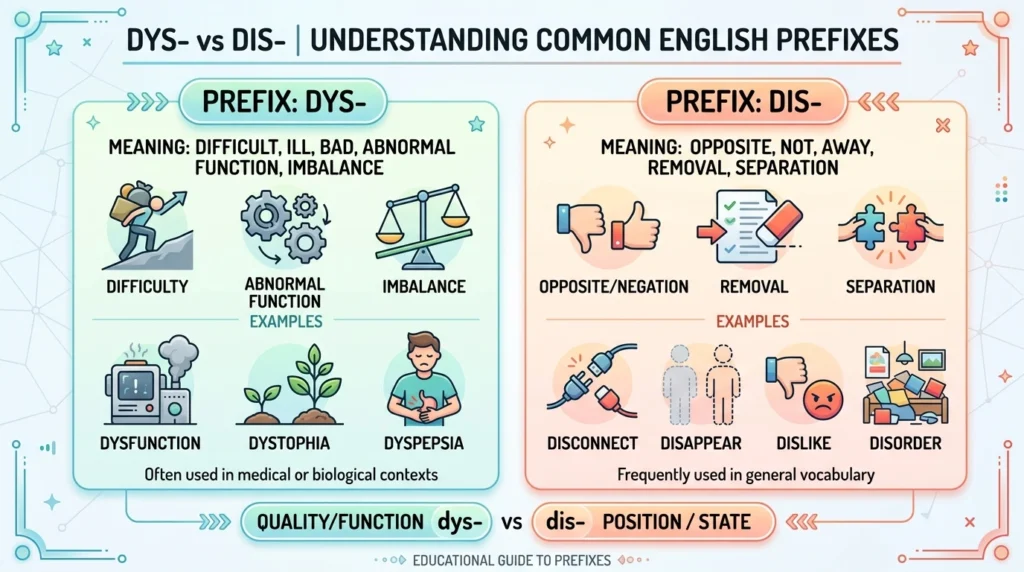
- dys- = bad, abnormal, difficult, or impaired
- regulated = controlled or adjusted
Together, dysregulated means “poorly regulated” or “not functioning with proper balance.”
The term is often used when a person, body system, or process reacts in a way that is too intense, too weak, too frequent, or poorly controlled.
For example:
- A dysregulated emotional response may involve extreme anger, sadness, or anxiety that feels difficult to manage.
- A dysregulated nervous system may refer to problems with how the body responds to stress.
- A dysregulated biological process may describe a system that is not operating normally.
The word does not simply mean “unregulated.” It usually suggests that regulation exists but is not working correctly.
What Is Disregulated?
Disregulated is generally not considered the standard English spelling.
People sometimes write disregulated because the prefix dis- is common in English words such as:
- disconnected
- disorganized
- dissatisfied
- disrupted
Because dis- often creates words meaning “apart,” “away,” or “opposite,” writers may assume that disregulated should mean “not regulated.”
However, English does not always build new words by simply adding familiar prefixes. In this case, the established form is dysregulated.
Examples:
❌ The patient showed signs of being disregulated.
✅ The patient showed signs of being dysregulated.
❌ The machine became disregulated after the error.
✅ The machine became dysregulated after the error.
Why It Matters
Using the correct form matters because word choice affects clarity and credibility.
In professional writing, incorrect terminology can make readers question the accuracy of the information. This is especially important in fields where dysregulated is a recognized technical term.
Common areas where this word appears include:
- Psychology
- Mental health discussions
- Neuroscience
- Medicine
- Education
- Workplace behavior studies
- Parenting resources
For example, a psychologist writing about emotional regulation would normally use:
“Children with emotional dysregulation may struggle to manage strong feelings.”
Using disregulated instead may distract the reader because it is not the accepted terminology.
Read More: Conex or Connex: What Is the Difference?
The Core Rule
Use “dysregulated” when you mean poorly controlled, imbalanced, or functioning abnormally. Avoid “disregulated” because it is not the standard form.
Simple Rule:
Dys- = difficulty, abnormality, or impaired function
Examples:
- dysregulated emotions
- dysregulated behavior
- dysregulated nervous system
- dysregulated metabolism
The prefix dys- often appears in medical and scientific words:
- dyslexia → difficulty with reading
- dysfunction → abnormal function
- dysphagia → difficulty swallowing
- dysregulation → impaired regulation
How to Use Dysregulated
1. Emotional and Behavioral Contexts
This is the most common modern usage.
Examples:
- Someone who becomes extremely upset over small problems may be described as emotionally dysregulated.
- A child who struggles to calm down after frustration may show dysregulated behavior.
Example sentence:
After several stressful events, he noticed that his emotional responses became more dysregulated.
2. Biological and Medical Contexts
In science and healthcare, dysregulated describes systems that are not maintaining normal balance.
Examples:
- dysregulated immune response
- dysregulated hormone levels
- dysregulated inflammatory processes
Example:
Researchers studied how a dysregulated immune system contributes to disease development.
3. Everyday Conversations
The word has become more common outside academic settings.
People may use it when describing:
- stress reactions
- overwhelming emotions
- difficulty calming down
- unhealthy routines
Example:
I was feeling emotionally dysregulated after a stressful week.
Correct Examples of Dysregulated
| Context | Example |
|---|---|
| Conversation | “I feel emotionally dysregulated when I do not sleep enough.” |
| Workplace | “High stress can lead to dysregulated decision-making.” |
| “The report suggests that the process has become dysregulated and needs review.” | |
| School | “Students may display dysregulated behavior when they feel overwhelmed.” |
| Academic Writing | “The study examined dysregulated neural activity.” |
| Healthcare | “The patient showed signs of dysregulated blood pressure control.” |
| Psychology | “Emotional dysregulation can affect relationships and communication.” |
| Social Media | “Taking breaks helps when your nervous system feels dysregulated.” |
| Parenting | “Parents often learn strategies for supporting dysregulated children.” |
| Research | “The researchers identified dysregulated pathways involved in the condition.” |
Incorrect vs Correct Usage
| ❌ Incorrect | ✅ Correct | Why |
|---|---|---|
| The child was emotionally disregulated. | The child was emotionally dysregulated. | The accepted term uses dys-, not dis-. |
| Stress caused her nervous system to become disregulated. | Stress caused her nervous system to become dysregulated. | Dysregulated describes impaired regulation. |
| The study examined disregulated brain activity. | The study examined dysregulated brain activity. | Scientific writing uses dysregulated. |
| His behavior became disregulated during the argument. | His behavior became dysregulated during the argument. | The spelling follows the established term. |
| The immune response was disregulated. | The immune response was dysregulated. | Medical terminology uses dysregulation. |
| The patient showed disregulated emotions. | The patient showed dysregulated emotions. | Emotional regulation problems are called dysregulation. |
| Sleep problems may create a disregulated state. | Sleep problems may create a dysregulated state. | Dysregulated is the recognized adjective. |
| The system became disregulated after failure. | The system became dysregulated after failure. | The word describes abnormal control. |
| Researchers studied disregulated processes. | Researchers studied dysregulated processes. | Academic usage favors dysregulated. |
| The child appeared disregulated at school. | The child appeared dysregulated at school. | Disregulated is a spelling error in standard usage. |
Read More: Copys or Copies: Which Spelling Is Correct?
Why People Make This Mistake
The confusion between dysregulated and disregulated happens because English prefixes do not always work in predictable ways. Many learners try to build words logically, but English often follows established usage rather than a simple formula.
1. The Similar Sound Creates Confusion
The prefixes dys- and dis- sound similar, especially when spoken quickly.
A person may hear:
“dysregulated”
and assume it begins with dis- because many common English words use that spelling.
This creates a spelling mistake that feels natural even though the standard form is different.
2. Familiarity With “Dis-” Words
The prefix dis- appears in many everyday words:
- disagree
- disconnect
- dislike
- dishonest
- disorder
Because these words are common, writers may automatically choose disregulated instead of dysregulated.
However, dys- has a different meaning. It often describes difficulty, abnormal function, or impaired performance.
Compare:
- disorder → a lack of order
- dysregulation → difficulty maintaining proper regulation
3. Overgeneralising Word Patterns
A common language-learning mistake is assuming that one pattern works everywhere.
For example:
“If something is not regulated, it should be disregulated.”
This seems logical, but English does not always follow direct word-building rules.
The correct word is determined by accepted usage, not only by what appears logical.
4. Spellcheck and Autocomplete Limitations
Modern writing tools help catch many spelling errors, but they are not perfect.
Some incorrect words may:
- appear in databases
- be used online
- exist as uncommon variations
Because of this, autocomplete may sometimes allow a form that is not the preferred standard.
Writers should check whether a word is accepted in professional and academic contexts.
5. Translation Interference
People learning English from other languages may create disregulated because their native language may form similar words using a negative prefix meaning “not” or “opposite.”
English often uses specific historical forms instead of directly translating concepts.
For example:
The idea:
“a system that is not working correctly”
becomes:
✅ dysregulated
not:
❌ disregulated
Dysregulated in Real English
Understanding a word requires more than knowing whether it is technically correct. It is also important to know how people actually use it.
Dysregulated is grammatically correct and widely accepted.
Grammatically Correct
It can describe emotions, behaviors, biological systems, and processes that are not properly controlled or balanced.
Examples:
- “The patient showed signs of a dysregulated stress response.”
- “The child became emotionally dysregulated after the conflict.”
The word works naturally when discussing a system that should normally regulate itself but is struggling to do so.
Grammatically Possible but Unnatural
A phrase can be understandable without being a normal English choice.
For example:
“The person was dysregulated in every area of life.”
This is grammatically possible, but it may sound vague because dysregulated usually needs context.
A clearer version:
“The person experienced emotional dysregulation during periods of high stress.”
The difference is precision. Good English does not only avoid mistakes; it chooses words that communicate clearly.
Natural Everyday English
In everyday conversations, dysregulated is most common when talking about emotions, stress, and the nervous system.
Examples:
- “I felt emotionally dysregulated after a difficult day.”
- “My child became dysregulated when the routine changed.”
- “Too much stress can leave you feeling dysregulated.”
However, in casual situations, many people may use simpler phrases:
- overwhelmed
- stressed out
- unable to calm down
- upset
For example:
Formal:
“The patient displayed emotional dysregulation.”
Everyday:
“The patient was having trouble calming down.”
Both communicate a similar idea, but the level of formality changes.
Formal vs Informal Usage
Formal Usage
Dysregulated is common in:
- academic research
- healthcare documents
- psychology writing
- scientific discussions
- professional reports
Examples:
“The study examined dysregulated neural activity associated with chronic stress.”
“The patient demonstrated dysregulated emotional responses.”
In formal writing, the term is useful because it provides a specific meaning.
Informal Usage
The word is increasingly used in everyday conversations, especially online.
Examples:
“I was completely dysregulated after that stressful meeting.”
“My nervous system feels dysregulated today.”
Although understandable, some audiences may prefer simpler words depending on context.
For general readers:
Instead of:
“Your nervous system is dysregulated.”
You might write:
“Your body may be stuck in a stress response.”
Dysregulated vs Disregulated Comparison Table
| Feature | Dysregulated | Disregulated |
|---|---|---|
| Standard spelling | ✅ Yes | ❌ No |
| Common usage | Psychology, medicine, science, everyday discussions | Rare and usually incorrect |
| Meaning | Poorly controlled or abnormally regulated | Intended meaning is usually “not regulated” |
| Prefix | Dys- (abnormal, impaired, difficult) | Dis- (different meaning pattern) |
| Used in research | Yes | No |
| Used in healthcare | Yes | No |
| Accepted in professional writing | Yes | No |
| Example | Emotional dysregulation | Emotional disregulation ❌ |
Similar Confusing Terms
| Term | Meaning | Example |
|---|---|---|
| Dysregulated | Not properly controlled or balanced | A dysregulated emotional response |
| Unregulated | Not controlled by rules or systems | An unregulated market |
| Deregulated | Removed from government control | A deregulated industry |
| Disorganized | Lacking structure or order | A disorganized workspace |
These words may sound related, but they describe different ideas.
Memory Trick
Remember:
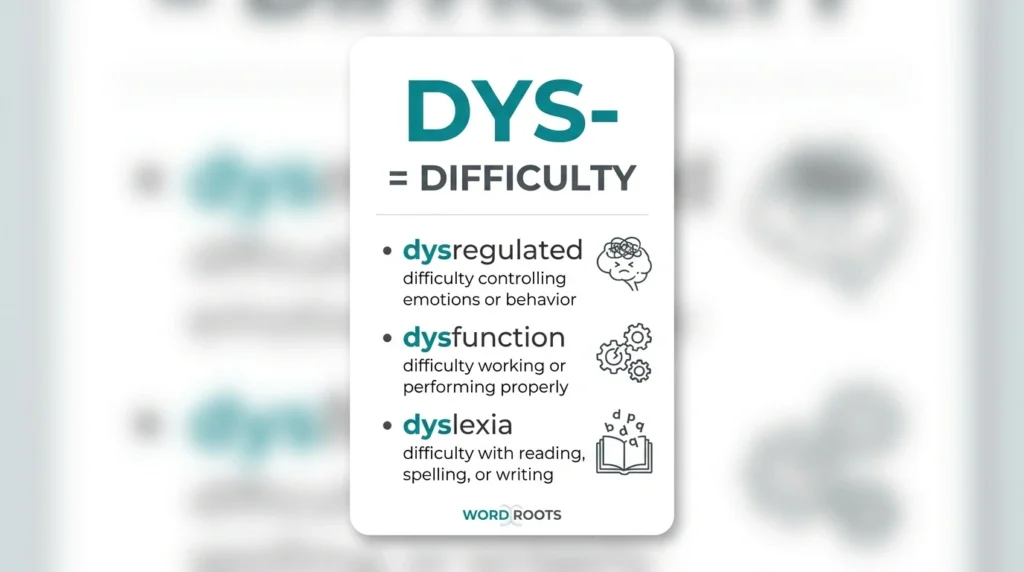
“Dys means difficulty.”
If something has difficulty regulating itself, it is:
✅ Dysregulated
Think:
- Dyslexia = difficulty reading
- Dysfunction = difficulty functioning
- Dysregulation = difficulty regulating
The DYS = DIFFICULT connection makes the spelling easier to remember.
Real-Life Situations
Job Interview
❌ Incorrect:
“I became disregulated during stressful interviews.”
✅ Correct:
“I sometimes become dysregulated under pressure, but I have learned strategies to manage stress.”
Workplace Meeting
❌ Incorrect:
“The team became disregulated after the project problems.”
✅ Correct:
“The team’s workflow became dysregulated after unexpected changes.”
❌ Incorrect:
“The system appears disregulated after the update.”
✅ Correct:
“The system appears dysregulated after the update and may require further testing.”
Text Message
❌ Incorrect:
“I’m feeling disregulated today.”
✅ Correct:
“I’m feeling dysregulated today and need some time to reset.”
Exam Writing
❌ Incorrect:
“The research focuses on disregulated emotional responses.”
✅ Correct:
“The research focuses on dysregulated emotional responses.”
Common Mistakes Checklist
Mistake 1: Using “disregulated” because it sounds logical
Problem: Writers assume dis- means “not.”
Fix: Remember that dysregulated is the established term.
Mistake 2: Treating dysregulated as meaning completely uncontrolled
Problem: Dysregulated does not always mean there is zero control.
Fix: It means regulation is impaired, ineffective, or out of balance.
Mistake 3: Using dysregulated without context
Problem: The word needs to describe what system or behavior is affected.
Better:
✅ dysregulated emotions
✅ dysregulated nervous system
✅ dysregulated immune response
Less clear:
❌ simply “a dysregulated person”
Mistake 4: Confusing dysregulated with unregulated
Problem: These words have different meanings.
- Unregulated = no rules or control
- Dysregulated = control exists but is not working properly
Mistake 5: Assuming spellcheck always proves correctness
Problem: Writing tools may not understand technical terminology.
Fix: Confirm specialized words through reliable language references and professional usage.
Part 3 will continue with:
- Expert Tips
- 10-question Mini Quiz Table
- FAQ (10 questions)
- Quick Summary
- Schema Markup
- Image Strategy & AI Prompts
Expert Tips You Should Know
1. Think About the System, Not Just the Emotion
Many people connect dysregulated only with feelings, but the word applies to any system that normally maintains balance.
Examples:
- emotional regulation
- nervous system regulation
- immune regulation
- metabolic regulation
A useful question is:
“Was this system supposed to regulate itself but failed to maintain balance?”
If yes, dysregulated may be the correct term.
2. Do Not Replace Simple Words With Dysregulated Everywhere
Although dysregulated is correct, it is not always the best choice.
Compare:
Technical:
“The patient showed signs of emotional dysregulation.”
Simple:
“The patient had difficulty controlling strong emotions.”
Both are correct. The best choice depends on your audience.
3. Use Specific Forms Instead of General Statements
A more precise sentence is usually stronger.
Weak:
“The person was dysregulated.”
Better:
“The person experienced emotional dysregulation during stressful situations.”
The second sentence tells the reader what type of regulation problem occurred.
4. Remember That Dysregulated Does Not Mean Bad
The word describes a state or condition. It does not automatically describe a person’s character.
Incorrect interpretation:
“A dysregulated person is a bad person.”
Correct interpretation:
“A dysregulated person may be experiencing difficulty managing a specific response or system.”
5. Match the Word to the Field
Different fields may use different terms.
Psychology:
emotional dysregulation
Biology:
dysregulated cellular processes
Workplace:
dysregulated decision-making
Choosing the right context improves clarity.
Mini Quiz: Dysregulated vs Disregulated
| Question | Answer | Explanation |
|---|---|---|
| Which spelling is correct? A) Disregulated B) Dysregulated | ✅ B) Dysregulated | Dysregulated is the accepted standard form. |
| Complete the sentence: “Stress can cause emotional ____.” | ✅ dysregulation | The standard noun form is dysregulation. |
| Correct this sentence: “The child became disregulated after the change.” | ✅ The child became dysregulated after the change. | Disregulated is not the standard spelling. |
| Is dysregulated only used in psychology? | ❌ No | It is also used in biology, medicine, and other fields. |
| Which prefix appears in dysregulated? | ✅ dys- | Dys- often indicates difficulty or abnormal function. |
| Choose the correct sentence: A) The immune system became disregulated. B) The immune system became dysregulated. | ✅ B | Scientific writing uses dysregulated. |
| What does dysregulated usually mean? | ✅ Poorly controlled or out of balance | It describes impaired regulation. |
| Is “unregulated” the same as “dysregulated”? | ❌ No | Unregulated means without control, while dysregulated means impaired control. |
| Fill the blank: “The study examined ____ neural activity.” | ✅ dysregulated | This is common scientific terminology. |
| Why do people write disregulated? | ✅ Because dis- sounds familiar and logical | The mistake comes from confusing prefixes. |
Frequently Asked Questions
Is dysregulated a real word?
Yes. Dysregulated is a real and widely accepted English word. It is commonly used in psychology, healthcare, biology, and scientific writing.
It describes something that is not functioning with normal regulation or balance.
Is disregulated ever correct?
In standard English, disregulated is generally not considered the correct form. Most uses of this spelling are mistakes caused by confusion with the prefix dis-.
The accepted spelling is:
✅ dysregulated
What is the difference between dysregulated and unregulated?
The difference is about whether regulation exists.
Unregulated means something has no control, rules, or restrictions.
Example:
An unregulated market has few official rules.
Dysregulated means a system has regulation but it is not working properly.
Example:
A dysregulated stress response reacts abnormally.
Is emotional dysregulation the same as being emotional?
No.
Everyone experiences emotions. Emotional dysregulation refers to difficulty managing emotional responses, especially when reactions are stronger, longer, or harder to control than expected.
Why is it called dysregulated instead of disregulated?
The word follows the prefix dys-, which is used in many scientific and medical terms to describe impaired or abnormal function.
Examples:
- dysfunction
- dyslexia
- dysphagia
- dysregulation
Can dysregulated be used for machines or systems?
Yes.
Although it is common in psychology, the word can describe any system that fails to maintain proper balance.
Example:
The automated process became dysregulated after repeated errors.
Is dysregulated a negative word?
It describes a problem or imbalance, but it is not a judgment about a person.
For example:
“The child is dysregulated.”
does not mean:
“The child is difficult.”
It means:
“The child is currently struggling to regulate emotions or behavior.”
Should I use dysregulated in everyday writing?
It depends on your audience.
For professional, academic, or psychology-related writing, it is appropriate.
For general audiences, simpler alternatives may sometimes be clearer:
- overwhelmed
- stressed
- unable to calm down
- struggling emotionally
Is dysregulation the noun form of dysregulated?
Yes.
Examples:
Adjective:
The patient showed dysregulated behavior.
Noun:
The patient experienced emotional dysregulation.
How can I remember the spelling?
Remember:
DYS = Difficulty
If something has difficulty regulating itself, it is:
✅ Dysregulated
Quick Summary
Dysregulated is the correct spelling, while disregulated is generally an incorrect form. The word describes something that is not properly controlled, balanced, or functioning normally. It is commonly used in psychology, healthcare, science, and everyday conversations about stress and emotions. The confusion happens because the prefix dis- appears in many familiar English words, but dys- is the correct prefix for impaired or abnormal regulation. Use dysregulated when describing emotional responses, biological systems, behaviors, or processes that struggle to maintain normal balance.