

Surprise is the correct spelling. Suprise is a common misspelling because the first r can be easy to overlook when the word is pronounced quickly. The correct form is s-u-r-p-r-i-s-e. Use surprise in everyday writing, emails, schoolwork, professional documents, and academic writing. There is no modern American/British spelling difference: surprise is correct in both.
What Is the Difference Between Suprise and Surprise?
The difference is simple: surprise is the correct standard English spelling, while suprise is a misspelling.
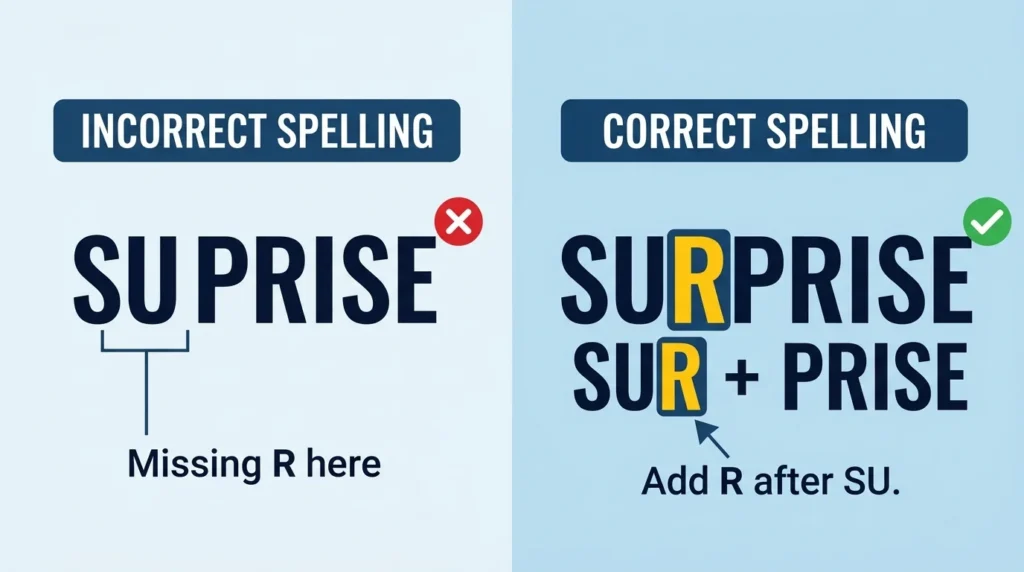
The word surprise contains two r letters:
S-U-R-P-R-I-S-E
The incorrect form suprise leaves out the first r:
S-U-P-R-I-S-E
That missing letter is easy to overlook because English pronunciation does not always make every written letter equally noticeable.
For example:
- ✅ The party was a surprise.
- ❌ The party was a suprise.
The meaning is not different. Suprise does not represent a separate modern English word with a different meaning. It is simply an incorrect spelling of surprise.
Why It Matters
A single missing letter may seem unimportant, but spelling errors can affect how your writing is received.
Consider these situations:
- School: A spelling mistake can cost marks or make an otherwise strong answer look less careful.
- Work: A misspelling in an email, report, proposal, or presentation can reduce the impression of professionalism.
- Business: Marketing copy and customer-facing content need consistent, polished spelling.
- Social media: A small error may be noticed immediately, especially in a short caption where every word is visible.
- Academic writing: Standard spelling is expected in essays, assignments, research papers, and formal correspondence.
- Job applications: Errors in a CV, cover letter, or application can make the writer appear less attentive to detail.
The good news is that this particular mistake is easy to eliminate once you remember where the first r belongs.
The Core Rule
Rule: Always spell the word as SURPRISE, with an r immediately after “su.”
Think of the word as:
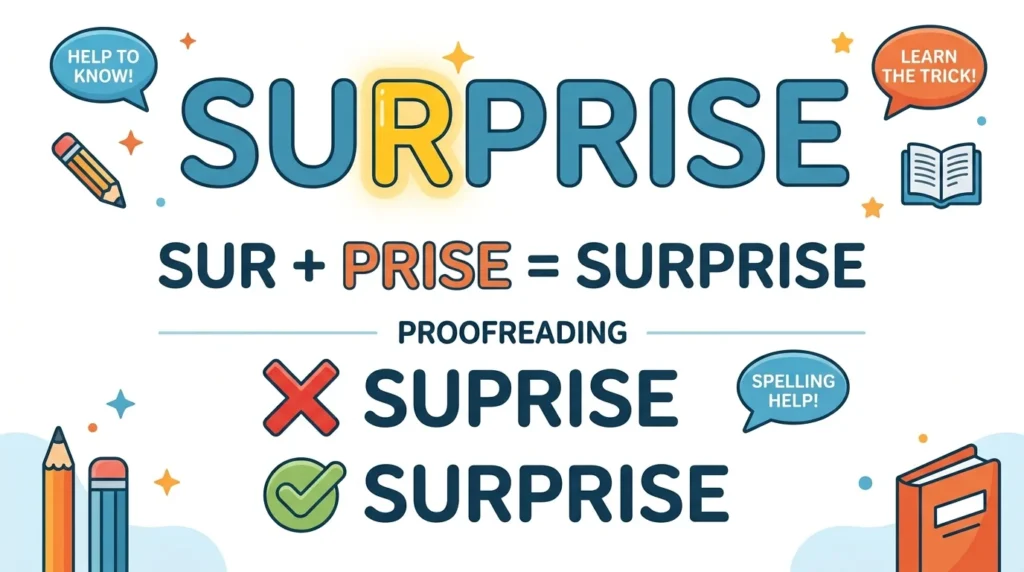
SUR + PRISE = SURPRISE
Not:
SU + PRISE = SUPRISE
The easiest visual check is to look directly after su.
If you have written:
suprise ❌
you have lost the first r.
If you have written:
surprise ✅
the spelling is correct.
Read More: Intention vs Intension: Which Is Correct?
How to Use “Surprise”
Surprise is a versatile word. It can function as a noun or a verb, and several related forms are also common.
Surprise as a noun
As a noun, surprise can refer to something unexpected or to the feeling caused by something unexpected.
Examples:
- The birthday party was a surprise.
- Her reaction showed genuine surprise.
- The announcement came as a complete surprise.
- To my surprise, everyone agreed.
- His visit was a pleasant surprise.
Here, surprise names an unexpected event, situation, or reaction.
Surprise as a verb
As a verb, surprise means to cause someone to feel surprised or to encounter someone unexpectedly.
Examples:
- The news surprised everyone.
- We wanted to surprise our teacher.
- Her answer surprised the interviewer.
- The results surprised the researchers.
- I did not expect to surprise him.
Notice that the spelling begins with the same sequence:
surprise
Changing the grammatical role does not make suprise correct.
Related forms of “surprise”
The word appears in several common forms:
| Word | Function | Example |
|---|---|---|
| surprise | Noun / verb | The result was a surprise. |
| surprises | Noun / verb | The gift surprises her. |
| surprised | Past tense / adjective | She looked surprised. |
| surprising | Adjective | The result was surprising. |
| surprisingly | Adverb | Surprisingly, nobody complained. |
A useful spelling pattern is to remember the beginning:
surpr-
That sequence remains visible in the common forms.
Correct Examples
Here are examples from different areas of everyday English.
- Conversation:
“What a surprise! I didn’t expect to see you here.” - Birthday:
“They planned a surprise party for their mother.” - Email:
“The announcement came as a complete surprise to the team.” - Workplace:
“The results were a pleasant surprise for the management.” - School:
“The teacher gave us a surprise quiz.” - Academic writing:
“The findings were surprising because they differed from the original prediction.” - Social media:
“What a beautiful surprise from my friends!” - Business:
“The sudden increase in demand was a welcome surprise.” - Personal message:
“I have a little surprise waiting for you.” - News:
“The election result came as a surprise to many observers.” - Interview:
“The unexpected question surprised the candidate.” - Everyday speech:
“You really surprised me!”
Read More: Ladel vs Ladle: Which Spelling Is Correct?
Incorrect vs. Correct
| ❌ Incorrect | ✅ Correct | Why |
|---|---|---|
| It was a suprise. | It was a surprise. | The standard spelling contains an r after “su.” |
| What a suprise! | What a surprise! | Suprise is a misspelling. |
| We planned a suprise party. | We planned a surprise party. | The noun is spelled surprise. |
| The news was a big suprise. | The news was a big surprise. | The first r must be retained. |
| She looked suprised. | She looked surprised. | The related form also begins surpr-. |
| The result was suprising. | The result was surprising. | The spelling pattern remains surpr-. |
| I wanted to suprise him. | I wanted to surprise him. | The verb requires the standard spelling. |
| It was an unexpected suprise. | It was an unexpected surprise. | Suprise is not the standard spelling. |
| The gift suprised her. | The gift surprised her. | The past-tense form is surprised. |
| Everyone was suprised by the result. | Everyone was surprised by the result. | The first r must not be omitted. |
| This was a wonderful suprise. | This was a wonderful surprise. | Only surprise is standard today. |
| He gave me a suprise yesterday. | He gave me a surprise yesterday. | The noun is spelled surprise. |
Why Do People Spell “Surprise” as “Suprise”?
This mistake is understandable because English spelling and pronunciation do not always match perfectly.
1. The first “r” can be easy to miss in speech
The main stress in surprise falls on the second syllable. The beginning can sound relatively weak, especially in natural, fast speech.
That means a learner may hear something closer to:
suh-PRIZE
rather than consciously noticing every letter in:
SUR-PRISE
The pronunciation does not remove the letter from the spelling.
2. People often spell from sound
A common spelling strategy is to write a word the way it seems to sound.
That strategy works for some simple English words, but it becomes unreliable when English spelling contains letters that are weakly pronounced or less noticeable.
Surprise is one of those words.
3. Fast typing encourages omissions
Someone who already knows the correct spelling can still type suprise accidentally.
This is especially likely when:
- typing quickly,
- using a phone keyboard,
- writing informal messages,
- concentrating on ideas rather than spelling,
- or repeatedly typing the same word.
An accidental typo is different from not knowing the spelling.
4. Visual familiarity can hide the mistake
The two forms look very similar:
suprise
surprise
Only one letter separates them.
Because the difference is small, the eye can sometimes read the intended word rather than carefully checking every letter.
This is one reason proofreading matters.
5. Translation can contribute to spelling confusion
English learners may also encounter this problem when their first language represents the sound differently from English spelling.
If a learner has learned the pronunciation before learning the written form, it is natural to reconstruct the spelling from sound.
The safest approach is to memorize the complete written pattern:
SURPRISE
rather than relying only on pronunciation.
Common Mistakes Checklist
Mistake 1: Dropping the first “r”
❌ suprise
✅ surprise
Why it happens: The first part of the word is not strongly stressed.
How to avoid it: Check the letters immediately after su. They should be r, not p.
Mistake 2: Writing “suprised”
❌ suprised
✅ surprised
The same missing r appears in the past form.
Mistake 3: Writing “suprising”
❌ suprising
✅ surprising
Do not let the spelling error carry over into related forms.
Mistake 4: Confusing spelling with pronunciation
You may hear the beginning of surprise as a weak sound, but spelling is not determined only by what is most obvious in pronunciation.
Mistake 5: Trusting visual familiarity
Because suprise looks almost correct, you may read past it without noticing the missing letter.
Slow down when proofreading important documents.
Mistake 6: Assuming frequent online use makes it correct
You may see suprise in comments, messages, posts, or user-generated content.
That does not make it an accepted standard spelling.
A misspelling can be widespread and still remain a misspelling.
Read More: Soo vs So: Which Is Correct?
Surprise in Real English
Everyday English: “What a surprise!”
Surprise is completely natural in everyday English when reacting to something unexpected. Phrases such as “What a surprise!”, “That was a surprise,” and “I have a surprise for you” are ordinary expressions. The key point is that the correct spelling remains surprise, even when the context is very casual. Informal writing does not create a different standard spelling.
“To my surprise”
To my surprise is a natural and widely used expression when something happens differently from what you expected. For example: “To my surprise, the meeting ended early.” It works well in conversation, personal writing, professional writing, and storytelling. There is no need to replace it with a more complicated expression simply because the writing is formal.
“A surprise”
The noun surprise is natural when referring to an unexpected event, gift, result, or reaction. “The gift was a surprise” and “The decision came as a surprise” are both ordinary constructions. The word can describe something pleasant, unpleasant, exciting, or simply unexpected. Surprise does not automatically mean something positive.
“Surprised” vs. “surprising”
These two related words describe different things. Surprised normally describes the person or thing experiencing the reaction: “I was surprised.” Surprising describes something that causes that reaction: “The result was surprising.” Confusing these forms can create a grammar problem even when the spelling itself is correct.
“Surprise” as a verb
The verb surprise is also completely natural: “The news surprised me.” In this structure, the news causes the person to experience surprise. The person is the object of the verb. This differs from “I was surprised,” where surprised describes the person’s resulting state.
American vs. British English
There is no modern American/British spelling difference for this word.
Both varieties use:
surprise
American English: surprise
British English: surprise
You should not change the spelling depending on whether you are writing for an American or British audience.
There has historically been an alternative spelling, surprize, but it is not the normal modern spelling and should not be used as a modern alternative in ordinary writing.
Formal vs. Informal Usage
Surprise is suitable for both formal and informal English.
Formal examples
- “The results came as a surprise to the research team.”
- “The announcement was met with considerable surprise.”
- “The unexpected finding surprised the researchers.”
Informal examples
- “What a surprise!”
- “I have a surprise for you.”
- “You really surprised me!”
The spelling does not change between these registers.
However, suprise should not be treated as an informal alternative. It is simply a spelling error.
Comparison Table
| Feature | Surprise | Suprise |
|---|---|---|
| Standard English spelling | ✅ Yes | ❌ No |
| Correct modern form | ✅ Yes | ❌ No |
| Noun | ✅ Yes | ❌ No |
| Verb | ✅ Yes | ❌ No |
| Used in formal writing | ✅ Yes | ❌ No |
| Used in informal writing | ✅ Yes | ❌ No |
| Used in American English | ✅ Yes | ❌ No |
| Used in British English | ✅ Yes | ❌ No |
| Meaning | Something unexpected / cause someone to feel surprised | No separate standard meaning |
| Main issue | Correct spelling | Missing r |
Memory Trick
Use this simple visual trick:
SURPRISE has “R” right after “SU.”
Break the word into two parts:
SUR + PRISE
Then remember:
SURPRISE = surprise with the first R in place.
You can also connect the beginning to another familiar word:
SUR + PRISE
The important part is not the pronunciation. It is the visual pattern:
S-U-R-P-R-I-S-E
If you see S-U-P-R…, stop and add the missing R.
Real-Life Situations
In an interview
Interviewer: “Were you surprised by the result?”
Candidate: “Yes. It was a complete surprise.”
Here, surprise is a noun.
In a meeting
“The sudden change in the deadline came as a surprise to the team.”
The word refers to an unexpected situation.
In an email
“Thank you for the gift. It was a lovely surprise.”
This is appropriate in a normal personal or professional message.
In a text message
“Guess what? I have a surprise for you!”
The informal context does not change the spelling.
In an exam
Question: Choose the correct spelling.
A. Suprise
B. Surprise
C. Suprize
D. Surprize
Answer: B. Surprise
In academic writing
“The unexpected result was a surprise to the researchers.”
The standard spelling is required in formal academic writing.
Mini Quiz
| # | Question | Answer | Explanation |
|---|---|---|---|
| 1 | Which spelling is correct: suprise or surprise? | Surprise | The standard spelling contains an r after “su.” |
| 2 | Fill in the blank: “The result was a complete ______.” | surprise | The noun is spelled surprise. |
| 3 | Choose: “The news ______ everyone.” A) suprised B) surprised | B) surprised | The past form retains the first r. |
| 4 | Correct the sentence: “She planned a suprise party.” | “She planned a surprise party.” | Suprise is a misspelling. |
| 5 | Which is correct? A) surprising B) suprising | A) surprising | The related form begins with surpr-. |
| 6 | Fill in the blank: “To my ______, he agreed.” | surprise | “To my surprise” is the standard expression. |
| 7 | Is “suprise” an accepted informal spelling? | No | It is a misspelling, not a standard informal variant. |
| 8 | Which spelling is used in both American and British English? A) suprise B) surprise | B) surprise | There is no modern spelling difference here. |
| 9 | Correct the sentence: “The announcement suprised the employees.” | “The announcement surprised the employees.” | The correct past form includes the first r. |
| 10 | Complete: “I have a little ______ for you.” | surprise | The noun requires the standard spelling surprise. |
Expert Tips
1. Memorize the spelling, not just the sound
If you learn surprise only from conversation, the first r can be easy to lose.
Learn the visual form:
SURPRISE
2. Remember the related words together
Instead of memorizing one word in isolation, create a small spelling family:
- surprise
- surprised
- surprising
- surprisingly
Seeing the shared surpr- pattern makes the spelling easier to recognize.
3. Proofread for small omissions
Many spelling mistakes are not complicated mistakes. They are missing letters.
When proofreading, look specifically for letters that may disappear during fast typing.
4. Do not rely completely on spellcheck
Spellcheck is useful, but it should support your proofreading rather than replace it.
A good habit is to recognize the correct form yourself.
5. Watch the first four letters
If you are in a hurry, you do not need to analyze the entire word.
Check:
SURP…
If you have written:
SUPR…
you have probably made the common mistake.
6. Remember that pronunciation is not a spelling guide
English has many words whose spelling cannot be predicted perfectly from pronunciation.
When a word is familiar but its spelling is uncertain, learn its written pattern rather than guessing from sound.
FAQ
Is “suprise” a word?
In modern standard English, suprise is treated as a misspelling of surprise, not as the standard spelling of a separate word.
Why is “suprise” wrong?
It is missing the first r in surprise. The correct sequence is sur-pri-se, written surprise.
How do you spell surprise?
The correct spelling is:
S-U-R-P-R-I-S-E
Is “surprise” a noun or a verb?
It can be both.
As a noun: “The visit was a surprise.”
As a verb: “The visit surprised me.”
Is “surprised” spelled with one or two r’s?
It is spelled with two r letters:
surprised
The first comes after su, and the second comes before i.
Is “suprising” correct?
No. The correct spelling is surprising.
The word begins with surpr-, not supr-.
Is “surprize” correct?
Surprize has historical usage as an alternative spelling, but it is rare or archaic in modern English. For contemporary writing, use surprise.
Is surprise spelled differently in British English?
No. Modern British English uses surprise, just like American English.
Can I use “surprise” in academic writing?
Yes. Surprise is a standard English word and can be used in academic writing when its meaning fits the sentence.
What is the easiest way to remember the spelling?
Remember:
SUR + PRISE = SURPRISE
The key is the r immediately after “su.”
Why does “suprise” look correct?
It is visually very close to surprise, and the first r may be less noticeable in pronunciation. That combination makes the error easy to overlook.
Quick Summary
Surprise is the correct spelling, while suprise is a common misspelling. The easiest way to remember the correct form is to keep the first r after “su”: SURPRISE. The word can be a noun, as in “The gift was a surprise,” or a verb, as in “The news surprised me.” Related forms such as surprised, surprising, and surprisingly also retain the surpr- spelling pattern. There is no modern American/British spelling difference. Although surprize appeared historically as an alternative spelling, surprise is the standard form for modern English. When proofreading, look for the first four letters: SURP, not SUPR.