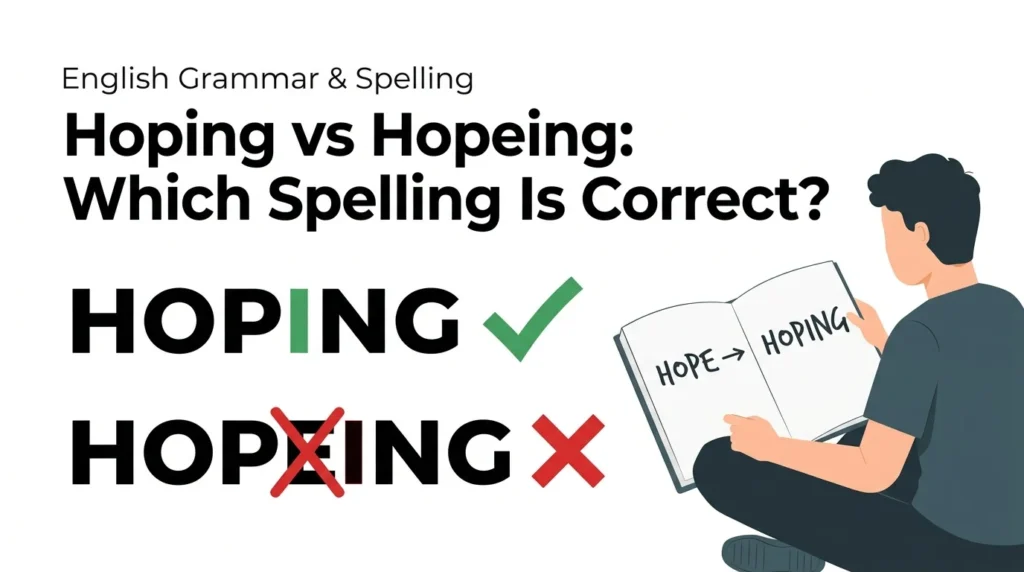

Hoping is the correct spelling. Hopeing is incorrect in standard English. The word hoping is the -ing form (present participle) of hope, meaning to want or expect something to happen. When -ing is added to hope, the final silent e is removed: hope → hoping. For example: “I am hoping to hear from you soon.”
What Is Hoping?
Hoping is the present participle of the verb hope.
To hope means to want something to happen or to be true, usually while believing that it is possible. The -ing form, hoping, is used in continuous verb forms and in other constructions where the action or state is presented as ongoing.
For example:
- I hope you feel better soon.
- I am hoping you feel better soon.
- She is hoping to get the job.
- We are hoping for good weather.
The meaning is connected to a desired or expected outcome.
The spelling is the important point here:
hope → hoping
Not:
hope → hopeing
What Does Hopeing Mean?
In standard contemporary English, hopeing is not the correct spelling of the -ing form of hope.
If you write:
❌ I am hopeing for good news.
you should change it to:
✅ I am hoping for good news.
Hopeing is normally the result of adding -ing to the complete written form of hope without applying the spelling change.
Why It Matters
A one-letter spelling mistake can change how polished your writing appears.
You may use hoping in:
- Job applications
- Professional emails
- School assignments
- University essays
- Business reports
- Social media posts
- Personal messages
- Customer communication
- Formal letters
- Everyday conversation
Writing hopeing in these situations can make the sentence look careless, especially when English spelling accuracy matters.
Compare:
❌ We are hopeing to receive your response soon.
✅ We are hoping to receive your response soon.
The meaning is still understandable in the incorrect sentence, but the spelling is not standard.
The Core Rule
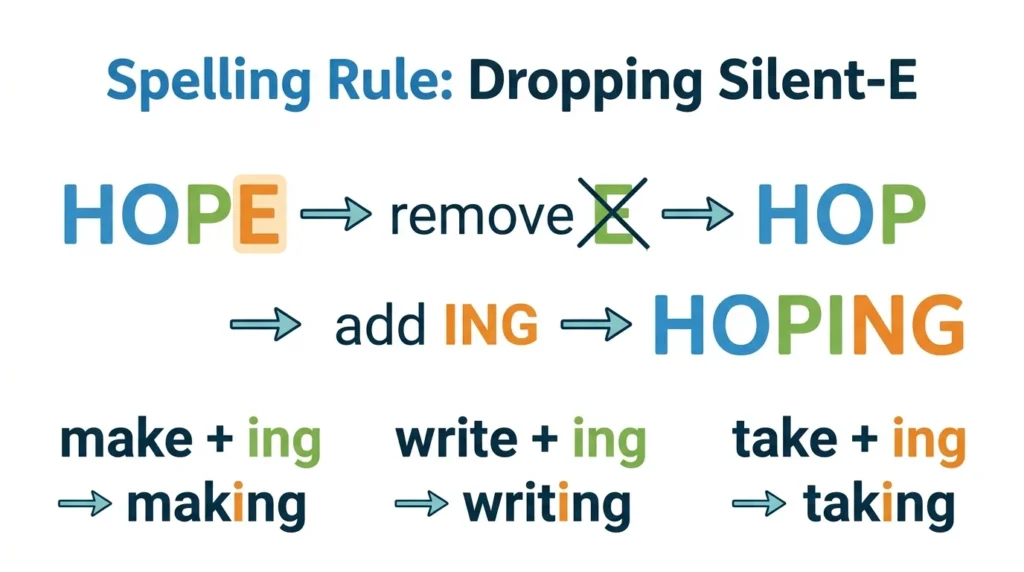
RULE: When a verb ends in a final silent “e,” the “e” is usually dropped before adding “-ing.”
For hope:
hope − e + ing = hoping
Other common examples include:
| Base verb | Correct -ing form |
|---|---|
| hope | hoping |
| make | making |
| write | writing |
| take | taking |
| love | loving |
| move | moving |
| drive | driving |
| smile | smiling |
| use | using |
| save | saving |
So the spelling pattern is not unique to hope.
The Three-Step Method
When you are unsure, use this simple process:
- Start with the base verb: hope
- Remove the final silent e: hop
- Add -ing: hoping
Therefore:
hope → hop → hoping
The important thing is that you are not changing the meaning of the verb. You are simply applying the normal spelling pattern used when forming the -ing form.
How to Use Hoping
Hoping can appear in several common grammatical structures.
Hoping + to + Verb
Use hoping to when someone wants or expects to do something.
Examples:
- I am hoping to visit London next year.
- She is hoping to find a new job.
- We are hoping to finish the project today.
- They are hoping to win the competition.
Hoping + for + Noun
Use hoping for when the desired thing is expressed as a noun or noun phrase.
Examples:
- I am hoping for good news.
- She is hoping for a promotion.
- We are hoping for better weather.
- They are hoping for a positive result.
Hoping + Clause
You can also use hoping with a clause describing the desired result.
- I am hoping that everything goes well.
- He is hoping that his application is accepted.
- We are hoping that the situation improves.
These structures are all normal uses of hoping. Cambridge lists constructions such as hope for, hope that, and hope to among the standard patterns of hope.
Read More: All-Time Favorite vs All Times Favorite: Which Is Correct?
Correct Examples
Here are examples showing how hoping works in different real-life contexts.
1. Everyday Conversation
I’m hoping everything works out.
The speaker wants a positive result.
2. Personal Message
I’m hoping to see you this weekend.
The speaker wants to meet the other person.
3. Professional Email
We are hoping to receive the documents by Friday.
This is a natural way to express an expected or desired outcome.
4. Job Application
I am hoping to hear from you regarding the position.
The applicant expresses a desire to receive a response.
5. Workplace
The team is hoping to complete the project before the deadline.
The team wants the project completed by a particular time.
6. School
Mia is hoping to improve her mathematics grade this term.
She wants a better result.
7. Academic Writing
The researchers are hoping to identify a clearer pattern in the data.
Here, hoping describes the researchers’ desired outcome.
8. Travel
We are hoping for good weather during our trip.
The travelers want favorable weather.
9. Social Media
Hoping for a better week ahead.
This is a common shortened social-media style. The subject and auxiliary verb are understood from context.
10. Customer Communication
We are hoping to resolve this issue as quickly as possible.
The company expresses its desired outcome in a professional way.
11. Family Conversation
She is hoping to hear from her brother soon.
The sentence describes what she wants or expects.
12. News or Reporting
Residents are hoping for further improvements to local services.
The word hoping describes a desired future development.
Incorrect vs. Correct
| ❌ Incorrect | ✅ Correct | Why |
|---|---|---|
| I am hopeing for good news. | I am hoping for good news. | The final silent e is dropped before -ing. |
| She is hopeing to pass. | She is hoping to pass. | Hope becomes hoping, not hopeing. |
| We are hopeing for rain. | We are hoping for rain. | The standard spelling removes the final e. |
| He was hopeing for a reply. | He was hoping for a reply. | The -ing form is hoping. |
| They are hopeing to win. | They are hoping to win. | Final silent e is removed. |
| I was hopeing you would agree. | I was hoping you would agree. | Hope + ing becomes hoping. |
| She kept hopeing for a change. | She kept hoping for a change. | The spelling does not retain the final e. |
| We have been hopeing for an answer. | We have been hoping for an answer. | The present participle is hoping. |
| He is hopeing that she comes. | He is hoping that she comes. | The correct form is hoping. |
| I’m hopeing to see you soon. | I’m hoping to see you soon. | Drop e before adding -ing. |
Why People Make This Mistake
The mistake is understandable because hope visibly contains the letter e.
A learner may think:
hope + ing = hopeing
That approach simply attaches the suffix to the whole written word.
But English spelling does not always work by adding letters without changing the base word.
With many verbs ending in a final silent e, the e is removed before a suffix such as -ing is added.
So:
- hope → hoping
- make → making
- write → writing
- drive → driving
Phonetic Similarity
When people hear hoping, they do not hear the written letter sequence clearly enough to determine whether an e should appear before -ing.
Spelling cannot always be reconstructed directly from pronunciation.
Spelling Overlap
The eyes see:
hope
and then:
ing
It is tempting to join them mechanically.
That produces hopeing, but standard spelling requires a change.
Overgeneralisation
Learners may learn that -ing is added to verbs and then apply the rule too literally:
verb + ing
The more complete rule is:
Some verbs change their spelling when -ing is added.
Autocomplete and Spellcheck
Spellcheck tools can catch hopeing in many situations, but relying completely on software is risky.
A spellchecker may help identify a spelling error, but it does not teach you why the error occurred.
Knowing the rule makes it easier to spell related words correctly without depending on correction tools.
Translation Interference
Learners whose first language handles verb endings differently may expect the base word to remain unchanged when an English suffix is added.
English spelling patterns do not always correspond neatly to patterns in another language. Learning common English suffix rules can reduce this type of interference.
Common Mistakes Checklist
1. Keeping the Final E
Mistake:
❌ hopeing
Why it happens:
The writer sees the spelling of the base verb and simply adds -ing.
How to avoid it:
Remember:
hope − e + ing = hoping
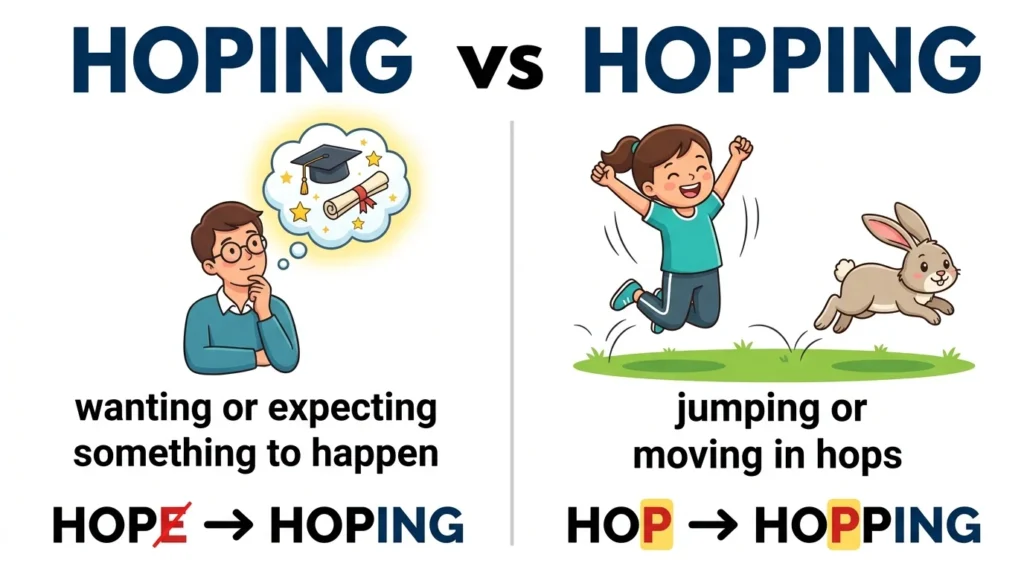
2. Confusing Hoping With Hopping
This is a different spelling issue.
Hoping comes from hope.
Hopping comes from hop.
They have different meanings.
- I am hoping for good news. → I want or expect good news.
- The rabbit is hopping across the field. → The rabbit is jumping.
The spelling difference is meaningful.
3. Writing Hopeing Because It “Looks Logical”
English spelling often has rules that are not obvious from simply looking at a word.
The logical-looking form is not always the standard form.
Hopeing may appear to follow hope + ing, but the spelling rule changes it to hoping.
4. Thinking the E Is Pronounced
The final e in hope is silent.
When -ing is added, it disappears from the spelling.
This is why:
hope → hoping
rather than:
hope → hopeing
5. Forgetting That Spelling and Grammar Are Connected
Hoping is not just an alternative spelling of hope.
It is the -ing form of the verb and is used in particular grammatical structures.
For example:
- I hope to see you.
- I am hoping to see you.
Both are grammatical, but they use different forms of the verb.
Read More: Pent vs Pant: Which Word Is Correct?
Hoping in Real English
Grammatically Correct
Hoping is completely standard in modern English. It is used in everyday conversation, professional communication, academic contexts, journalism, and informal writing. For example, “I’m hoping to hear from you soon” is a normal construction. The word can be followed by to + verb, for + noun, or a clause beginning with that. (Cambridge Dictionary)
Grammatically Possible but Unnatural
A sentence can sometimes be grammatically possible while still sounding unnecessarily complicated. For example, “I am hoping with considerable expectation that the outcome will be favorable” is grammatically understandable, but it is much heavier than most everyday contexts require. Natural English usually favors a simpler expression such as “I’m hoping for a good result.”
Natural Everyday English
In ordinary conversation, people commonly use short patterns such as “I’m hoping so,” “I’m hoping for the best,” “I’m hoping to see you,” and “I’m hoping everything goes well.” The word itself is neither unusually formal nor unusually informal. Its naturalness depends more on the sentence around it than on hoping itself.
American vs. British English
There is no meaningful American-versus-British spelling difference here.
Both varieties use:
✅ hoping
Neither standard American English nor standard British English uses hopeing as the normal spelling of the -ing form.
The same silent-e spelling rule applies in both varieties.
Formal vs. Informal Usage
Hoping works in both formal and informal English.
Informal
- I’m hoping you can make it.
- Hoping for good news!
- I’m hoping everything is okay.
Professional
- We are hoping to finalize the agreement this week.
- I am hoping to receive your response by Friday.
Academic
- The researchers are hoping to identify a consistent relationship between the variables.
The spelling does not change according to formality.
One useful distinction is that a sentence such as “Hoping you have a great day!” is more conversational because it leaves out the subject and auxiliary verb. In a formal document, “I hope you have a great day” or “I am hoping you have a great day” may be more appropriate depending on the intended meaning.
Comparison Table
| Feature | Hoping | Hopeing |
|---|---|---|
| Correct standard spelling | ✅ Yes | ❌ No |
| Base word | hope | hope |
| Form | Present participle / -ing form | Incorrect formation |
| Meaning | Wanting or expecting something to happen | No standard meaning |
| Final e retained? | No | Yes |
| Used in formal writing | Yes | No |
| Used in informal writing | Yes | No |
| Used in American English | Yes | No |
| Used in British English | Yes | No |
| Example | I am hoping for good news. | I am hopeing for good news. ❌ |
Hoping vs. Hopping
Because the words look very similar, it is worth learning this distinction too.
| Word | Base word | Meaning | Example |
|---|---|---|---|
| hoping | hope | Wanting or expecting something | I’m hoping for good news. |
| hopping | hop | Jumping or moving in hops | The rabbit is hopping across the grass. |
The spelling follows two different patterns:
hope → hoping
hop → hopping
The extra p in hopping belongs to the base verb hop and results from the consonant-doubling pattern used in this type of word.
Why Is There One P in Hoping but Two Ps in Hopping?
This is one of the easiest ways to see why hoping and hopping are not interchangeable.
Hope → Hoping
The base word is:
hope
Remove the final silent e:
hop
Add -ing:
hoping
Hop → Hopping
The base word is:
hop
Here there is no silent e to remove. Instead, the final consonant is doubled before -ing:
hop → hopping
This preserves the short vowel pattern of the base word.
So:
- hope → hoping
- hop → hopping
The different spelling reflects different base words and meanings.
Memory Trick
Use this simple mnemonic:
Hope loses E when it starts -ing.
Think:
HOPE − E + ING = HOPING
Or remember the pair:
Hope = wish → Hoping = wishing
Hop = jump → Hopping = jumping
If you see hopeing, mentally cross out the e:
hop[e]ing → hoping
That gives you the correct spelling immediately.
Real-Life Situations
In an Interview
Question: What are your career goals?
Answer:
“I’m hoping to develop my leadership skills and take on more responsibility.”
Here, hoping introduces a desired future outcome.
In a Meeting
“We are hoping to reach a decision today.”
The team wants the decision to be reached today.
In an Email
“I’m hoping to receive the revised document by Thursday.”
This is a professional use of hoping.
In a Text Message
“I’m hoping you can come tonight.”
The speaker wants the other person to come.
In an Exam
“She is hoping to improve her final grade.”
The correct spelling is hoping, not hopeing.
On Social Media
“Hoping for better days ahead.”
This shortened structure is common in informal social writing.
In a Business Update
“The company is hoping to expand into new markets next year.”
The company wants or expects this outcome to happen.
Expert Tips
Tip 1: Learn the Base Word
Do not memorize hoping as an isolated spelling.
Memorize:
hope → hoping
Understanding the transformation makes the spelling easier to reproduce.
Tip 2: Watch for Silent E
When you see a verb ending in a silent e, check whether -ing is being added.
Common patterns include:
- make → making
- write → writing
- take → taking
- hope → hoping
- use → using
Tip 3: Do Not Apply One Rule Blindly
English spelling has patterns, but they have exceptions.
For this particular word, however, the standard form is straightforward:
hope → hoping
Tip 4: Check the Meaning Before Choosing the Spelling
If you mean wanting or expecting something, the word you need is hoping.
If you mean jumping, you may need hopping.
Tip 5: Read the Whole Sentence
If you write:
“I am ___ to hear from you.”
the correct word is:
hoping
If you write:
“The rabbit is ___ across the garden.”
the correct word is:
hopping
Meaning can help you confirm spelling.
Tip 6: Do Not Trust “Looks Right”
Hopeing looks as though it should be correct if you simply attach -ing.
But standard spelling requires the final e to disappear.
FAQ
Is hoping or hopeing correct?
Hoping is correct. Hopeing is a misspelling in standard modern English.
How do you spell hoping?
The correct spelling is H-O-P-I-N-G.
The final e in hope is removed before -ing is added.
Why is hopeing wrong?
Because the standard spelling rule for this verb removes the final silent e before adding -ing:
hope − e + ing = hoping
Is hopeing ever a word?
Not as the standard modern -ing form of hope. If you mean the ordinary verb hope in its -ing form, use hoping.
What is the difference between hope and hoping?
Hope is the base verb, while hoping is its -ing form.
For example:
- I hope you succeed.
- I am hoping you succeed.
What does hoping mean?
Hoping means wanting or expecting something to happen or be true, usually with some sense that the desired outcome is possible.
Is hoping formal or informal?
It is suitable for both formal and informal English. The surrounding sentence determines the overall level of formality.
Is hoping the same in American and British English?
Yes. Both standard American and British English use hoping.
Is hopping the same as hoping?
No. Hoping comes from hope and relates to wanting or expecting something. Hopping comes from hop and refers to jumping or moving in hops.
Why does hope become hoping instead of hopeing?
The final silent e is normally dropped before the -ing suffix is added.
Can I write “I’m hoping for good news”?
Yes. I’m hoping for good news is a natural and grammatically correct sentence.
Quick Summary
Hoping is the correct spelling, while hopeing is incorrect in standard modern English. Hoping is the -ing form of the verb hope, which means wanting or expecting something to happen. The spelling follows a common English pattern: when a verb ends in a final silent e, that e is usually dropped before -ing is added. Therefore, hope + ing = hoping, not hopeing. Do not confuse hoping with hopping: hoping comes from hope, while hopping comes from hop. The simplest memory trick is: “Hope loses E when it starts -ing.” Use hoping in everyday, professional, academic, and formal writing.
Quiz
| # | Question | Answer | Explanation |
|---|---|---|---|
| 1 | Which spelling is correct? A) hoping B) hopeing | A) hoping | The final silent e in hope is dropped before -ing. |
| 2 | Fill in the blank: “I am ___ to hear from you soon.” | hoping | The correct -ing form of hope is hoping. |
| 3 | Correct the sentence: “She is hopeing to pass the exam.” | She is hoping to pass the exam. | Hope loses its final e before -ing. |
| 4 | Which word means “jumping or moving in hops”? A) hoping B) hopping | B) hopping | Hopping comes from the verb hop. |
| 5 | Complete the spelling: hope − ___ + ing | e | Remove the final e, then add -ing. |
| 6 | Is this correct? “We are hoping for good weather.” | Yes | Hoping for + noun is a standard construction. |
| 7 | Which sentence is correct? A) They are hopeing to win. B) They are hoping to win. | B | Hoping is the standard spelling. |
| 8 | Correct the sentence: “I was hopeing you could help me.” | I was hoping you could help me. | The final e is removed before -ing. |
| 9 | Which base verb produces hopping? A) hope B) hop | B) hop | Hop becomes hopping through final-consonant doubling. |
| 10 | Fill in the blank: “The researchers are ___ to find a solution.” | hoping | Hoping correctly expresses their desired outcome. |