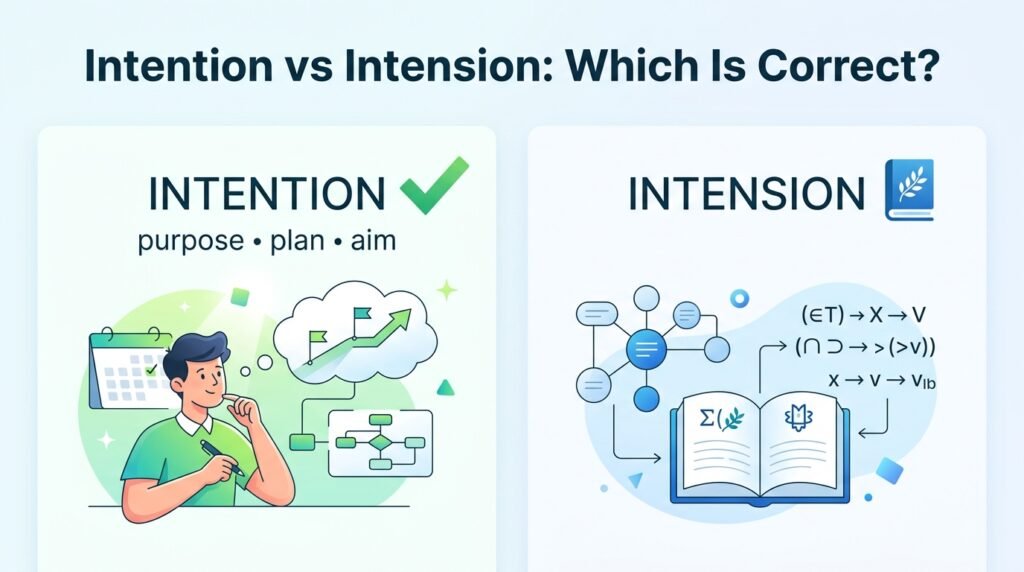

Intention and intension are both real English words, but they have different meanings. Intention means a purpose, plan, aim, or something you mean to do. Intension is a specialized term used mainly in logic, linguistics, semantics, and philosophy to describe the defining properties or conceptual content of a term. In everyday English, intention is almost always the word you need.
What Is the Difference Between Intention and Intension?
The main difference is purpose versus conceptual meaning.
Intention describes what someone plans, wants, or means to do. It is common in everyday English:
My intention is to finish the project today.
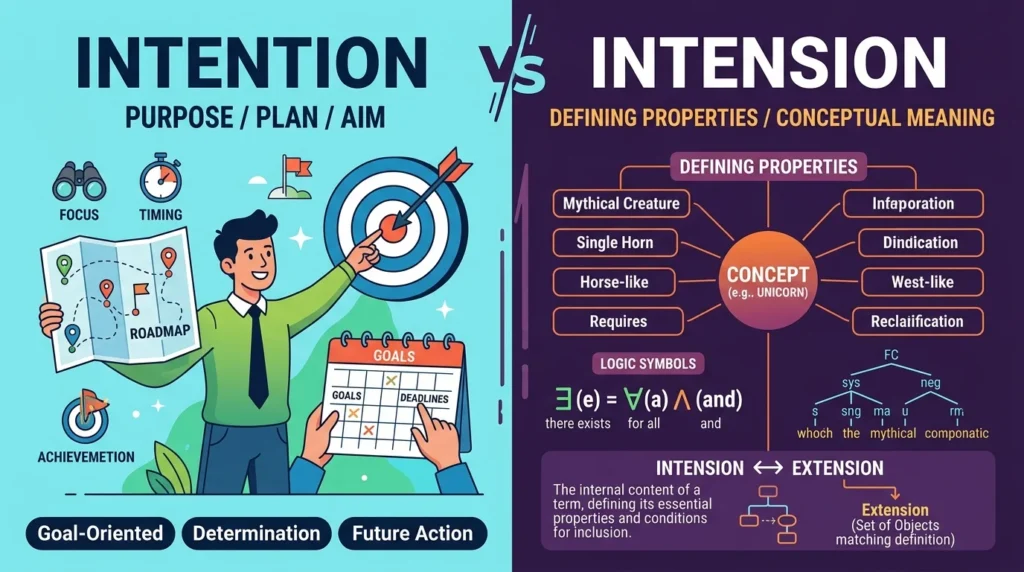
Intension, on the other hand, is a technical noun. In logic and semantics, it refers roughly to the properties, characteristics, or conceptual content associated with a term. It is often discussed alongside extension, which concerns the things to which a term applies.
A simple way to separate them is:
- Intention = purpose, plan, or aim
- Intension = defining meaning or properties of a concept
So if you are talking about someone’s plans, use intention.
If you are discussing the meaning or defining characteristics of a concept in a technical field, intension may be the correct word.
Why It Matters
The two words are easy to confuse because they are pronounced alike in English and differ by only one letter. They are also closely related historically. This makes the mistake especially easy for students, professionals, and even experienced writers.
Using intension when you mean someone’s purpose can make ordinary writing look like a spelling error:
❌ My intension was to help you.
The intended word is:
✅ My intention was to help you.
The distinction becomes even more important in academic writing. In philosophy, linguistics, and logic, intension is not simply a misspelling of intention. It has a specialized meaning. Replacing one with the other can change the meaning of a technical statement.
The Core Rule
Use intention for a purpose, plan, aim, or intended action. Use intension only when you mean the technical concept of the defining properties or conceptual content of a term.
For most everyday writing, intention is the correct choice.
The fastest test
Ask yourself:
Am I talking about what someone plans or wants to do?
- Yes → intention
Am I discussing the meaning or defining properties of a concept in logic, semantics, linguistics, or philosophy?
- Yes → intension
How to Use Intention
Intention is a noun referring to something a person plans, means, or wants to do. Dictionaries define it in terms of a purpose, aim, or something someone wants and plans to do.
It commonly appears in structures such as:
- my intention is to…
- his intention was to…
- with the intention of…
- have no intention of…
- make your intentions clear
- good intentions
- the intention behind something
Read More: Ladel vs Ladle: Which Spelling Is Correct?
Common patterns
Intention + to-infinitive
Use intention + to + verb when describing a planned action.
My intention is to improve my English.
She announced her intention to resign.
His intention was to start a new business.
The structure intention to do something is standard English.
Intention of + -ing
You can also use intention of + gerund.
I have no intention of leaving.
They had every intention of attending the meeting.
She had no intention of changing her decision.
Both structures are useful, but the grammar after them is different:
- intention to leave
- intention of leaving
Do not write:
❌ intention of to leave
How to Use Intension
Intension is a legitimate word, but it is much less common in ordinary English.
In logic and semantics, an intension concerns the properties, characteristics, or conceptual content associated with a term. It is commonly contrasted with extension.
For example, suppose we are discussing the concept triangle.
Its intension can be described through defining characteristics such as:
- being a geometric figure
- having three sides
- having three angles
- being a closed plane figure
The extension, by contrast, concerns the particular things that fall under the concept—for example, individual triangles that satisfy the definition.
The exact technical treatment of intension varies by theory and field, so it is better to think of intension as a specialized concept concerning meaning, properties, or conditions associated with an expression rather than as simply “the inside meaning.”
Correct Examples
Here are examples showing how the two words work in real contexts.
| Situation | Correct Example |
|---|---|
| Conversation | My intention was never to offend you. |
| It was my intention to reply earlier. | |
| Workplace | The company’s intention is to expand into new markets. |
| Interview | My intention is to build a long-term career here. |
| School | Her intention was to complete the assignment before Friday. |
| Academic writing | The philosopher examines the intension of the term. |
| Social media | My intention was simply to share my experience. |
| Business | We have no intention of changing the agreement. |
| Personal message | I had no intention of ignoring you. |
| Linguistics | The intension of a term concerns its conceptual content. |
More Examples of Intention
- My intention is to learn three new words every day.
- She had no intention of causing trouble.
- His intention was to help the new employee.
- The manager made his intentions clear during the meeting.
- Their intention is to open another branch next year.
- I had every intention of calling you yesterday.
- Her good intentions were obvious to everyone.
- The email was written with the intention of clarifying the issue.
- What was your intention when you sent that message?
- The candidate explained his intention to continue his studies.
These are all ordinary uses of intention because they concern plans, purposes, motives, or intended actions.
More Examples of Intension
Because intension is technical, its examples tend to appear in academic contexts.
- The philosopher examined the intension of the concept.
- The intension of a term can differ from its extension.
- The textbook explains intension and extension in formal semantics.
- The researcher analyzed the intension of the predicate.
- The definition focuses on the intension of the category.
- Students of logic learn to distinguish intension from extension.
- The theory provides an intensional account of meaning.
- The author discusses how intension affects interpretation.
- The linguistic analysis separates conceptual content from reference.
- The distinction between intension and extension is important in philosophical semantics.
Read More: Soo vs So: Which Is Correct?
Incorrect vs. Correct
| ❌ Incorrect | ✅ Correct | Why |
|---|---|---|
| My intension was to help. | My intention was to help. | The sentence describes a purpose. |
| What is your intension? | What is your intention? | It asks about someone’s plan or purpose. |
| Her intension was to study abroad. | Her intention was to study abroad. | Studying abroad is a planned action. |
| I have no intension of leaving. | I have no intention of leaving. | The phrase means you do not plan to leave. |
| His intension was clear. | His intention was clear. | The sentence concerns his purpose. |
| The company’s intension is to expand. | The company’s intention is to expand. | Expansion is a planned business action. |
| She explained her intension to resign. | She explained her intention to resign. | Resigning is the intended action. |
| I didn’t understand his intension. | I didn’t understand his intention. | The context concerns what he meant to do. |
| The intention of the term is its defining properties. | The intension of the term is its defining properties. | This is a technical logic/semantics context. |
| We studied the intention of a concept in logic. | We studied the intension of a concept in logic. | Here, the specialized technical term is intended. |
Notice that the last two examples are different from the others. Intension is not simply “wrong English.” It is a genuine technical word. The problem is using it outside the context where its specialized meaning is intended.
Why People Make This Mistake
1. They sound the same
For many English speakers, intention and intension are homophones: they have the same or essentially the same pronunciation while having different spellings and meanings.
When a word is heard rather than seen, the listener cannot tell which spelling is intended.
2. The spelling difference is tiny
Compare:
- intention
- intension
Only one letter changes, but the meanings are significantly different.
3. The words look related
Both words are associated historically with the Latin root connected with intendere, meaning roughly “to stretch toward” or “aim.” Their related history helps explain why they look and sound so similar.
4. Spellcheck may not help
A spellchecker generally cannot solve a real-word error.
Both intention and intension are legitimate spellings. If you type the wrong one but spell it correctly, ordinary spellchecking may not flag it.
For example:
My intension was to apologize.
There is no simple spelling error in intension. The problem is meaning and context.
5. Translation can cause confusion
Learners may encounter a single word in another language that covers ideas such as intention, purpose, meaning, or sense. English separates these concepts more precisely in some contexts.
The safest approach is not to translate word-for-word. Instead, ask what the English sentence actually means.
6. Technical terminology creates another trap
Students who encounter intension in philosophy or linguistics may later assume it is an alternative spelling of intention.
It is not.
The two words have distinct uses.
Common Mistakes Checklist
Mistake 1: Using “intension” for a personal plan
❌ My intension is to become a doctor.
Why it happens: The words sound identical.
Avoid it: Connect intention with intend.
I intend to become a doctor.
My intention is to become a doctor.
Mistake 2: Assuming “intension” is always incorrect
❌ “Intension” is not an English word.
That statement is also incorrect.
Intension is a real word, especially in technical discussions of logic, linguistics, semantics, and philosophy.
Mistake 3: Treating the words as interchangeable
They are not interchangeable.
intention → purpose or plan
intension → conceptual or defining properties in a technical sense
Mistake 4: Trusting spellcheck completely
A correctly spelled word can still be the wrong word.
Always check meaning, not just spelling.
Mistake 5: Using “intension” to sound academic
Using a technical word does not automatically make writing more sophisticated.
If you mean purpose, write intention.
Clear writing is better than unnecessarily technical writing.
Intention vs Intension in Real English
Intention in everyday English
Intention is natural and widely used when people talk about plans, goals, motives, or purposes. Sentences such as “I had no intention of hurting you” or “My intention is to improve” fit ordinary conversation and writing naturally. It also appears frequently in professional and formal contexts. This is the normal word for a person’s intended action or purpose.
Intension in everyday English
Intension is grammatically correct as a word, but it is not an everyday substitute for intention. In ordinary conversation, saying “My intension was to help” would normally be understood as a mistaken spelling or word choice. The word becomes natural when the subject is technical—for example, when discussing logic, semantics, conceptual meaning, or the relationship between intension and extension.
Intension in technical English
In technical writing, intension has a legitimate role. Philosophers and linguists may use it to discuss the meaning, sense, defining properties, or conditions associated with an expression. In formal semantics, the concept can become even more precise: an intension may be modeled in relation to possible worlds and the expression’s extension in those worlds. This is specialist terminology, not everyday vocabulary.
American vs. British English
There is no major American-versus-British spelling difference between intention and intension that explains this confusion.
Both varieties use intention for a purpose or plan and recognize intension as a specialized word.
Pronunciation can vary slightly by speaker or accent, but the fundamental distinction between the two words remains the same. Dictionary sources list both forms and meanings across English varieties.
Formal vs. Informal Usage
Intention works in almost every register.
Informal
I had no intention of upsetting you.
Professional
Our intention is to complete the project by June.
Academic
The author’s intention appears to be a critique of conventional assumptions.
Intension, however, is mainly appropriate when the subject itself is technical.
Technical/academic
The paper distinguishes the intension of a term from its extension.
Using intension in a casual message is usually unnecessary and may confuse the reader.
Comparison Table
| Feature | Intention | Intension |
|---|---|---|
| Part of speech | Noun | Noun |
| Basic meaning | Purpose, plan, aim | Defining properties or conceptual content |
| Everyday English | Very common | Very rare |
| Business writing | Common | Rare |
| Conversation | Common | Unusual |
| Academic writing | Common | Common in certain technical fields |
| Philosophy | Common | Technical term |
| Linguistics | Common | Technical term |
| Logic | Common in ordinary meaning | Technical term |
| Related word | intend, intentional | intensional |
| Typical question | “What do you plan to do?” | “What properties define this concept?” |
| Common mistake | — | Often used mistakenly for intention |
Intention, Intent, and Intensionality
There are a few related words worth separating.
Intention
A purpose, plan, or intended action.
My intention is to help.
Intent
A purpose or objective, often with a somewhat more formal or legal flavor.
The police investigated his intent.
Intent can also function as an adjective:
She was intent on finishing the project.
Intensional
The adjective related to intension.
The paper presents an intensional analysis of meaning.
Intentionality
This is another technical term and should not automatically be treated as a synonym for intention or intension. In philosophy, intentionality is a broader concept concerning the “aboutness” or directedness of mental states and is distinct from both terms.
This distinction matters if you are reading philosophical or linguistic material.
Memory Trick
Use this simple connection:
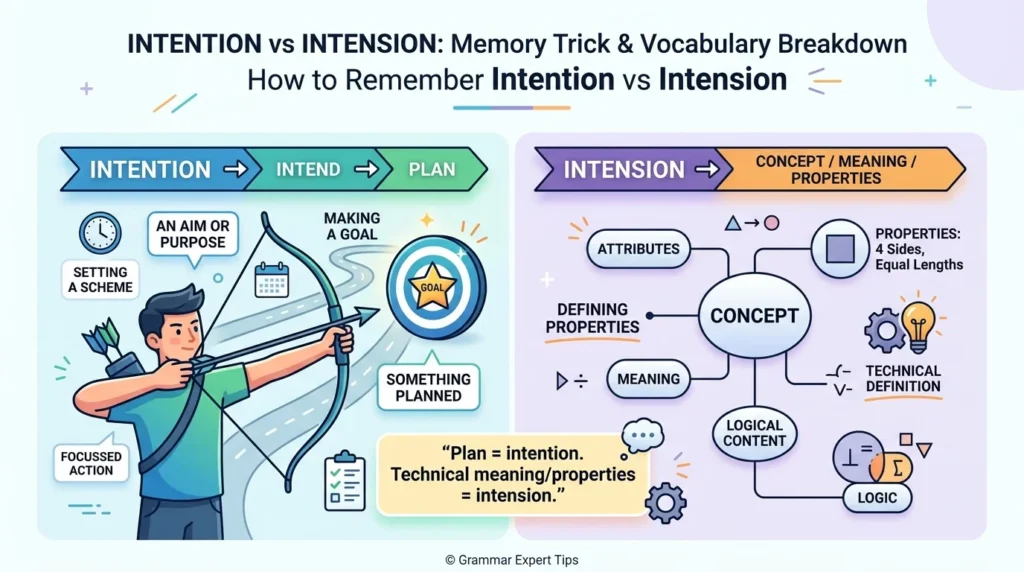
INTENTION → INTEND → PLAN
If you intend to do something, you have an intention to do it.
For example:
I intend to study tonight.
My intention is to study tonight.
For intension, think:
INTENSION → INTERNAL FEATURES OF A CONCEPT
This is only a memory aid, not a technical definition. The safest way to remember the word is to associate it with logic, semantics, meaning, properties, and extension.
Real-Life Situations
1. In an interview
Interviewer: What are your long-term plans?
Candidate: My intention is to develop my skills and take on greater responsibility.
Use intention because the candidate is talking about a future plan.
2. In a workplace meeting
“Our intention is to launch the new service next quarter.”
Again, this is a business plan, so intention is correct.
3. In an email
“I had no intention of delaying the project.”
The writer is explaining purpose, so use intention.
4. In a text message
“Sorry. I had no intention of hurting your feelings.”
This is natural everyday English.
5. In an exam
If the question asks about someone’s purpose or plan, choose intention.
If the question is about the defining characteristics of a concept in logic or semantics, intension may be correct.
6. In a philosophy class
“The professor explained the distinction between intension and extension.”
Here, intension is appropriate because the discussion is technical.
Mini Quiz
| # | Question | Answer | Explanation |
|---|---|---|---|
| 1 | My ___ was to help you. (intention/intension) | intention | The sentence describes a purpose. |
| 2 | She has no ___ of moving abroad. | intention | “Have no intention of” is a standard expression for having no plan to do something. |
| 3 | Which word is technical in logic and semantics? | intension | Intension concerns conceptual meaning or defining properties. |
| 4 | Correct the sentence: “His intension was to apologize.” | His intention was to apologize. | Apologizing is an intended action. |
| 5 | The philosopher discussed the ___ of the term. | intension | The context concerns the conceptual meaning/properties of a term. |
| 6 | True or false: “Intension” is simply a misspelling of “intention.” | False | Intension is a legitimate technical word. |
| 7 | Choose the natural sentence: A) My intension is to study. B) My intention is to study. | B | The sentence describes a personal plan. |
| 8 | Complete: “I had every ___ of attending the meeting.” | intention | The phrase means the person fully planned or meant to attend. |
| 9 | Correct the sentence: “The company has no intension of closing.” | The company has no intention of closing. | Closing is a planned action. |
| 10 | In technical semantics, intension is commonly contrasted with what term? | extension | Intension and extension are commonly treated as related but distinct concepts. |
Expert Tips
1. Connect “intention” to “intend”
This is the most useful spelling connection.
intend → intention
If the sentence can naturally use intend, you probably need intention.
I intend to leave.
My intention is to leave.
2. Don’t assume every unusual word is a spelling mistake
Intension looks unusual because it is unusual in everyday English. But it is a legitimate technical term.
3. Context is more important than spelling alone
Ask what the sentence is actually discussing.
- Person’s plan → intention
- Concept’s defining properties → intension
4. Be especially careful with academic terminology
If you are writing about philosophy, semantics, linguistics, or formal logic, do not automatically replace intension with intention. The technical distinction can be meaningful.
5. Remember that spellcheck cannot always identify word-choice errors
Both words are valid spellings. Software may not know which meaning you intended.
6. Prefer the simpler word when the meaning is simple
If you mean:
“What does she plan to do?”
write:
“What is her intention?”
There is no reason to use intension.
FAQ
Is “intension” a correct English word?
Yes. Intension is a real English word. In modern specialist usage, it is associated particularly with logic, linguistics, semantics, and philosophy, where it concerns the conceptual content or defining properties associated with a term. It also has some less common dictionary senses related to intensity or determination.
Is “intension” a misspelling of “intention”?
Not always. If you mean a person’s purpose or plan, then intension is the wrong word and intention is correct. However, intension itself is a legitimate technical term, so it should not be described as universally incorrect.
Are intention and intension pronounced the same?
They are commonly pronounced alike or nearly alike in English, which is one reason they are easy to confuse. Their spelling and meanings are different.
Can I use “intension” in normal conversation?
Usually, no. If you are talking about your plans, motives, or purpose, use intention. Intension is mainly useful when the conversation involves technical ideas about meaning, concepts, logic, or semantics.
What is the easiest way to remember intention?
Connect it with intend:
intend → intention
If someone intends to do something, they have an intention to do it.
What is the easiest way to remember intension?
Associate intension with meaning and defining properties, especially in logic and semantics. It is commonly discussed alongside extension.
Is “intention” a noun?
Yes. Intention is a noun.
Her intention was clear.
It can refer to a particular plan or purpose, or to the general act or state of intending.
What is the difference between intent and intention?
Both can refer to purpose or what someone means to do. Intention is the general everyday noun, while intent can be somewhat more formal or specialized and is especially common in legal contexts.
What is the difference between intension and extension?
In logic and semantics, intension concerns the meaning, properties, or conditions associated with a concept, while extension concerns the objects or cases to which the concept applies. The exact technical definitions vary by theory, but the distinction is fundamental in many discussions of formal meaning.
Is “intensional” related to “intension”?
Yes. Intensional is the adjective associated with intension. It is used in technical discussions of logic and semantics.
The researcher proposed an intensional analysis.
It should not automatically be confused with intentional, which is associated with intention.
Should I use intention or intension in business writing?
Almost always intention when you mean a company’s plan or purpose.
Our intention is to expand into new markets.
Use intension only if the business document is genuinely discussing a technical concept from logic, semantics, linguistics, or a related field.
Quick Summary
Intention and intension are both correct English words, but they are not interchangeable. Intention is the everyday word for a purpose, plan, aim, or intended action. You use it when discussing what a person, company, or organization plans or means to do. Intension is much less common and is mainly a technical term in logic, semantics, linguistics, and philosophy. It refers to the conceptual content, defining characteristics, or properties associated with a term. The easiest way to remember the difference is intend → intention. If you are talking about a plan or purpose, choose intention. If you are discussing a technical concept’s meaning or defining properties, intension may be the right word.