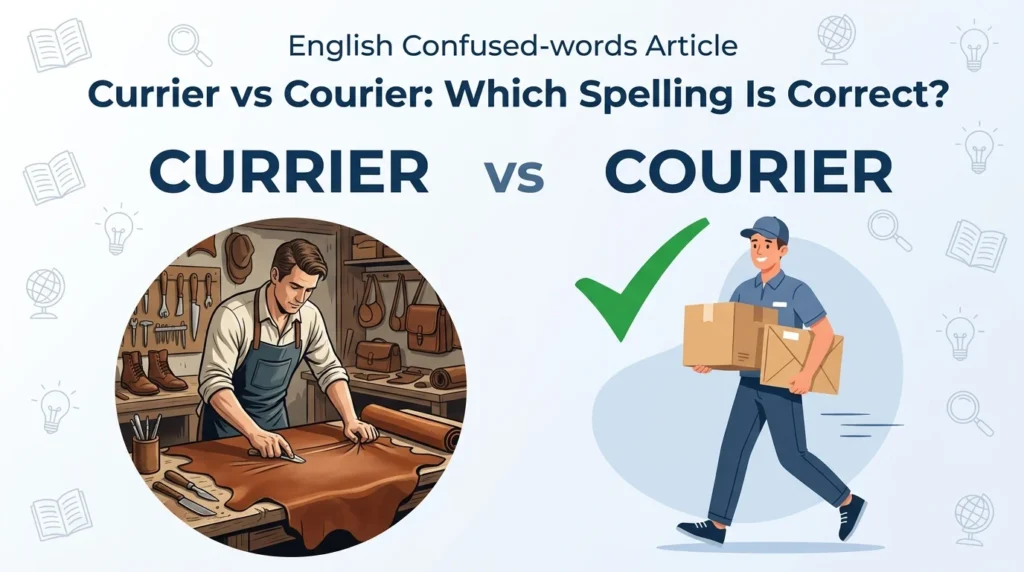

Courier is the correct word when you mean a person or company that carries and delivers letters, packages, or goods. Currier is also a real English word, but it has a different meaning: traditionally, a currier is a person who prepares and finishes leather after it has been tanned. So, if you are talking about parcel delivery, use courier, not currier.
What Is the Difference Between Currier and Courier?
Currier and courier are both correctly spelled English words, but they refer to completely different things.
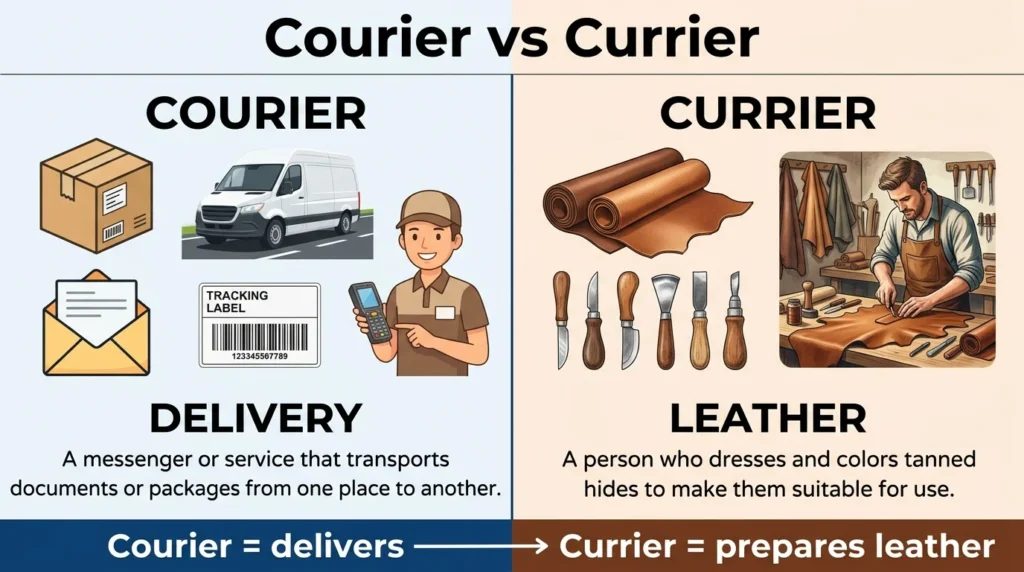
- Courier = a person or service that transports and delivers messages, documents, parcels, or goods.
- Currier = a person who prepares, cleans, softens, and finishes leather after tanning.
The confusion usually happens because the two words look and sound somewhat similar. However, they belong to different areas of vocabulary.
If you need to send a package, you contact a courier.
If you are talking about the traditional leather trade, currier may be the correct word.
Courier
A courier is someone who carries or delivers something from one place to another. Today, the word commonly refers to delivery workers and delivery companies.
For example:
I sent the documents by courier.
You might also hear courier service, courier company, or courier delivery.
Currier
A currier is a person whose traditional occupation involves preparing and finishing leather.
The word is much less common in everyday modern English than courier.
For example:
The currier carefully finished the leather before it was used to make the boots.
The word may appear more often in historical, industrial, or specialist writing about leather production.
Why It Matters
Using currier when you mean courier can make a sentence confusing or simply incorrect.
This matters particularly in practical writing. Imagine writing:
Please send the contract through a reliable currier.
A reader who knows the distinction may understand that you probably mean courier.
The mistake can appear in:
- Business emails
- Delivery instructions
- Online orders
- Shipping information
- Customer-service messages
- Job descriptions
- School assignments
- Social-media posts
- Formal documents
A one-letter spelling difference can completely change the meaning of a word.
The Core Rule
Rule: Use courier for someone or a service that delivers messages, documents, packages, or goods. Use currier for a person who prepares and finishes leather.
A simple distinction is:
Courier → carries and delivers
Currier → works with leather
How to Use Courier
Use courier when talking about delivery or transportation of things such as:
- Packages
- Letters
- Documents
- Parcels
- Business materials
- Goods
- Messages
As a noun
Courier is normally a noun when it refers to the person or service doing the delivery.
The courier delivered my package this morning.
We hired a courier to send the documents.
The courier company collected the parcel at noon.
Courier service
Courier service refers to a service that transports and delivers items.
We need a reliable courier service for international shipments.
Courier as a business term
In modern English, courier is common in business and logistics.
Please provide the courier tracking number.
The documents were sent by courier.
Our courier will collect the package tomorrow.
How to Use Currier
Use currier when discussing the traditional occupation of preparing leather.
A currier works with leather after the tanning process. The work can involve processes that improve the leather’s texture, flexibility, appearance, and suitability for use.
For example:
The currier prepared the leather for manufacturing.
Because this is a specialized occupation, currier is considerably less likely to appear in ordinary everyday conversation.
Currier in historical writing
You may encounter currier in descriptions of traditional trades.
His family had worked as curriers for several generations.
The town was once known for its tanners and curriers.
Correct Examples
Here are examples showing how courier and currier work in real sentences.
| Context | Correct Example |
|---|---|
| Conversation | The courier just delivered my package. |
| Please send the signed contract by courier. | |
| Workplace | The courier will collect the documents at 3 p.m. |
| Online shopping | The courier is expected to deliver the order tomorrow. |
| Customer service | I have contacted the courier about the delayed parcel. |
| Business | We are looking for a reliable international courier. |
| Shipping | The package was handed over to the courier yesterday. |
| School | The history book describes the work of a medieval currier. |
| Historical writing | The village had several tanners and curriers. |
| Leather industry | The currier prepared the leather for further production. |
| Social media | The courier finally brought my new shoes! |
| Academic writing | Curriers played an important role in traditional leather production. |
Incorrect vs. Correct
| ❌ Incorrect | ✅ Correct | Why |
|---|---|---|
| I sent the parcel by currier. | I sent the parcel by courier. | A delivery service is a courier. |
| The currier delivered my documents. | The courier delivered my documents. | A person delivering documents is a courier. |
| Please call the currier company. | Please call the courier company. | A delivery company is a courier company. |
| The currier will arrive at 5 p.m. | The courier will arrive at 5 p.m. | The context is package delivery. |
| We need a fast currier service. | We need a fast courier service. | Delivery services are courier services. |
| The courier prepared the leather. | The currier prepared the leather. | Leather preparation is traditionally the work of a currier. |
| My currier tracking number is missing. | My courier tracking number is missing. | Tracking numbers relate to delivery services. |
| The currier brought my online order. | The courier brought my online order. | An online order is delivered by a courier. |
| He worked as a courier in the leather factory. | He worked as a currier in the leather industry. | The occupation involving leather is currier. |
| The currier delivered the letter. | The courier delivered the letter. | Someone delivering a letter is a courier. |
Why People Make This Mistake
1. The words look similar
The spelling currier and courier contains many of the same letters. That visual similarity can make it easy to choose the wrong form while typing.
2. Their pronunciation can cause uncertainty
Courier has pronunciation patterns that vary somewhat across English varieties, and learners may not clearly hear the difference between courier and currier in fast speech.
When a word is not familiar, people often rely on the spelling pattern that feels most natural.
3. Spellcheck cannot always save you
This is an important point.
Both currier and courier are legitimate English words. A spellchecker may therefore accept currier even when your sentence requires courier.
For example:
Please contact the currier.
The spelling checker may not flag this because currier is a real word.
The problem is not spelling alone. It is word choice.
4. Translation can interfere
Learners who translate directly from another language may choose a word that looks or sounds familiar without checking its exact English meaning.
This is especially risky with confusing word pairs where both forms exist in English.
5. One word is much more common
Courier is common in modern delivery, shipping, business, and e-commerce contexts.
Currier belongs mainly to the specialized vocabulary of leatherworking and historical trades.
Because courier is the word most people encounter in everyday life, learners may remember its sound but reconstruct the spelling incorrectly.
Read More: Cubical vs Cubicle: Which Word Is Correct?
Common Mistakes Checklist
Mistake 1: Writing “currier service”
Problem: The word refers to a leather worker, not a delivery service.
Correct: courier service
How to avoid it: Think about what the person or company does. If it delivers something, choose courier.
Mistake 2: Trusting spellcheck
Problem: Currier is a legitimate word, so software may not identify it as an error.
How to avoid it: Check the meaning, not just the spelling.
Mistake 3: Using “currier” for a delivery person
Problem: The occupation has been confused with another occupation.
Correct: courier
How to avoid it: Connect courier with delivery.
Mistake 4: Assuming “currier” is simply another spelling of “courier”
It is not.
They are separate words with different meanings.
Mistake 5: Avoiding the word because of uncertainty
Some writers replace the word with vague alternatives such as “delivery person” even when courier is the precise term.
There is no need to avoid courier. Once you associate it with delivery, the distinction becomes straightforward.
Currier vs Courier in Real English
Courier: natural everyday usage
Courier is the natural and standard word when talking about parcel, document, or package delivery. You will commonly see it in business communication, e-commerce, shipping notices, and everyday conversations. Phrases such as courier service, courier company, and courier delivery are normal modern English.
Currier: specialized usage
Currier is a genuine English word, but it is much more specialized. It refers to a person who prepares and finishes leather. You are most likely to encounter it in writing about leatherworking, traditional occupations, manufacturing, or history. It would be unusual to use it in an ordinary conversation about sending a package.
Grammatically correct but semantically wrong
A sentence can be grammatically well formed while still using the wrong word.
I contacted the currier about my parcel.
The sentence structure is fine. The problem is the noun currier. If the person handles parcel delivery, courier is the appropriate word.
This is a useful lesson: grammar and word choice are not the same thing. A sentence can have correct grammar but incorrect vocabulary.
Natural everyday English
If you are talking about sending or receiving a package, simply use courier.
The courier is outside.
The courier delivered the parcel.
Which courier company are you using?
These are natural, ordinary uses. There is no need for a more complicated expression.
American vs. British English
There is no important American-versus-British spelling distinction between currier and courier.
Both varieties use:
- courier for a person or service that delivers messages or goods
- currier for a person who prepares and finishes leather
Pronunciation can vary between speakers and regions, but the spelling and basic meanings remain distinct.
Formal vs. Informal Usage
The distinction is mainly about meaning, not formality.
Courier works in both formal and informal English:
Please send the documents by courier. — formal/business
The courier just arrived. — everyday
Currier is not an informal alternative to courier. It remains a specialized occupational term referring to leatherwork.
Comparison Table
| Feature | Courier | Currier |
|---|---|---|
| Main meaning | Person/service that delivers items | Person who prepares and finishes leather |
| Modern everyday use | Very common | Uncommon |
| Business use | Very common | Rare |
| Delivery context | ✅ Yes | ❌ No |
| Parcel context | ✅ Yes | ❌ No |
| Leatherworking context | ❌ No | ✅ Yes |
| Courier service | ✅ Correct | ❌ Incorrect |
| Leather trade | ❌ Incorrect | ✅ Correct |
| Part of speech | Noun | Noun |
| Common learner error | Spelling it as “currier” | Using it to mean delivery worker |
Memory Trick
Think:
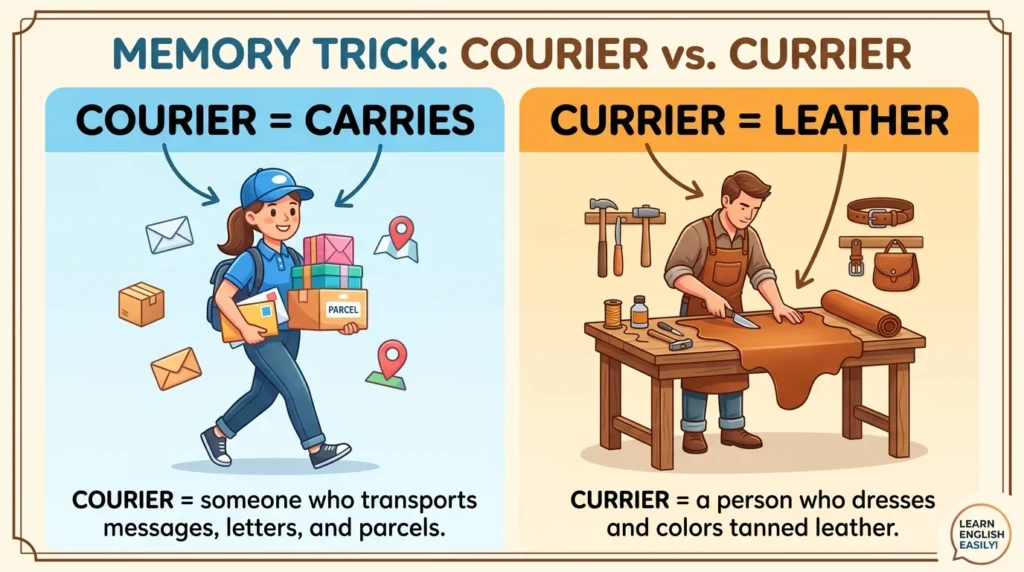
COURIER = CARRIES
Both words are connected with moving something from one place to another.
Courier → carries your parcel.
For currier, think:
CURRIER → leather
A currier works with leather.
So remember:
Courier carries. Currier cures/conditions leather.
The exact mnemonic is less important than the key association:
Courier = delivery
Currier = leather
Real-Life Situations
Interview
Question: “What does your company do?”
Answer: “We provide courier services for businesses.”
Here, courier is correct because the company delivers documents and packages.
Read More: Until vs Untill: Which Spelling Is Correct?
Business meeting
“The courier should arrive before lunch.”
The speaker is discussing a delivery person.
“Please send the signed agreement by courier.”
This is a natural business use of courier.
Text message
“The courier has delivered the package.”
Again, the context is delivery.
Online shopping
“The courier says my order will arrive tomorrow.”
The delivery worker or service is the courier.
History assignment
“Curriers were involved in the traditional preparation of leather.”
Here, curriers is correct because the subject is the leather trade.
Leather industry
“The currier inspected the leather before production.”
The word refers to a specialist working with leather.
Mini Quiz
| # | Question | Answer | Explanation |
|---|---|---|---|
| 1 | I am waiting for the ___ to deliver my package. A) currier B) courier | B) courier | A delivery worker is a courier. |
| 2 | Please send the documents by ___. | courier | Documents can be sent through a courier service. |
| 3 | The ___ prepared the leather for production. | currier | A currier traditionally prepares and finishes leather. |
| 4 | Correct the sentence: “The currier delivered my parcel.” | The courier delivered my parcel. | Parcel delivery requires courier. |
| 5 | Which word belongs to the leather trade? A) courier B) currier | B) currier | Currier is a leatherworking occupation. |
| 6 | Our ___ company offers same-day delivery. | courier | A company providing delivery is a courier company. |
| 7 | Correct the sentence: “I contacted the currier about my tracking number.” | I contacted the courier about my tracking number. | Tracking a parcel is a courier context. |
| 8 | A person who prepares and finishes leather is a ___. | currier | That is the traditional meaning of currier. |
| 9 | “The courier arrived with my shoes.” Is this correct? | Yes. | The courier can deliver shoes or other goods. |
| 10 | “The currier arrived with my online order.” Is this correct if the person is the delivery worker? | No. | It should be courier because the person is delivering an order. |
Expert Tips
1. Check meaning before spelling
When two words look similar, do not ask only:
“Which spelling looks right?”
Ask:
“What exactly am I trying to describe?”
That question will usually solve the problem.
2. Learn words in phrases
Instead of memorizing courier by itself, remember common combinations:
- courier service
- courier company
- courier delivery
- courier driver
- send by courier
Likewise, associate currier with:
- leather
- leatherworking
- traditional trade
- tanning and finishing
3. Do not rely completely on spellcheck
A spelling tool can detect many misspellings, but it cannot always detect a correctly spelled word used in the wrong context.
Currier is a good example.
4. Use the context test
Ask:
Is this about delivery?
→ Courier
Is this about leather preparation?
→ Currier
5. Remember that both words are real
This is the key reason the mistake can survive proofreading.
Neither word is simply a misspelling of the other.
The question is not:
“Is currier a real word?”
It is.
The real question is:
“Is currier the right word for this sentence?”
FAQ
Is “currier” a correct English word?
Yes. Currier is a real English word for a person who prepares and finishes leather, traditionally after tanning.
Is “courier” the correct word for package delivery?
Yes. Courier is the standard word for a person or service that transports and delivers packages, documents, letters, and other goods.
Is “currier” another spelling of “courier”?
No. They are separate words with different meanings.
Why does my spellchecker accept “currier”?
Because currier is a legitimate English word. A spellchecker may recognize the spelling without knowing that you intended courier.
Should I say “courier service” or “currier service”?
Say courier service when you mean a service that delivers packages, documents, or goods.
What does a currier do?
A currier traditionally prepares and finishes leather after it has been tanned, making it suitable for further use or manufacture.
Is courier a noun or a verb?
Courier is primarily used as a noun when referring to a person or service that carries and delivers something. It can also occur in specialized uses as a verb, but the noun is by far the most relevant use for ordinary delivery contexts.
Is “courier” formal or informal?
Courier is neutral. It can be used naturally in casual conversation, business communication, and formal writing.
Which word is more common: currier or courier?
Courier is much more common in modern everyday English because delivery services are widely used. Currier is a specialized occupational term.
How do I remember the difference between currier and courier?
Remember courier = delivery and currier = leather. You can also associate courier with “carries” to remind yourself that a courier carries and delivers items.
Is “currier” wrong in a sentence about a delivery driver?
Yes, if you mean a person delivering a package, letter, or other item. In that context, the correct word is courier.
Quick Summary
Courier and currier are both real English words, but they have completely different meanings. Courier refers to a person or service that delivers packages, documents, letters, messages, or goods. Currier refers to a person who traditionally prepares and finishes leather. If you are talking about online orders, parcels, shipping, tracking numbers, or delivery services, use courier. If you are discussing leatherworking or traditional leather trades, currier may be correct. The easiest memory trick is “courier = delivery” and “currier = leather.” Because both words are correctly spelled, spellcheck may not catch the mistake. Always check the meaning and context, not just the spelling.
Image Prompt 1 — Hero Image
Create a clean, modern educational hero illustration for an English confused-words article titled “Currier vs Courier: Which Spelling Is Correct?” Show the two words prominently side by side. Present COURIER with a green check mark and a visual of a delivery worker carrying a package, parcel, or envelope. Present CURRIER with a contrasting visual of a traditional leatherworker preparing leather, making it clear that both words are real but have different meanings. Use a polished grammar-education website style, uncluttered composition, readable typography, subtle academic elements, and a professional blue-and-neutral visual palette. Do not add unnecessary text.
Image Prompt 2 — Comparison Graphic
Create an educational comparison infographic titled “Courier vs Currier”. Divide the image into two clear sections. On the COURIER side, show a package, delivery van, envelope, tracking label, and delivery worker, with the key idea “Delivery”. On the CURRIER side, show leather, leather tools, and a traditional craftsperson preparing leather, with the key idea “Leather”. Include a simple visual distinction: Courier = delivers and Currier = prepares leather. Make the typography highly readable and the layout suitable for a grammar and spelling website.
Image Prompt 3 — Memory Trick
Create a simple, memorable educational graphic for learners showing the mnemonic “COURIER = CARRIES”. Show the word COURIER connected visually to a person carrying a parcel, letter, or package. Beside it, show CURRIER = LEATHER with a leatherworker handling a piece of leather. Use arrows, simple icons, and minimal text to make the distinction instantly understandable. The design should look like a premium English-learning infographic: clean, modern, friendly, highly legible, and suitable for mobile viewing.