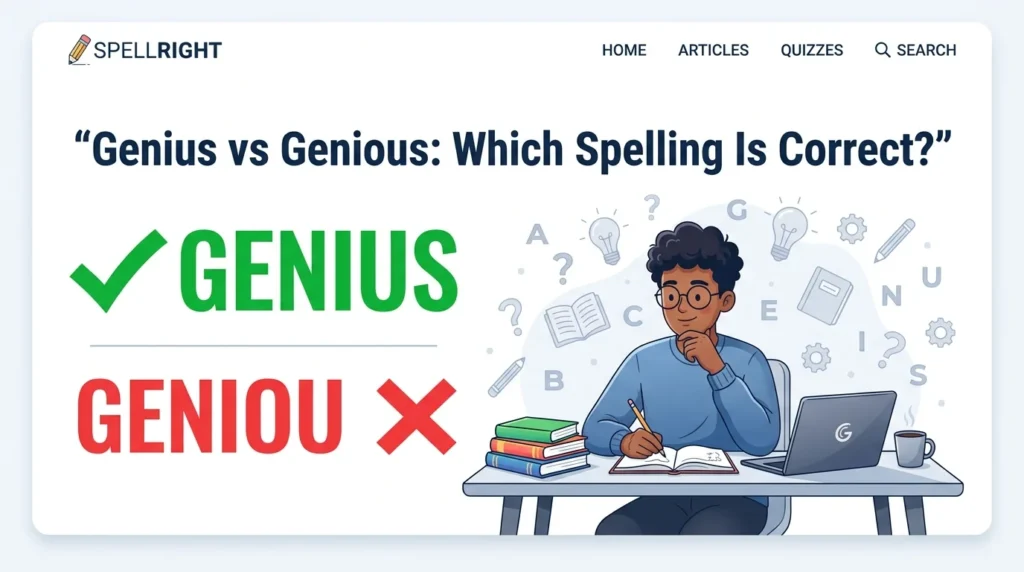

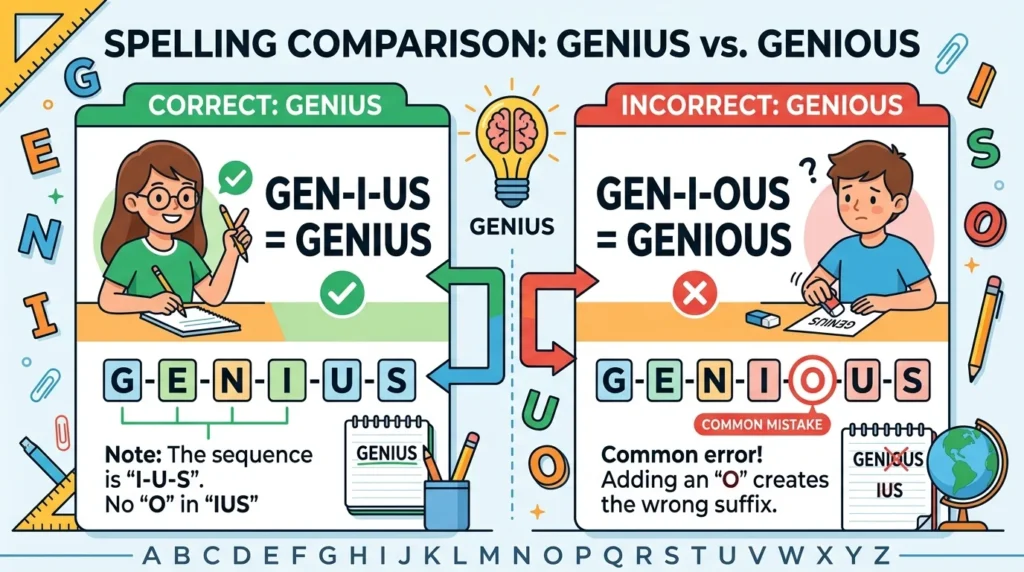
Genius is the correct spelling. Genious is a common spelling mistake and is not the standard spelling of the English word. Genius is a noun meaning a person with exceptional intellectual ability, or exceptional skill or creativity in something. For example: “She is a mathematical genius.” The easiest way to remember the spelling is GENIUS, not GENIOUS.
What Is the Difference Between Genius and Genious?
The difference is simple:
- Genius is the correct English spelling.
- Genious is a misspelling and should not be used in standard English.
- Genius can describe a person with exceptional intelligence or an exceptional level of skill or creativity.
- Genius can also describe an exceptionally clever idea, method, or creation.
There is no separate standard English word genious with a different meaning.
Genius
Genius is a noun. It refers to extraordinary intellectual ability, exceptional creative ability, or a person who possesses such ability.
Examples:
- Albert Einstein was widely regarded as a genius.
- Her genius for solving difficult problems impressed everyone.
- That was a genius idea.
Genious
Genious is not the standard spelling of the word. In most writing, it is simply a spelling error for genius.
For example:
❌ He is a genious.
✅ He is a genius.
If you see genious in an email, essay, social media post, or document, the intended word is almost certainly genius.
Why It Matters
Spelling genius correctly matters because genious can make otherwise strong writing look careless.
The mistake is especially easy to notice in:
- School and university assignments
- Professional emails
- CVs and applications
- Articles and blog posts
- Social media captions
- Business presentations
- Marketing copy
- Formal reports
A single spelling mistake does not automatically make someone a poor writer. However, repeatedly writing genious instead of genius can reduce a reader’s confidence in the accuracy of the text.
The Core Rule
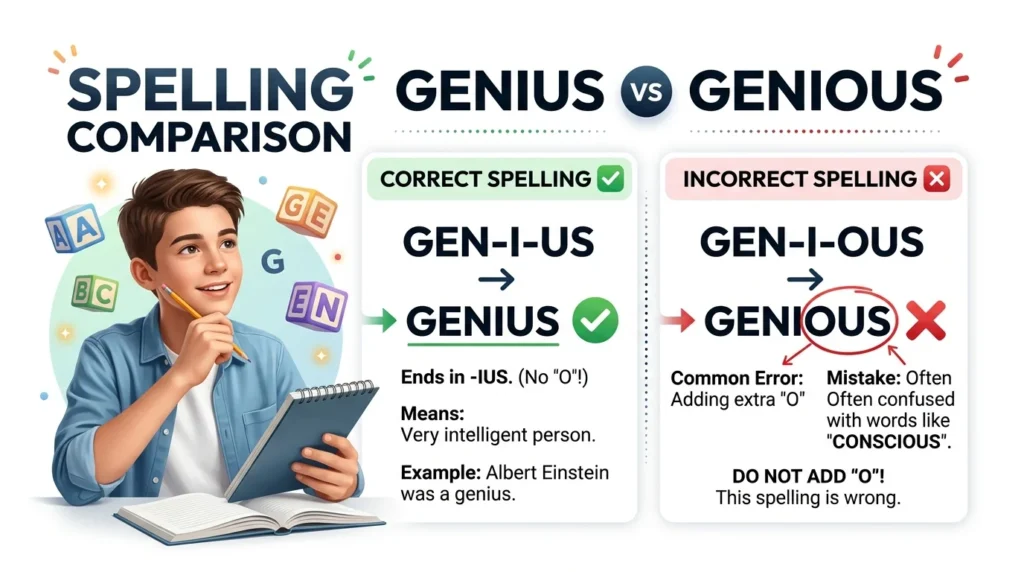
Rule: Always spell the word as GENIUS. “Genious” is a misspelling in standard English.
Think of the ending as:
GEN + IUS → GENIUS
Not:
GEN + IOUS → GENIOUS
There is no O after the I in genius.
How to Use Genius
Use “genius” for exceptional intelligence
When you are talking about someone with extraordinary intellectual ability, use genius.
Marie Curie was a scientific genius.
Use “genius” for exceptional creative or practical ability
The word does not have to refer only to academic intelligence.
His genius for music became obvious at an early age.
She has a genius for turning simple designs into successful products.
Use “genius” for an exceptionally clever idea
In informal English, genius can also describe an idea, decision, or solution that is extremely clever.
That shortcut was genius.
Here, genius is being used as an informal adjective-like expression. In more formal writing, you may prefer brilliant, ingenious, or exceptionally clever, depending on what you mean.
Use “genius” when referring to a person
The most common noun pattern is:
a genius
Examples:
He is a genius at mathematics.
She is a creative genius.
Everyone thought the young inventor was a genius.
Correct Examples
Here are examples from different types of real writing:
- Conversation: “You fixed the problem in two minutes. You’re a genius!”
- Email: “Your solution was a genius way to simplify the process.”
- School: “The essay discusses Einstein’s reputation as a scientific genius.”
- University: “The study explores how society defines intellectual genius.”
- Workplace: “That was a genius solution to a difficult scheduling problem.”
- Social media: “Whoever designed this feature is a genius.”
- Marketing: “The campaign was a stroke of genius.”
- Technology: “The engineer’s genius was evident in the simplicity of the design.”
- Creative writing: “Her genius was not only in what she created but in how she saw the world.”
- Academic writing: “The concept demonstrates the author’s intellectual genius.”
Incorrect vs. Correct
| ❌ Incorrect | ✅ Correct | Why |
|---|---|---|
| He is a genious. | He is a genius. | Genious is a misspelling. |
| She was a mathematical genious. | She was a mathematical genius. | The standard spelling is genius. |
| What a genious idea! | What a genius idea! | The word is spelled genius. |
| Einstein was a genious. | Einstein was a genius. | The final part is -ius, not -ious. |
| He has the mind of a genious. | He has the mind of a genius. | Genious is not the standard form. |
| Her musical genious was obvious. | Her musical genius was obvious. | The correct noun is genius. |
| That was genious. | That was genius. | The informal expression uses genius. |
| His genious impressed everyone. | His genius impressed everyone. | Genius is the correct noun. |
| A true genious can solve it. | A true genius can solve it. | The spelling does not contain ou. |
| She is a creative genious. | She is a creative genius. | Genius is the standard English spelling. |
Why Do People Spell Genius as Genious?
The mistake is understandable because genious looks like several familiar English words.
Phonetic similarity
When people hear genius, the ending can sound as though it contains an extra vowel sound. This can make -ious seem plausible when spelling the word from memory.
But pronunciation does not always tell you exactly how an English word is spelled.
Spelling patterns
English has many words ending in -ious, including:
- curious
- serious
- obvious
- various
- previous
Because -ious is a common spelling pattern, writers may incorrectly transfer it to genius.
Overgeneralisation
A learner may remember a general spelling pattern rather than the spelling of the individual word.
The problem is that genius is not spelled according to the pattern the writer expects.
Autocomplete and spellcheck
Spellcheck can catch genious in many applications, but writers should not depend completely on software.
A spelling checker may fail to help when:
- the software does not recognize the intended language,
- the word is entered in an unusual context,
- the writer ignores the warning,
- or another valid word is accidentally selected.
Translation interference
Learners who use another language may mentally transfer a familiar spelling or pronunciation pattern into English. This can make genious feel natural even though it is incorrect in standard English.
Common Mistakes Checklist
1. Adding “o” before “us”
Mistake: genious
Correct: genius
Why it happens: The writer hears or remembers an extra vowel sound.
How to avoid it: Memorize the ending -ius.
2. Thinking “genious” is a different word
Mistake: treating genious as an alternative spelling.
Why it happens: English contains many words with similar-looking endings.
How to avoid it: Remember that standard English uses genius.
3. Confusing genius with ingenious
These are different words.
Genius relates to exceptional intelligence, ability, or creativity.
Ingenious means clever, inventive, or skillful in solving a problem.
For example:
Einstein was a genius.
She developed an ingenious solution.
4. Assuming pronunciation determines spelling
English spelling often cannot be predicted perfectly from pronunciation.
How to avoid it: Learn frequently confused words as complete spelling units.
5. Trusting visual familiarity
A misspelled word can look correct simply because you have seen it many times.
How to avoid it: When in doubt, slow down and check the spelling rather than relying on appearance.
Genius in Real English
Genius as a person
When genius refers to a person, it is a normal and widely understood noun. In everyday conversation, people often use it enthusiastically or playfully: “You’re a genius!” The expression does not always mean the person has extraordinary intellectual ability. It can simply praise someone for making a particularly clever decision or solving a problem effectively.
Genius as an ability
Genius can also refer to exceptional ability itself. Phrases such as “a genius for mathematics” or “her creative genius” focus on the person’s unusual talent rather than simply labeling the person. This use is natural in both everyday and formal contexts, although the word can sound stronger and more dramatic than simpler terms such as talent or skill.
Genius as an informal description of an idea
In casual English, genius can describe something exceptionally clever: “That idea is genius.” This usage is common in modern informal communication. In formal academic or professional writing, however, brilliant, highly effective, innovative, or ingenious may communicate the intended meaning more precisely.
Genius vs. ingenious
The words look and sound related, but they are not interchangeable. Genius is mainly a noun referring to exceptional intellectual or creative ability. Ingenious is an adjective meaning clever, inventive, or skillful. You can describe a person as a genius and an idea as ingenious, although informal English sometimes uses genius to praise an idea.
Read More: Cubical vs Cubicle: Which Word Is Correct?
American vs. British English
There is no standard American-versus-British spelling difference between genius and genious.
Both American and British English use:
genius
And in both varieties:
genious is a misspelling.
The pronunciation can vary slightly between speakers and accents, but the standard spelling remains the same.
Formal vs. Informal Usage
Genius works in both formal and informal English, but its meaning and tone can change with context.
Formal
The researcher was recognized for his intellectual genius.
The exhibition examines the artistic genius of the painter.
Informal
You’re a genius!
That was genius!
In formal writing, be careful not to use genius simply as exaggerated praise when a more precise word would communicate the idea better.
For example:
The engineer developed an ingenious solution.
may be more precise than:
The engineer developed a genius solution.
Genius vs. Genious: Comparison Table
| Feature | Genius | Genious |
|---|---|---|
| Standard English word? | Yes | No |
| Correct spelling? | ✅ Yes | ❌ No |
| Part of speech | Mainly noun; also used informally as a modifier | — |
| Meaning | Exceptional intelligence, ability, or creativity | No standard meaning |
| Used in American English? | Yes | No |
| Used in British English? | Yes | No |
| Appropriate in formal writing? | Yes, when appropriate | No |
| Example | “She is a genius.” | “She is a genious.” ❌ |
Genius vs. Ingenious
Because these words are frequently confused, it is useful to separate them clearly.
| Word | Part of Speech | Main Meaning | Example |
|---|---|---|---|
| genius | Noun | An exceptionally intelligent or talented person; exceptional ability | “He is a genius.” |
| ingenious | Adjective | Clever, inventive, or skillful | “She found an ingenious solution.” |
| genious | — | Misspelling of genius | “He is a genious.” ❌ |
Memory Trick
Remember:
GENIUS has I before US: GEN-I-US.
Break the word into three easy parts:
GEN + I + US = GENIUS
There is no O between I and US.
If you see:
GENIOUS
ask yourself:
“Why did I add an O?”
Then remove it:
GENIOUS → GENIUS ✅
Real-Life Situations
In an interview
“I think the most successful entrepreneurs are not necessarily geniuses; they are often excellent learners.”
In a meeting
“That is a genius solution. It solves the problem without increasing our costs.”
In an email
“Your idea was genius. It saved the team several hours.”
For a more formal email:
“Your solution was exceptionally clever and effective.”
In a text message
“You’re a genius 😂”
In an exam
“The scientist was recognized as a genius because of his groundbreaking work.”
On social media
“This person is a genius for finding such a simple solution.”
Mini Quiz
| # | Question | Answer | Explanation |
|---|---|---|---|
| 1 | Choose the correct spelling: genius / genious | genius | Genius is the standard spelling. |
| 2 | Fill in the blank: “She is a musical ___.” | genius | The noun referring to exceptional ability is genius. |
| 3 | Correct the sentence: “He is a genious.” | “He is a genius.” | Genious is a misspelling. |
| 4 | Which is correct: “a genius idea” or “a genious idea”? | a genius idea | Genius is the correct spelling. |
| 5 | Fill in the blank: “That was an ___ solution.” | ingenious | Ingenious is an adjective meaning clever or inventive. |
| 6 | True or false: “Genious” is the British spelling of “genius.” | False | British English also uses genius. |
| 7 | Correct the sentence: “Einstein was a genious.” | “Einstein was a genius.” | The word is spelled genius. |
| 8 | Which word means “clever and inventive”: genius / ingenious? | ingenious | Ingenious is an adjective. |
| 9 | Fill in the blank: “You’re a ___!” | genius | This is a common informal expression of praise. |
| 10 | Choose the correct sentence: A) “She has creative genious.” B) “She has creative genius.” | B | Genius is the correct noun. |
Expert Tips
- Memorize genius as a complete word rather than trying to spell it from pronunciation.
- Remember the sequence I-U-S at the end.
- Do not create genious by analogy with words such as serious or curious.
- Do not confuse genius with ingenious.
- If you mean “clever and inventive,” ingenious may be the more precise choice.
- In casual speech, “You’re a genius!” can be playful praise and does not necessarily make a claim about someone’s intellectual ability.
- In formal writing, choose the word that expresses your exact meaning rather than using genius simply as strong praise.
- When proofreading, search specifically for genious because spellcheck may not always catch every mistake.
Read More: Until vs Untill: Which Spelling Is Correct?
FAQ
Is “genious” a correct English word?
No. Genious is generally a misspelling of genius in standard English.
What is the correct spelling: genius or genious?
The correct spelling is genius.
Why do people spell genius as genious?
The mistake is likely influenced by pronunciation and by familiar English spelling patterns such as -ious, found in words like serious and curious.
Is genius a noun or an adjective?
Genius is primarily a noun. It can refer to an exceptionally intelligent or talented person or to exceptional intellectual or creative ability. In informal English, it can also be used to praise something as extremely clever.
What is the plural of genius?
The standard plural is geniuses.
The school produced several geniuses.
Is “genius” the same as “ingenious”?
No. Genius is mainly a noun, while ingenious is an adjective meaning clever or inventive.
She is a genius.
She created an ingenious device.
Is “genious” an alternative British spelling?
No. British English uses genius, just as American English does.
Can I use “genius” for an idea?
Yes. In informal English, people commonly use genius to praise a particularly clever idea or solution.
“That was genius!”
Is “genius idea” grammatically correct?
It can occur in informal English, particularly as enthusiastic praise. In more formal writing, brilliant idea, ingenious idea, or highly effective idea may be more precise depending on the intended meaning.
How do you remember the spelling of genius?
Remember GEN-I-US. The word ends in -ius, not -ious.
What is the difference between genius and genious?
Genius is the correct English word. Genious is a misspelling and should be corrected to genius.
Quick Summary
Genius is the correct spelling, while genious is a common misspelling. Genius is primarily a noun for a person with exceptional intellectual or creative ability, or for exceptional ability itself. In informal English, it can also be used to praise a clever idea or solution. There is no American-British spelling difference: both varieties use genius. Do not confuse genius with ingenious. Genius is mainly a noun, while ingenious is an adjective meaning clever or inventive. The easiest way to remember the spelling is GEN-I-US: there is no O between the I and US.