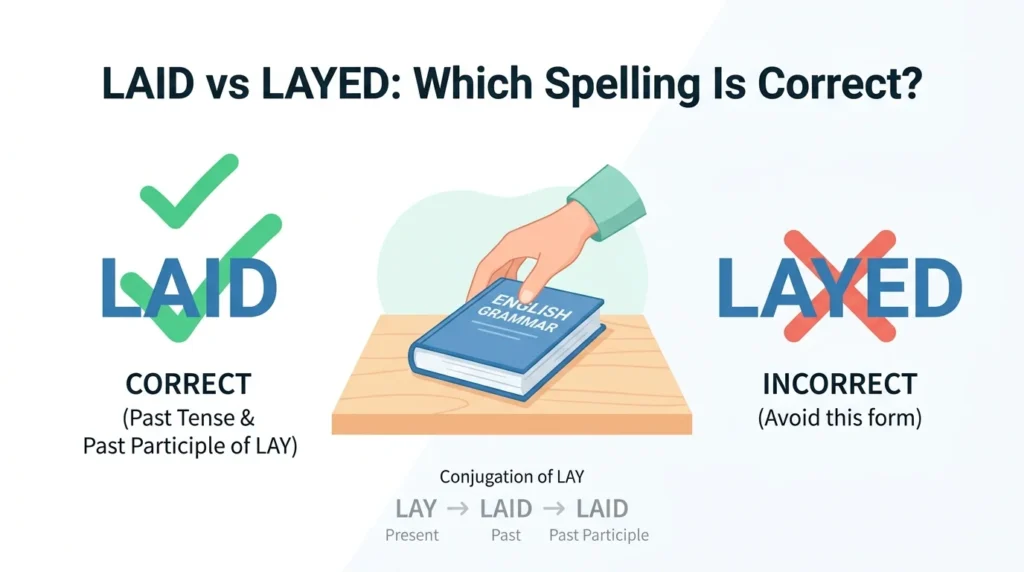

Laid is the correct standard form when you need the past tense or past participle of lay, meaning “to put or place something somewhere.” Layed is not the normal modern form of this verb. For example, write “She laid the book on the table,” not “She layed the book on the table.” The confusion happens because many English verbs form their past tense by adding -ed, but lay → laid is an irregular spelling pattern.
What Is the Difference Between Laid and Layed?
The main difference is simple:
- Laid is the standard past tense and past participle of lay.
- Layed is not the standard modern past form of lay.
- Lay means to put, place, or set something somewhere.
- Laid describes that action when it has already happened or when the past participle is required.
For example:
Present: I lay the keys on the desk every morning.
Past: I laid the keys on the desk yesterday.
Past participle: I have laid the keys on the desk.
The important point is that lay normally takes an object. An object is the person or thing receiving the action.
In “She laid the book on the table,” the book is the object. She placed the book somewhere.
This is why laid is the form you need in sentences such as:
- She laid the baby on the bed.
- He laid his phone beside the computer.
- They laid the foundation for the building.
- The company laid off several employees.
- The hen has laid an egg.
The standard verb forms are:
| Verb form | Correct form | Example |
|---|---|---|
| Base form | lay | Please lay the book here. |
| Present participle | laying | She is laying the books on the shelf. |
| Past tense | laid | She laid the books on the shelf. |
| Past participle | laid | She has laid the books on the shelf. |
Cambridge specifically identifies laid, not layed, as the past simple and past participle form of lay.
Why Does It Matter?
Using layed instead of laid can make otherwise clear writing look careless or unfinished.
That matters in situations such as:
- School assignments
- University essays
- Job applications
- Professional emails
- Business reports
- Website content
- Social media posts
- Formal letters
- Editing and publishing
- English-language exams
Consider these two sentences:
❌ The manager layed the documents on my desk.
✅ The manager laid the documents on my desk.
The meaning is easy to understand in both cases, but laid is the standard form.
The mistake can be especially noticeable because layed looks like a regular English past-tense formation. A reader may understand what you mean while still recognizing the spelling as nonstandard.
Read More: Bailer vs Baler: Which Spelling Is Correct?
The Core Rule
If you mean “put” or “placed” something in the past, use laid, not layed.
The basic pattern is:
lay → laid → laid
Not:
lay → layed → layed
For example:
- I lay the folder on the desk every morning.
- I laid the folder on the desk yesterday.
- I have laid the folder on the desk.
A useful test is to replace lay with put.
If the sentence means that someone put or placed something somewhere, laid is usually the correct past form.
She laid the jacket on the chair.
Think:
She put the jacket on the chair.
That meaning points you toward lay → laid.
How to Use Laid Correctly
Use Laid for a Past Action
Use laid when someone placed something somewhere in the past.
She laid the keys on the counter.
The action happened earlier, so laid is correct.
The teacher laid the worksheets on each student’s desk.
The worksheets were placed on the desks.
We laid the carpet last weekend.
The carpet was installed or placed in the past.
Use Laid as a Past Participle
Laid is also the past participle of lay. A past participle is a verb form used with helping verbs or in passive constructions.
Examples:
I have laid the documents on the table.
They had laid the foundation before winter.
The tiles were laid last month.
The plans have been laid out clearly.
Notice that laid does not change to layed in these constructions.
Use Laying for an Ongoing Action
Another important form is laying.
She is laying the books on the desk.
The workers are laying new flooring.
They were laying bricks when the rain started.
Do not change laying to layed when you are describing an action in progress.
The basic pattern is:
lay → laying → laid
Not:
lay → layed
Watch Out for “Lay” and “Lie”
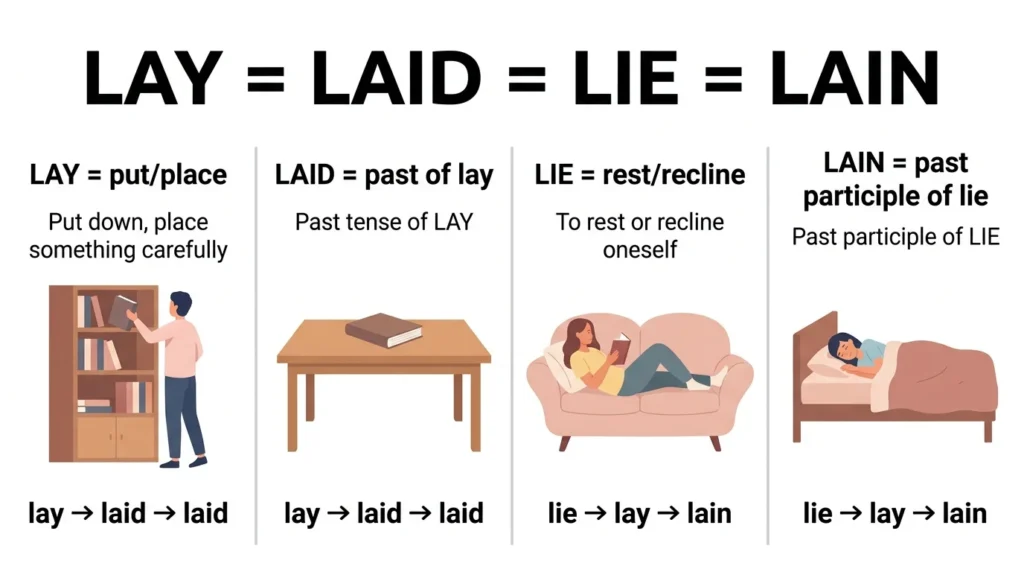
The biggest source of confusion is not actually laid vs layed. It is the larger family of lay, laid, lie, lay, and lain.
There are two different verbs involved.
Lay means to put or place something. It normally takes an object.
Lie means to recline or be in a resting position. It does not normally take an object.
Compare:
Please lay the book on the table.
The book is the object.
I want to lie on the sofa.
There is no object being placed.
The forms look confusing because the past tense of lie is lay.
| Meaning | Present | Past | Past participle |
|---|---|---|---|
| Put/place something | lay | laid | laid |
| Recline/rest | lie | lay | lain |
| Tell an untruth | lie | lied | lied |
This distinction is confirmed by standard grammar guidance: lay requires an object when it means “put something down,” while lie does not.
Correct Examples
Here are examples of laid in different real-life situations.
Conversation
“I laid your jacket on the chair.”
“She laid the baby down for a nap.”
I laid the signed documents on your desk this morning.
Workplace
The project manager laid out the new schedule during the meeting.
School
The student laid her notes beside the textbook before starting the exam.
Academic Writing
The researchers laid the foundation for further investigation.
Home
He laid the plates on the dining table.
Construction
The workers laid the concrete foundation last week.
News or Formal Writing
The committee laid out several recommendations in its report.
Social Media
I finally laid the last tile in the kitchen today!
Everyday Writing
She laid her phone next to the bed before going to sleep.
Business Communication
The director laid out the company’s priorities for the next quarter.
History or Politics
The agreement laid the groundwork for future cooperation.
Incorrect vs. Correct
| ❌ Incorrect | ✅ Correct | Why |
|---|---|---|
| She layed the book on the desk. | She laid the book on the desk. | The past tense of lay is laid. |
| He layed the keys beside the phone. | He laid the keys beside the phone. | Layed is not the standard past form of lay. |
| They layed the carpet yesterday. | They laid the carpet yesterday. | The completed action requires laid. |
| We have layed the foundation. | We have laid the foundation. | The past participle is laid. |
| The workers layed the bricks. | The workers laid the bricks. | Lay → laid is the correct verb pattern. |
| She had layed the papers on the table. | She had laid the papers on the table. | The past participle after had is laid. |
| He layed the cards on the table. | He laid the cards on the table. | The cards are the object being placed. |
| The company layed off 20 workers. | The company laid off 20 workers. | The phrasal verb is lay off → laid off. |
| The teacher layed out the rules. | The teacher laid out the rules. | The correct phrasal verb is lay out → laid out. |
| They are layed new tiles. | They are laying new tiles. | An ongoing action requires laying, not layed. |
Why People Make This Mistake
1. English Usually Makes Past Tense Look Predictable
Many common verbs simply take -ed:
- play → played
- walk → walked
- work → worked
- clean → cleaned
- open → opened
So it is understandable that someone might reason:
lay + ed = layed
The problem is that English contains many verbs whose past forms do not follow that simple pattern.
For lay, the standard form is:
lay → laid
2. Lay Looks Like Other -ay Verbs
Words such as play, stay, and pray form their past tense with -ed:
play → played
stay → stayed
pray → prayed
That makes layed visually tempting.
But spelling patterns do not always transfer from one verb to another. Lay has its own established past form: laid.
3. Lay and Lie Create Extra Confusion
The problem becomes harder because lay is also the past tense of lie.
For example:
I lie on the sofa every afternoon.
Past:
Yesterday, I lay on the sofa.
But when you put something somewhere:
Yesterday, I laid the book on the sofa.
These are different verbs with overlapping forms.
4. Pronunciation Does Not Rescue You
Laid and layed, when someone tries to pronounce them as the same form, can seem like an obvious spelling choice.
But English spelling cannot always be reconstructed from sound.
You need to know which verb form you are using.
5. Spellcheck Can Have Limits
A spellchecker may identify layed in many ordinary contexts, but automated tools are not a substitute for understanding the grammar.
A tool can tell you that a word looks unusual. It may not fully explain why the correct form is laid, or whether you have confused lay, lie, or lain.
Common Mistakes Checklist
Mistake 1: Writing “layed” as the past tense
Problem:
She layed the book down.
Fix:
She laid the book down.
Remember:
lay → laid
Mistake 2: Using “lay” when you mean “laid”
Problem:
Yesterday, she lay the book on the desk.
Fix:
Yesterday, she laid the book on the desk.
The action happened in the past.
Mistake 3: Using “laid” when you mean “lay”
Problem:
Please laid the folder here.
Fix:
Please lay the folder here.
The sentence is a command, so it uses the base form lay.
Mistake 4: Confusing “lay” with “lie”
Problem:
I am going to lay down for a while.
In careful standard grammar, when the speaker means “recline,” the verb is lie:
I am going to lie down for a while.
But:
I am going to lay the baby down.
Here lay is correct because there is an object: the baby.
Mistake 5: Confusing “laid” with “lain”
Use laid for the past participle of lay:
I have laid the book on the table.
Use lain for the past participle of lie:
I have lain awake all night.
The two words belong to different verbs.
Laid in Real English
Grammatically correct and natural
She laid the keys on the table.
This is completely standard and natural English. Laid is the normal past form when someone puts or places an object somewhere. It works equally well in everyday conversation, professional writing, schoolwork, and formal prose. The sentence is short, direct, and uses the verb exactly as expected: someone performs an action on an object.
Grammatically possible but confusing
Yesterday, I lay on the sofa and laid my laptop beside me.
This sentence is grammatically correct, but it can feel confusing to learners because lay and laid appear close together while belonging to different grammatical roles. Here, lay is the past tense of lie, meaning “recline,” while laid is the past tense of lay, meaning “placed.” The contrast is correct, even though the forms look similar.
Natural everyday English
I laid my phone on the table.
This is the natural choice when describing a completed action of putting a phone somewhere. Native speakers do not normally substitute layed for laid in standard modern English. The unusual-looking spelling of laid should not tempt you to “correct” it to layed. In this context, laid is both grammatically correct and the ordinary form.
Natural but easy to confuse with another verb
I lay on the bed for an hour.
This is natural English when lay means that the speaker reclined. It is the past tense of lie, not the present tense of lay. If you mean that the speaker placed something on the bed, however, you would need laid: “I laid the book on the bed.” The object determines which verb you need.
Natural in formal and professional writing
The report laid out the company’s recommendations.
This is standard English. Laid out is the past form of the phrasal verb lay out, meaning to present, arrange, or explain something clearly. It appears in professional, academic, journalistic, and everyday writing. The same pattern applies to expressions such as laid down, laid aside, and laid off.
American vs. British English
There is no meaningful American-versus-British spelling difference between laid and layed in ordinary standard English.
Both varieties use:
lay → laid → laid
Examples are standard in both varieties:
She laid the book on the table.
The workers laid the foundation.
The company laid off several employees.
So you should not choose layed because you are writing for an American audience, or choose laid only because you are writing for a British audience.
Laid is the standard choice in both.
Formal vs. Informal Usage
Laid is appropriate in virtually every register.
It can be used in:
- Casual conversation
- Text messages
- Social media
- School assignments
- Business emails
- Academic writing
- Reports
- Professional documents
There is no need to replace laid with another form simply because the writing is formal or informal.
Layed, when used as an ordinary past form of lay, should not be treated as a casual alternative to laid.
There are historical examples of layed, and specialized or historical usage can sometimes preserve forms that are not standard in everyday modern English. For ordinary contemporary writing, however, laid is the form to use.
Read More: Ingage vs Engage: Which Spelling Is Correct?
Laid vs. Layed Comparison Table
| Feature | Laid | Layed |
|---|---|---|
| Standard modern English | ✅ Yes | ❌ No |
| Past tense of lay | ✅ Yes | ❌ No |
| Past participle of lay | ✅ Yes | ❌ No |
| Means “put or placed” in the past | ✅ Yes | ❌ No |
| Used in professional writing | ✅ Yes | ❌ No |
| Used in academic writing | ✅ Yes | ❌ No |
| Used in everyday standard English | ✅ Yes | ❌ No |
| Historical/archaic occurrences | Possible | Yes |
| Recommended for ordinary writing | ✅ Yes | ❌ No |
The key distinction is therefore not one of meaning between two normal modern alternatives. In ordinary contemporary English, laid is the standard form you want.
Memory Trick
Use this simple mnemonic:
“Lay today, laid yesterday.”
If you are talking about putting something somewhere now:
I lay the book here.
If you are talking about putting something somewhere before now:
I laid the book here yesterday.
And if you use a helping verb such as have, has, or had:
I have laid the book here.
Remember the three-form pattern:
LAY → LAID → LAID
Never build the past form by adding -ed.
Real-Life Situations
1. In an Interview
“I laid out a three-step plan for improving customer retention.”
Why: The speaker is describing a completed action.
2. In a Meeting
“Sarah laid the documents on the conference table.”
Why: Sarah placed the documents there.
3. In an Email
“I have laid the signed contract on your desk.”
Why: Laid is the past participle after have.
4. In a Text Message
“I laid your keys next to the coffee machine.”
Why: The keys were placed there earlier.
5. In an Exam
❌ The student layed the answer sheet on the desk.
✅ The student laid the answer sheet on the desk.
Why: The past form of lay is laid.
6. At Home
“I laid the towels on the bed.”
Why: Someone placed the towels somewhere.
7. At Work
“The manager laid out the new rules.”
Why: Laid out means presented or explained the rules.
8. In Construction
“The workers laid the foundation last month.”
Why: The foundation was put in place in the past.
Lay vs. Lie: The Shortcut You Really Need
If laid vs. layed keeps confusing you, learn this three-line comparison.
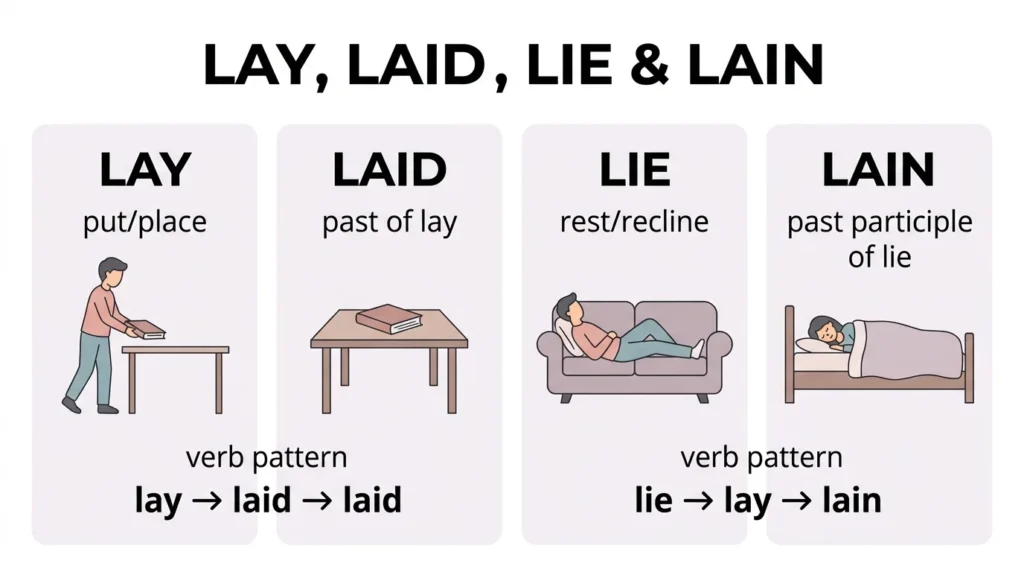
- Lay = put something somewhere.
- Lie = rest or recline.
- Laid = past tense of lay.
Examples:
Please lay the phone on the desk.
Yesterday, I laid the phone on the desk.
Yesterday, I lay on the sofa.
The last sentence is correct because lay is the past tense of lie.
A useful question is:
“Am I putting something somewhere, or am I resting?”
If you are putting something somewhere:
lay / laid
If you are resting:
lie / lay / lain
That one question eliminates much of the confusion.
Expert Tips
Tip 1: Use “put” as a diagnostic
When you’re unsure whether you need laid, mentally replace the verb with put.
She ___ the folder on the desk.
If you mean:
She put the folder on the desk.
then:
She laid the folder on the desk.
Tip 2: Look for an object
If lay means “put or place,” it normally has an object.
He laid the book on the desk.
What did he lay?
The book.
If you are talking about yourself or someone resting, you probably need lie instead.
He lay on the sofa.
There is no object receiving the action.
Tip 3: Memorize the whole verb family
Instead of memorizing only laid, learn:
lay – laid – laid
And separately:
lie – lay – lain
This prevents one grammar mistake from turning into another.
Tip 4: Do not trust “-ed” automatically
English has thousands of regular verbs, but common verbs often have irregular forms.
Compare:
play → played
with:
lay → laid
The fact that played exists does not mean layed should exist as the normal past form.
Tip 5: Remember “laying”
If you need the -ing form of lay, use:
laying
Examples:
She is laying the table.
They are laying bricks.
He was laying the foundation.
Not:
❌ She is layed the table.
FAQ
Is “layed” a correct word?
Not as the standard modern past tense or past participle of lay. For ordinary contemporary English, use laid. Historical sources do contain layed, and it can occur in archaic or specialized contexts, but that does not make it the normal modern form.
Read More: Home Made vs Homemade: Which Spelling Is Correct?
Is it “I laid down” or “I layed down”?
If you mean that you placed something down, use laid:
I laid the book down.
If you mean that you reclined, standard grammar uses:
I lay down.
For example:
Yesterday, I lay down for an hour.
Here lay is the past tense of lie.
Is “I laid on the bed” correct?
Not when you mean “I reclined on the bed.” In standard grammar, use:
I lay on the bed.
But if you mean that you placed something on the bed:
I laid the book on the bed.
The object changes the verb.
What is the past tense of lay?
The past tense of lay, meaning “to put or place,” is laid.
Present: I lay the book here.
Past: I laid the book here.
Past participle: I have laid the book here.
What is the past participle of lay?
The past participle is laid.
Examples:
I have laid the documents on the desk.
She had laid the baby in the crib.
The tiles were laid last year.
Is “laying” correct?
Yes. Laying is the present participle of lay.
She is laying the books on the table.
Do not confuse it with lying, which is the present participle of lie when someone is reclining.
Why does “layed” look so correct?
It looks correct because many English verbs form the past tense by adding -ed. Words such as played, stayed, and worked encourage that pattern. But lay does not use -ed for its standard past form. It uses laid.
Is “laid” only used for physically putting something down?
No. Laid appears in many expressions and meanings connected with lay.
For example:
laid the foundation
laid out a plan
laid down the rules
laid off employees
laid claim to something
So the word is much broader than physically placing an object on a surface.
Is “laid” formal or informal?
It works in both formal and informal English. You can use laid in conversation, text messages, business writing, academic work, and professional documents. It is the standard form of the verb, not a particularly formal alternative.
Should I use “layed” in British English?
No. British English does not normally use layed as the standard past form of lay. Laid is the standard form in both British and American English.
What is the easiest way to remember laid vs. layed?
Remember:
Lay today, laid yesterday.
Or memorize:
Lay → Laid → Laid
If you mean “put or placed” and the action is in the past, choose laid.
Mini Quiz
| # | Question | Answer | Explanation |
|---|---|---|---|
| 1 | Yesterday, she ___ the book on the table. (laid / layed) | Laid | The past tense of lay is laid. |
| 2 | Please ___ the keys on the counter. (lay / laid) | Lay | A command uses the base form. |
| 3 | They have ___ the new carpet. (laid / layed) | Laid | Laid is the past participle of lay. |
| 4 | Correct the sentence: “He layed the papers on my desk.” | He laid the papers on my desk. | Layed is not the standard past form. |
| 5 | Yesterday, I ___ on the sofa for two hours. (lay / laid) | Lay | Here lay is the past tense of lie, meaning recline. |
| 6 | The workers are ___ new tiles. (laying / layed) | Laying | The ongoing form of lay is laying. |
| 7 | She ___ out the plan during the meeting. (laid / layed) | Laid | The past form of lay out is laid out. |
| 8 | Correct the sentence: “I have layed the documents here.” | I have laid the documents here. | Laid is the past participle. |
| 9 | Which sentence is correct? A) I laid down on the bed. B) I lay down on the bed. | B | When you mean “reclined,” the past tense of lie is lay. |
| 10 | Which sentence is correct? A) She layed the baby in the crib. B) She laid the baby in the crib. | B | The baby is the object being placed, so the past tense of lay is laid. |
Quick Summary
Laid is the correct standard past tense and past participle of lay when lay means “to put or place something.” Layed is not the normal modern form and should not be used in ordinary writing. The key pattern is lay → laid → laid. For an ongoing action, use laying. The confusion becomes greater because lay is also the past tense of lie, as in “Yesterday, I lay on the sofa.” Use laid when an object is being placed: “She laid the book on the table.” Use lay when someone rested: “She lay on the sofa.” When in doubt, ask whether you mean put something or rest.
Final Takeaway
If you remember only one thing, remember this:
Laid is correct. Layed is not the standard past form of lay.
Use:
lay → laid → laid
Examples:
I lay the book on the desk.
I laid the book on the desk yesterday.
I have laid the book on the desk.
And when you mean resting:
I lie on the sofa.
Yesterday, I lay on the sofa.
Once you separate lay = put something from lie = rest, the entire laid vs. layed problem becomes much easier.