
Success vs Sucess: Which Spelling Is Correct?
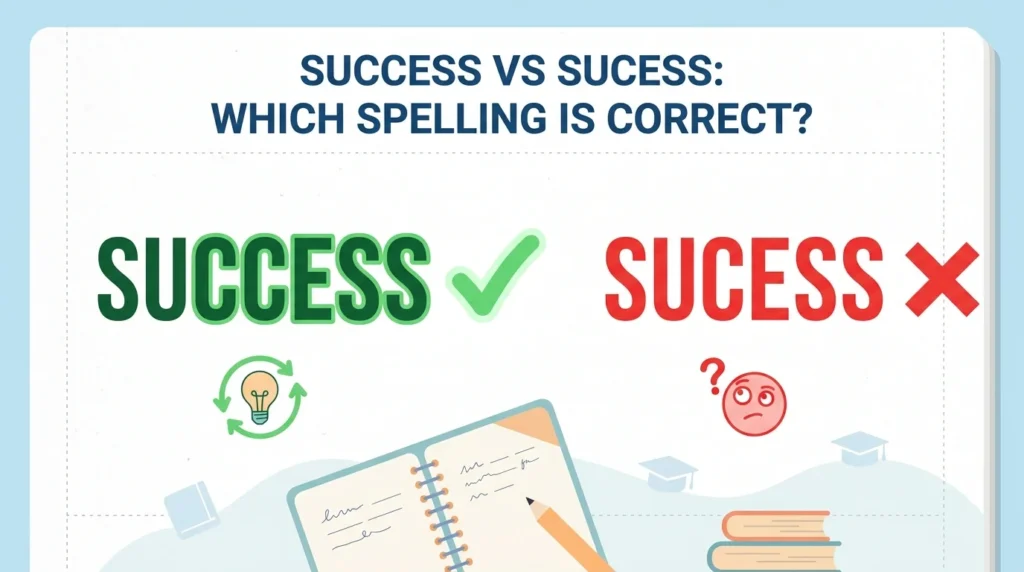
If you are wondering whether success or sucess is correct, the answer is simple: success is the correct spelling. Sucess is a misspelling.
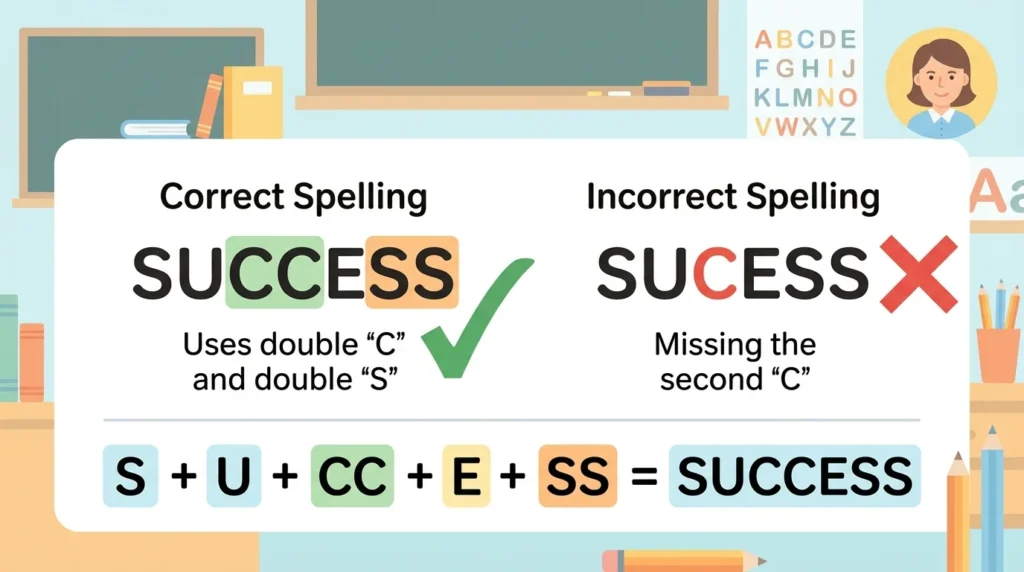
The word success contains two c’s and two s’s:
S-U-C-C-E-S-S
The spelling sucess leaves out one of the c’s. Because the missing letter is not obvious in pronunciation, this mistake is easy to make, especially when typing quickly.
What Is the Difference Between Success and Sucess?
There is no difference in meaning between success and sucess because sucess is not a standard English word.
The two forms look almost identical:
- success ✅ correct
- sucess ❌ incorrect
The only difference is the second c. That small difference matters because spelling is part of standard written English.
Success is a noun. It describes the achievement of a goal, a favorable result, or something that has achieved a desired outcome.
For example:
The new product was a great success.
You would not write:
The new product was a great sucess. ❌
The second sentence contains a spelling error.
Why It Matters
A one-letter spelling mistake may seem minor, but success appears frequently in situations where accuracy matters.
You might use the word in:
- A job application
- A business proposal
- An academic essay
- A school assignment
- A professional email
- A presentation
- A social media post
- A website headline
- A report
- A personal message
Writing sucess can make the reader stop and notice the error. In formal or professional writing, repeated spelling mistakes can make your work look less polished.
The problem is especially easy to miss because sucess still looks like a recognizable version of the word. Your brain may read it as success even when one letter is missing.
That is why learning the correct letter pattern is more useful than simply relying on spellcheck.
The Core Rule
Rule: Always spell the word as SUCCESS — with two c’s and two s’s.
The spelling pattern is:
S + U + CC + E + SS = SUCCESS
Not:
S + U + C + E + SS = SUCESS ❌
A quick visual check can help:
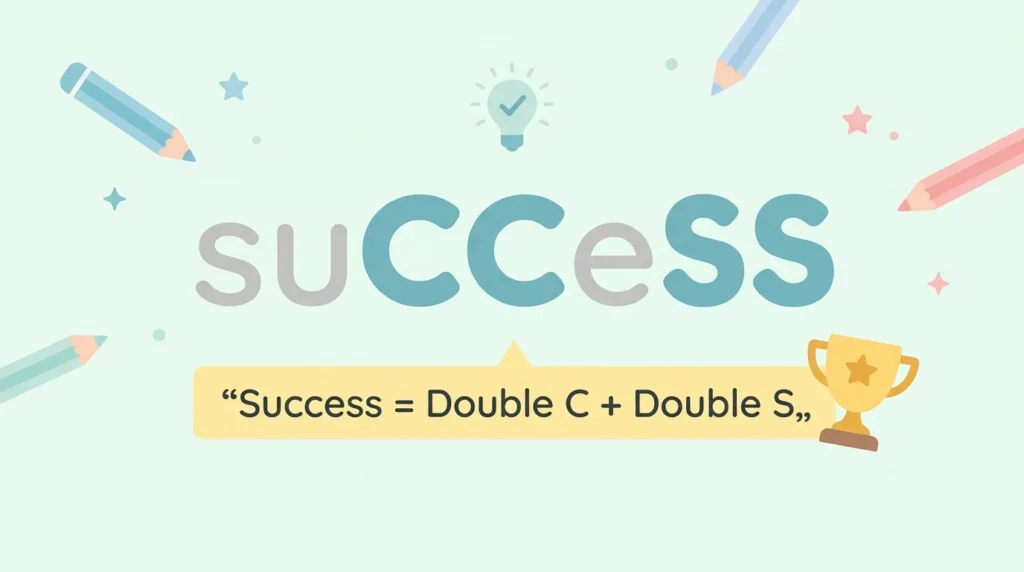
suCCeSS ✅
The word has:
- CC in the middle
- SS at the end
This is the spelling you should use in both formal and everyday English.
Read More: Unenroll vs Disenroll: Meaning and Key Difference
How to Spell Success Correctly
Break the word into two parts:
suc + cess
Then put them together:
suc + cess = success
Another useful way to see it is:
SU + CC + E + SS
That gives you all seven letters:
S U C C E S S
The most commonly forgotten letter is the second c. Writers sometimes remember the final ss but accidentally type only one c.
A simple spelling check
Before writing the word, ask yourself:
- Do I have CC?
- Do I have SS at the end?
- Does it look like success?
If yes, you have the standard spelling.
What Does Success Mean?
Success is a noun that generally refers to achieving a desired result or goal.
Its meaning depends on the situation.
For example:
- Passing an exam can be a success.
- Completing a difficult project can be a success.
- Building a profitable business can be a success.
- Winning a competition can be a success.
- Solving a difficult problem can be a success.
Success does not necessarily mean fame or money. It can simply mean that something produced the result you wanted.
Compare these sentences:
The experiment was a success.
Here, success means the experiment produced a satisfactory result.
She achieved success through years of practice.
Here, success refers to achievement.
The event was a huge success.
Here, success means the event went very well.
Success as a Noun
The word success is normally used as a noun.
A noun names a person, place, thing, idea, or concept. In this case, success names an achievement or favorable result.
Examples:
His first book was a major success.
The team celebrated its success.
Hard work contributed to her success.
The campaign was a commercial success.
Academic success requires consistent effort.
You can also use success after expressions such as:
- a success
- great success
- considerable success
- remarkable success
- financial success
- academic success
- professional success
- business success
Success vs. Successful
One useful distinction is between success and successful.
Success is a noun.
Successful is an adjective.
Compare:
The project was a success.
The project was successful.
The first sentence uses success to name the positive result.
The second uses successful to describe the project.
This distinction is important because writers sometimes focus so much on spelling success that they overlook related forms.
Correct forms
- success
- successful
- successfully
- successes
Incorrect forms
- sucess ❌
- succes ❌
- sucessful ❌
- succesful ❌
The base word remains success.
How to Use Success in a Sentence
The word success works naturally in many different sentence structures.
With “a”
The event was a success.
Here, success is a countable noun referring to a particular successful event or result.
With “great”
Her presentation was a great success.
With “achieve”
He worked hard to achieve success.
With “find”
She found success in a competitive industry.
With “lead to”
Consistent practice can lead to success.
With “measure”
Financial results are not the only way to measure success.
These patterns are useful because learning a word means more than memorizing its spelling. You also need to know how it behaves in a sentence.
Correct Examples
Here are examples of success in different real-world situations.
Conversation
“How did your interview go?”
“It was a success. I received the job offer.”
The product launch was a great success, and we appreciate everyone’s effort.
School
Her hard work resulted in academic success.
Workplace
The team celebrated the success of the new marketing campaign.
Business
The company achieved significant success in its first year.
Social Media
Small steps every day can lead to long-term success.
Academic Writing
The study’s success depended on accurate data collection.
Sports
The team’s success came from consistent training and strong teamwork.
Personal Development
For some people, success means having enough time for family and personal interests.
Formal Report
The project was considered a success because it was completed on schedule.
Incorrect vs. Correct
The most important correction is simple: replace sucess with success.
| ❌ Incorrect | ✅ Correct | Why |
|---|---|---|
| The project was a great sucess. | The project was a great success. | The correct spelling contains two c’s. |
| She achieved sucess at school. | She achieved success at school. | Sucess is a misspelling. |
| His business became a sucess. | His business became a success. | The word requires cc. |
| We celebrated our sucess. | We celebrated our success. | The second c cannot be omitted. |
| The event was a huge sucess. | The event was a huge success. | The standard spelling is success. |
| Her career has been a sucess. | Her career has been a success. | Success contains seven letters. |
| Hard work leads to sucess. | Hard work leads to success. | The correct middle pattern is cc. |
| The campaign was a sucess. | The campaign was a success. | Sucess is a spelling error. |
| Academic sucess requires effort. | Academic success requires effort. | The second c is required. |
| They hoped for sucess. | They hoped for success. | Use the standard spelling success. |
| The plan was surprisingly sucessful. | The plan was surprisingly successful. | The related adjective also retains cc. |
| She worked sucessfully. | She worked successfully. | The adverb is based on successful. |
Read More: Mama vs. Momma: Which Spelling Is Correct?
Why People Make This Mistake
The mistake usually happens because the spelling is easier to recognize than to reconstruct.
1. The pronunciation does not clearly reveal the double c
When you pronounce success, the two c’s are not heard as two separate sounds.
The word is commonly pronounced approximately as:
sək-SESS
The spelling therefore cannot be reliably guessed from pronunciation alone.
A learner may hear the word and think:
s-u-c-e-s-s
instead of:
s-u-c-c-e-s-s
This is a normal spelling problem, not a difference in pronunciation.
2. The word contains repeated letters
English has many words in which repeated letters are easy to overlook.
In success, there are two separate doubled-letter patterns:
CC
and
SS
That gives the word a visual pattern that is easy to simplify accidentally.
3. Fast typing
When people type quickly, they may skip repeated letters.
The brain often knows what word it intends to produce before the fingers have finished typing it. That can make a missing letter surprisingly difficult to notice.
4. Sound-based spelling
Some learners try to spell English words exactly as they hear them.
That strategy does not always work because English spelling and pronunciation do not have a one-to-one relationship.
5. Autocomplete can create false confidence
Spellcheck and autocomplete are useful, but they should not replace proofreading.
A writer may become accustomed to relying on software to identify mistakes. If a correction is missed or not accepted, the spelling error can remain in the final text.
Read More: Steer vs Stear: Which Spelling Is Correct?
Common Mistakes Checklist
Before publishing or submitting your writing, check these common errors.
Mistake 1: Writing “sucess”
Wrong: sucess
Right: success
Why it happens: The second c is easy to forget.
How to avoid it: Look specifically for cc.
Mistake 2: Writing “succes”
Wrong: succes
Right: success
Why it happens: The writer remembers the double c but forgets the final s.
How to avoid it: Remember that success ends with ss.
Mistake 3: Writing “succesful”
Wrong: succesful
Right: successful
Why it happens: The writer starts with an incorrectly spelled version of success.
How to avoid it: Start with success, then add -ful.
Mistake 4: Writing “sucessful”
Wrong: sucessful
Right: successful
Why it happens: The writer loses the second c before adding -ful.
How to avoid it: Check the base word first: success.
Mistake 5: Assuming pronunciation gives the spelling
Wrong approach: Spell the word exactly as it sounds.
Better approach: Learn the visual pattern suCCeSS.
Success in Real English
Success is grammatically correct and completely natural in everyday English. It is not limited to formal writing. People use it in conversations, news reports, business discussions, education, sports, and personal writing. Phrases such as “a success,” “achieve success,” “great success,” and “business success” are ordinary English expressions.
The spelling sucess, however, is not an alternative form. It is simply a misspelling. There is no context in standard English where you should deliberately choose sucess instead of success.
The word success can also be grammatically correct while still sounding less natural in a particular sentence if another construction better expresses the intended idea. For example, “The project succeeded” may be more direct than “The project achieved success.” Both can be grammatical, but the best choice depends on what you want to emphasize.
A useful distinction is between grammatical correctness and natural wording. Success itself is standard and natural, but not every sentence needs the noun. Sometimes successful, succeeded, or another expression will make the sentence clearer.
American vs. British English
There is no spelling difference between American and British English for this word.
Both varieties use:
success ✅
Neither standard variety uses:
sucess ❌
So you do not need to remember separate American and British spellings.
| English variety | Correct spelling |
|---|---|
| American English | success |
| British English | success |
| International English | success |
The pronunciation may vary slightly by speaker or accent, but the standard spelling remains success.
Read More: Emaculate vs Immaculate: Correct Spelling & Meaning
Formal vs. Informal Usage
There is also no formal-versus-informal spelling difference.
Success is appropriate in:
- Casual conversation
- Text messages
- Social media
- School assignments
- Academic writing
- Business emails
- Reports
- Professional documents
- Presentations
The issue is not whether success is formal or informal. The issue is simply spelling it correctly.
You can use success in almost any register. If you need a different word for stylistic reasons, alternatives might include achievement, accomplishment, positive result, or triumph, depending on context.
Comparison Table
| Feature | Success | Sucess |
|---|---|---|
| Standard English word | Yes | No |
| Correct spelling | Yes | No |
| Part of speech | Noun | — |
| Meaning | Achievement or favorable result | — |
| Contains double c | Yes | No |
| Ends in double s | Yes | Yes |
| Used in formal writing | Yes | No |
| Used in everyday English | Yes | No |
| American English | Correct | Incorrect |
| British English | Correct | Incorrect |
| Suitable for academic writing | Yes | No |
| Suitable for professional writing | Yes | No |
Memory Trick
Here is an easy mnemonic:
Success needs two C’s and two S’s.
Think:
CC = Correct Construction
SS = Successful Spelling
Or simply remember:
suCCeSS
The visual pattern is often easier to remember than trying to memorize the entire word letter by letter.
Another useful connection is:
success → successful → successfully
The base word always begins with:
succ-
So:
- success
- successful
- successfully
All retain the cc.
Real-Life Situations
1. Job Interview
You are talking about a previous project:
“The campaign was a major success, and our team exceeded its target.”
The noun success identifies the positive outcome.
2. Business Meeting
A manager says:
“The launch was a success, but we need to improve customer support.”
Here, a success means the launch produced a good result.
3. Professional Email
Thank you to everyone who contributed to the success of the project.
This is natural and appropriate for workplace communication.
4. Text Message
“The exam went really well. I think it was a success!”
The same spelling applies in informal communication.
5. School Essay
Consistent study habits can contribute to academic success.
The word works naturally in academic writing.
6. Social Media
Success rarely happens overnight. Keep learning and keep improving.
Again, the spelling does not change because the platform is informal.
7. Presentation
“There are three factors behind the company’s success: quality, consistency, and customer service.”
8. Personal Conversation
“What does success mean to you?”
Here, success refers to a broader personal idea rather than a specific achievement.
Expert Tips
Tip 1: Memorize the shape, not just the sound
Instead of repeatedly saying the word aloud, look at its spelling:
suCCeSS
The double-letter pattern is the important visual feature.
Tip 2: Learn related forms together
Do not learn success in isolation.
Learn this family:
succeed → success → successful → successfully
Knowing the related words can strengthen your spelling memory.
Tip 3: Watch the middle of the word
The most common problem is the missing second c.
When proofreading, deliberately inspect:
suCC
rather than scanning the entire word casually.
Tip 4: Do not trust pronunciation alone
English contains many words whose spelling cannot be perfectly predicted from pronunciation.
Treat spelling as a visual pattern as well as a sound pattern.
Tip 5: Proofread high-visibility writing
If you are writing a:
- Resume
- Cover letter
- Business proposal
- Website
- Academic assignment
- Presentation
- Public social media post
take an extra second to check frequently used words such as success.
Tip 6: Watch the related adjective
Remember:
success → successful
Not:
sucess → sucessful
The correct spelling of the base word carries forward.
FAQ
Is “sucess” a correct spelling?
No. Sucess is a misspelling. The standard English spelling is success, with two c’s and two s’s.
Why is “sucess” wrong?
The word success is conventionally spelled with cc in the middle. Removing one c produces the incorrect form sucess.
How do you spell success correctly?
Spell it:
S-U-C-C-E-S-S
A useful visual reminder is suCCeSS.
Does success have two c’s?
Yes. Success contains two consecutive c’s: cc.
Does success have two s’s?
Yes. It begins with s and ends with ss.
Is “success” the same in American and British English?
Yes. Both American and British English use success. There is no standard regional spelling such as sucess.
Is success a noun or an adjective?
Success is a noun. The related adjective is successful.
For example:
Her success was impressive.
She was successful.
What is the plural of success?
The plural is successes.
For example:
The company experienced several successes during the year.
Is “successful” spelled with one or two c’s?
It is spelled with two c’s:
successful
The word is formed from success plus -ful.
What is the difference between success and successful?
Success is a noun that refers to an achievement or favorable result. Successful is an adjective that describes someone or something that achieves a desired result.
Can success be used in informal English?
Yes. Success is completely normal in informal English as well as formal writing.
What is an easy way to remember success?
Remember:
Success = CC + SS
Or visualize the word as:
suCCeSS
What are common misspellings of success?
Common errors include:
- sucess
- succes
- succesful
- sucessful
- sucessfully
The standard forms are success, successful, and successfully.
Can “success” refer to something other than money?
Yes. Success can refer to achieving almost any desired goal or favorable outcome. It can involve education, relationships, personal development, sports, work, business, or other areas of life.
Quick Summary
Success is the only correct spelling; sucess is a misspelling. The word success is a noun meaning an achievement, favorable result, or accomplishment. Its spelling contains two important double-letter patterns: cc in the middle and ss at the end. Think of it visually as suCCeSS. The word is spelled the same way in American and British English and is appropriate in both formal and informal writing. Common related forms include successful, successfully, and successes. The easiest way to avoid the mistake is to remember that success has double C and double S. When proofreading, pay special attention to the middle cc, because that is the letter pattern most often omitted.
Mini Quiz
| # | Question | Answer | Explanation |
|---|---|---|---|
| 1 | Which spelling is correct: success or sucess? | success | The correct word contains two c’s. |
| 2 | Fill in the blank: “The event was a great ____.” | success | Success is the noun used for a favorable result. |
| 3 | Correct the sentence: “Her business became a huge sucess.” | Her business became a huge success. | Sucess is missing one c. |
| 4 | How many c’s are in success? | Two | The middle of the word is cc. |
| 5 | Which is correct: succesful or successful? | successful | The base word is success, so the double c remains. |
| 6 | Fill in the blank: “Hard work can lead to ____.” | success | The noun success fits naturally after “lead to.” |
| 7 | Which spelling is standard in British English? success / sucess | success | British English uses the same spelling. |
| 8 | Correct the sentence: “The project was a sucess.” | The project was a success. | The correct spelling has cc. |
| 9 | Is successful a noun or adjective? | Adjective | It describes a person, thing, action, or situation. |
| 10 | Complete the pattern: suCCe__ | SS | The word ends with two s’s: success. |