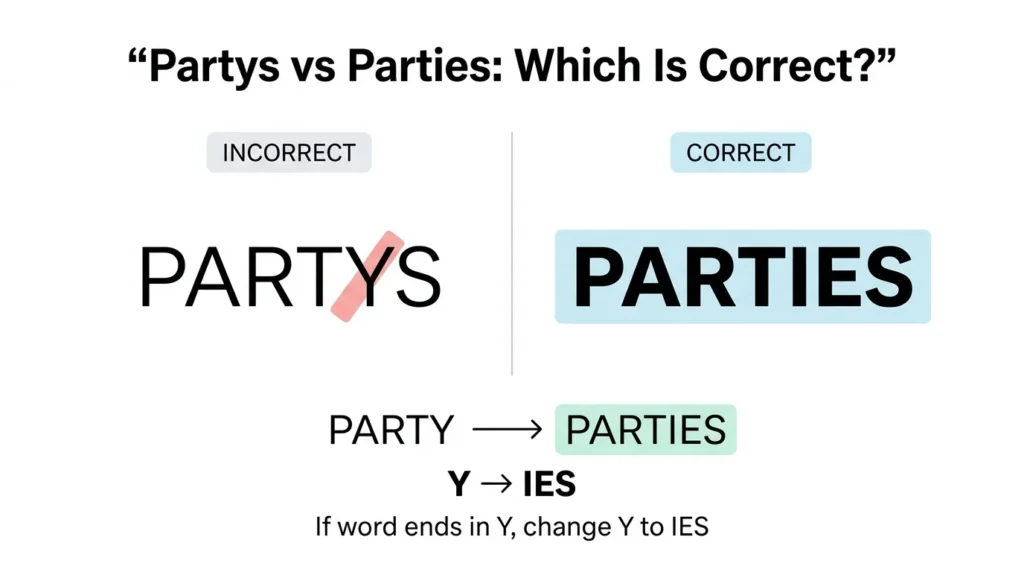

Parties is the correct plural form of party. Partys is incorrect in standard English. When you mean more than one party, write parties: “We attended three parties.” If you mean something belongs to one party, use party’s: “The party’s decision was final.” For possession involving multiple parties, use parties’: “The parties’ agreement was signed.”
What Is the Difference Between Partys and Parties?
The difference is simple: parties is the correct plural spelling of party, while partys is a spelling error in standard English.
The noun party can refer to a social gathering, a political organization, a group involved in an activity, or one side in an agreement, dispute, or legal matter. Its plural form is parties.
For example:
- One party → two parties
- One political party → several political parties
- One birthday party → several birthday parties
- One party to a contract → all parties to the contract
The spelling changes from y to ies because party ends in a consonant followed by y.
So:
party → parties
Not:
party → partys
The apostrophe creates a different issue. Party’s and parties’ are possessive forms, not ordinary plurals.
Why It Matters
A single misplaced letter or apostrophe can change the grammatical meaning of a sentence.
Compare:
- The parties signed the contract.
- The party’s representative signed the contract.
- The parties’ representatives signed the contract.
These sentences are not interchangeable.
In the first sentence, parties means more than one party.
In the second, party’s refers to something belonging to one party.
In the third, parties’ shows that something belongs to multiple parties.
This distinction matters especially in:
- Business emails
- Contracts and legal documents
- Academic writing
- Political reporting
- Workplace communication
- Invitations and event planning
- Social media posts
- School assignments
The plural parties is also common in legal and business English, where party can mean a person, company, organization, or group involved in an agreement or dispute.
The Core Rule
Use “parties” when you mean more than one party. Never use “partys” as the standard plural of “party.”
The basic spelling pattern is:
party → parties
The reason is that nouns ending in a consonant + y generally change the y to i and add -es when forming the plural.
Examples:
- party → parties
- city → cities
- baby → babies
- company → companies
- country → countries
- family → families
- story → stories
By contrast, words ending in a vowel + y normally keep the y and simply take -s:
- boy → boys
- toy → toys
- day → days
- key → keys
- journey → journeys
So the spelling of parties follows a regular English plural pattern.
How to Use Parties
Use parties whenever you are referring to two or more parties.
This applies regardless of what party means.
Social gatherings
We attended three parties during the holiday season.
Here, parties means several social events.
Political organizations
Several political parties announced their policies.
Here, parties means multiple political organizations. Party has this political meaning as well as its social meaning.
Groups involved in an agreement
Both parties agreed to the revised terms.
Here, parties refers to two sides involved in an agreement.
Groups involved in a dispute
The two parties eventually reached a settlement.
Again, parties means two sides.
Groups participating in an activity
The hotel offers special rates for large parties.
Here, parties means groups of people.
The meaning of party changes with context, but its plural spelling remains parties.
Correct Examples
Here are natural examples showing how parties works in different types of writing.
- Conversation: “We went to two parties last weekend.”
- Email: “Several parties have expressed interest in the proposal.”
- Workplace: “The parties will meet again on Monday.”
- School: “The students compared the positions of the two political parties.”
- Academic writing: “The study examined how different parties responded to the policy.”
- Legal writing: “Both parties agreed to the terms of the settlement.”
- Business: “The contract requires all parties to provide written approval.”
- Social media: “Three birthday parties in one weekend was exhausting!”
- News writing: “The two parties are still negotiating.”
- Event planning: “The venue can accommodate several private parties.”
- Everyday English: “There were too many parties happening at the same time.”
- Formal communication: “All parties involved were notified of the change.”
Notice that none of these examples needs an apostrophe simply because the noun is plural.
Read More: Infront vs In Front: Which Is Correct?
Incorrect vs. Correct
| ❌ Incorrect | ✅ Correct | Why |
|---|---|---|
| We attended three partys. | We attended three parties. | Parties is the standard plural of party. |
| Several partys were scheduled. | Several parties were scheduled. | A plural noun is needed, and party changes to parties. |
| Both partys signed the agreement. | Both parties signed the agreement. | Parties means two or more sides. |
| The company hosted several partys. | The company hosted several parties. | The plural ending is -ies, not -ys. |
| Political partys are campaigning. | Political parties are campaigning. | The plural of political party is parties. |
| Three birthday partys were held. | Three birthday parties were held. | Party becomes parties in the plural. |
| The two partys disagreed. | The two parties disagreed. | Two requires a plural noun. |
| Several partys joined the discussion. | Several parties joined the discussion. | The standard plural spelling is parties. |
| All partys were informed. | All parties were informed. | All refers to multiple parties. |
| The contract applies to both partys. | The contract applies to both parties. | Both requires the plural parties. |
| Many party’s attended the meeting. | Many parties attended the meeting. | Party’s is not the plural form. |
| The three party’s reached an agreement. | The three parties reached an agreement. | An apostrophe does not create an ordinary plural. |
Why People Make This Mistake
The spelling looks tempting
English has many plurals formed simply by adding s:
- book → books
- car → cars
- table → tables
- meeting → meetings
A learner may therefore assume:
party + s = partys
But party belongs to a different spelling pattern.
The final sound can be misleading
Parties ends with a sound that can make the spelling less obvious, particularly for learners who are relying heavily on pronunciation.
English spelling cannot always be predicted perfectly from sound. Seeing the written pattern party → parties repeatedly is more reliable than trying to spell the plural entirely by ear.
Apostrophes create another layer of confusion
Some writers see party’s and assume that the apostrophe helps turn party into a plural.
It does not.
An apostrophe is not normally used to form ordinary noun plurals. It is primarily used for possession and contractions.
Compare:
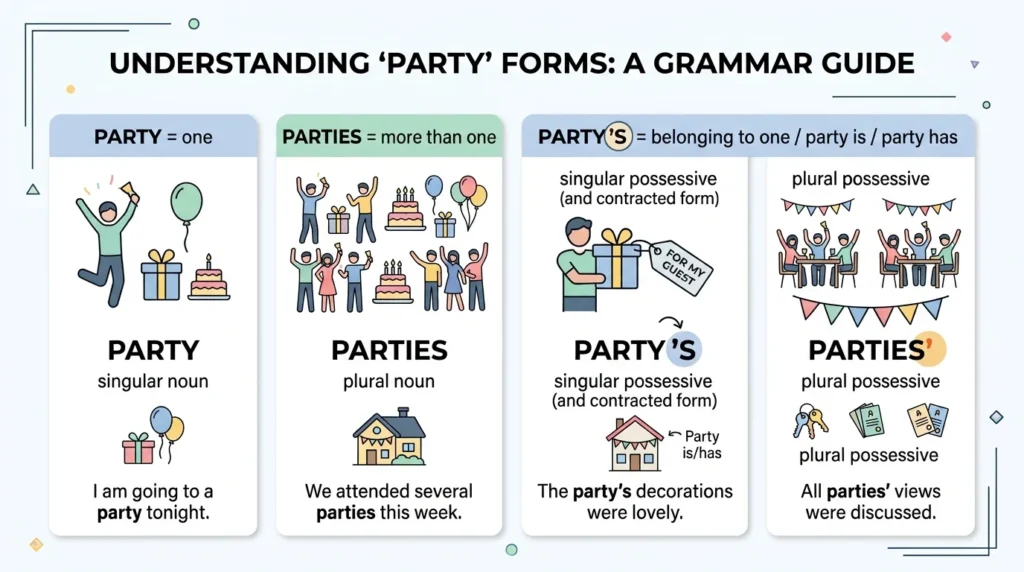
- party → parties
- party → party’s
- parties → parties’
Each form has a different job.
Autocomplete and spellcheck can hide the problem
Modern keyboards and writing software may automatically correct obvious spelling errors, but they cannot always determine what you mean.
A sentence such as:
The party’s agreed to the terms.
might contain an apostrophe error that a writer should catch manually.
The intended sentence may be:
The parties agreed to the terms.
Spellcheck is useful, but it does not replace understanding the grammatical function of the word.
Translation interference
Learners whose first language forms plurals differently may naturally try to transfer their own spelling or grammar pattern into English.
The safest approach is to learn the English pattern directly:
consonant + y → ies
So:
party → parties
Common Mistakes Checklist
Mistake 1: Writing “partys”
Problem: Using partys as the plural.
Why it happens: The writer simply adds s to the singular noun.
Fix: Change y to i and add es.
party → parties
Mistake 2: Writing “party’s” for multiple parties
Problem: “The three party’s signed the agreement.”
Why it happens: The writer thinks the apostrophe helps make the noun plural.
Fix: Use parties.
The three parties signed the agreement.
Mistake 3: Confusing “parties” with “parties’”
Problem: “The parties agreement was signed.”
Why it happens: The writer knows that parties is plural but forgets the possessive apostrophe.
Fix: If the agreement belongs to the parties, use:
The parties’ agreement was signed.
Mistake 4: Confusing “party’s” with “parties”
Problem: “The party’s agreed to the proposal.”
Why it happens: The writer uses party’s because it sounds like a plural form.
Fix: If the meaning is “more than one party agreed,” write:
The parties agreed to the proposal.
Mistake 5: Forgetting that “party” has several meanings
A party can be a celebration, political organization, group, or side in an agreement.
That means parties can appear in very different contexts.
For example:
We attended several parties.
and:
The parties to the contract agreed.
The spelling is identical even though the meanings are different.
Read More: Challenge vs Challange: Which Is Correct?
Parties in Real English
Grammatically correct and natural: “We went to several parties.”
This is ordinary, natural English. Parties is the expected plural when talking about multiple social gatherings. A native speaker would not normally choose partys or party’s for this meaning. The same spelling applies whether the gatherings are birthday parties, dinner parties, office parties, or other social events.
Grammatically correct and natural: “Both parties agreed.”
This is especially common in business, legal, and formal English. Here, parties refers to two sides involved in an agreement, negotiation, dispute, or transaction. It is not limited to social events. The phrase both parties is a standard way to identify two participating sides.
Grammatically possible but potentially unclear: “Their party’s leaders met.”
The form party’s can be completely grammatical because it is the singular possessive of party. However, context can determine whether readers understand which party is meant. If you are discussing several groups and each has its own leader, a clearer construction may be “the leaders of their respective parties.” The issue here is clarity, not the basic spelling rule.
Correct but different: “The parties’ lawyers attended.”
Here, parties’ is the plural possessive. It means the lawyers belong to or represent multiple parties. This is different from party’s lawyer, which refers to one party. The apostrophe comes after the s because parties is already plural. This distinction is especially important in legal and business writing.
American vs. British English
There is no genuine spelling difference between American and British English for this issue.
Both varieties use:
- party — singular
- parties — plural
- party’s — singular possessive or contraction
- parties’ — plural possessive
For example:
Both parties agreed to the proposal.
is correctly spelled the same way in American and British English.
The difference is therefore not regional. It is grammatical and orthographic.
Formal vs. Informal Usage
The spelling parties is appropriate in both formal and informal writing.
You can use it in:
- Text messages
- Social media
- Emails
- Schoolwork
- Business reports
- Academic writing
- Contracts
- Legal documents
- News writing
The main difference concerns the meaning of party, not the level of formality.
For example:
Informal:
We went to three parties this month.
Formal:
All parties must comply with the terms of the agreement.
Both use the same plural spelling: parties.
One additional point is worth remembering: party’s can be a contraction for party is or party has, so contractions may be less common in highly formal writing even though the form itself is grammatically valid.
Comparison Table
| Form | Grammar | Meaning | Example |
|---|---|---|---|
| party | Singular noun | One party | The party agreed. |
| parties | Plural noun | More than one party | Both parties agreed. |
| party’s | Singular possessive | Belonging to one party | The party’s position changed. |
| party’s | Contraction | Party is / party has | The party’s ready. |
| parties’ | Plural possessive | Belonging to multiple parties | The parties’ positions differed. |
| partys | Incorrect spelling | Not the standard plural | ❌ The partys agreed. |
What About “Parties’”?
This is an important form because it is sometimes overlooked.
Parties’ is correct when you have multiple parties and something belongs to, concerns, or is associated with those parties.
For example:
The parties’ lawyers met yesterday.
This means the lawyers representing multiple parties.
Compare:
The party’s lawyer met yesterday.
This refers to one party.
And:
The parties met yesterday.
This simply means multiple parties met.
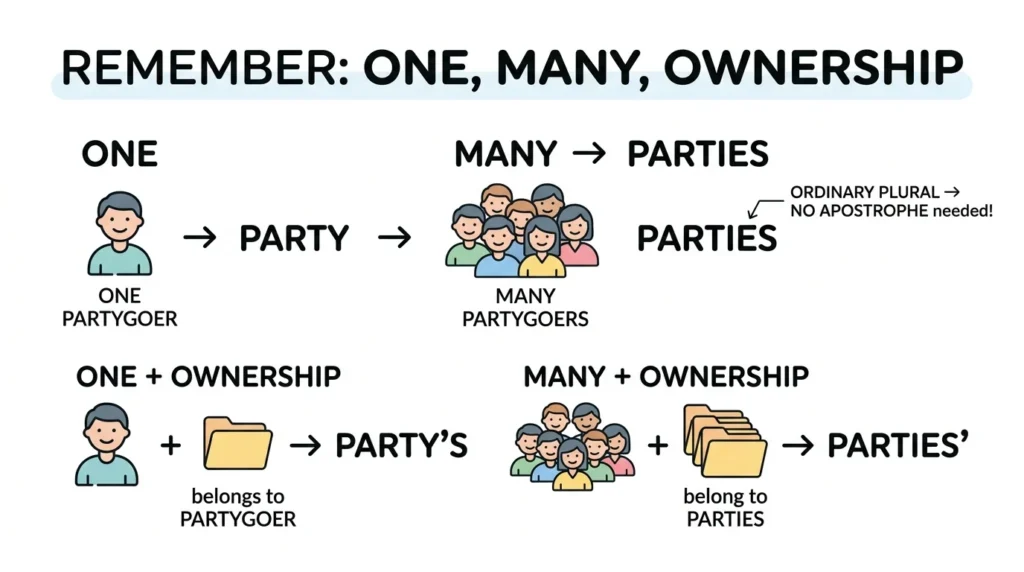
The three forms therefore have three different functions:
- party’s = one party + possession
- parties = multiple parties
- parties’ = multiple parties + possession
This distinction is particularly useful when writing contracts, legal correspondence, and business documents.
Memory Trick
Use this three-step memory trick:
One? Party.
Many? Parties.
Belonging to one? Party’s.
Belonging to many? Parties’.
Or remember:
No apostrophe for number. Apostrophe for possession.
So if you are simply counting:
one party → two parties
If something belongs to one:
the party’s decision
If something belongs to several:
the parties’ decisions
And partys should disappear from your standard-English spelling.
Real-Life Situations
At an interview
Interviewer: “Have you organized events before?”
Candidate: “Yes. I helped organize several parties and corporate events.”
Because the candidate is talking about more than one event, parties is correct.
In a business meeting
“Both parties need to approve the final proposal.”
Here, parties refers to two sides involved in the business arrangement.
In an email
“Please confirm that all parties have received the updated document.”
The writer means everyone involved, so parties is correct.
In a text message
“How many parties are you going to this summer?”
Again, more than one social event is meant.
In an exam
Question:
“The two political _____ announced their policies.”
Answer:
parties
The word is plural because two political organizations are being discussed.
In a contract
“Both parties agree to the terms below.”
Here, parties is the plural noun.
Showing possession
“The party’s official position was published yesterday.”
Only one party is being discussed, and the position belongs to that party.
Showing plural possession
“The parties’ representatives met to discuss the dispute.”
Multiple parties have representatives, so parties’ is the appropriate possessive form.
Mini Quiz
| # | Question | Answer | Explanation |
|---|---|---|---|
| 1 | Which is correct? “We attended three ___.” A) partys B) parties C) party’s | B) parties | Parties is the plural of party. |
| 2 | Fill in the blank: “Both ___ agreed to the deal.” | parties | Two sides are involved, so the plural noun is required. |
| 3 | Correct the sentence: “Several party’s were held last month.” | Several parties were held last month. | Party’s is not the plural form. |
| 4 | Which shows possession by one party? A) parties B) party’s C) parties’ | B) party’s | Party’s is the singular possessive. |
| 5 | Fill in the blank: “The ___ representatives signed the document.” More than one party owns or has representatives. | parties’ | Parties’ is the plural possessive. |
| 6 | Is “partys” standard English? | No. | The standard plural spelling is parties. |
| 7 | Correct the sentence: “The two partys reached an agreement.” | The two parties reached an agreement. | Two requires the plural parties. |
| 8 | Which is correct? “The party’s / parties’ decision affected everyone.” One party made the decision. | party’s | One party is the possessor, so use the singular possessive. |
| 9 | Which is correct? “The parties / party’s met yesterday.” More than one side met. | parties | The sentence needs a plural subject without an apostrophe. |
| 10 | Correct the sentence: “The parties agreement was signed.” | The parties’ agreement was signed. | The agreement belongs to multiple parties, so the plural possessive needs an apostrophe after s. |
Expert Tips
1. Look at the word before “party”
Words such as two, three, several, many, both, all, and numerous usually signal that you need the plural:
- two parties
- several parties
- both parties
- all parties
2. Do not use an apostrophe just because a word ends in “s”
The apostrophe is not a general plural marker.
Compare:
three parties
with:
the parties’ agreement
The first is plural. The second is plural possessive.
3. Use the “of” test for possession
If you are unsure whether you need an apostrophe, try replacing the possessive phrase with of.
the party’s decision
can become:
the decision of the party
That indicates possession.
For multiple parties:
the parties’ decision
can become:
the decision of the parties
If the “of” version makes sense, the apostrophe may be expressing possession. The “of” test is a useful proofreading technique for apostrophes.
4. Watch for “each”
This is especially important in formal writing.
Compare:
Each party’s representative signed the document.
with:
The parties’ representatives signed the document.
Each party treats the parties individually, so party’s is appropriate after each. The second sentence treats multiple parties collectively, so parties’ is appropriate.
5. Remember that “party” is not only about celebrations
If you only associate party with birthdays and celebrations, legal and business examples may seem unusual.
But party also means a person, group, or organization involved in an agreement, dispute, transaction, or other formal matter.
That is why phrases such as these are standard:
- both parties
- interested parties
- third parties
- contracting parties
- parties to the agreement
- parties involved
Read More: Parents vs Parent: What Is the Difference?
FAQ
Is “partys” a word?
Partys is not the standard plural spelling of party. In standard English, the correct plural is parties.
Is “parties” the plural of “party”?
Yes. Parties is the standard plural form of party. This applies whether party means a social gathering, political organization, group, or side in an agreement.
Why is “party” changed to “parties”?
Because party ends in a consonant followed by y. In the standard plural spelling pattern, the y changes to i and -es is added:
party → parties
Is “party’s” ever correct?
Yes. Party’s is correct when it is the singular possessive:
The party’s representative arrived.
It can also be a contraction of party is or party has:
The party’s ready.
The party’s announced its decision.
Is “parties’” correct?
Yes. Parties’ is the plural possessive form.
The parties’ representatives met.
It means the representatives belong to or are associated with multiple parties.
What is the difference between “party’s” and “parties’”?
Party’s refers to possession by one party.
Parties’ refers to possession by multiple parties.
Compare:
The party’s leader spoke.
The parties’ leaders spoke.
Should I write “both party’s” or “both parties”?
Write both parties.
❌ Both party’s agreed.
✅ Both parties agreed.
If you need possession, the form may be both parties’:
Both parties’ representatives attended.
Is “partys” acceptable in texting?
It may appear as a casual spelling error in messages, but it is not standard English. If you want correct spelling, professional writing, schoolwork, or polished social content, use parties.
Is “parties” the same in American and British English?
Yes. The spelling parties is used in both American and British English. There is no regional spelling difference here.
How do I remember “party” vs. “parties”?
Remember:
One party, many parties.
The y changes to ies when the noun becomes plural.
What is the easiest way to check whether I need an apostrophe?
First ask whether you mean more than one. If yes, use parties.
Then ask whether you mean something belonging to one party. If yes, use party’s.
If something belongs to multiple parties, use parties’.
Quick Summary
The correct plural of party is parties, not partys. The spelling changes from y to ies because party ends in a consonant followed by y. Use parties when you mean two or more parties, whether they are social gatherings, political organizations, groups, or sides in an agreement. Use party’s for possession by one party or as a contraction of party is or party has. Use parties’ for possession by multiple parties. The easiest rule is: party = one, parties = many, party’s = one party’s possession, parties’ = multiple parties’ possession. An apostrophe does not make an ordinary plural.